

Rethinking Photosynthesis: Intracellular Water Dynamics, Bicarbonate Photolysis, and Electrophysiological Coupling in Inorganic Carbon Assimilation



Article Information
Abstract
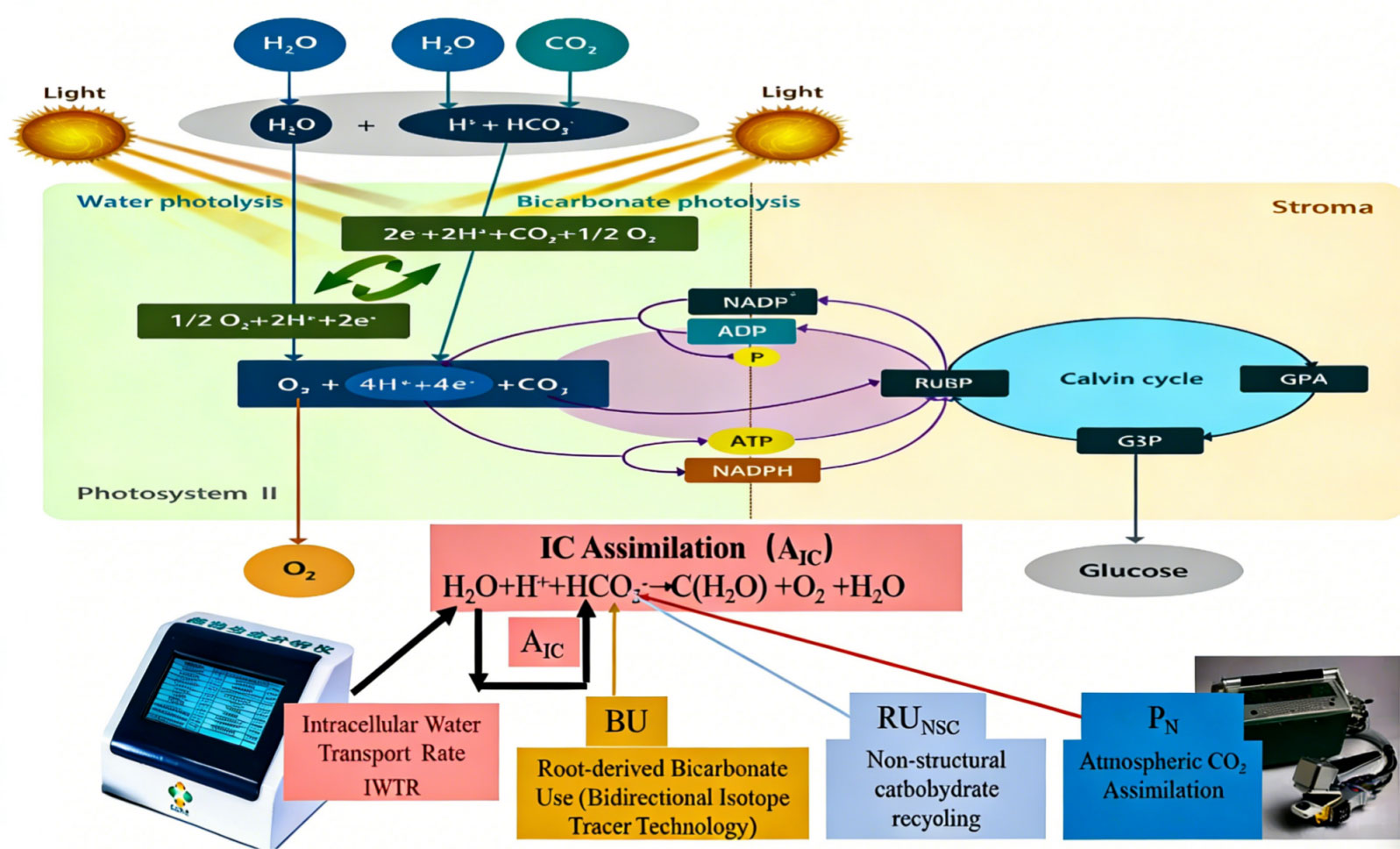
Photosynthesis is the fundamental biochemical process driving Earth's biogeochemical cycles. The traditional theory holds that water is the sole source of photosynthetic oxygen and atmospheric CO$_2$ the only inorganic carbon substrate. However, electrophysiological, isotopic, and physiological evidence from our systematic research prompts a re-examination of this paradigm, revealing an unrecognized coupling between plant inorganic carbon assimilation and intracellular water utilization. Our key findings are: (i) Intracellular water utilization rate is decoupled from atmospheric CO$_2$ assimilation, suggesting that terrestrial plants assimilate inorganic carbon from atmospheric CO$_2$, soil inorganic carbon, and internally recycled inorganic carbon derived from metabolic carbon turnover. (ii) Electrophysiologically quantified intracellular water utilization, reflecting photosynthetic water photolysis through electron transfer dynamics, may serve as a broader indicator of total photosynthetic capacity than leaf CO$_2$ flux. (iii) Bicarbonate photolysis---the first step of inorganic carbon assimilation---may contribute equally to photosynthetic oxygen evolution as water photolysis, forming a coupled chain reaction that minimizes diffusion and concentration losses to enhance efficiency. (iv) Plant growth and adaptation are jointly driven by chemical energy (ATP) and internal electrical energy stored in cellular electrical components, with energy allocation prioritizing stress responses under abiotic stressors. We propose a revised photosynthesis framework integrating bicarbonate photolysis, intracellular water--electrophysiology coupling, and multi-source inorganic carbon assimilation. This perspective highlights the theoretical significance of updating classical photosynthesis theory, its applied value for improving crop photosynthetic efficiency and stress tolerance, and outlines future directions to dissect the underlying molecular-electrophysiological mechanisms and their biotechnological translation.
Graphical Abstract
Keywords
Data Availability Statement
Funding
Conflicts of Interest
AI Use Statement
Ethical Approval and Consent to Participate
References
- Wu, Y. (2023). Combined effect of bicarbonate and water in photosynthetic oxygen evolution and carbon neutrality. Acta Geochimica, 42(1), 77-88.
[CrossRef] [Google Scholar] - Wu, Y., Aboueldahab, M., & Liu, C. (2025). Reviews and syntheses: Photosynthetic oxygen evolution in plants-A potential inheritance from early abiotic oxygen production on Earth. EGUsphere, 2025, 1-26.
[CrossRef] [Google Scholar] - Ruben, S., Randall, M., Kamen, M., & Hyde, J. L. (1941). Heavy oxygen (O$_{18$) as a tracer in the study of photosynthesis. Journal of the American Chemical Society, 63(3), 877–879.
[CrossRef] [Google Scholar] - Stemler, A., & Radmer, R. (1975). Source of photosynthetic oxygen in bicarbonate-stimulated Hill reaction. Science, 190(4213), 457-458.
[CrossRef] [Google Scholar] - Shitov, A. V., Terentyev, V. V., & Govindjee, G. (2025). High and unique carbonic anhydrase activity of Photosystem II from Pisum sativum: Measurements by a new and very sensitive fluorescence method. Plant Physiology and Biochemistry, 221, 109516.
[CrossRef] [Google Scholar] - Guo, S., Wu, Y., & Aboueldahab, M. (2024). Rapid oxygen isotopic exchange between bicarbonate and water during photosynthesis. Journal of Photochemistry and Photobiology B: Biology, 255, 112924.
[CrossRef] [Google Scholar] - Stemler, A., & Govindjee. (1974). Bicarbonate stimulation of oxygen evolution, ferricyanide reduction and photoinactivation using isolated chloroplasts. Plant and Cell Physiology, 15(3), 533-544.
[CrossRef] [Google Scholar] - Yamano, T., Sato, E., Iguchi, H., Fukuda, Y., & Fukuzawa, H. (2015). Characterization of cooperative bicarbonate uptake into chloroplast stroma in the green alga Chlamydomonas reinhardtii. Proceedings of the National Academy of Sciences of the United States of America, 112(23), 7315–7320.
[CrossRef] [Google Scholar] - Dismukes, G. C., Klimov, V. V., Baranov, S. V., Kozlov, Y. N., DasGupta, J., & Tyryshkin, A. (2001). The origin of atmospheric oxygen on Earth: the innovation of oxygenic photosynthesis. Proceedings of the National Academy of Sciences, 98(5), 2170-2175.
[CrossRef] [Google Scholar] - Dole, M., & Jenks, G. (1944). Isotopic composition of photosynthetic oxygen. Science, 100(2601), 409-409.
[CrossRef] [Google Scholar] - Dole, M. (1935). The relative atomic weight of oxygen in water and in air. Journal of the American Chemical Society, 57(12), 2731-2731.
[CrossRef] [Google Scholar] - Villarejo, A., Shutova, T., Moskvin, O., Forssén, M., Klimov, V. V., & Samuelsson, G. (2002). A photosystem II‐associated carbonic anhydrase regulates the efficiency of photosynthetic oxygen evolution. The EMBO journal, 21(8), 1930-1938.
[CrossRef] [Google Scholar] - Blubaugh, D. J. (1986). Bicarbonate, not CO2, is the species required for the stimulation of Photosystem II electron transport. Biochimica et Biophysica Acta (BBA)-Bioenergetics, 848(1), 147-151.
[CrossRef] [Google Scholar] - Wu, Y., & Rao, S. (2023). Root-derived bicarbonate assimilation in plants. Springer.
[CrossRef] [Google Scholar] - Rao, S., Wu, Y., & Wang, R. (2019). Bicarbonate stimulates non‐structural carbohydrate pools of Camptotheca acuminata. Physiologia plantarum, 165(4), 780-789.
[CrossRef] [Google Scholar] - Rao, S., & Wu, Y. (2017). Root-derived bicarbonate assimilation in response to variable water deficit in Camptotheca acuminate seedlings. Photosynthesis research, 134(1), 59-70.
[CrossRef] [Google Scholar]
Cite This Article
TY  - JOUR
AU  - Wu, Yanyou
AU  - Aboueldahab, Mohamed
PY  - 2026
DA  - 2026/05/13
TI  - Rethinking Photosynthesis: Intracellular Water Dynamics, Bicarbonate Photolysis, and Electrophysiological Coupling in Inorganic Carbon Assimilation
JO  - Journal of Plant Electrobiology
T2  - Journal of Plant Electrobiology
JF  - Journal of Plant Electrobiology
VL  - 1
IS  - 2
SP  - 82
EP  - 93
DO  - 10.62762/JPE.2026.900219
UR  - https://www.icck.org/article/abs/JPE.2026.900219
KW  - photosynthesis
KW  - bicarbonate photolysis
KW  - intracellular water dynamics
KW  - plant electrophysiology
KW  - inorganic carbon assimilation
KW  - energy allocation
AB  - Photosynthesis is the fundamental biochemical process driving Earth's biogeochemical cycles. The traditional theory holds that water is the sole source of photosynthetic oxygen and atmospheric CO$_2$ the only inorganic carbon substrate. However, electrophysiological, isotopic, and physiological evidence from our systematic research prompts a re-examination of this paradigm, revealing an unrecognized coupling between plant inorganic carbon assimilation and intracellular water utilization. Our key findings are: (i) Intracellular water utilization rate is decoupled from atmospheric CO$_2$ assimilation, suggesting that terrestrial plants assimilate inorganic carbon from atmospheric CO$_2$, soil inorganic carbon, and internally recycled inorganic carbon derived from metabolic carbon turnover. (ii) Electrophysiologically quantified intracellular water utilization, reflecting photosynthetic water photolysis through electron transfer dynamics, may serve as a broader indicator of total photosynthetic capacity than leaf CO$_2$ flux. (iii) Bicarbonate photolysis---the first step of inorganic carbon assimilation---may contribute equally to photosynthetic oxygen evolution as water photolysis, forming a coupled chain reaction that minimizes diffusion and concentration losses to enhance efficiency. (iv) Plant growth and adaptation are jointly driven by chemical energy (ATP) and internal electrical energy stored in cellular electrical components, with energy allocation prioritizing stress responses under abiotic stressors. We propose a revised photosynthesis framework integrating bicarbonate photolysis, intracellular water--electrophysiology coupling, and multi-source inorganic carbon assimilation. This perspective highlights the theoretical significance of updating classical photosynthesis theory, its applied value for improving crop photosynthetic efficiency and stress tolerance, and outlines future directions to dissect the underlying molecular-electrophysiological mechanisms and their biotechnological translation.
SN  - 3071-6268
PB  - Institute of Central Computation and Knowledge
LA  - English
ER  -
@article{Wu2026Rethinking,
  author = {Yanyou Wu and Mohamed Aboueldahab},
  title = {Rethinking Photosynthesis: Intracellular Water Dynamics, Bicarbonate Photolysis, and Electrophysiological Coupling in Inorganic Carbon Assimilation},
  journal = {Journal of Plant Electrobiology},
  year = {2026},
  volume = {1},
  number = {2},
  pages = {82-93},
  doi = {10.62762/JPE.2026.900219},
  url = {https://www.icck.org/article/abs/JPE.2026.900219},
  abstract = {Photosynthesis is the fundamental biochemical process driving Earth's biogeochemical cycles. The traditional theory holds that water is the sole source of photosynthetic oxygen and atmospheric CO\$\_2\$ the only inorganic carbon substrate. However, electrophysiological, isotopic, and physiological evidence from our systematic research prompts a re-examination of this paradigm, revealing an unrecognized coupling between plant inorganic carbon assimilation and intracellular water utilization. Our key findings are: (i) Intracellular water utilization rate is decoupled from atmospheric CO\$\_2\$ assimilation, suggesting that terrestrial plants assimilate inorganic carbon from atmospheric CO\$\_2\$, soil inorganic carbon, and internally recycled inorganic carbon derived from metabolic carbon turnover. (ii) Electrophysiologically quantified intracellular water utilization, reflecting photosynthetic water photolysis through electron transfer dynamics, may serve as a broader indicator of total photosynthetic capacity than leaf CO\$\_2\$ flux. (iii) Bicarbonate photolysis---the first step of inorganic carbon assimilation---may contribute equally to photosynthetic oxygen evolution as water photolysis, forming a coupled chain reaction that minimizes diffusion and concentration losses to enhance efficiency. (iv) Plant growth and adaptation are jointly driven by chemical energy (ATP) and internal electrical energy stored in cellular electrical components, with energy allocation prioritizing stress responses under abiotic stressors. We propose a revised photosynthesis framework integrating bicarbonate photolysis, intracellular water--electrophysiology coupling, and multi-source inorganic carbon assimilation. This perspective highlights the theoretical significance of updating classical photosynthesis theory, its applied value for improving crop photosynthetic efficiency and stress tolerance, and outlines future directions to dissect the underlying molecular-electrophysiological mechanisms and their biotechnological translation.},
  keywords = {photosynthesis, bicarbonate photolysis, intracellular water dynamics, plant electrophysiology, inorganic carbon assimilation, energy allocation},
  issn = {3071-6268},
  publisher = {Institute of Central Computation and Knowledge}
}
Article Metrics
Publisher's Note
ICCK stays neutral with regard to jurisdictional claims in published maps and institutional affiliations.
Rights and Permissions