

A Software-Oriented Deep Learning Framework for Multiclass Academic Stress and Mental Health Risk Prediction



Article Information
Abstract
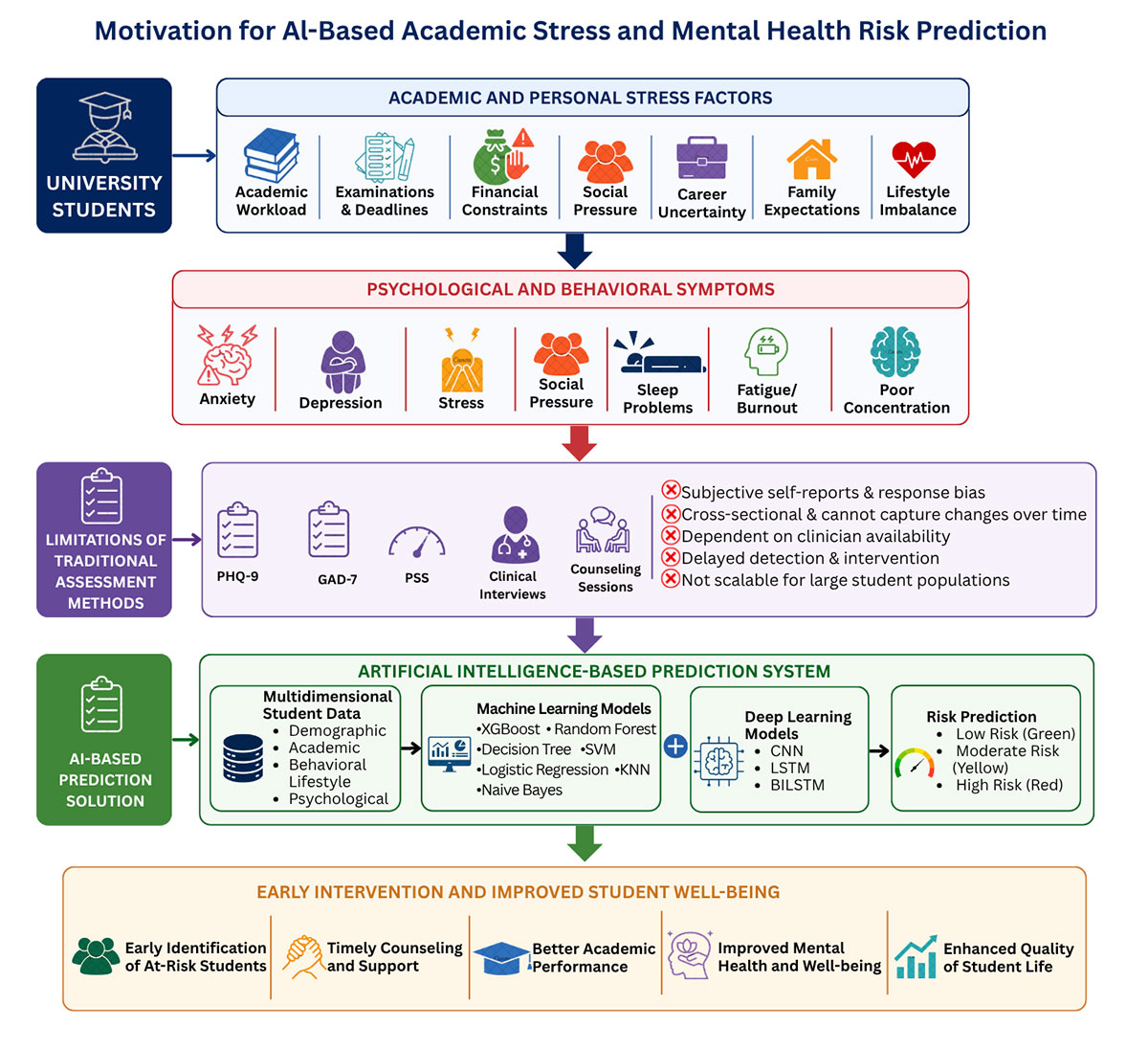
Student mental health and academic stress are significant concerns in higher education, creating a need for effective approaches to early risk identification. This study proposes a multiclass predictive framework for academic stress and mental health risk classification among students. The framework was developed using a Kaggle dataset containing 25,000 records with demographic, academic, behavioral, psychological, lifestyle, and medical attributes. A unified comparison was conducted across six conventional machine learning algorithms, namely Decision Tree, Random Forest, XGBoost, CatBoost, K-Nearest Neighbors (KNN), and Naïve Bayes, and three deep learning architectures, namely Convolutional Neural Network (CNN), Long Short-Term Memory (LSTM), and Bidirectional Long Short-Term Memory (BiLSTM). Class imbalance was addressed using the Synthetic Minority Over-sampling Technique (SMOTE), applied only to the training data, and model performance was evaluated using accuracy, precision, recall, F1-score, and confusion matrices. CatBoost and BiLSTM achieved the highest classification accuracy of 97%, with weighted F1-scores of 0.97 and macro F1-scores of 0.96. The results indicate that ensemble and deep learning approaches can effectively support multiclass mental health risk classification. Because the provenance and label construction of the secondary dataset are not documented, the results should be read as within-dataset performance. The findings provide a basis for future real-world validation and decision-support applications.
Graphical Abstract
Keywords
Data Availability Statement
Funding
Conflicts of Interest
AI Use Statement
Ethical Approval and Consent to Participate
References
- Auerbach, R. P., Mortier, P., Bruffaerts, R., Alonso, J., Benjet, C., Cuijpers, P., ... & Kessler, R. C. (2018). WHO World Mental Health Surveys International College Student Project: Prevalence and distribution of mental disorders. Journal of Abnormal Psychology, 127(7), 623--638.
[CrossRef] [Google Scholar] - Ibrahim, A. K., Kelly, S. J., Adams, C. E., & Glazebrook, C. (2013). A systematic review of studies of depression prevalence in university students. Journal of Psychiatric Research, 47(3), 391--400.
[CrossRef] [Google Scholar] - Rahman, H. A., Kwicklis, M., Ottom, M., Amornsriwatanakul, A., Abdul-Mumin, K. H., Rosenberg, M., & Dinov, I. D. (2023). Machine learning-based prediction of mental well-being using health behavior data from university students. Bioengineering, 10(5), 575.
[CrossRef] [Google Scholar] - Shafiee, N. S. M., & Mutalib, S. (2020). Prediction of mental health problems among higher education student using machine learning. International Journal of Education and Management Engineering, 10(6), 1--9.
[CrossRef] [Google Scholar] - Beiter, R., Nash, R., McCrady, M., Rhoades, D., Linscomb, M., Clarahan, M., & Sammut, S. (2015). The prevalence and correlates of depression, anxiety, and stress in a sample of college students. Journal of Affective Disorders, 173, 90--96.
[CrossRef] [Google Scholar] - Zhang, L., Zhao, S., Yang, Z., Zheng, H., & Lei, M. (2024). An artificial intelligence tool to assess the risk of severe mental distress among college students in terms of demographics, eating habits, lifestyles, and sport habits: an externally validated study using machine learning. BMC psychiatry, 24(1), 581.
[CrossRef] [Google Scholar] - Baba, A., & Bunji, K. (2023). Prediction of mental health problem using annual student health survey: machine learning approach. JMIR Mental Health, 10(1), e42420.
[CrossRef] [Google Scholar] - Shatte, A. B., Hutchinson, D. M., & Teague, S. J. (2019). Machine learning in mental health: a scoping review of methods and applications. Psychological medicine, 49(9), 1426-1448.
[CrossRef] [Google Scholar] - Graham, S., Depp, C., Lee, E. E., Nebeker, C., Tu, X., Kim, H. C., & Jeste, D. V. (2019). Artificial intelligence for mental health and mental illnesses: an overview. Current psychiatry reports, 21(11), 116.
[CrossRef] [Google Scholar] - Razavi, M., Ziyadidegan, S., Mahmoudzadeh, A., Kazeminasab, S., Baharlouei, E., Janfaza, V., ... & Sasangohar, F. (2024). Machine learning, deep learning, and data preprocessing techniques for detecting, predicting, and monitoring stress and stress-related mental disorders: scoping review. JMIR Mental Health, 11(1), e53714.
[CrossRef] [Google Scholar] - Osman, A. B., Tabassum, F., Patwary, M. J., Imteaj, A., Alam, T., Bhuiyan, M. A. S., & Miraz, M. H. (2022). Examining mental disorder/psychological chaos through various ML and DL techniques: a critical review. Annals of Emerging Technologies in Computing, 6(2), 61-71.
[CrossRef] [Google Scholar] - Kannan, K. D., Jagatheesaperumal, S. K., Kandala, R. N., Lotfaliany, M., Alizadehsani, R., & Mohebbi, M. (2026). Advancements in machine learning and deep learning for early detection and management of mental health disorder. Journal of Affective Disorders Reports, 25, 101100.
[CrossRef] [Google Scholar] - Zhai, Y., Zhang, Y., Chu, Z., Geng, B., Almaawali, M., Fulmer, R., ... & Du, X. (2025). Machine learning predictive models to guide prevention and intervention allocation for anxiety and depressive disorders among college students. Journal of Counseling & Development, 103(1), 110-125.
[CrossRef] [Google Scholar] - Fu, Y., Ren, F., & Lin, J. (2025). Apriori algorithm based prediction of students’ mental health risks in the context of artificial intelligence. Frontiers in Public Health, 13, 1533934.
[CrossRef] [Google Scholar] - Dhariwal, N., Sengupta, N., Madiajagan, M., Patro, K. K., Kumari, P. L., Abdel Samee, N., ... & Prakash, A. J. (2024). A pilot study on AI-driven approaches for classification of mental health disorders. Frontiers in Human Neuroscience, 18, 1376338.
[CrossRef] [Google Scholar] - Gkotsis, G., Oellrich, A., Velupillai, S., Liakata, M., Hubbard, T. J., Dobson, R. J., & Dutta, R. (2017). Characterisation of mental health conditions in social media using Informed Deep Learning. Scientific reports, 7(1), 45141.
[CrossRef] [Google Scholar] - Venkatachalam, B., & Sivanraju, K. (2023). Predicting student performance using mental health and linguistic attributes with deep learning. Revue d'Intelligence Artificielle, 37(4), 889--899.
[CrossRef] [Google Scholar] - Chawla, N. V., Bowyer, K. W., Hall, L. O., & Kegelmeyer, W. P. (2002). SMOTE: Synthetic minority over-sampling technique. Journal of Artificial Intelligence Research, 16, 321--357.
[CrossRef] [Google Scholar] - Nickson, D., Meyer, C., Walasek, L., & Toro, C. (2023). Prediction and diagnosis of depression using machine learning with electronic health records data: a systematic review. BMC medical informatics and decision making, 23(1), 271.
[CrossRef] [Google Scholar] - Garriga, R., Mas, J., Abraha, S., Nolan, J., Harrison, O., Tadros, G., & Matic, A. (2022). Machine learning model to predict mental health crises from electronic health records. Nature medicine, 28(6), 1240-1248.
[CrossRef] [Google Scholar] - Tutun, S., Johnson, M. E., Ahmed, A., Albizri, A., Irgil, S., Yesilkaya, I., ... & Harfouche, A. (2023). An AI-based decision support system for predicting mental health disorders. Information Systems Frontiers, 25(3), 1261-1276.
[CrossRef] [Google Scholar] - Mutalib, S., Shafiee, N. S. M., & Abdul-Rahman, S. (2021). Mental Health Prediction Models Using Machine Learning in Higher Education. Turkish Journal of Computer and Mathematics Education Vol, 12(5), 1782-1792.
[CrossRef] [Google Scholar] - Meda, N., Pardini, S., Rigobello, P., Visioli, F., & Novara, C. (2023). Frequency and machine learning predictors of severe depressive symptoms and suicidal ideation among university students. Epidemiology and Psychiatric Sciences, 32, e42.
[CrossRef] [Google Scholar] - Luo, L., Yuan, J., Wu, C., Wang, Y., Zhu, R., Xu, H., ... & Zhang, Z. (2025). Predictors of depression among Chinese college students: A machine learning approach. BMC Public Health, 25(1), 470.
[CrossRef] [Google Scholar] - Hasan, M. E., Arif, M., Rakibul Hasan, S. M., Muwanguzi, M., Abaatyo, J., Kaggwa, M. M., ... & Mamun, M. A. (2025). Prevalence, associated factors, and machine learning-based prediction of depression, anxiety, and stress among university students: a cross-sectional study from Bangladesh. Journal of Health, Population and Nutrition, 44(1), 361.
[CrossRef] [Google Scholar] - Macalli, M., Navarro, M., Orri, M., Tournier, M., Thiébaut, R., Côté, S. M., & Tzourio, C. (2021). A machine learning approach for predicting suicidal thoughts and behaviours among college students. Scientific reports, 11(1), 11363.
[CrossRef] [Google Scholar] - Sharma, D., Kapoor, N., & Kang, S. S. (2020). Stress prediction of students using machine learning. International Journal of Mechanical and Production Engineering Research and Development, 10(3), 5609--5620.
[CrossRef] [Google Scholar] - Chung, J., & Teo, J. (2023). Single classifier vs. ensemble machine learning approaches for mental health prediction. Brain informatics, 10(1), 1.
[CrossRef] [Google Scholar] - Su, C., Xu, Z., Pathak, J., & Wang, F. (2020). Deep learning in mental health outcome research: a scoping review. Translational psychiatry, 10(1), 116.
[CrossRef] [Google Scholar] - El Morr, C., Jammal, M., Bou-Hamad, I., Hijazi, S., Ayna, D., Romani, M., & Hoteit, R. (2024). Predictive machine learning models for assessing lebanese university students’ depression, anxiety, and stress during COVID-19. Journal of Primary Care & Community Health, 15, 21501319241235588.
[CrossRef] [Google Scholar] - Shrestha, I., & Srinivasan, P. (2022). Comparing deep learning and conventional machine learning models for predicting mental illness from history of present illness notations. In AMIA Annual Symposium Proceedings, 2021 (pp. 1109-1118). https://pubmed.ncbi.nlm.nih.gov/35308915/
[Google Scholar] - Karamat, A., Imran, M., Yaseen, M. U., Bukhsh, R., Aslam, S., & Ashraf, N. (2024). A hybrid transformer architecture for multiclass mental illness prediction using social media text. IEEE Access, 13, 12148-12167.
[CrossRef] [Google Scholar] - guriya79. (n.d.). Mental Health Risk Prediction Dataset [Data set]. Kaggle. Retrieved from https://www.kaggle.com/datasets/guriya79/mental-health-disorder/data
[Google Scholar] - Chen, T., & Guestrin, C. (2016, August). Xgboost: A scalable tree boosting system. In Proceedings of the 22nd acm sigkdd international conference on knowledge discovery and data mining (pp. 785-794).
[CrossRef] [Google Scholar] - Prokhorenkova, L., Gusev, G., Vorobev, A., Dorogush, A. V., & Gulin, A. (2018). CatBoost: unbiased boosting with categorical features. Advances in neural information processing systems, 31.
[Google Scholar] - Singh, A., Singh, K., Kumar, A., Shrivastava, A., & Kumar, S. (2024, April). Machine learning algorithms for detecting mental stress in college students. In 2024 IEEE 9th International Conference for Convergence in Technology (I2CT) (pp. 1-5). IEEE.
[CrossRef] [Google Scholar] - Pan, L., & Ma, H. (2025). A computational CNN-LSTM-based mental health consultation system in a college environment. Informatica: an international journal of computing and informatics, 49(10), 147-162.
[CrossRef] [Google Scholar] - Yu, C., Kong, X., Yu, W., Ni, X., Chen, J., & Liao, X. (2025). Machine learning models for predicting the risk of depressive symptoms in Chinese college students. Frontiers in Psychiatry, 16, 1648585.
[CrossRef] [Google Scholar]
Cite This Article
TY  - JOUR
AU  - Ahmad, Shoaib
AU  - Imran, Ali
AU  - Kshif, Tahoona
AU  - Rasheed, Zubdah Tur
AU  - Khan, Ayesha
AU  - Ali, Aamir
AU  - Ali, Muhammad
PY  - 2026
DA  - 2026/09/22
TI  - A Software-Oriented Deep Learning Framework for Multiclass Academic Stress and Mental Health Risk Prediction
JO  - ICCK Journal of Software Engineering
T2  - ICCK Journal of Software Engineering
JF  - ICCK Journal of Software Engineering
VL  - 2
IS  - 3
SP  - 220
EP  - 247
DO  - 10.62762/JSE.2026.690220
UR  - https://www.icck.org/article/abs/JSE.2026.690220
KW  - academic stress
KW  - mental health risk
KW  - deep learning
KW  - multiclass classification
KW  - BiLSTM
KW  - CatBoost
KW  - student well-being
KW  - SMOTE
KW  - predictive analytics
AB  - Student mental health and academic stress are significant concerns in higher education, creating a need for effective approaches to early risk identification. This study proposes a multiclass predictive framework for academic stress and mental health risk classification among students. The framework was developed using a Kaggle dataset containing 25,000 records with demographic, academic, behavioral, psychological, lifestyle, and medical attributes. A unified comparison was conducted across six conventional machine learning algorithms, namely Decision Tree, Random Forest, XGBoost, CatBoost, K-Nearest Neighbors (KNN), and Naïve Bayes, and three deep learning architectures, namely Convolutional Neural Network (CNN), Long Short-Term Memory (LSTM), and Bidirectional Long Short-Term Memory (BiLSTM). Class imbalance was addressed using the Synthetic Minority Over-sampling Technique (SMOTE), applied only to the training data, and model performance was evaluated using accuracy, precision, recall, F1-score, and confusion matrices. CatBoost and BiLSTM achieved the highest classification accuracy of 97%, with weighted F1-scores of 0.97 and macro F1-scores of 0.96. The results indicate that ensemble and deep learning approaches can effectively support multiclass mental health risk classification. Because the provenance and label construction of the secondary dataset are not documented, the results should be read as within-dataset performance. The findings provide a basis for future real-world validation and decision-support applications.
SN  - 3069-1834
PB  - Institute of Central Computation and Knowledge
LA  - English
ER  -
@article{Ahmad2026A,
  author = {Shoaib Ahmad and Ali Imran and Tahoona Kshif and Zubdah Tur Rasheed and Ayesha Khan and Aamir Ali and Muhammad Ali},
  title = {A Software-Oriented Deep Learning Framework for Multiclass Academic Stress and Mental Health Risk Prediction},
  journal = {ICCK Journal of Software Engineering},
  year = {2026},
  volume = {2},
  number = {3},
  pages = {220-247},
  doi = {10.62762/JSE.2026.690220},
  url = {https://www.icck.org/article/abs/JSE.2026.690220},
  abstract = {Student mental health and academic stress are significant concerns in higher education, creating a need for effective approaches to early risk identification. This study proposes a multiclass predictive framework for academic stress and mental health risk classification among students. The framework was developed using a Kaggle dataset containing 25,000 records with demographic, academic, behavioral, psychological, lifestyle, and medical attributes. A unified comparison was conducted across six conventional machine learning algorithms, namely Decision Tree, Random Forest, XGBoost, CatBoost, K-Nearest Neighbors (KNN), and Naïve Bayes, and three deep learning architectures, namely Convolutional Neural Network (CNN), Long Short-Term Memory (LSTM), and Bidirectional Long Short-Term Memory (BiLSTM). Class imbalance was addressed using the Synthetic Minority Over-sampling Technique (SMOTE), applied only to the training data, and model performance was evaluated using accuracy, precision, recall, F1-score, and confusion matrices. CatBoost and BiLSTM achieved the highest classification accuracy of 97\%, with weighted F1-scores of 0.97 and macro F1-scores of 0.96. The results indicate that ensemble and deep learning approaches can effectively support multiclass mental health risk classification. Because the provenance and label construction of the secondary dataset are not documented, the results should be read as within-dataset performance. The findings provide a basis for future real-world validation and decision-support applications.},
  keywords = {academic stress, mental health risk, deep learning, multiclass classification, BiLSTM, CatBoost, student well-being, SMOTE, predictive analytics},
  issn = {3069-1834},
  publisher = {Institute of Central Computation and Knowledge}
}
Article Metrics
Publisher's Note
ICCK stays neutral with regard to jurisdictional claims in published maps and institutional affiliations.
Rights and Permissions
 Copyright © 2026 by the Author(s). Published by Institute of Central Computation and Knowledge. This article is an open access article distributed under the terms and conditions of the Creative Commons Attribution (CC BY) license (https://creativecommons.org/licenses/by/4.0/), which permits use, sharing, adaptation, distribution and reproduction in any medium or format, as long as you give appropriate credit to the original author(s) and the source, provide a link to the Creative Commons licence, and indicate if changes were made.


Portico
