

Smart Digital Stethoscope Using Artificial Intelligence, Machine Learning, and IoT


Article Information
Abstract
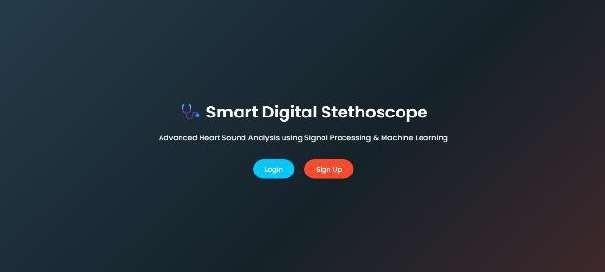
There is an increase in heart diseases at a very high rate in today's world, and therefore early detection becomes a necessity in the treatment of such cases. In this paper, we present a digital stethoscope with AI and ML that records heart sounds automatically. Phonocardiogram (PCG) signals are recorded by the system, and the recorded signals are then processed using filtering, normalization, and peak detection to obtain features including heart sounds S1 and S2. The extracted features are fed into the classification algorithm, which in this case is the Random Forest Classifier, and they are classified as either abnormal or normal heart conditions. IoT is implemented in the system to ensure storage of data. Experimental tests carried out have shown that the system can detect abnormalities such as irregular heart rates and murmurs.
Graphical Abstract
Keywords
Data Availability Statement
Funding
Conflicts of Interest
AI Use Statement
Ethical Approval and Consent to Participate
References
- Tavel, M. E. (2006). Cardiac auscultation: a glorious past—and it does have a future!. Circulation, 113(9), 1255-1259.
[CrossRef] [Google Scholar] - Chakir, F., Jilbab, A., Nacir, C., & Hammouch, A. (2018). Phonocardiogram signals processing approach for PASCAL classifying heart sounds challenge. Signal, Image and Video Processing, 12(6), 1149-1155.
[CrossRef] [Google Scholar] - Springer, D. B., Tarassenko, L., & Clifford, G. D. (2015). Logistic regression-HSMM-based heart sound segmentation. IEEE transactions on biomedical engineering, 63(4), 822-832.
[CrossRef] [Google Scholar] - Schmidt, S. E., Holst-Hansen, C., Graff, C., Toft, E., & Struijk, J. J. (2010). Segmentation of heart sound recordings by a duration-dependent hidden Markov model. Physiological measurement, 31(4), 513-529.
[CrossRef] [Google Scholar] - Durand, L. G., & Pibarot, P. (1995). Digital signal processing of the phonocardiogram: review of the most recent advancements. Critical Reviews™ in biomedical engineering, 23(3-4).
[CrossRef] [Google Scholar] - Liu, C., Springer, D., Li, Q., Moody, B., Juan, R. A., Chorro, F. J., ... & Clifford, G. D. (2016). An open access database for the evaluation of heart sound algorithms. Physiological measurement, 37(12), 2181-2213.
[CrossRef] [Google Scholar] - Maglogiannis, I., Loukis, E., Zafiropoulos, E., & Stasis, A. (2009). Support vectors machine-based identification of heart valve diseases using heart sounds. Computer methods and programs in biomedicine, 95(1), 47-61.
[CrossRef] [Google Scholar] - Bhatikar, S. R., DeGroff, C., & Mahajan, R. L. (2005). A classifier based on the artificial neural network approach for cardiologic auscultation in pediatrics. Artificial intelligence in medicine, 33(3), 251-260.
[CrossRef] [Google Scholar] - Potes, C., Parvaneh, S., Rahman, A., & Conroy, B. (2016, September). Ensemble of feature-based and deep learning-based classifiers for detection of abnormal heart sounds. In 2016 computing in cardiology conference (CinC) (pp. 621-624). IEEE.
[Google Scholar] - Rubin, J., Abreu, R., Ganguli, A., Nelaturi, S., Matei, I., & Sricharan, K. (2017). Recognizing abnormal heart sounds using deep learning. arXiv preprint arXiv:1707.04642.
[CrossRef] [Google Scholar] - Rangayyan, R. M. (2002). Biomedical Signal Analysis: A Case-Study Approach. IEEE Signal Processing Magazine, 19(4), 86-86.
[CrossRef] [Google Scholar] - Liang, H., Lukkarinen, S., & Hartimo, I. (1997, September). Heart sound segmentation algorithm based on heart sound envelogram. In Computers in Cardiology 1997 (pp. 105-108). IEEE.
[CrossRef] [Google Scholar] - El-Segaier, M., Lilja, O., Lukkarinen, S., Sörnmo, L., Sepponen, R., & Pesonen, E. (2005). Computer-based detection and analysis of heart sound and murmur. Annals of biomedical engineering, 33(7), 937-942.
[CrossRef] [Google Scholar]
Cite This Article
TY  - JOUR
AU  - Raju, D. S. S. N.
AU  - Harshitha, Medisetty
AU  - Parimala, Doppa
AU  - Reddy, Jeeru Venkata Chakradhar
AU  - Vamsi, Anguru Krishna
PY  - 2026
DA  - 2026/06/27
TI  - Smart Digital Stethoscope Using Artificial Intelligence, Machine Learning, and IoT
JO  - Next-Generation Computing Systems and Technologies
T2  - Next-Generation Computing Systems and Technologies
JF  - Next-Generation Computing Systems and Technologies
VL  - 2
IS  - 2
SP  - 59
EP  - 63
DO  - 10.62762/NGCST.2026.345581
UR  - https://www.icck.org/article/abs/NGCST.2026.345581
KW  - heart sound analysis
KW  - digital stethoscope
KW  - machine learning
KW  - signal processing
KW  - IoT
KW  - PCG
AB  - There is an increase in heart diseases at a very high rate in today's world, and therefore early detection becomes a necessity in the treatment of such cases. In this paper, we present a digital stethoscope with AI and ML that records heart sounds automatically. Phonocardiogram (PCG) signals are recorded by the system, and the recorded signals are then processed using filtering, normalization, and peak detection to obtain features including heart sounds S1 and S2. The extracted features are fed into the classification algorithm, which in this case is the Random Forest Classifier, and they are classified as either abnormal or normal heart conditions. IoT is implemented in the system to ensure storage of data. Experimental tests carried out have shown that the system can detect abnormalities such as irregular heart rates and murmurs.
SN  - 3070-3328
PB  - Institute of Central Computation and Knowledge
LA  - English
ER  -
@article{Raju2026Smart,
  author = {D. S. S. N. Raju and Medisetty Harshitha and Doppa Parimala and Jeeru Venkata Chakradhar Reddy and Anguru Krishna Vamsi},
  title = {Smart Digital Stethoscope Using Artificial Intelligence, Machine Learning, and IoT},
  journal = {Next-Generation Computing Systems and Technologies},
  year = {2026},
  volume = {2},
  number = {2},
  pages = {59-63},
  doi = {10.62762/NGCST.2026.345581},
  url = {https://www.icck.org/article/abs/NGCST.2026.345581},
  abstract = {There is an increase in heart diseases at a very high rate in today's world, and therefore early detection becomes a necessity in the treatment of such cases. In this paper, we present a digital stethoscope with AI and ML that records heart sounds automatically. Phonocardiogram (PCG) signals are recorded by the system, and the recorded signals are then processed using filtering, normalization, and peak detection to obtain features including heart sounds S1 and S2. The extracted features are fed into the classification algorithm, which in this case is the Random Forest Classifier, and they are classified as either abnormal or normal heart conditions. IoT is implemented in the system to ensure storage of data. Experimental tests carried out have shown that the system can detect abnormalities such as irregular heart rates and murmurs.},
  keywords = {heart sound analysis, digital stethoscope, machine learning, signal processing, IoT, PCG},
  issn = {3070-3328},
  publisher = {Institute of Central Computation and Knowledge}
}
Article Metrics
Publisher's Note
ICCK stays neutral with regard to jurisdictional claims in published maps and institutional affiliations.
Rights and Permissions
 Copyright © 2026 by the Author(s). Published by Institute of Central Computation and Knowledge. This article is an open access article distributed under the terms and conditions of the Creative Commons Attribution (CC BY) license (https://creativecommons.org/licenses/by/4.0/), which permits use, sharing, adaptation, distribution and reproduction in any medium or format, as long as you give appropriate credit to the original author(s) and the source, provide a link to the Creative Commons licence, and indicate if changes were made.


Portico
