

EcoPulse-India: An AIoT Framework for Scalable, Privacy-Compliant Urban Air Quality Monitoring on Public Transit Fleets



Article Information
Abstract
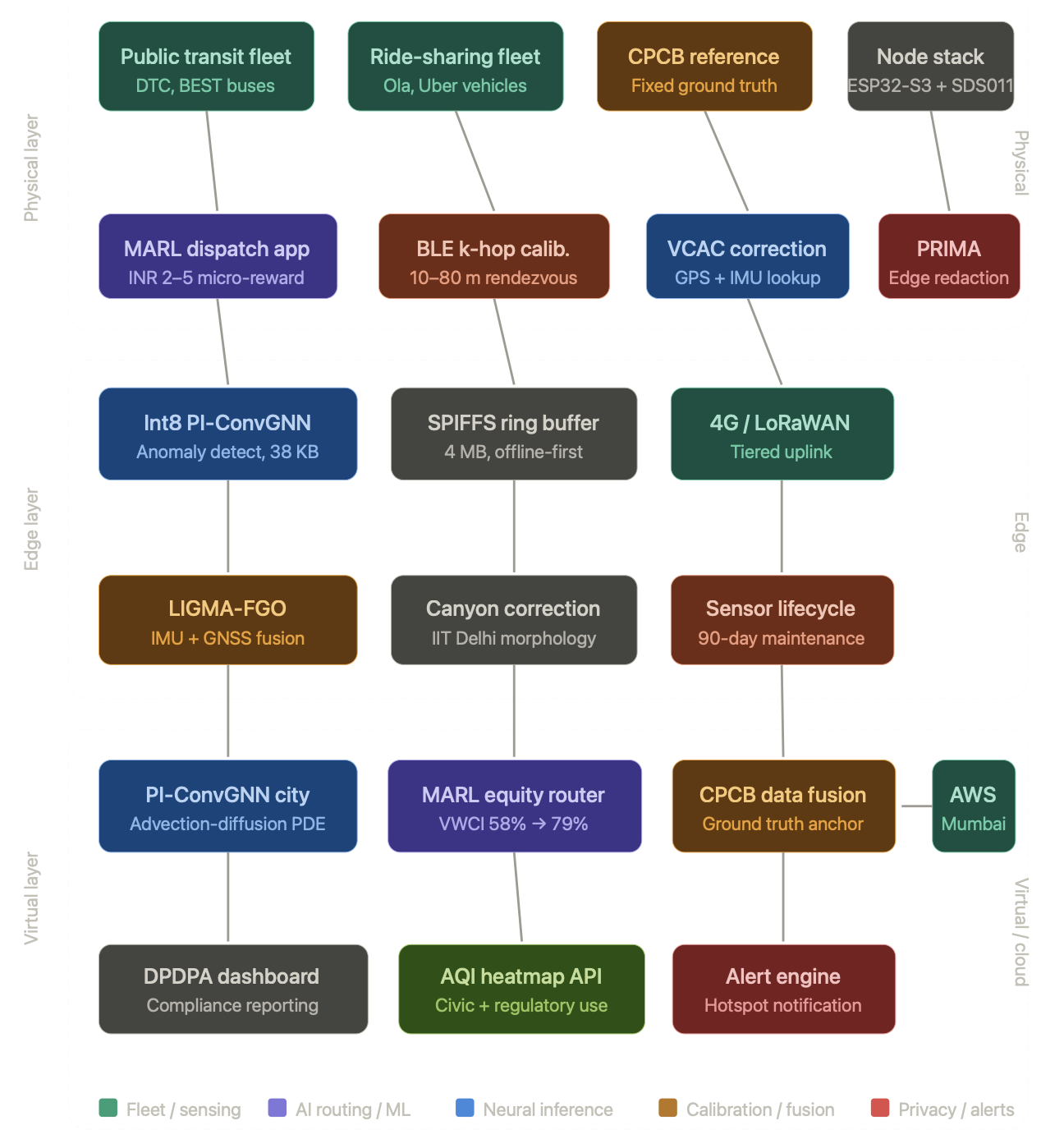
India's stationary air-quality monitoring network remains sparse, particularly in underserved urban and peri-urban areas. EcoPulse-India addresses this limitation by using public transit buses as mobile sensing platforms within an integrated artificial intelligence of things (AIoT) framework. The framework integrates velocity-compensated aerodynamic correction (VCAC), a physics-informed convolutional graph neural network (PI-ConvGNN), multi-agent reinforcement learning (MARL)-based coverage optimisation, and privacy-respecting inference and masking architecture (PRIMA). VCAC compensates for motion-related measurement bias using vehicle kinematic and environmental information, while the quantised int8 PI-ConvGNN enables lightweight edge inference on an ESP32-S3 with a model size of approximately 38~KB. MARL prioritises underserved areas using the vulnerability-weighted coverage index (VWCI), whereas PRIMA applies on-device spatial perturbation and trajectory segmentation to reduce location-privacy risks. Simulation experiments seeded with real-world GPS traces from Delhi DTC and Mumbai BEST fleets showed that VCAC reduced mean absolute error by 22% relative to uncompensated measurements against reference-station data. MARL routing incentives raised city-level mean VWCI to 0.79---a 36.2% relative improvement over the static-routing baseline. Edge inference required 45~ms per pass with average power consumption below 0.8~W. PRIMA retained 94% of grid-cell-level spatial information required for pollution interpolation. These results demonstrate the potential of EcoPulse-India as a lightweight, privacy-aware mobile air-quality monitoring framework for resource-constrained urban environments.
Graphical Abstract
Keywords
Data Availability Statement
Funding
Conflicts of Interest
AI Use Statement
Ethical Approval and Consent to Participate
References
- IQAir. (2025). 2024 World Air Quality Report. IQAir Group, Goldach, Switzerland. Available at https://www.iqair.com/world-most-polluted-cities/world-air-quality-report-2024-en.pdf
[Google Scholar] - Guttikunda, S. K., Nishadh, K. A., & Jawahar, P. (2019). Air pollution knowledge assessments (APnA) for 20 Indian cities. Urban Climate, 27, 124-141.
[CrossRef] [Google Scholar] - Kumar, P., Morawska, L., Martani, C., Biskos, G., Neophytou, M., Di Sabatino, S., ... & Britter, R. (2015). The rise of low-cost sensing for managing air pollution in cities. Environment international, 75, 199-205.
[CrossRef] [Google Scholar] - Jayaratne, R., Liu, X., Thai, P., Dunbabin, M., & Morawska, L. (2018). The influence of humidity on the performance of a low-cost air particle mass sensor and the effect of atmospheric fog. Atmospheric Measurement Techniques, 11(8), 4883-4890.
[CrossRef] [Google Scholar] - Munir, M. M., Adrian, M., Saputra, C., & Lestari, P. (2022). Utilizing low-cost mobile monitoring to estimate the PM2. 5 inhaled dose in urban environment. Aerosol and Air Quality Research, 22(6), 220079.
[CrossRef] [Google Scholar] - Li, Y., Yu, R., Shahabi, C., & Liu, Y. (2017). Diffusion convolutional recurrent neural network: Data-driven traffic forecasting. arXiv preprint arXiv:1707.01926.
[CrossRef] [Google Scholar] - Yu, B., Yin, H., & Zhu, Z. (2017). Spatio-temporal graph convolutional networks: A deep learning framework for traffic forecasting. arXiv preprint arXiv:1709.04875.
[CrossRef] [Google Scholar] - Government of India. (2023). The Digital Personal Data Protection Act, 2023. Ministry of Electronics and Information Technology, New Delhi. Available at https://www.meity.gov.in/static/uploads/2024/06/2bf1f0e9f04e6fb4f8fef35e82c42aa5.pdf
[Google Scholar] - Raissi, M., Perdikaris, P., & Karniadakis, G. E. (2019). Physics-informed neural networks: A deep learning framework for solving forward and inverse problems involving nonlinear partial differential equations. Journal of Computational physics, 378, 686-707.
[CrossRef] [Google Scholar] - Li, L., Wang, J., Franklin, M., Yin, Q., Wu, J., Camps-Valls, G., ... & Reichstein, M. (2023). Improving air quality assessment using physics-inspired deep graph learning. npj Climate and Atmospheric Science, 6(1), 152.
[CrossRef] [Google Scholar] - Krause, A., Singh, A., & Guestrin, C. (2008). Near-optimal sensor placements in Gaussian processes: Theory, efficient algorithms and empirical studies. Journal of Machine Learning Research, 9(2). Available at https://www.jmlr.org/papers/volume9/krause08a/krause08a.pdf
[Google Scholar] - Morello-Frosch, R., Zuk, M., Jerrett, M., Shamasunder, B., & Kyle, A. D. (2011). Understanding the cumulative impacts of inequalities in environmental health: implications for policy. Health affairs, 30(5), 879-887.
[CrossRef] [Google Scholar] - Ji, W., Han, K., & Liu, T. (2023). Trip-based mobile sensor deployment for drive-by sensing with bus fleets. Transportation Research Part C: Emerging Technologies, 157, 104404.
[CrossRef] [Google Scholar] - Kaginalkar, A., Kumar, S., Gargava, P., & Niyogi, D. (2023). Stakeholder analysis for designing an urban air quality data governance ecosystem in smart cities. Urban Climate, 48, 101403.
[CrossRef] [Google Scholar] - Warden, E., & Situnayake, D. (2019). TinyML: Machine Learning with TensorFlow Lite on Arduino and Ultra-Low-Power Microcontrollers. O'Reilly Media. Retrieved from https://www.semanticscholar.org/paper/TinyML%3A-Machine-Learning-with-TensorFlow-Lite-on-Warden-Situnayake/9d312f454068259015e38608f7ebb65947978f65
[Google Scholar] - Bandyopadhyay, D., & Sen, J. (2011). Internet of things: Applications and challenges in technology and standardization. Wireless personal communications, 58(1), 49-69.
[CrossRef] [Google Scholar]
Cite This Article
TY  - JOUR
AU  - Prakash, Satya
AU  - Nayak, Om Prakash
AU  - Patra, Om Prakash
AU  - Panigrahy, Manas Ranjan
AU  - Dass, Ashish Kumar
PY  - 2026
DA  - 2026/09/03
TI  - EcoPulse-India: An AIoT Framework for Scalable, Privacy-Compliant Urban Air Quality Monitoring on Public Transit Fleets
JO  - Next-Generation Computing Systems and Technologies
T2  - Next-Generation Computing Systems and Technologies
JF  - Next-Generation Computing Systems and Technologies
VL  - 2
IS  - 3
SP  - 89
EP  - 98
DO  - 10.62762/NGCST.2026.429196
UR  - https://www.icck.org/article/abs/NGCST.2026.429196
KW  - air quality monitoring
KW  - AIoT
KW  - edge computing
KW  - physics-informed neural networks
KW  - multi-agent reinforcement learning
KW  - data privacy
KW  - DPDPA 2023
KW  - urban sensing
KW  - India
AB  - India's stationary air-quality monitoring network remains sparse, particularly in underserved urban and peri-urban areas. EcoPulse-India addresses this limitation by using public transit buses as mobile sensing platforms within an integrated artificial intelligence of things (AIoT) framework. The framework integrates velocity-compensated aerodynamic correction (VCAC), a physics-informed convolutional graph neural network (PI-ConvGNN), multi-agent reinforcement learning (MARL)-based coverage optimisation, and privacy-respecting inference and masking architecture (PRIMA). VCAC compensates for motion-related measurement bias using vehicle kinematic and environmental information, while the quantised int8 PI-ConvGNN enables lightweight edge inference on an ESP32-S3 with a model size of approximately 38~KB. MARL prioritises underserved areas using the vulnerability-weighted coverage index (VWCI), whereas PRIMA applies on-device spatial perturbation and trajectory segmentation to reduce location-privacy risks. Simulation experiments seeded with real-world GPS traces from Delhi DTC and Mumbai BEST fleets showed that VCAC reduced mean absolute error by 22% relative to uncompensated measurements against reference-station data. MARL routing incentives raised city-level mean VWCI to 0.79---a 36.2% relative improvement over the static-routing baseline. Edge inference required 45~ms per pass with average power consumption below 0.8~W. PRIMA retained 94% of grid-cell-level spatial information required for pollution interpolation. These results demonstrate the potential of EcoPulse-India as a lightweight, privacy-aware mobile air-quality monitoring framework for resource-constrained urban environments.
SN  - 3070-3328
PB  - Institute of Central Computation and Knowledge
LA  - English
ER  -
@article{Prakash2026EcoPulseIn,
  author = {Satya Prakash and Om Prakash Nayak and Om Prakash Patra and Manas Ranjan Panigrahy and Ashish Kumar Dass},
  title = {EcoPulse-India: An AIoT Framework for Scalable, Privacy-Compliant Urban Air Quality Monitoring on Public Transit Fleets},
  journal = {Next-Generation Computing Systems and Technologies},
  year = {2026},
  volume = {2},
  number = {3},
  pages = {89-98},
  doi = {10.62762/NGCST.2026.429196},
  url = {https://www.icck.org/article/abs/NGCST.2026.429196},
  abstract = {India's stationary air-quality monitoring network remains sparse, particularly in underserved urban and peri-urban areas. EcoPulse-India addresses this limitation by using public transit buses as mobile sensing platforms within an integrated artificial intelligence of things (AIoT) framework. The framework integrates velocity-compensated aerodynamic correction (VCAC), a physics-informed convolutional graph neural network (PI-ConvGNN), multi-agent reinforcement learning (MARL)-based coverage optimisation, and privacy-respecting inference and masking architecture (PRIMA). VCAC compensates for motion-related measurement bias using vehicle kinematic and environmental information, while the quantised int8 PI-ConvGNN enables lightweight edge inference on an ESP32-S3 with a model size of approximately 38~KB. MARL prioritises underserved areas using the vulnerability-weighted coverage index (VWCI), whereas PRIMA applies on-device spatial perturbation and trajectory segmentation to reduce location-privacy risks. Simulation experiments seeded with real-world GPS traces from Delhi DTC and Mumbai BEST fleets showed that VCAC reduced mean absolute error by 22\% relative to uncompensated measurements against reference-station data. MARL routing incentives raised city-level mean VWCI to 0.79---a 36.2\% relative improvement over the static-routing baseline. Edge inference required 45~ms per pass with average power consumption below 0.8~W. PRIMA retained 94\% of grid-cell-level spatial information required for pollution interpolation. These results demonstrate the potential of EcoPulse-India as a lightweight, privacy-aware mobile air-quality monitoring framework for resource-constrained urban environments.},
  keywords = {air quality monitoring, AIoT, edge computing, physics-informed neural networks, multi-agent reinforcement learning, data privacy, DPDPA 2023, urban sensing, India},
  issn = {3070-3328},
  publisher = {Institute of Central Computation and Knowledge}
}
Article Metrics
Publisher's Note
ICCK stays neutral with regard to jurisdictional claims in published maps and institutional affiliations.
Rights and Permissions
 Copyright © 2026 by the Author(s). Published by Institute of Central Computation and Knowledge. This article is an open access article distributed under the terms and conditions of the Creative Commons Attribution (CC BY) license (https://creativecommons.org/licenses/by/4.0/), which permits use, sharing, adaptation, distribution and reproduction in any medium or format, as long as you give appropriate credit to the original author(s) and the source, provide a link to the Creative Commons licence, and indicate if changes were made.


Portico
