


Variation in Phenolic Acids, Flavonoids Contents, and Antibacterial Activity of Prosopis farcta L. During Phenological Growth Stage



Article Information
Abstract
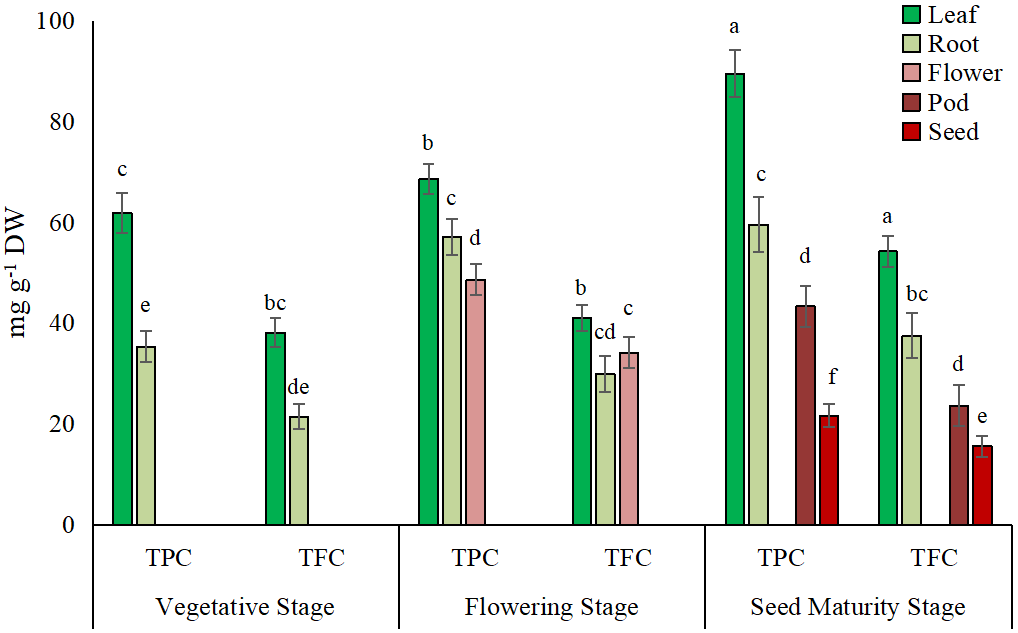
Plants are rich in phenolic chemicals, which have been demonstrated to have antibacterial activities. The current study aims to track changes in phenolic compound accumulation in Prosopis farcta organs (leaf, root, flower, pod, and seed) at various growth stages (vegetative, flowering, and seed maturity) and investigate the antibacterial activity of its extracts. At all growth stages, the highest total amount of phenolic compounds and flavonoids was observed in leaves, followed by roots, with the highest quantities measured at maturity. Flowers had the highest concentrations of several phenolics (caffeic acid, coumaric acid, luteolin, and diosmin). In P. farcta, there was a strong link between phenolic content and antibacterial action. By using low minimum inhibitory concentrations (MICs), leaf extracts were found to have a robust antibacterial effect against both gram-positive (Bacillus subtilis and Staphylococcus aureus) and gram-negative bacteria (Escherichia coli and Pseudomonas aeruginosa). As a result, P. farcta is recommended as a useful source of antibiotic substances for treating bacterial infections.
Graphical Abstract
Keywords
Data Availability Statement
Funding
Conflicts of Interest
AI Use Statement
Ethical Approval and Consent to Participate
References
- Fabricant, D. S., & Farnsworth, N. R. (2001). The value of plants used in traditional medicine for drug discovery. Environmental health perspectives, 109(Suppl 1), 69.
[CrossRef] [Google Scholar] - Sharifi-Rad, J., Kobarfard, F., Ata, A., Ayatollahi, S. A., Khosravi-Dehaghi, N., Jugran, A. K., ... & Martins, N. (2019). Prosopis plant chemical composition and pharmacological attributes: Targeting clinical studies from preclinical evidence. Biomolecules, 9(12), 777.
[CrossRef] [Google Scholar] - Dias, M. C., Pinto, D. C., & Silva, A. M. (2021). Plant flavonoids: Chemical characteristics and biological activity. Molecules, 26(17), 5377.
[CrossRef] [Google Scholar] - Zhong, J., Lu, P., Wu, H., Liu, Z., Sharifi-Rad, J., Setzer, W. N., & Suleria, H. A. (2022). Current insights into phytochemistry, nutritional, and pharmacological properties of Prosopis plants. Evidence‐Based Complementary and Alternative Medicine, 2022(1), 2218029.
[CrossRef] [Google Scholar] - Sharifi-Rad, J., Zhong, J., Ayatollahi, S. A., Kobarfard, F., Faizi, M., Khosravi-Dehaghi, N., & Suleria, H. A. (2021). LC-ESI-QTOF-MS/MS characterization of phenolic compounds from Prosopis farcta (Banks & Sol.) JF Macbr. and their potential antioxidant activities. Cellular and Molecular Biology, 67(1), 189-200.
[CrossRef] [Google Scholar] - Pasiecznik, N. M., Harris, P. J., & Smith, S. J. (2004). Identifying tropical Prosopis species: a field guide (Vol. 29). Coventry: Hdra Publishing. https://assets.publishing.service.gov.uk/media/57a08ce740f0b652dd00163e/R7295_prosopis_field_guide.pdf
[Google Scholar] - Al-Aboudi, A., & Afifi, F. U. (2011). Plants used for the treatment of diabetes in Jordan: A review of scientific evidence. Pharmaceutical Biology, 49(3), 221-239.
[CrossRef] [Google Scholar] - George, C., Lochner, A., & Huisamen, B. (2011). The efficacy of Prosopis glandulosa as antidiabetic treatment in rat models of diabetes and insulin resistance. Journal of ethnopharmacology, 137(1), 298-304.
[CrossRef] [Google Scholar] - Robertson, S., Narayanan, N., & Raj Kapoor, B. (2011). Antitumor activity of Prosopis cineraria (L.) Druce against Ehrlich ascites carcinoma-induced mice. Natural Product Research, 25(8), 857-862.
[CrossRef] [Google Scholar] - Sharma, R., Jodhawat, N., Purohit, S., & Kaur, S. (2012). Anti-bacterial activity and phytochemical screening of dried pods of Prosopis cineraria. International Journal of Pharmaceutical Sciences Review and Research, 14(1), 15-17. https://globalresearchonline.net/journalcontents/v14-1/04.pdf
[Google Scholar] - Ghasemian‐Yadegari, J., Adineh, A., Mohammadi, H., Davari, S., Veisani, Y., Ghaneialvar, H., ... & Karimi, E. (2024). Attenuation of cannabis withdrawal symptoms by Prosopis farcta extract, its luteolin and melatonin in mice: Involvement of brain‐derived neurotrophic factor and dopamine. Cell biochemistry and function, 42(2), e3980.
[CrossRef] [Google Scholar] - Isah, T. (2019). Stress and defense responses in plant secondary metabolites production. Biological Research, 52, 39. http://dx.doi.org/10.1186/s40659-019-0246-3
[Google Scholar] - Liu, J., Du, C., Beaman, H. T., & Monroe, M. B. B. (2020). Characterization of phenolic acid antimicrobial and antioxidant structure–property relationships. Pharmaceutics, 12(5), 419.
[CrossRef] [Google Scholar] - Marchiosi, R., dos Santos, W. D., Constantin, R. P., de Lima, R. B., Soares, A. R., Finger-Teixeira, A., ... & Ferrarese-Filho, O. (2020). Biosynthesis and metabolic actions of simple phenolic acids in plants. Phytochemistry Reviews, 19(4), 865-906.
[CrossRef] [Google Scholar] - Crozier, A., Jaganath, I. B., & Clifford, M. N. (2009). Dietary phenolics: chemistry, bioavailability and effects on health. Natural product reports, 26(8), 1001-1043.
[CrossRef] [Google Scholar] - Agirman, E., Celik, I., & Dogan, A. (2022). Consumption of the Syrian mesquite plant (Prosopis farcta) fruit and seed lyophilized extracts may have both protective and toxic effects in STZ-induced diabetic rats. Archives of Physiology and Biochemistry, 128(4), 887-896.
[CrossRef] [Google Scholar] - Ho, T. T., Murthy, H. N., & Park, S. Y. (2020). Methyl jasmonate induced oxidative stress and accumulation of secondary metabolites in plant cell and organ cultures. International journal of molecular sciences, 21(3), 716.
[CrossRef] [Google Scholar] - Winkel-Shirley, B. (2002). Biosynthesis of flavonoids and effects of stress. Current Opinion in Plant Biology, 5(3), 218-223.
[CrossRef] [Google Scholar] - Dong, N. Q., & Lin, H. X. (2021). Contribution of phenylpropanoid metabolism to plant development and plant–environment interactions. Journal of integrative plant biology, 63(1), 180-209.
[CrossRef] [Google Scholar] - Panche, A. N., Diwan, A. D., & Chandra, S. R. (2016). Flavonoids: an overview. Journal of nutritional science, 5, e47.
[CrossRef] [Google Scholar] - Berini, J. L., Brockman, S. A., Hegeman, A. D., Reich, P. B., Muthukrishnan, R., Montgomery, R. A., & Forester, J. D. (2018). Combinations of abiotic factors differentially alter production of plant secondary metabolites in five woody plant species in the boreal-temperate transition zone. Frontiers in plant science, 9, 1257.
[CrossRef] [Google Scholar] - Ramakrishna, A., & Ravishankar, G. A. (2011). Influence of abiotic stress signals on secondary metabolites in plants. Plant Signaling & Behavior, 6(11), 1720-1731.
[CrossRef] [Google Scholar] - Sampaio, B. L., Edrada-Ebel, R., & Da Costa, F. B. (2016). Effect of the environment on the secondary metabolic profile of Tithonia diversifolia: a model for environmental metabolomics of plants. Scientific reports, 6(1), 29265.
[CrossRef] [Google Scholar] - Górniak, I., Bartoszewski, R., & Króliczewski, J. (2019). Comprehensive review of antimicrobial activities of plant flavonoids. Phytochemistry reviews, 18(1), 241-272.
[CrossRef] [Google Scholar] - Borges, A., Ferreira, C., Saavedra, M. J., & Simões, M. (2013). Antibacterial activity and mode of action of ferulic and gallic acids against pathogenic bacteria. Microbial drug resistance, 19(4), 256-265.
[CrossRef] [Google Scholar] - Feduraev, P., Chupakhina, G., Maslennikov, P., Tacenko, N., & Skrypnik, L. (2019). Variation in phenolic compounds content and antioxidant activity of different plant organs from Rumex crispus L. and Rumex obtusifolius L. at different growth stages. Antioxidants, 8(7), 237.
[CrossRef] [Google Scholar] - Singleton, V. L., Orthofer, R., & Lamuela-Raventós, R. M. (1999). Analysis of total phenols and other oxidation substrates and antioxidants by means of Folin–Ciocalteu reagent. In L. Packer (Ed.), Methods in enzymology (Vol. 299, pp. 152-178). Academic Press.
[CrossRef] [Google Scholar] - Akkol, E. K., Göger, F., Koşar, M., & Başer, K. H. C. (2008). Phenolic composition and biological activities of Salvia halophila and Salvia virgata from Turkey. Food chemistry, 108(3), 942-949.
[CrossRef] [Google Scholar] - Zhishen, J., Mengcheng, T., & Jianming, W. (1999). The determination of flavonoid contents in mulberry and their scavenging effect on superoxide radicals. Food Chemistry, 64(4), 555-559.
[CrossRef] [Google Scholar] - Zafari, S., Sharifi, M., Ahmadian-Chashmi, N., & Mur, L. (2016). Modulation of Pb-induced stress in Prosopis shoot through an interconnected network of signaling molecules, phenolic compounds, and amino acids. Plant Physiology and Biochemistry, 99, 11-20.
[CrossRef] [Google Scholar] - Naczk, M., & Shahidi, F. (2004). Extraction and analysis of phenolics in food. Journal of Chromatography A, 1054(1--2), 95--111.
[CrossRef] [Google Scholar] - Owen, R. W., Haubner, R., Mier, W., Giacosa, A., Hull, W. E., Spiegelhalder, B., & Bartsch, H. (2003). Isolation, structure elucidation and antioxidant potential of the major phenolic and flavonoid compounds in brined olive drupes. Food and chemical toxicology, 41(5), 703-717.
[CrossRef] [Google Scholar] - Gudej, J., & Tomczyk, M. (2004). Determination of flavonoids, tannins and ellagic acid in leaves from Rubus L. species. Archives of pharmacal research, 27(11), 1114-1119.
[CrossRef] [Google Scholar] - Hudzicki, J. (2009). Kirby-Bauer disk diffusion susceptibility test protocol. American society for microbiology, 15(1), 1-23. https://rc.med.sumdu.edu.ua/wp-content/uploads/2019/08/Kirby-Bauer-Disk-Diffusion-Susceptibility-Test-Protocol-pdf.pdf
[Google Scholar] - National Committee for Clinical Laboratory Standards. (2000). Methods for dilution antimicrobial susceptibility tests for bacteria that grow aerobically (5th ed., Approved Standard M7–A5). NCCLS. Retrieved from https://clsi.org/shop/standards/m07/
[Google Scholar] - Wiegand, I., Hilpert, K., & Hancock, R. (2008). Agar and broth dilution methods to determine the minimal inhibitory concentration (MIC) of antimicrobial substances. Nature Protocols, 3(2), 163-175.
[CrossRef] [Google Scholar] - Andrews, J. M. (2001). Determination of minimum inhibitory concentrations. Journal of antimicrobial Chemotherapy, 48(suppl\_1), 5-16.
[CrossRef] [Google Scholar] - Aligiannis, N., Kalpoutzakis, E., Mitaku, S., & Chinou, I. B. (2001). Composition and antimicrobial activity of the essential oils of two Origanum species. Journal of agricultural and food chemistry, 49(9), 4168-4170.
[CrossRef] [Google Scholar] - Biyiti, L. F., Meko'o, D. J. L., Tamzc, V., & Amvam Zollo, P. H. (2004). Recherche de l'activité antibactérienne de quatre plantes médicinales Camerounaises. Pharmacologie et Médecine Traditionnelle en Afrique, 13, 11-20. https://www.researchgate.net/publication/258282938
[Google Scholar] - Adamczak, A., Ożarowski, M., & Karpiński, T. M. (2019). Antibacterial activity of some flavonoids and organic acids widely distributed in plants. Journal of Clinical Medicine, 9(1), 109.
[CrossRef] [Google Scholar] - Miklasińska-Majdanik, M., Kępa, M., Wojtyczka, R. D., Idzik, D., & Wąsik, T. J. (2018). Phenolic compounds diminish antibiotic resistance of Staphylococcus aureus clinical strains. International journal of environmental research and public health, 15(10), 2321.
[CrossRef] [Google Scholar] - Das, M. C., Das, A., Samaddar, S., Daware, A. V., Ghosh, C., Acharjee, S., ... & Bhattacharjee, S. (2018). Vitexin alters Staphylococcus aureus surface hydrophobicity to interfere with biofilm formation. BioRxiv, 301473.
[CrossRef] [Google Scholar] - Rammohan, A., Bhaskar, B. V., Venkateswarlu, N., Rao, V. L., Gunasekar, D., & Zyryanov, G. V. (2019). Isolation of flavonoids from the flowers of Rhynchosia beddomei Baker as prominent antimicrobial agents and molecular docking. Microbial Pathogenesis, 136, 103667.
[CrossRef] [Google Scholar] - Zafari, S., Sharifi, M., & Ahmadian-Chashmi, N. (2018). A comparative study of biotechnological approaches for producing valuable flavonoids in Prosopis farcta. Cytotechnology, 70(2), 603-614.
[CrossRef] [Google Scholar] - Chepel, V., Lisun, V., & Skrypnik, L. (2020). Changes in the content of some groups of phenolic compounds and biological activity of extracts of various parts of heather (Calluna vulgaris (L.) Hull) at different growth stages. Plants, 9(8), 926.
[CrossRef] [Google Scholar] - Saffaryazdi, A., Ganjeali, A., Farhoosh, R., & Cheniany, M. (2020). Variation in phenolic compounds, $\alpha$-linolenic acid and linoleic acid contents and antioxidant activity of purslane (Portulaca oleracea L.) during phenological growth stages. Physiology and Molecular Biology of Plants, 26(7), 1519-1529.
[CrossRef] [Google Scholar] - Kotilainen, T., Tegelberg, R., Julkunen‐tiitto, R. I. I. T. T. A., Lindfors, A., & Aphalo, P. J. (2008). Metabolite specific effects of solar UV‐A and UV‐B on alder and birch leaf phenolics. Global change biology, 14(6), 1294-1304.
[CrossRef] [Google Scholar] - Chang, X., Lu, Y., Lin, Z., Qiu, J., Guo, X., Pan, J., & Abbasi, A. M. (2018). Impact of leaf development stages on polyphenolics profile and antioxidant activity in Clausena lansium (Lour.) Skeels. BioMed research international, 2018(1), 7093691.
[CrossRef] [Google Scholar] - Kumar, N., & Goel, N. (2019). Phenolic acids: Natural versatile molecules with promising therapeutic applications. Biotechnology Reports, 24, e00370.
[CrossRef] [Google Scholar] - Tian, Y., Puganen, A., Alakomi, H. L., Uusitupa, A., Saarela, M., & Yang, B. (2018). Antioxidative and antibacterial activities of aqueous ethanol extracts of berries, leaves, and branches of berry plants. Food Research International, 106, 291-303.
[CrossRef] [Google Scholar] - Aleksic, V., & Knezevic, P. (2014). Antimicrobial and antioxidative activity of extracts and essential oils of Myrtus communis L. Microbiological Research, 169(4), 240-254.
[CrossRef] [Google Scholar] - Das, Q., Islam, M. R., Marcone, M. F., Warriner, K., & Diarra, M. S. (2017). Potential of berry extracts to control foodborne pathogens. Food Control, 73, 650-662.
[CrossRef] [Google Scholar] - Puupponen‐Pimiä, R., Nohynek, L., Meier, C., Kähkönen, M., Heinonen, M., Hopia, A., & Oksman‐Caldentey, K. M. (2001). Antimicrobial properties of phenolic compounds from berries. Journal of applied microbiology, 90(4), 494-507.
[CrossRef] [Google Scholar] - Bouarab-Chibane, L., Forquet, V., Lantéri, P., Clément, Y., Léonard-Akkari, L., Oulahal, N., Degraeve, P., & Bordes, C. (2019). Antibacterial properties of polyphenols: Characterization and QSAR (quantitative structure–activity relationship) models. Frontiers in Microbiology, 10, 829.
[CrossRef] [Google Scholar] - Othman, L., Sleiman, A., & Abdel-Massih, R. M. (2019). Antimicrobial activity of polyphenols and alkaloids in middle eastern plants. Frontiers in Microbiology, 10, 911.
[CrossRef] [Google Scholar] - Kumar, S., & Pandey, A. K. (2013). Chemistry and biological activities of flavonoids: an overview. The scientific world journal, 2013(1), 162750.
[CrossRef] [Google Scholar] - Xie, Y., Yang, W., Tang, F., Chen, X., & Ren, L. (2015). Anti-bacterial activities of flavonoids: Structure-activity relationship and mechanism. Current Medicinal Chemistry, 22(1), 132-149.
[CrossRef] [Google Scholar] - Díaz-Gómez, R., López-Solís, R., Obreque-Slier, E., & Toledo-Araya, H. (2013). Comparative antibacterial effect of gallic acid and catechin against Helicobacter pylori. LWT - Food Science and Technology, 54(2), 331-335.
[CrossRef] [Google Scholar]
Cite This Article
TY - JOUR AU - Sagharyan, Mostafa AU - Mohammadbagherlou, Shirin PY - 2026 DA - 2026/07/25 TI - Variation in Phenolic Acids, Flavonoids Contents, and Antibacterial Activity of Prosopis farcta L. During Phenological Growth Stage JO - Plant Innovation Journal T2 - Plant Innovation Journal JF - Plant Innovation Journal VL - 1 IS - 2 SP - 88 EP - 98 DO - 10.62762/PIJ.2026.589587 UR - https://www.icck.org/article/abs/PIJ.2026.589587 KW - Prosopis farcta KW - antibacterial activity KW - phenolic compound KW - flavonoids KW - minimum inhibitory concentrations AB - Plants are rich in phenolic chemicals, which have been demonstrated to have antibacterial activities. The current study aims to track changes in phenolic compound accumulation in Prosopis farcta organs (leaf, root, flower, pod, and seed) at various growth stages (vegetative, flowering, and seed maturity) and investigate the antibacterial activity of its extracts. At all growth stages, the highest total amount of phenolic compounds and flavonoids was observed in leaves, followed by roots, with the highest quantities measured at maturity. Flowers had the highest concentrations of several phenolics (caffeic acid, coumaric acid, luteolin, and diosmin). In P. farcta, there was a strong link between phenolic content and antibacterial action. By using low minimum inhibitory concentrations (MICs), leaf extracts were found to have a robust antibacterial effect against both gram-positive (Bacillus subtilis and Staphylococcus aureus) and gram-negative bacteria (Escherichia coli and Pseudomonas aeruginosa). As a result, P. farcta is recommended as a useful source of antibiotic substances for treating bacterial infections. SN - 3142-7596 PB - Institute of Central Computation and Knowledge LA - English ER -
@article{Sagharyan2026Variation,
author = {Mostafa Sagharyan and Shirin Mohammadbagherlou},
title = {Variation in Phenolic Acids, Flavonoids Contents, and Antibacterial Activity of Prosopis farcta L. During Phenological Growth Stage},
journal = {Plant Innovation Journal},
year = {2026},
volume = {1},
number = {2},
pages = {88-98},
doi = {10.62762/PIJ.2026.589587},
url = {https://www.icck.org/article/abs/PIJ.2026.589587},
abstract = {Plants are rich in phenolic chemicals, which have been demonstrated to have antibacterial activities. The current study aims to track changes in phenolic compound accumulation in Prosopis farcta organs (leaf, root, flower, pod, and seed) at various growth stages (vegetative, flowering, and seed maturity) and investigate the antibacterial activity of its extracts. At all growth stages, the highest total amount of phenolic compounds and flavonoids was observed in leaves, followed by roots, with the highest quantities measured at maturity. Flowers had the highest concentrations of several phenolics (caffeic acid, coumaric acid, luteolin, and diosmin). In P. farcta, there was a strong link between phenolic content and antibacterial action. By using low minimum inhibitory concentrations (MICs), leaf extracts were found to have a robust antibacterial effect against both gram-positive (Bacillus subtilis and Staphylococcus aureus) and gram-negative bacteria (Escherichia coli and Pseudomonas aeruginosa). As a result, P. farcta is recommended as a useful source of antibiotic substances for treating bacterial infections.},
keywords = {Prosopis farcta, antibacterial activity, phenolic compound, flavonoids, minimum inhibitory concentrations},
issn = {3142-7596},
publisher = {Institute of Central Computation and Knowledge}
}
Article Metrics
Publisher's Note
ICCK stays neutral with regard to jurisdictional claims in published maps and institutional affiliations.
Rights and Permissions
 Copyright © 2026 by the Author(s). Published by Institute of Central Computation and Knowledge. This article is an open access article distributed under the terms and conditions of the Creative Commons Attribution (CC BY) license (https://creativecommons.org/licenses/by/4.0/), which permits use, sharing, adaptation, distribution and reproduction in any medium or format, as long as you give appropriate credit to the original author(s) and the source, provide a link to the Creative Commons licence, and indicate if changes were made.

