


Genome-Wide Identification and Expression Profiling of the SBP-box Gene Family in Medicago truncatula



Article Information
Abstract
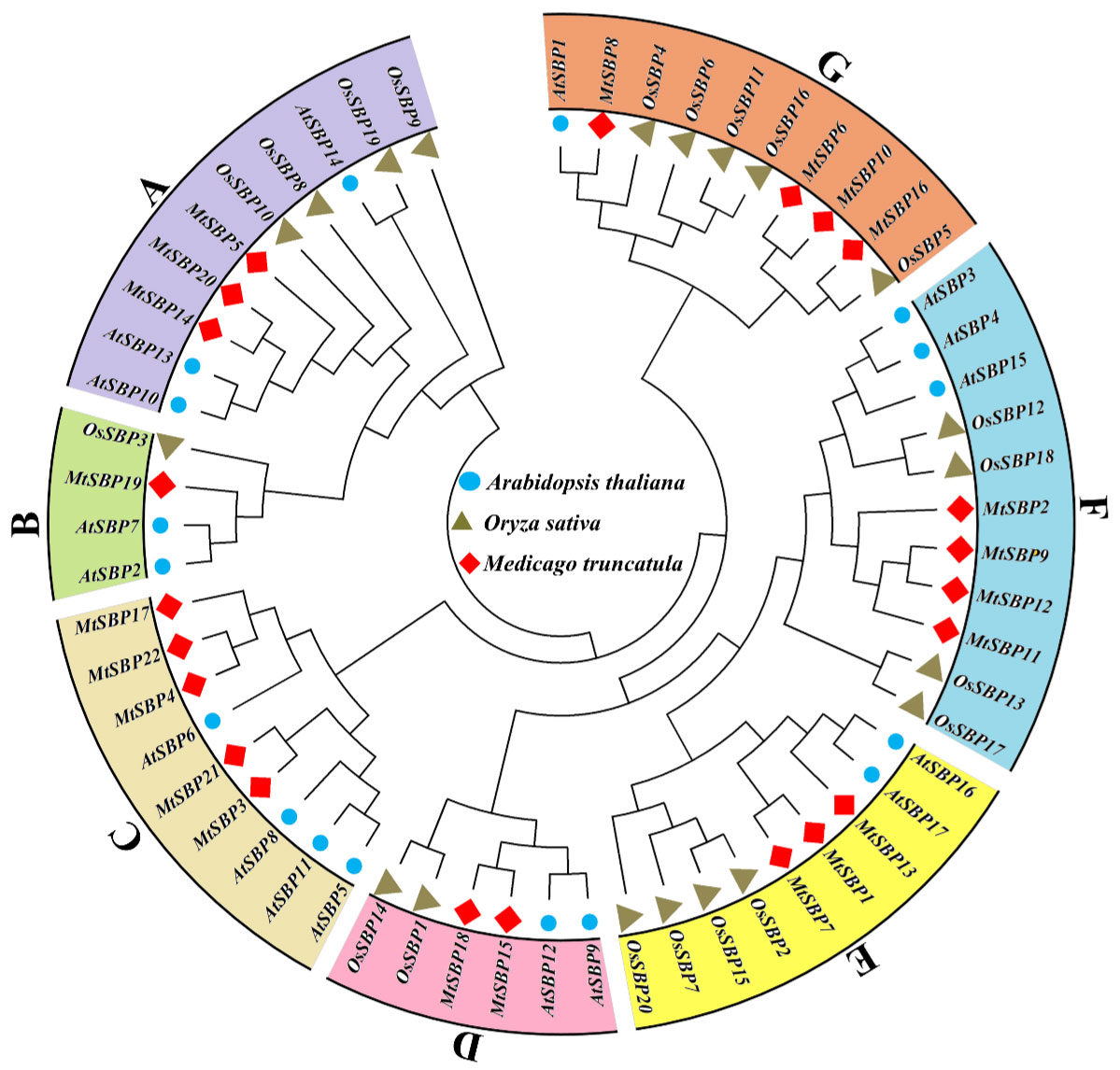
The Squamosa Promoter Binding Protein (SBP) family comprises plant-specific transcription factors widely distributed across green plant lineages and holds significant value for agricultural improvement by regulating key traits including yield, flowering, and stress tolerance. Here, we performed a genome-wide analysis of Medicago truncatula and identified 22 SBP-box genes (MtSBP). These genes are irregularly distributed across seven chromosomes, with chromosome 6 devoid of any SBP-box gene. Sequence alignment confirmed that all MtSBP proteins share conserved nuclear localization signals and two zinc finger structures essential for transcriptional regulation. Phylogenetic analysis grouped these genes into seven subgroups, supported by conserved domain organization, motif composition, and gene structure. Gene Ontology analysis indicated that most MtSBP genes are involved in biological regulation. Expression profiling using public RNA-seq data revealed variable patterns across different nitrogen sources and symbiotic conditions, suggesting roles in nitrogen metabolism, symbiosis, and growth. Overall, this study provides a comprehensive overview of the SBP-box family in M. truncatula and identifies candidate genes for future functional studies on legume growth and nitrogen-use efficiency.
Graphical Abstract
Keywords
Data Availability Statement
Funding
Conflicts of Interest
AI Use Statement
Ethical Approval and Consent to Participate
References
- Yu, N., Yang, J. C., Yin, G. T., Li, R. S., & Zou, W. T. (2020). Genome-wide characterization of the SPL gene family involved in the age development of Jatropha curcas. BMC genomics, 21(1), 368.
[CrossRef] [Google Scholar] - Peng, X., Wang, Q., Zhao, Y., Li, X., & Ma, Q. (2019). Comparative genome analysis of the SPL gene family reveals novel evolutionary features in maize. Genetics and Molecular Biology, 42(2), 380-394.
[CrossRef] [Google Scholar] - Klein, J., Saedler, H., & Huijser, P. (1996). A new family of DNA binding proteins includes putative transcriptional regulators of the Antirrhinum majus floral meristem identity gene SQUAMOSA. Molecular and General Genetics MGG, 250(1), 7-16.
[CrossRef] [Google Scholar] - Riechmann, J. L., Heard, J., Martin, G., Reuber, L., Jiang, C. Z., Keddie, J., ... & Yu, G. (2000). Arabidopsis transcription factors: genome-wide comparative analysis among eukaryotes. Science, 290(5499), 2105-2110.
[CrossRef] [Google Scholar] - Preston, J. C., & Hileman, L. C. (2013). Functional evolution in the plant SQUAMOSA-PROMOTER BINDING PROTEIN-LIKE (SPL) gene family. Frontiers in Plant Science, 4, 80.
[CrossRef] [Google Scholar] - Yang, Z., Wang, X., Gu, S., Hu, Z., Xu, H., & Xu, C. (2008). Comparative study of SBP-box gene family in Arabidopsis and rice. Gene, 407(1-2), 1-11.
[CrossRef] [Google Scholar] - Han, Y. Y., Ma, Y. Q., Li, D. Z., Yao, J. W., & Xu, Z. Q. (2016). Characterization and phylogenetic analysis of fifteen NtabSPL genes in Nicotiana tabacum L. cv. Qinyan95. Development genes and evolution, 226(1), 1-14.
[CrossRef] [Google Scholar] - Salinas, M., Xing, S., Höhmann, S., Berndtgen, R., & Huijser, P. (2012). Genomic organization, phylogenetic comparison and differential expression of the SBP-box family of transcription factors in tomato. Planta, 235(6), 1171-1184.
[CrossRef] [Google Scholar] - Hou, H., Li, J., Gao, M., Singer, S. D., Wang, H., Mao, L., ... & Wang, X. (2013). Genomic organization, phylogenetic comparison and differential expression of the SBP-box family genes in grape. PLoS One, 8(3), e59358.
[CrossRef] [Google Scholar] - Li, J., Hou, H., Li, X., Xiang, J., Yin, X., Gao, H., ... & Wang, X. (2013). Genome-wide identification and analysis of the SBP-box family genes in apple (Malus × domestica Borkh.). Plant Physiology and Biochemistry, 70, 100-114.
[CrossRef] [Google Scholar] - Guo, A. Y., Zhu, Q. H., Gu, X., Ge, S., Yang, J., & Luo, J. (2008). Genome-wide identification and evolutionary analysis of the plant specific SBP-box transcription factor family. Gene, 418(1-2), 1-8.
[CrossRef] [Google Scholar] - Lan, T., Zheng, Y., Su, Z., Yu, S., Song, H., Zheng, X., ... & Wu, W. (2019). OsSPL10, a SBP-box gene, plays a dual role in salt tolerance and trichome formation in rice (Oryza sativa L.). G3: Genes, Genomes, Genetics, 9(12), 4107-4114.
[CrossRef] [Google Scholar] - Hanly, A., Karagiannis, J., Lu, Q. S. M., Tian, L., & Hannoufa, A. (2020). Characterization of the role of SPL9 in drought stress tolerance in Medicago sativa. International journal of molecular sciences, 21(17), 6003.
[CrossRef] [Google Scholar] - Zhang, H. X., Feng, X. H., Ali, M., Jin, J. H., Wei, A. M., Khattak, A. M., & Gong, Z. H. (2020). Identification of pepper CaSBP08 gene in defense response against Phytophthora capsici infection. Frontiers in plant science, 11, 183.
[CrossRef] [Google Scholar] - Wang, S., Wu, K., Yuan, Q., Liu, X., Liu, Z., Lin, X., ... & Fu, X. (2012). Control of grain size, shape and quality by OsSPL16 in rice. Nature genetics, 44(8), 950-954.
[CrossRef] [Google Scholar] - Wang, S., Li, S., Liu, Q., Wu, K., Zhang, J., Wang, S., ... & Fu, X. (2015). The OsSPL16-GW7 regulatory module determines grain shape and simultaneously improves rice yield and grain quality. Nature Genetics, 47(8), 949-954.
[CrossRef] [Google Scholar] - Manning, K., Tör, M., Poole, M., Thompson, A. J., King, G. J., Giovannoni, J. J., & Seymour, G. B. (2006). A naturally occurring epigenetic mutation in a gene encoding an SBP-box transcription factor inhibits tomato fruit ripening. Nature genetics, 38(8), 948-952.
[CrossRef] [Google Scholar] - Yamasaki, H., Hayashi, M., Fukazawa, M., Kobayashi, Y., & Shikanai, T. (2009). SQUAMOSA promoter binding protein–like7 is a central regulator for copper homeostasis in Arabidopsis. The Plant Cell, 21(1), 347-361.
[CrossRef] [Google Scholar] - Xing, S., Salinas, M., Garcia-Molina, A., Höhmann, S., Berndtgen, R., & Huijser, P. (2013). SPL8 and miR156-targeted SPL genes redundantly regulate Arabidopsis gynoecium differential patterning. The Plant Journal, 75(4), 566-577.
[CrossRef] [Google Scholar] - Stone, J. M., Liang, X., Nekl, E. R., & Stiers, J. J. (2005). Arabidopsis AtSPL14, a plant‐specific SBP‐domain transcription factor, participates in plant development and sensitivity to fumonisin B1. The Plant Journal, 41(5), 744-754.
[CrossRef] [Google Scholar] - Limpens, E., Moling, S., Hooiveld, G., Pereira, P.A., Bisseling, T., Becker, J.D., & Küster, H. (2013). Cell- and tissue-specific transcriptome analyses of Medicago truncatula root nodules. PLoS ONE, 8(5), e64377.
[CrossRef] [Google Scholar] - Wang, H., Lu, Z., Xu, Y., Kong, L., Shi, J., Liu, Y., ... & Han, L. (2019). Genome-wide characterization of SPL family in Medicago truncatula reveals the novel roles of miR156/SPL module in spiky pod development. BMC genomics, 20(1), 552.
[CrossRef] [Google Scholar] - Jin, J., Tian, F., Yang, D. C., Meng, Y. Q., Kong, L., Luo, J., & Gao, G. (2016). PlantTFDB 4.0: toward a central hub for transcription factors and regulatory interactions in plants. Nucleic acids research, gkw982.
[CrossRef] [Google Scholar] - Altschul, S. F., Madden, T. L., Schäffer, A. A., Zhang, J., Zhang, Z., Miller, W., & Lipman, D. J. (1997). Gapped BLAST and PSI-BLAST: a new generation of protein database search programs. Nucleic acids research, 25(17), 3389-3402.
[CrossRef] [Google Scholar] - Li, J., Gao, X., Zhang, X., & Liu, C. (2020). Dynamic expansion and functional evolutionary profiles of plant conservative gene family SBP-box in twenty two flowering plants and the origin of miR156. Biomolecules, 10(5), 757.
[CrossRef] [Google Scholar] - Wang, Y., Ruan, Q., Zhu, X., Wang, B., Wei, B., & Wei, X. (2023). Identification of Alfalfa SPL gene family and expression analysis under biotic and abiotic stresses. Scientific Reports, 13(1), 84.
[CrossRef] [Google Scholar] - Tong, T., Fang, Y., Zhang, Z., Zheng, J., Lu, X., Zhang, X., & Xue, D. (2020). Genome-wide identification, phylogenetic and expression analysis of SBP-box gene family in barley (Hordeum vulgare L.). Plant Growth Regulation, 90(1), 137-149.
[CrossRef] [Google Scholar] - Wang, P., Chen, D., Zheng, Y., Jin, S., Yang, J., & Ye, N. (2018). Identification and expression analyses of SBP-box genes reveal their involvement in abiotic stress and hormone response in tea plant (Camellia sinensis). International journal of molecular sciences, 19(11), 3404.
[CrossRef] [Google Scholar] - Zeng, R. F., Zhou, J. J., Liu, S. R., Gan, Z. M., Zhang, J. Z., & Hu, C. G. (2019). Genome-wide identification and characterization of squamosa—promoter-binding protein (sbp) genes involved in the flowering development of Citrus clementina. Biomolecules, 9(2), 66.
[CrossRef] [Google Scholar] - Zhou, Q., Zhang, S., Chen, F., Liu, B., Wu, L., Li, F., ... & Liu, G. (2018). Genome-wide identification and characterization of the SBP-box gene family in Petunia. Bmc Genomics, 19(1), 193.
[CrossRef] [Google Scholar] - He, F., Long, R., Wei, C., Zhang, Y., Li, M., Kang, J., ... & Chen, L. (2022). Genome-wide identification, phylogeny and expression analysis of the SPL gene family and its important role in salt stress in Medicago sativa L. BMC plant biology, 22(1), 295.
[CrossRef] [Google Scholar] - Xie, K., Wu, C., & Xiong, L. (2006). Genomic organization, differential expression, and interaction of SQUAMOSA promoter-binding-like transcription factors and microRNA156 in rice. Plant Physiology, 142(1), 280-293.
[CrossRef] [Google Scholar]
Cite This Article
TY  - JOUR
AU  - Noor, Maryam
AU  - Afzal, Muhammad
AU  - Dilshad, Ameena
AU  - Awais, Muhammad
AU  - Haris, Sial
AU  - Mehar, Iqra
AU  - Hussain, Hadia
PY  - 2026
DA  - 2026/08/10
TI  - Genome-Wide Identification and Expression Profiling of the SBP-box Gene Family in Medicago truncatula
JO  - Plant Innovation Journal
T2  - Plant Innovation Journal
JF  - Plant Innovation Journal
VL  - 1
IS  - 2
SP  - 99
EP  - 117
DO  - 10.62762/PIJ.2026.672525
UR  - https://www.icck.org/article/abs/PIJ.2026.672525
KW  - Medicago truncatula
KW  - SBP-box gene family
KW  - phylogenetic analysis
KW  - Gene Ontology
KW  - expression analysis
KW  - nitrogen utilization
KW  - symbiotic interaction
AB  - The Squamosa Promoter Binding Protein (SBP) family comprises plant-specific transcription factors widely distributed across green plant lineages and holds significant value for agricultural improvement by regulating key traits including yield, flowering, and stress tolerance. Here, we performed a genome-wide analysis of Medicago truncatula and identified 22 SBP-box genes (MtSBP). These genes are irregularly distributed across seven chromosomes, with chromosome 6 devoid of any SBP-box gene. Sequence alignment confirmed that all MtSBP proteins share conserved nuclear localization signals and two zinc finger structures essential for transcriptional regulation. Phylogenetic analysis grouped these genes into seven subgroups, supported by conserved domain organization, motif composition, and gene structure. Gene Ontology analysis indicated that most MtSBP genes are involved in biological regulation. Expression profiling using public RNA-seq data revealed variable patterns across different nitrogen sources and symbiotic conditions, suggesting roles in nitrogen metabolism, symbiosis, and growth. Overall, this study provides a comprehensive overview of the SBP-box family in M. truncatula and identifies candidate genes for future functional studies on legume growth and nitrogen-use efficiency.
SN  - 3142-7596
PB  - Institute of Central Computation and Knowledge
LA  - English
ER  -
@article{Noor2026GenomeWide,
  author = {Maryam Noor and Muhammad Afzal and Ameena Dilshad and Muhammad Awais and Sial Haris and Iqra Mehar and Hadia Hussain},
  title = {Genome-Wide Identification and Expression Profiling of the SBP-box Gene Family in Medicago truncatula},
  journal = {Plant Innovation Journal},
  year = {2026},
  volume = {1},
  number = {2},
  pages = {99-117},
  doi = {10.62762/PIJ.2026.672525},
  url = {https://www.icck.org/article/abs/PIJ.2026.672525},
  abstract = {The Squamosa Promoter Binding Protein (SBP) family comprises plant-specific transcription factors widely distributed across green plant lineages and holds significant value for agricultural improvement by regulating key traits including yield, flowering, and stress tolerance. Here, we performed a genome-wide analysis of Medicago truncatula and identified 22 SBP-box genes (MtSBP). These genes are irregularly distributed across seven chromosomes, with chromosome 6 devoid of any SBP-box gene. Sequence alignment confirmed that all MtSBP proteins share conserved nuclear localization signals and two zinc finger structures essential for transcriptional regulation. Phylogenetic analysis grouped these genes into seven subgroups, supported by conserved domain organization, motif composition, and gene structure. Gene Ontology analysis indicated that most MtSBP genes are involved in biological regulation. Expression profiling using public RNA-seq data revealed variable patterns across different nitrogen sources and symbiotic conditions, suggesting roles in nitrogen metabolism, symbiosis, and growth. Overall, this study provides a comprehensive overview of the SBP-box family in M. truncatula and identifies candidate genes for future functional studies on legume growth and nitrogen-use efficiency.},
  keywords = {Medicago truncatula, SBP-box gene family, phylogenetic analysis, Gene Ontology, expression analysis, nitrogen utilization, symbiotic interaction},
  issn = {3142-7596},
  publisher = {Institute of Central Computation and Knowledge}
}
Article Metrics
Publisher's Note
ICCK stays neutral with regard to jurisdictional claims in published maps and institutional affiliations.
Rights and Permissions
 Copyright © 2026 by the Author(s). Published by Institute of Central Computation and Knowledge. This article is an open access article distributed under the terms and conditions of the Creative Commons Attribution (CC BY) license (https://creativecommons.org/licenses/by/4.0/), which permits use, sharing, adaptation, distribution and reproduction in any medium or format, as long as you give appropriate credit to the original author(s) and the source, provide a link to the Creative Commons licence, and indicate if changes were made.

