


Fidelity and Delivery: Coupled Barriers in Plant CRISPR-Cas Genome Editing



Article Information
Abstract
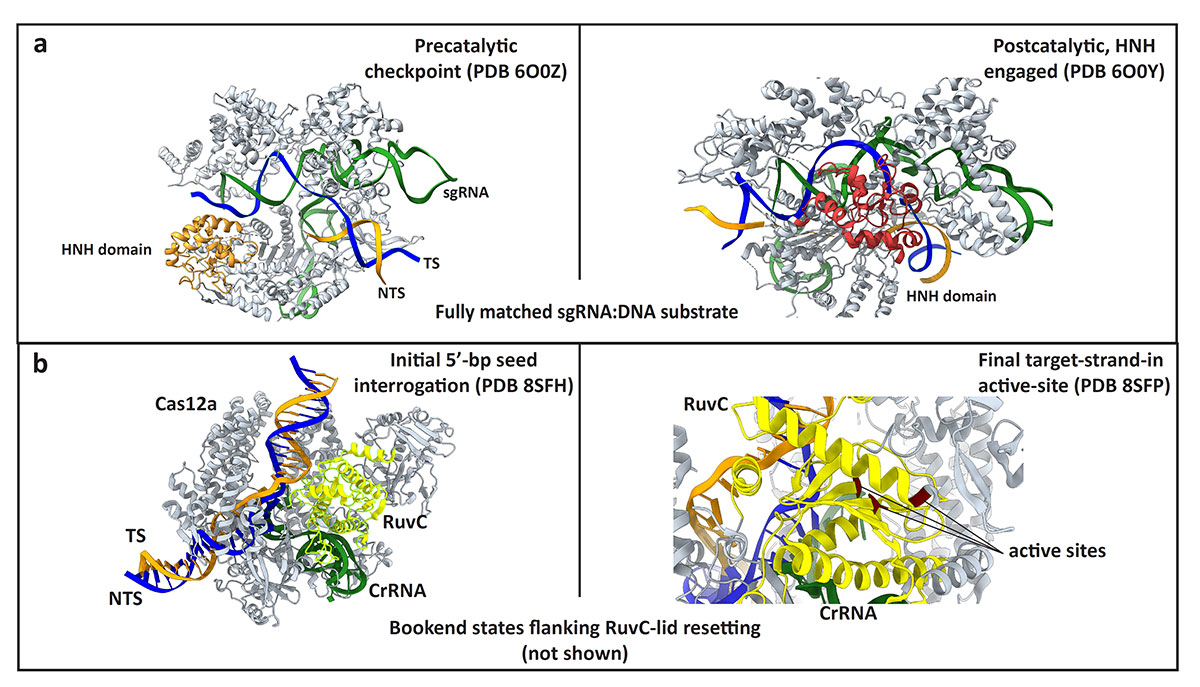
CRISPR-Cas platforms have transformed plant functional genomics, yet nucleases such as Cas9 and Cas12a remain constrained by two seemingly distinct limitations: imperfect target discrimination and inefficient intracellular delivery. Here, this review proposes that these constraints are functionally coupled through the intracellular abundance, nuclear access, and chromatin residence time of active Cas-gRNA complexes. Off-target activity arises from guide-target mismatch tolerance during R-loop formation, whereas rigid plant cell walls constrain the delivery of RNP and DNA cargo. These processes can become coupled when delivery limitations alter the concentration or duration of active Cas-gRNA exposure. When inefficient delivery is addressed through sustained or elevated nuclease expression, it can increase cumulative active Cas-gRNA exposure and may consequently increase off-target risk. Evidence from maize, rice, wheat, and carrot systems is synthesized and convergent biochemical solutions, including transgene-free RNP delivery, are outlined spanning herbaceous and woody species.
Graphical Abstract
Keywords
Data Availability Statement
Funding
Conflicts of Interest
AI Use Statement
Ethical Approval and Consent to Participate
References
- Liu, X., Xie, C., Si, H., & Yang, J. (2017). CRISPR/Cas9-mediated genome editing in plants. Methods, 121, 94-102.
[CrossRef] [Google Scholar] - Fu, R., He, W., Dou, J., Villarreal, O. D., Bedford, E., Wang, H., ... & Xu, H. (2022). Systematic decomposition of sequence determinants governing CRISPR/Cas9 specificity. Nature Communications, 13(1), 474.
[CrossRef] [Google Scholar] - Endo, M., Mikami, M., & Toki, S. (2015). Multigene knockout utilizing off-target mutations of the CRISPR/Cas9 system in rice. Plant and Cell Physiology, 56(1), 41-47.
[CrossRef] [Google Scholar] - Young, J., Zastrow-Hayes, G., Deschamps, S., Svitashev, S., Zaremba, M., Acharya, A., ... & Kumar, S. (2019). CRISPR-Cas9 editing in maize: systematic evaluation of off-target activity and its relevance in crop improvement. Scientific Reports, 9(1), 6729.
[CrossRef] [Google Scholar] - Laforest, L. C., & Nadakuduti, S. S. (2022). Advances in delivery mechanisms of CRISPR gene-editing reagents in plants. Frontiers in Genome Editing, 4, 830178.
[CrossRef] [Google Scholar] - Shen, C. C., Hsu, M. N., Chang, C. W., Lin, M. W., Hwu, J. R., Tu, Y., & Hu, Y. C. (2019). Synthetic switch to minimize CRISPR off-target effects by self-restricting Cas9 transcription and translation. Nucleic Acids Research, 47(3), e13.
[CrossRef] [Google Scholar] - Ramakrishnan, M., Kaul, R., Sharma, A., Ahmad, Z., Vijayakanth, V., Keerthana, K., Gao, Z., Zhou, M., & Wei, Q. (2025). CRISPR RNP-Mediated Transgene-Free Genome Editing in Plants: Advances, Challenges and Future Directions for Tree Species. Plant, Cell & Environment. Advance online publication.
[CrossRef] [Google Scholar] - Rutkauskas, M., Krivoy, A., Szczelkun, M. D., Rouillon, C., & Seidel, R. (2017). Single-molecule insight into target recognition by CRISPR--Cas complexes. In Methods in enzymology (Vol. 582, pp. 239-273). Academic Press.
[CrossRef] [Google Scholar] - Handelmann, C. R., Tsompana, M., Samudrala, R., & Buck, M. J. (2023). The impact of nucleosome structure on CRISPR/Cas9 fidelity. Nucleic Acids Research, 51(5), 2333-2344.
[CrossRef] [Google Scholar] - Strohkendl, I., Saha, A., Moy, C., Nguyen, A. H., Ahsan, M., Russell, R., ... & Taylor, D. W. (2024). Cas12a domain flexibility guides R-loop formation and forces RuvC resetting. Molecular Cell, 84(14), 2717-2731.
[CrossRef] [Google Scholar] - Saha, A., Ahsan, M., Arantes, P. R., Schmitz, M., Chanez, C., Jinek, M., & Palermo, G. (2024). An alpha-helical lid guides the target DNA toward catalysis in CRISPR-Cas12a. Nature Communications, 15(1), 1473.
[CrossRef] [Google Scholar] - Wörle, E., Newman, A., D'Silva, J., Burgio, G., & Grohmann, D. (2022). Allosteric activation of CRISPR-Cas12a requires the concerted movement of the bridge helix and helix 1 of the RuvC II domain. Nucleic Acids Research, 50(17), 10153-10168.
[CrossRef] [Google Scholar] - Zhang, X. H., Tee, L. Y., Wang, X. G., Huang, Q. S., & Yang, S. H. (2015). Off-target effects in CRISPR/Cas9-mediated genome engineering. Molecular Therapy: Nucleic Acids, 4.
[CrossRef] [Google Scholar] - Miyamoto, T., Tsuchiya, K., Toyooka, K., Goto, Y., Tateishi, A., & Numata, K. (2022). Relaxation of the Plant Cell Wall Barrier via Zwitterionic Liquid Pretreatment for Micelle-Complex-Mediated DNA Delivery to Specific Plant Organelles. Angewandte Chemie International Edition, 61(32), e202204234.
[CrossRef] [Google Scholar] - Cunningham, F. J., Goh, N. S., Demirer, G. S., Matos, J. L., & Landry, M. P. (2018). Nanoparticle-mediated delivery towards advancing plant genetic engineering. Trends in Biotechnology, 36(9), 882-897.
[CrossRef] [Google Scholar] - Wu, H., & Li, Z. (2022). Nano-enabled agriculture: How do nanoparticles cross barriers in plants? Plant Communications, 3(6), 100346.
[CrossRef] [Google Scholar] - Klimek-Chodacka, M., Gieniec, M., & Baranski, R. (2021). Multiplex site-directed gene editing using polyethylene glycol-mediated delivery of CRISPR gRNA: Cas9 ribonucleoprotein (RNP) complexes to carrot protoplasts. International Journal of Molecular Sciences, 22(19), 10740.
[CrossRef] [Google Scholar] - Hu, W., & Jans, D. A. (1999). Efficiency of importin $\alpha / \beta$-mediated nuclear localization sequence recognition and nuclear import: differential role of NTF2. Journal of Biological Chemistry, 274(22), 15820-15827.
[CrossRef] [Google Scholar] - Shui, S., Wang, S., & Liu, J. (2022). Systematic investigation of the effects of multiple SV40 nuclear localization signal fusion on the genome editing activity of purified SpCas9. Bioengineering, 9(2), 83.
[CrossRef] [Google Scholar] - Grützner, R., Martin, P., Horn, C., Mortensen, S., Cram, E. J., Lee-Parsons, C. W. T., Stuttmann, J., & Marillonnet, S. (2021). High-efficiency genome editing in plants mediated by a Cas9 gene containing multiple introns. Plant Communications, 2(2), 100135.
[CrossRef] [Google Scholar] - Hamada, H., Liu, Y., Nagira, Y., Miki, R., Taoka, N., & Imai, R. (2018). Biolistic-delivery-based transient CRISPR/Cas9 expression enables in planta genome editing in wheat. Scientific Reports, 8(1), 14422.
[CrossRef] [Google Scholar] - Long, L., Guo, D. D., Gao, W., Yang, W. W., Hou, L. P., Ma, X. N., ... & Song, C. P. (2018). Optimization of CRISPR/Cas9 genome editing in cotton by improved sgRNA expression. Plant Methods, 14(1), 85.
[CrossRef] [Google Scholar] - Kleinstiver, B. P., Pattanayak, V., Prew, M. S., Tsai, S. Q., Nguyen, N. T., Zheng, Z., & Joung, J. K. (2016). High-fidelity CRISPR--Cas9 nucleases with no detectable genome-wide off-target effects. Nature, 529(7587), 490-495.
[CrossRef] [Google Scholar] - Zhang, L., He, W., Fu, R., Wang, S., Chen, Y., & Xu, H. (2023). Guide-specific loss of efficiency and off-target reduction with Cas9 variants. Nucleic Acids Research, 51(18), 9880-9893.
[CrossRef] [Google Scholar] - Sakovina, L., Vokhtantsev, I., Vorobyeva, M., Vorobyev, P., & Novopashina, D. (2022). Improving stability and specificity of CRISPR/Cas9 system by selective modification of guide RNAs with 2'-fluoro and locked nucleic acid nucleotides. International Journal of Molecular Sciences, 23(21), 13460.
[CrossRef] [Google Scholar] - Chen, Q., Zhang, Y., & Yin, H. (2021). Recent advances in chemical modifications of guide RNA, mRNA and donor template for CRISPR-mediated genome editing. Advanced Drug Delivery Reviews, 168, 246-258.
[CrossRef] [Google Scholar] - Filippova, J., Matveeva, A., Zhuravlev, E., & Stepanov, G. (2019). Guide RNA modification as a way to improve CRISPR/Cas9-based genome-editing systems. Biochimie, 167, 49-60.
[CrossRef] [Google Scholar] - Thakore, P. I., D'ippolito, A. M., Song, L., Safi, A., Shivakumar, N. K., Kabadi, A. M., ... & Gersbach, C. A. (2015). Highly specific epigenome editing by CRISPR-Cas9 repressors for silencing of distal regulatory elements. Nature Methods, 12(12), 1143-1149.
[CrossRef] [Google Scholar] - Li, Z., Ma, R., Liu, D., Wang, M., Zhu, T., & Deng, Y. (2022). A straightforward plant prime editing system enabled highly efficient precise editing of rice Waxy gene. Plant Science, 323, 111400.
[CrossRef] [Google Scholar] - Tan, J., Zhang, F., Karcher, D., & Bock, R. (2019). Engineering of high-precision base editors for site-specific single nucleotide replacement. Nature Communications, 10(1), 439.
[CrossRef] [Google Scholar]
Cite This Article
TY  - JOUR
AU  - Movahedi, Ali
PY  - 2026
DA  - 2026/08/11
TI  - Fidelity and Delivery: Coupled Barriers in Plant CRISPR-Cas Genome Editing
JO  - Plant Innovation Journal
T2  - Plant Innovation Journal
JF  - Plant Innovation Journal
VL  - 1
IS  - 2
SP  - 118
EP  - 125
DO  - 10.62762/PIJ.2026.809255
UR  - https://www.icck.org/article/abs/PIJ.2026.809255
KW  - R-loop formation kinetics
KW  - off-target mutagenesis
KW  - ribonucleoprotein delivery
KW  - nuclear localization signal
KW  - prime editing
AB  - CRISPR-Cas platforms have transformed plant functional genomics, yet nucleases such as Cas9 and Cas12a remain constrained by two seemingly distinct limitations: imperfect target discrimination and inefficient intracellular delivery. Here, this review proposes that these constraints are functionally coupled through the intracellular abundance, nuclear access, and chromatin residence time of active Cas-gRNA complexes. Off-target activity arises from guide-target mismatch tolerance during R-loop formation, whereas rigid plant cell walls constrain the delivery of RNP and DNA cargo. These processes can become coupled when delivery limitations alter the concentration or duration of active Cas-gRNA exposure. When inefficient delivery is addressed through sustained or elevated nuclease expression, it can increase cumulative active Cas-gRNA exposure and may consequently increase off-target risk. Evidence from maize, rice, wheat, and carrot systems is synthesized and convergent biochemical solutions, including transgene-free RNP delivery, are outlined spanning herbaceous and woody species.
SN  - 3142-7596
PB  - Institute of Central Computation and Knowledge
LA  - English
ER  -
@article{Movahedi2026Fidelity,
  author = {Ali Movahedi},
  title = {Fidelity and Delivery: Coupled Barriers in Plant CRISPR-Cas Genome Editing},
  journal = {Plant Innovation Journal},
  year = {2026},
  volume = {1},
  number = {2},
  pages = {118-125},
  doi = {10.62762/PIJ.2026.809255},
  url = {https://www.icck.org/article/abs/PIJ.2026.809255},
  abstract = {CRISPR-Cas platforms have transformed plant functional genomics, yet nucleases such as Cas9 and Cas12a remain constrained by two seemingly distinct limitations: imperfect target discrimination and inefficient intracellular delivery. Here, this review proposes that these constraints are functionally coupled through the intracellular abundance, nuclear access, and chromatin residence time of active Cas-gRNA complexes. Off-target activity arises from guide-target mismatch tolerance during R-loop formation, whereas rigid plant cell walls constrain the delivery of RNP and DNA cargo. These processes can become coupled when delivery limitations alter the concentration or duration of active Cas-gRNA exposure. When inefficient delivery is addressed through sustained or elevated nuclease expression, it can increase cumulative active Cas-gRNA exposure and may consequently increase off-target risk. Evidence from maize, rice, wheat, and carrot systems is synthesized and convergent biochemical solutions, including transgene-free RNP delivery, are outlined spanning herbaceous and woody species.},
  keywords = {R-loop formation kinetics, off-target mutagenesis, ribonucleoprotein delivery, nuclear localization signal, prime editing},
  issn = {3142-7596},
  publisher = {Institute of Central Computation and Knowledge}
}
Article Metrics
Publisher's Note
ICCK stays neutral with regard to jurisdictional claims in published maps and institutional affiliations.
Rights and Permissions
 Copyright © 2026 by the Author(s). Published by Institute of Central Computation and Knowledge. This article is an open access article distributed under the terms and conditions of the Creative Commons Attribution (CC BY) license (https://creativecommons.org/licenses/by/4.0/), which permits use, sharing, adaptation, distribution and reproduction in any medium or format, as long as you give appropriate credit to the original author(s) and the source, provide a link to the Creative Commons licence, and indicate if changes were made.

