
Analysis of Capacitor Implementation and Rectifier Circuit Impact on the Reciprocating Load of A Single-Phase AC Generator



Article Information
Abstract
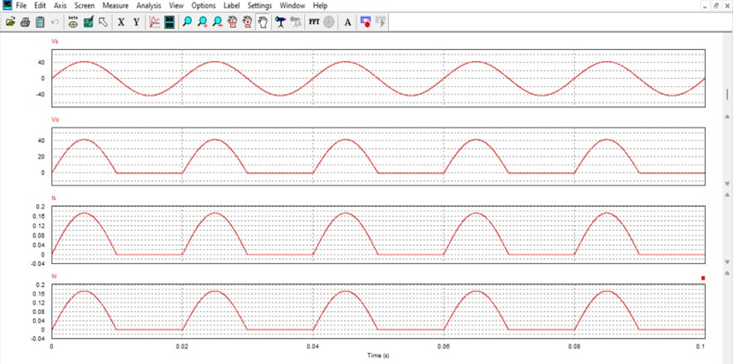
Rectifier circuits have long played a crucial role in electronic technology, yet there remains significant potential for optimizing their performance to enhance real-world applications. The primary function of a rectifier circuit is to convert alternating current (AC) into direct current (DC). Additionally, generators are widely studied components in power electronics research due to their fundamental role in energy conversion. A single-phase AC generator consists of a stator that generates electric current, a rotor that produces a magnetic field, and an air gap between them. This configuration enables the conversion of mechanical energy into electrical energy, resulting in an alternating voltage output. This study examines the impact of capacitor installation and half-wave rectifier circuits on the performance of reciprocating loads in single-phase AC generators. Experimental results demonstrate that capacitors significantly influence the rectifier circuit's output waveform. The sinusoidal AC waveform generated by the single-phase generator is rectified by diodes, and when capacitors are connected in parallel with the load, they effectively reduce noise and voltage fluctuations in the output signal. As a result, the output waveform becomes more stable and closely resembles pure DC voltage. These findings offer valuable insights into the role of capacitors in enhancing the quality of power output from single-phase AC generators. Although the basic principles are well-established, their relevance remains strong, particularly in modern applications requiring efficient and decentralized power solutions such as renewable energy systems and portable electronic devices.
Graphical Abstract
Keywords
Data Availability Statement
Funding
Conflicts of Interest
Ethical Approval and Consent to Participate
References
- Georgakas, K. G., Vovos, P. N., & Vovos, N. A. (2013). Harmonic reduction method for a single-phase DC–AC converter without an output filter. IEEE Transactions on Power Electronics, 29(9), 4624-4632.
[CrossRef] [Google Scholar] - Karafil, A., & Özbay, H. (2019). Power control of single phase active rectifier. Balkan Journal of Electrical and Computer Engineering, 7(3), 332-336.
[CrossRef] [Google Scholar] - Drapela, J., Langella, R., Testa, A., & Vendemia, V. (2023). A new analytical model of single-phase diode bridge rectifiers in the presence of interharmonics in supply voltage. IEEE Open Access Journal of Power and Energy, 10, 385-394.
[CrossRef] [Google Scholar] - Ion, C. P. (2020). A comprehensive overview of single–phase self-excited induction generators. IEEE Access, 8, 197420-197430.
[CrossRef] [Google Scholar] - Somkun, S. (2021). High performance current control of single‐phase grid‐connected converter with harmonic mitigation, power extraction and frequency adaptation capabilities. IET Power Electronics, 14(2), 352-372.
[CrossRef] [Google Scholar] - Khatua, S., Choudhury, A., Pati, S., Kar, S. K., & Sharma, R. (2020). Voltage Stabilization in a Single-Phase SEIG System with Electronic Load Controller. In Innovation in Electrical Power Engineering, Communication, and Computing Technology: Proceedings of IEPCCT 2019 (pp. 637-646). Singapore: Springer Singapore.
[CrossRef] [Google Scholar] - Wang, Y., Zhang, L., Zheng, Z., & Wu, C. (2021, November). Optimal LC filter design method for fully-digital-controlled CRM single-phase inverter. In 2021 IEEE 1st International Power Electronics and Application Symposium (PEAS) (pp. 1-5). IEEE.
[CrossRef] [Google Scholar] - Das, S. R., Ray, P. K., Sahoo, A. K., Ramasubbareddy, S., Babu, T. S., Kumar, N. M., ... & Mihet-Popa, L. (2021). A comprehensive survey on different control strategies and applications of active power filters for power quality improvement. Energies, 14(15), 4589.
[CrossRef] [Google Scholar] - Wang, A., Zhang, Y., Guo, B., & Li, H. (2019, November). Design and Operation of Low Speed and Direct Drive of Single-Phase Generator. In 2019 6th International Conference on Systems and Informatics (ICSAI) (pp. 213-217). IEEE.
[CrossRef] [Google Scholar] - Saputra, N. R. (2023, November). Evaluation of the One-Phase Uncontrolled Rectifier Full-Wave Conversion System in Renewable Energy Applications for Community Empowerment Projects. In Conference of Electrical, Marine and Its Application (Vol. 2, No. 1, pp. 1-9).
[Google Scholar] - Yang, Y., Zhou, K., & Blaabjerg, F. (2015). Current harmonics from single-phase grid-connected inverters—Examination and suppression. IEEE Journal of Emerging and Selected Topics in Power Electronics, 4(1), 221-233.
[CrossRef] [Google Scholar] - Barote, L., Marinescu, C., & Cirstea, M. N. (2012). Control structure for single-phase stand-alone wind-based energy sources. IEEE Transactions on Industrial Electronics, 60(2), 764-772.
[CrossRef] [Google Scholar] - Nwaneto, U. C., & Knight, A. M. (2022). Dynamic phasor-based modeling and simulation of a single-phase diode-bridge rectifier. IEEE Transactions on Power Electronics, 38(4), 4921-4936.
[CrossRef] [Google Scholar] - Liu, X., & Zhu, Z. Q. (2012). Electromagnetic performance of novel variable flux reluctance machines with DC-field coil in stator. IEEE transactions on magnetics, 49(6), 3020-3028.
[CrossRef] [Google Scholar] - Mohammed, S. A. Q., & Jung, J. W. (2021). A state-of-the-art review on soft-switching techniques for DC–DC, DC–AC, AC–DC, and AC–AC power converters. IEEE Transactions on Industrial Informatics, 17(10), 6569-6582.
[CrossRef] [Google Scholar] - Maza-Ortega, J. M., Acha, E., García, S., & Gómez-Expósito, A. (2017). Overview of power electronics technology and applications in power generation transmission and distribution. Journal of Modern Power Systems and Clean Energy, 5(4), 499-514.
[CrossRef] [Google Scholar] - Wilamowski, B. M., & Irwin, J. D. (Eds.). (2018). Power electronics and motor drives. CRC press.
[Google Scholar] - Raab, S., Krämer, A., & Ackva, A. (2020). Determination of RMS current load on the DC-link capacitor of voltage source converters using direct current control. IEEE transactions on power electronics, 36(1), 968-977.
[CrossRef] [Google Scholar] - Singh, LB Shilpakar, SS Murthy, AK Tiwari, B. (2000). Improved steady state and transient performance with optimum excitation of single-phase self-excited induction generator. Electric Machines & Power Systems, 28(7), 591-604.
[CrossRef] [Google Scholar] - Fauzi, A. R., Sobhita, R. A., Nugraha, A. T., & Santosa, A. F. (2024). Performance of Permanent Magnet Synchronous Generator (pmsg) 3 Phase Radial Flux Results Modification of Induction Motor. MEIN: Journal of Mechanical, Electrical & Industrial Technology, 1(2), 5-11.
[CrossRef] [Google Scholar]
Cited By (1)
-
Omkar Vishnu Daware, Chetana Krushna Belkare. BioMEMS-enabled gastrointestinal biomechanical energy harvesting for self-powered ingestible microdevices.
Biomedical Microdevices, 2026 , 28 (2).
[CrossRef]
Cite This Article
TY  - JOUR
AU  - Sobhita, Rama Arya
AU  - Nugraha, Anggara Trisna
AU  - Jamaludin, Mukhammad
PY  - 2025
DA  - 2025/05/29
TI  - Analysis of Capacitor Implementation and Rectifier Circuit Impact on the Reciprocating Load of A Single-Phase AC Generator
JO  - Sustainable Energy Control and Optimization
T2  - Sustainable Energy Control and Optimization
JF  - Sustainable Energy Control and Optimization
VL  - 1
IS  - 1
SP  - 1
EP  - 9
DO  - 10.62762/SECO.2025.690620
UR  - https://www.icck.org/article/abs/seco.2025.690620
KW  - generator
KW  - sinusoidal wave
KW  - rectifier
KW  - phase
AB  - Rectifier circuits have long played a crucial role in electronic technology, yet there remains significant potential for optimizing their performance to enhance real-world applications. The primary function of a rectifier circuit is to convert alternating current (AC) into direct current (DC). Additionally, generators are widely studied components in power electronics research due to their fundamental role in energy conversion. A single-phase AC generator consists of a stator that generates electric current, a rotor that produces a magnetic field, and an air gap between them. This configuration enables the conversion of mechanical energy into electrical energy, resulting in an alternating voltage output. This study examines the impact of capacitor installation and half-wave rectifier circuits on the performance of reciprocating loads in single-phase AC generators. Experimental results demonstrate that capacitors significantly influence the rectifier circuit's output waveform. The sinusoidal AC waveform generated by the single-phase generator is rectified by diodes, and when capacitors are connected in parallel with the load, they effectively reduce noise and voltage fluctuations in the output signal. As a result, the output waveform becomes more stable and closely resembles pure DC voltage. These findings offer valuable insights into the role of capacitors in enhancing the quality of power output from single-phase AC generators. Although the basic principles are well-established, their relevance remains strong, particularly in modern applications requiring efficient and decentralized power solutions such as renewable energy systems and portable electronic devices.
SN  - 3068-7330
PB  - Institute of Central Computation and Knowledge
LA  - English
ER  -
@article{Sobhita2025Analysis,
  author = {Rama Arya Sobhita and Anggara Trisna Nugraha and Mukhammad Jamaludin},
  title = {Analysis of Capacitor Implementation and Rectifier Circuit Impact on the Reciprocating Load of A Single-Phase AC Generator},
  journal = {Sustainable Energy Control and Optimization},
  year = {2025},
  volume = {1},
  number = {1},
  pages = {1-9},
  doi = {10.62762/SECO.2025.690620},
  url = {https://www.icck.org/article/abs/seco.2025.690620},
  abstract = {Rectifier circuits have long played a crucial role in electronic technology, yet there remains significant potential for optimizing their performance to enhance real-world applications. The primary function of a rectifier circuit is to convert alternating current (AC) into direct current (DC). Additionally, generators are widely studied components in power electronics research due to their fundamental role in energy conversion. A single-phase AC generator consists of a stator that generates electric current, a rotor that produces a magnetic field, and an air gap between them. This configuration enables the conversion of mechanical energy into electrical energy, resulting in an alternating voltage output. This study examines the impact of capacitor installation and half-wave rectifier circuits on the performance of reciprocating loads in single-phase AC generators. Experimental results demonstrate that capacitors significantly influence the rectifier circuit's output waveform. The sinusoidal AC waveform generated by the single-phase generator is rectified by diodes, and when capacitors are connected in parallel with the load, they effectively reduce noise and voltage fluctuations in the output signal. As a result, the output waveform becomes more stable and closely resembles pure DC voltage. These findings offer valuable insights into the role of capacitors in enhancing the quality of power output from single-phase AC generators. Although the basic principles are well-established, their relevance remains strong, particularly in modern applications requiring efficient and decentralized power solutions such as renewable energy systems and portable electronic devices.},
  keywords = {generator, sinusoidal wave, rectifier, phase},
  issn = {3068-7330},
  publisher = {Institute of Central Computation and Knowledge}
}
Article Metrics
Publisher's Note
ICCK stays neutral with regard to jurisdictional claims in published maps and institutional affiliations.
Rights and Permissions
 Copyright © 2025 by the Author(s). Published by Institute of Central Computation and Knowledge. This article is an open access article distributed under the terms and conditions of the Creative Commons Attribution (CC BY) license (https://creativecommons.org/licenses/by/4.0/), which permits use, sharing, adaptation, distribution and reproduction in any medium or format, as long as you give appropriate credit to the original author(s) and the source, provide a link to the Creative Commons licence, and indicate if changes were made.


Portico
