

A Review of Wheel-Slip Control Algorithms for Wheeled Mobile Robots


Article Information
Abstract
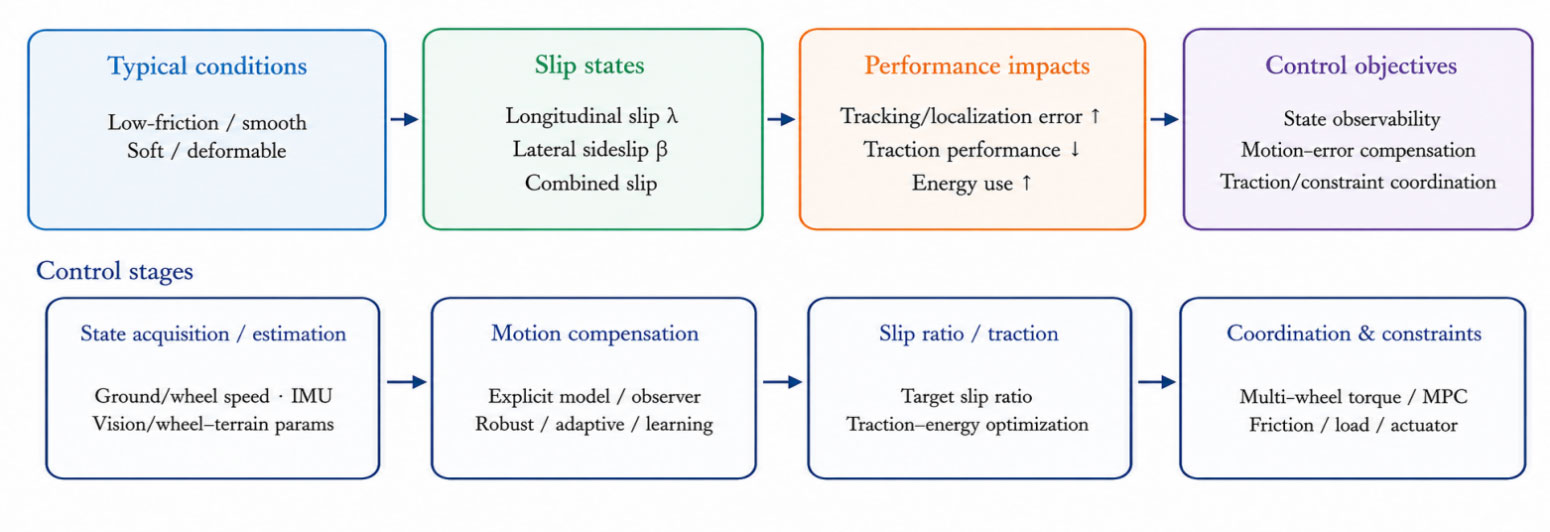
Wheeled mobile robots are prone to longitudinal slip, lateral sideslip, and combined slip when operating on wet, soft, and unstructured terrain, which degrades localization accuracy, trajectory tracking, traction performance, and energy consumption. Based on 36 studies, this paper reviews slip modeling and state estimation, trajectory compensation, slip-ratio and traction control, multi-wheel slip coordination and torque allocation, and integrated multi-constraint control. The methods are compared in terms of technological evolution, control objectives, applicable operating conditions, validation levels, and representative experimental results. Existing studies still face challenges in modeling combined slip, reliable state identification under abrupt terrain changes, and standardized cross-platform real-world evaluation. Future research should further integrate multi-source sensing, online identification, and hierarchical coordinated control to improve adaptability to complex terrain and engineering applicability.
Graphical Abstract
Keywords
Data Availability Statement
Funding
Conflicts of Interest
AI Use Statement
Ethical Approval and Consent to Participate
References
- Wang, D., & Low, C. B. (2008). Modeling and analysis of skidding and slipping in wheeled mobile robots: Control design perspective. IEEE Transactions on robotics, 24(3), 676-687.
[CrossRef] [Google Scholar] - Hà, V. T., Thuong, T. T., Thanh, N. T., & Vinh, V. Q. (2024, January). Research on some control algorithms to compensate for the negative effects of model uncertainty parameters, external interference, and wheeled slip for mobile robot. In Actuators (Vol. 13, No. 1, p. 31). MDPI.
[CrossRef] [Google Scholar] - Teji, M. D., Zou, T., & Zeleke, D. S. (2023). A survey of off-road mobile robots: Slippage estimation, robot control, and sensing technology. Journal of Intelligent & Robotic Systems, 109(2), 38.
[CrossRef] [Google Scholar] - Pavlov, C., & Johnson, A. M. (2024). A terramechanics model for high slip angle and skid with prediction of wheel-soil interaction geometry. Journal of Terramechanics, 111, 9-19.
[CrossRef] [Google Scholar] - Alipour, K., Robat, A. B., & Tarvirdizadeh, B. (2019). Dynamics modeling and sliding mode control of tractor-trailer wheeled mobile robots subject to wheels slip. Mechanism and Machine Theory, 138, 16-37.
[CrossRef] [Google Scholar] - Kim, C. H., & Cho, D. I. (2023). DNN-based slip ratio estimator for lugged-wheel robot localization in rough deformable terrains. IEEE Access, 11, 53468-53484.
[CrossRef] [Google Scholar] - Qin, B., Yan, H., Hu, X., Tian, Y., & Yang, S. X. (2024). Enhanced extended state observer based prescribed time tracking control of wheeled mobile robot with slipping and skidding. International Journal of Robust and Nonlinear Control, 34(11), 7314-7331.
[CrossRef] [Google Scholar] - Low, C. B., & Wang, D. (2010). Maneuverability and path following control of wheeled mobile robot in the presence of wheel skidding and slipping. Journal of Field Robotics, 27(2), 127-144.
[CrossRef] [Google Scholar] - Cui, M., Huang, R., Liu, H., Liu, X., & Sun, D. (2014). Adaptive tracking control of wheeled mobile robots with unknown longitudinal and lateral slipping parameters. Nonlinear Dynamics, 78(3), 1811-1826.
[CrossRef] [Google Scholar] - Liu, K., Ji, H., & Zhang, Y. (2019). Extended state observer based adaptive sliding mode tracking control of wheeled mobile robot with input saturation and uncertainties. Proceedings of the Institution of Mechanical Engineers, Part C: Journal of Mechanical Engineering Science, 233(15), 5460-5476.
[CrossRef] [Google Scholar] - Korayem, M. H., Safarbali, M., & Lademakhi, N. Y. (2024). Adaptive robust control with slipping parameters estimation based on intelligent learning for wheeled mobile robot. ISA transactions, 147, 577-589.
[CrossRef] [Google Scholar] - Gao, H., Xia, K., Ding, L., Deng, Z., Liu, Z., & Liu, G. (2015). Optimized control for longitudinal slip ratio with reduced energy consumption. Acta Astronautica, 115, 1-17.
[CrossRef] [Google Scholar] - Kim, J., & Lee, J. (2018). Traction-energy balancing adaptive control with slip optimization for wheeled robots on rough terrain. Cognitive systems research, 49, 142-156.
[CrossRef] [Google Scholar] - Kobelski, A., Osinenko, P., & Streif, S. (2021). Experimental verification of an online traction parameter identification method. Control Engineering Practice, 113, 104837.
[CrossRef] [Google Scholar] - Korayem, M. H., Namdarpour, F., & Lademakhi, N. Y. (2025). Hybrid stable adaptive control approach for navigation of nonholonomic wheeled mobile robots on slippery surfaces with obstacles. International Journal of Control, Automation and Systems, 23(5), 1542-1550.
[CrossRef] [Google Scholar] - Seo, D., Moon, S., & Kang, J. (2026). Unified motion control of 4WIS-4WID WMR with unlimited steering and load transfer consideration. Robotics and Autonomous Systems, 105341.
[CrossRef] [Google Scholar] - Bei, X., Ping, X., & Gao, W. (2018). Trajectory tracking control of wheeled mobile robots under longitudinal slipping conditions. China Mechanical Engineering, 29(16), 1958-1964. https://www.cmemo.org.cn/EN/abstract/abstract7202.shtml
[Google Scholar] - Li, B., Liu, H., Ahn, C. K., Wang, C., & Zhu, X. (2024). Fixed-time tracking control of wheel mobile robot in slipping and skidding conditions. IEEE/ASME Transactions on Mechatronics, 30(3), 1865-1875.
[CrossRef] [Google Scholar] - Peng, J., Xiao, H., & Lai, G. (2024). Nonlinear disturbance observer incorporated model predictive strategy for wheeled mobile robot's trajectory tracking control. International Journal of Control, Automation and Systems, 22(7), 2251-2262.
[CrossRef] [Google Scholar] - Liu, X., Zhu, H., Shan, Z., & Su, C. (2024). Active disturbance rejection control for target tracking of wheeled mobile robot based on hyperbolic-tangent line-of-sight guidance. Chinese Journal of Scientific Instrument, 45(12), 201-209.
[CrossRef] [Google Scholar] - Ryu, J. C., & Agrawal, S. K. (2011). Differential flatness-based robust control of mobile robots in the presence of slip. The International Journal of Robotics Research, 30(4), 463-475.
[CrossRef] [Google Scholar] - Chen, M. (2016). Disturbance attenuation tracking control for wheeled mobile robots with skidding and slipping. IEEE Transactions on Industrial Electronics, 64(4), 3359-3368.
[CrossRef] [Google Scholar] - https://xuebao.neu.edu.cn/natural/EN/Y2024/V45/I6/858
[Google Scholar] - Bai, J., Liu, C., Zhou, S., Chen, Y., & Li, X. (2025). Trajectory tracking control for wheeled mobile robot subject to slipping and skidding. Neurocomputing, 638, 130203.
[CrossRef] [Google Scholar] - Bai, J., Ren, M., Li, J., & Chen, Y. (2025). Trajectory tracking control for wheeled mobile robots subject to longitudinal slippage. Asian Journal of Control, 27(5), 2576-2587.
[CrossRef] [Google Scholar] - Li, Z., Guo, J., Wang, T., Xiong, X., Feng, Y., & Li, X. (2025). Trajectory tracking control for wheeled mobile robots with unknown slip rates based on improved rapid variable exponential reaching law and sliding mode observer. Machines, 13(9), 765. https://xuebao.neu.edu.cn/natural/EN/abstract/abstract12391.shtml
[Google Scholar] - Park, B. S., Yoo, S. J., Park, J. B., & Choi, Y. H. (2009). Adaptive neural sliding mode control of nonholonomic wheeled mobile robots with model uncertainty. IEEE Transactions on Control Systems Technology, 17(1), 207-214.
[CrossRef] [Google Scholar] - Zhu, C., Li, B., Zhao, C., & Wang, Y. (2024). Trajectory tracking control of car-like mobile robots based on extended state observer and backstepping control. Electronics, 13(8), 1563.
[CrossRef] [Google Scholar] - Trojnacki, M. (2025). Tracking control of a four-wheeled skid-steered robot with slip compensation and application of the drive unit model. Electronics, 14(3), 444.
[CrossRef] [Google Scholar] - Gao, H., Chen, C., Ding, L., Li, W., Yu, H., Xia, K., & Liu, Z. (2017). Tracking control of WMRs on loose soil based on mixed H$_2$/H$_\infty$ control with longitudinal slip ratio estimation. Acta Astronautica, 140, 49-58.
[CrossRef] [Google Scholar] - Ding, L., Gao, H., Deng, Z., & Liu, Z. (2010, October). Slip-ratio-coordinated control of planetary exploration robots traversing over deformable rough terrain. In 2010 IEEE/RSJ international conference on intelligent robots and systems (pp. 4958-4963). IEEE.
[CrossRef] [Google Scholar] - Degel, W., Lupberger, S., Odenthal, D., & Bajcinca, N. (2022). Scalable slip control with torque vectoring including input-to-state stability analysis. IEEE Transactions on Control Systems Technology, 31(3), 1250-1265.
[CrossRef] [Google Scholar] - Wang, L., Wang, S., & Wang, J. (2024). Coordinated torque control for enhanced steering and stability of independently driven mobile robots. Industrial Robot: the international journal of robotics research and application, 51(4), 658-670.
[CrossRef] [Google Scholar] - Korayem, M. H., Namdarpour, F., & Lademakhi, N. Y. (2024). Superiority of model predictive control with robust and stable approach for sliding wheeled mobile systems in the presence of obstacles. Optimal Control Applications and Methods, 45(4), 1503-1523.
[CrossRef] [Google Scholar] - Wang, M., Chen, H., Chen, Y., Cao, Y., & Hou, L. (2024). Trajectory tracking control of wheeled mobile robots with skidding and time-varying delay. Transactions of the Institute of Measurement and Control, 46(13), 2636-2646.
[CrossRef] [Google Scholar] - Azimi, A., Amjadifard, R., & Ghasemzadeh, A. (2024, May). Control of a Wheeled Robot in the Presence of Wheels Sliding Using Robust Adaptive Control in Differential Game Format. In 2024 32nd International Conference on Electrical Engineering (ICEE) (pp. 1-6). IEEE.
[CrossRef] [Google Scholar]
Cite This Article
TY  - JOUR
AU  - Yang, Shiteng
PY  - 2026
DA  - 2026/09/25
TI  - A Review of Wheel-Slip Control Algorithms for Wheeled Mobile Robots
JO  - ICCK Transactions on Intelligent Cyber-Physical Systems
T2  - ICCK Transactions on Intelligent Cyber-Physical Systems
JF  - ICCK Transactions on Intelligent Cyber-Physical Systems
VL  - 1
IS  - 3
SP  - 113
EP  - 120
DO  - 10.62762/TICPS.2026.133355
UR  - https://www.icck.org/article/abs/TICPS.2026.133355
KW  - wheeled mobile robot
KW  - wheel slip
KW  - trajectory tracking
KW  - slip-ratio control
AB  - Wheeled mobile robots are prone to longitudinal slip, lateral sideslip, and combined slip when operating on wet, soft, and unstructured terrain, which degrades localization accuracy, trajectory tracking, traction performance, and energy consumption. Based on 36 studies, this paper reviews slip modeling and state estimation, trajectory compensation, slip-ratio and traction control, multi-wheel slip coordination and torque allocation, and integrated multi-constraint control. The methods are compared in terms of technological evolution, control objectives, applicable operating conditions, validation levels, and representative experimental results. Existing studies still face challenges in modeling combined slip, reliable state identification under abrupt terrain changes, and standardized cross-platform real-world evaluation. Future research should further integrate multi-source sensing, online identification, and hierarchical coordinated control to improve adaptability to complex terrain and engineering applicability.
SN  - 3071-2947
PB  - Institute of Central Computation and Knowledge
LA  - English
ER  -
@article{Yang2026A,
  author = {Shiteng Yang},
  title = {A Review of Wheel-Slip Control Algorithms for Wheeled Mobile Robots},
  journal = {ICCK Transactions on Intelligent Cyber-Physical Systems},
  year = {2026},
  volume = {1},
  number = {3},
  pages = {113-120},
  doi = {10.62762/TICPS.2026.133355},
  url = {https://www.icck.org/article/abs/TICPS.2026.133355},
  abstract = {Wheeled mobile robots are prone to longitudinal slip, lateral sideslip, and combined slip when operating on wet, soft, and unstructured terrain, which degrades localization accuracy, trajectory tracking, traction performance, and energy consumption. Based on 36 studies, this paper reviews slip modeling and state estimation, trajectory compensation, slip-ratio and traction control, multi-wheel slip coordination and torque allocation, and integrated multi-constraint control. The methods are compared in terms of technological evolution, control objectives, applicable operating conditions, validation levels, and representative experimental results. Existing studies still face challenges in modeling combined slip, reliable state identification under abrupt terrain changes, and standardized cross-platform real-world evaluation. Future research should further integrate multi-source sensing, online identification, and hierarchical coordinated control to improve adaptability to complex terrain and engineering applicability.},
  keywords = {wheeled mobile robot, wheel slip, trajectory tracking, slip-ratio control},
  issn = {3071-2947},
  publisher = {Institute of Central Computation and Knowledge}
}
Article Metrics
Publisher's Note
ICCK stays neutral with regard to jurisdictional claims in published maps and institutional affiliations.
Rights and Permissions


Portico
