

ISSN: 3071-2947
ICCK Transactions on Intelligent Cyber-Physical Systems publishes high-quality, original research and review articles that advance the theory, technology, and application of intelligent cyber-physical systems (CPS).
DOI Prefix: 10.62762/TICPS

Journal Metrics

-
Impact Factor
-
CiteScore

Recent Articles

Open Access | Research Article | 09 September 2026
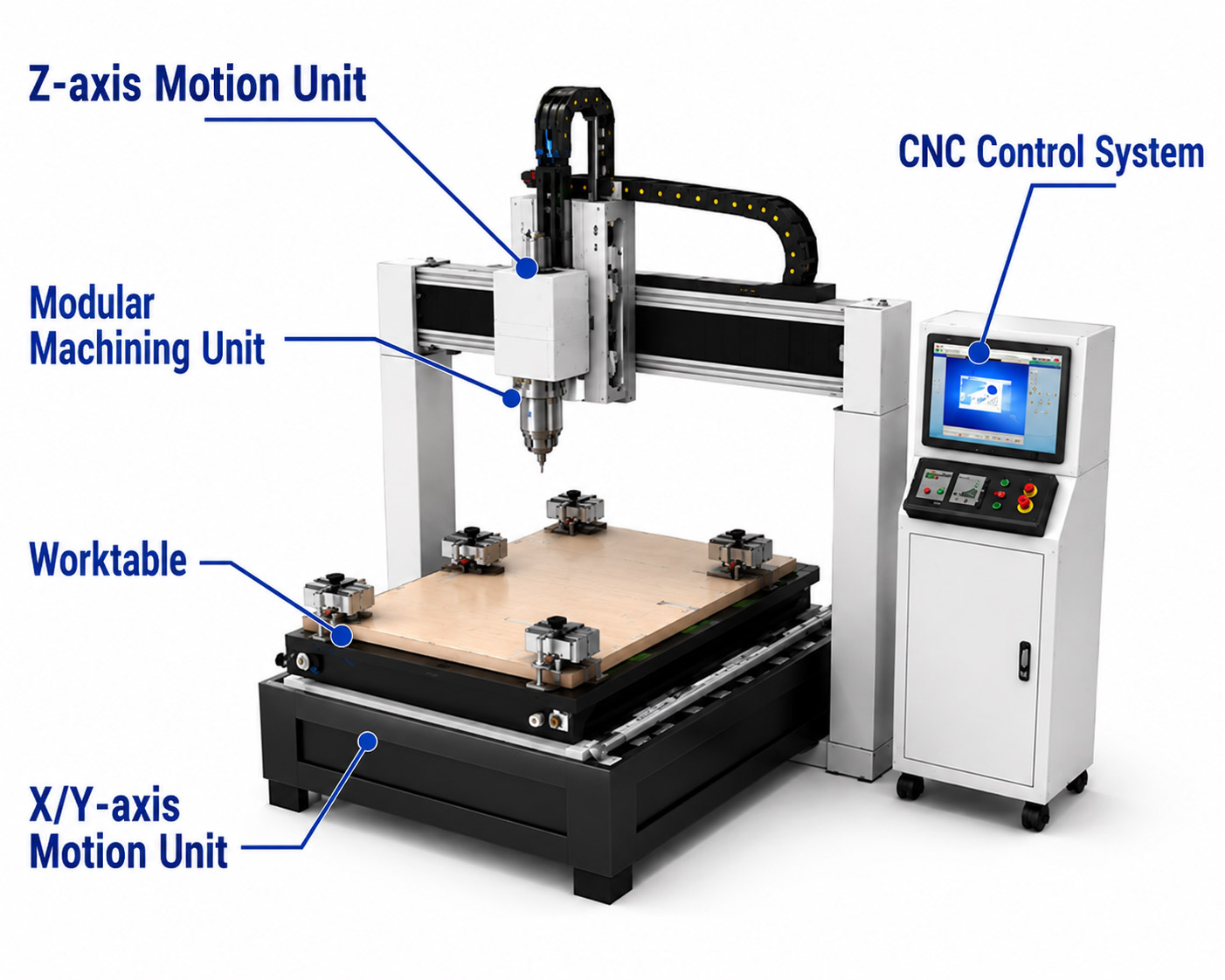
Design and Performance Evaluation of Flexible CNC Machining Equipment for Panel Furniture Manufacturing
ICCK Transactions on Intelligent Cyber-Physical Systems | Volume 1, Issue 3: 86-92, 2026 | DOI: 10.62762/TICPS.2026.403794
Abstract
A flexible CNC machining system is developed for panel furniture manufacturing to improve equipment adaptability and reduce non-machining time in customized production. The proposed system integrates a modular machining structure, multi-axis motion platform, automatic positioning fixtures, and a digital control system to enable flexible drilling and grooving operations. A machining path optimization strategy is introduced to reduce unnecessary tool movements. Experiments on medium-density fiberboard (MDF) panels demonstrate that the optimized method reduces machining time from 986~s to 654~s for 20 machining tasks and from 1248~s to 812~s for 25 tasks. The proposed equipment achieves a posit... More >

Graphical Abstract
Design and Performance Evaluation of Flexible CNC Machining Equipment for Panel Furniture Manufacturing
Free Access | Perspective | 29 June 2026
Digital Twin Production Lines: A Perspective on Intelligent Sensing, Prediction, and Cognitive Manufacturing
ICCK Transactions on Intelligent Cyber-Physical Systems | Volume 1, Issue 2: 83-85, 2026 | DOI: 10.62762/TICPS.2026.636441
Abstract
Digital twin (DT) technology has evolved beyond static physical mapping into a dynamic intelligence layer for smart manufacturing. We argue that three capabilities are now decisive for advancing DT production lines in complex industrial environments: data-driven quality correction through nonlinear feature learning, real-time edge vision for surface defect sensing, and deep time-series modeling for predictive maintenance. We further contend that the next inflection point lies not in individual algorithmic improvements, but in the cognitive integration of structured engineering knowledge-such as Manufacturer Knowledge Packages (MKP) and the Theory of Inventive Problem Solving (TRIZ)-with gene... More >
Free Access | Review Article | 27 June 2026
A Review of Dynamic Resource Allocation Techniques for Integrated Sensing, Communication, and Computing Networks Based on Deep Reinforcement Learning
ICCK Transactions on Intelligent Cyber-Physical Systems | Volume 1, Issue 2: 76-82, 2026 | DOI: 10.62762/TICPS.2026.591816
Abstract
The integrated sensing, communication, and computing (ISCC) network, as a core direction of the sixth-generation mobile communication system, provides a key enabling technology for efficient collaboration in future intelligent networks by deeply integrating communication, sensing, and computing capabilities. However, the dynamic management and joint optimization of multi-dimensional heterogeneous resources in ISCC networks face severe challenges such as high-dimensional state spaces, tightly coupled constraints, and time-varying environments. Traditional optimization methods struggle to achieve both real-time performance and optimality. Deep reinforcement learning (DRL), with its end-to-end... More >
Free Access | Review Article | 19 June 2026
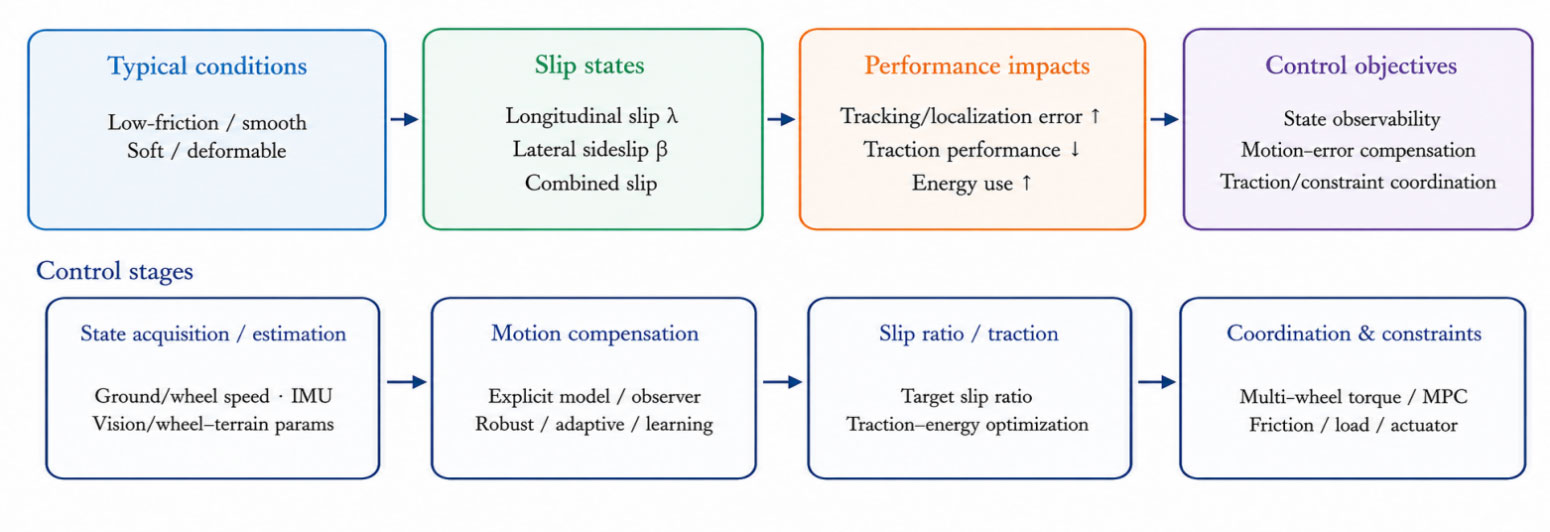
A Mini Review of Control Technologies for Wheeled Mobile Robots Under Different Operating Conditions
ICCK Transactions on Intelligent Cyber-Physical Systems | Volume 1, Issue 2: 72-75, 2026 | DOI: 10.62762/TICPS.2026.507420
Abstract
Wheeled mobile robots are widely used in intelligent logistics, unmanned delivery, industrial inspection, service robots, and other fields due to their simple structure, flexible mobility, and low energy consumption. However, during actual operation, robots often encounter complex operating conditions such as tire slip, model uncertainty, input saturation, and external disturbances, which can lead to reduced trajectory tracking accuracy or even system instability. In recent years, scholars in China and abroad have proposed numerous advanced control methods for the control problems of wheeled robots under different operating conditions, including sliding mode control, disturbance observer-bas... More >
Free Access | Review Article | 12 June 2026
Current Status and Trend Analysis of Motor Fault Diagnosis
ICCK Transactions on Intelligent Cyber-Physical Systems | Volume 1, Issue 2: 66-71, 2026 | DOI: 10.62762/TICPS.2026.215789
Abstract
As the core power equipment and primary load in power systems, electric motors are involved throughout the entire power generation, transmission, substation, and distribution processes. Their operational reliability directly determines the safety and stability of the power grid. This paper provides a systematic analysis of the current status and future trends in motor fault diagnosis. Specifically, it summarizes the three mainstream approaches currently used in motor fault diagnosis: model-based methods, signal processing-based methods, and artificial intelligence-based methods, while highlighting the respective advantages and application limitations of each approach. The analysis reveals th... More >
Free Access | Review Article | 07 June 2026
A Review on Embedded Arduino-Based Visual Robotic Arm Grasping and SLAM Navigation
ICCK Transactions on Intelligent Cyber-Physical Systems | Volume 1, Issue 2: 60-65, 2026 | DOI: 10.62762/TICPS.2026.578769
Abstract
With the development of desktop robotic arms towards low cost, lightweight and intelligence, the embedded Arduino vision-based robotic arm grasping technology has become a research hotspot. This paper reviews the current research status of the robotic arm vision grasping technology and embedded SLAM navigation with Arduino as the lower computer. Firstly, the embedded Arduino vision-based robotic arm grasping is introduced, and the system architecture, mainstream kinematic modeling methods, visual calibration, pose estimation, dynamic analysis and stability, and trajectory planning processes are sorted out in sequence. Then, the shortcomings of the system in terms of adaptability to complex e... More >
Free Access | Research Article | 19 February 2026 | Cited: Scopus 1
Design and Kinematic Simulation Analysis of a Vision-Guided 5-DOF Robotic Arm System
ICCK Transactions on Intelligent Cyber-Physical Systems | Volume 1, Issue 1: 51-59, 2026 | DOI: 10.62762/TICPS.2026.895157
Abstract
Traditional teach-and-repeat robotic arms, which rely on pre-programmed trajectories and manual teaching, struggle to adapt to operational requirements in unstructured environments where the position, posture, or type of target objects may vary unpredictably. In contrast, robot control technology based on visual servoing empowers robotic arms with "visual perception" capabilities, enabling real-time environment sensing and dynamic action adjustment, which significantly enhances the flexibility and efficiency of sorting and assembly operations. This paper designs and implements a five-degree-of-freedom (5-DOF) vision-guided picking robotic arm system based on a distributed control architectur... More >

Graphical Abstract
Design and Kinematic Simulation Analysis of a Vision-Guided 5-DOF Robotic Arm System
Free Access | Research Article | 17 February 2026
A Multi-Dimensional Data Learning-Based Production Quality Management Method for Intelligent Manufacturing
ICCK Transactions on Intelligent Cyber-Physical Systems | Volume 1, Issue 1: 38-50, 2026 | DOI: 10.62762/TICPS.2026.380630
Abstract
In the field of high-end precision manufacturing, quality control in production processes has long been challenged by both spatiotemporal data sparsity and error lag. Traditional offline sampling methods struggle to capture the dynamic fluctuations in production, while single-dimensional feedback controls fall short in addressing the nonlinear coupling between multi-dimensional process parameters and final product quality. To address these challenges, this paper proposes a production quality management system based on multi-dimensional data learning and an active error elimination method. First, to tackle the issue of sparse sampling, an Adaptive Gaussian Process Regression (AGPR) algorithm... More >

Graphical Abstract
A Multi-Dimensional Data Learning-Based Production Quality Management Method for Intelligent Manufacturing

Journal Statistics

23
Authors
1
Countries / Regions
11
Articles
1
Scopus Citations
9.1% Cited
2025
Published Since
9,553
Article Views
2,251
Article Downloads
ICCK Transactions on Intelligent Cyber-Physical Systems
eISSN: 3071-2947
Crossref
Crossref
Member of Crossref
Visit Crossref →