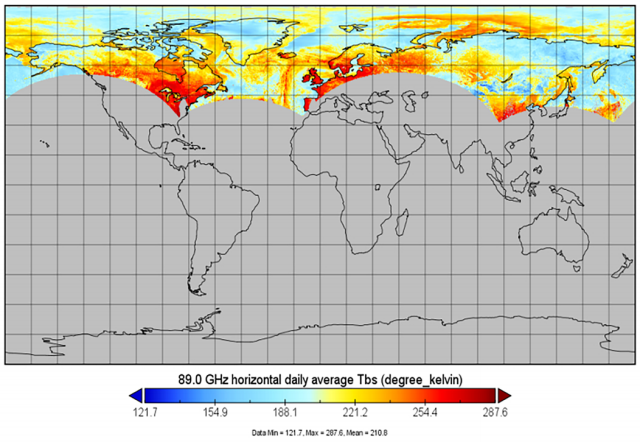
Detection of Arctic Sea Ice Using 89 GHz Microwave Radiometer Channels
Research Article  ·  Published: 07 April 2024
Issue cover
ICCK Transactions on Internet of Things
Volume 2, Issue 2, 2024: 36-43
Research Article Free to Read

Detection of Arctic Sea Ice Using 89 GHz Microwave Radiometer Channels

1 College of Information Science and Engineering, Henan University of Technology, Zhengzhou 450001, China
Corresponding Author: Yue Zhao, [email protected]
Volume 2, Issue 2

Article Information

Abstract

Sea ice is a crucial component of the cryosphere, and extensive research has been conducted on sea ice using microwave remote sensing due to its robustness against cloud cover and illumination variations. This paper focuses on classifying Arctic sea ice based on microwave remote sensing data. Leveraging the high stability of microwave radiometers, we analyze the characteristics of different sea ice types across the Arctic region in January 2017 using high-resolution AMSR-E/AMSR2 data at the 89 GHz frequency band. Data at this frequency are less susceptible to cloud and water vapor interference, while lower frequency bands have traditionally been more commonly used in similar studies. However, our study emphasizes the significance of the 89 GHz frequency band, which offers high-resolution data for distinguishing between multi-year ice, first-year ice, and open water. The brightness temperature differences among these sea ice types are analyzed, and a method based on these differences is proposed for classification. The fine tree algorithm in MATLAB’s decision tree toolbox is employed to generate the classification results.

Graphical Abstract

Detection of Arctic Sea Ice Using 89 GHz Microwave Radiometer Channels

Keywords

Sea ice classification Arctic Microwave remote sensing Decision tree

Funding

This work was supported without any funding.

References

  1. Cavalieri, D. J. (1994). A microwave technique for mapping thin sea ice. Journal of Geophysical Research: Oceans, 99(C6), 12561-12572.
    [Google Scholar]
  2. Cavalieri, D. J., Gloersen, P., & Campbell, W. J. (1984). Determination of sea ice parameters with the Nimbus 7 SMMR. Journal of Geophysical Research: Atmospheres, 89(D4), 5355-5369.
    [Google Scholar]
  3. Cavalieri, D. J., & Parkinson, C. L. (2012). Arctic sea ice variability and trends, 1979–2010. The Cryosphere, 6(4), 881-889.
    [Google Scholar]
  4. Comiso, J. C., & Nishio, F. (2008). Trends in the sea ice cover using enhanced and compatible AMSR-E, SSM/I, and SMMR data. Journal of Geophysical Research: Oceans, 113(C2).
    [Google Scholar]
  5. Comiso, J. C. (1986). Characteristics of Arctic winter sea ice from satellite multispectral microwave observations. Journal of Geophysical Research: Oceans, 91(C1), 975-994.
    [Google Scholar]
  6. Ulaby, F. T., Kouyate, F., Brisco, B., & Williams, T. L. (1986). Textural infornation in SAR images. IEEE Transactions on Geoscience and Remote Sensing, (2), 235-245.
    [Google Scholar]
  7. Soh, L. K., Tsatsoulis, C., Gineris, D., & Bertoia, C. (2004). ARKTOS: An intelligent system for SAR sea ice image classification. IEEE Transactions on geoscience and remote sensing, 42(1), 229-248.
    [Google Scholar]
  8. Ressel, R., Frost, A., & Lehner, S. (2015). A neural network-based classification for sea ice types on X-band SAR images. IEEE Journal of Selected Topics in Applied Earth Observations and Remote Sensing, 8(7), 3672-3680.
    [Google Scholar]
  9. Cavalieri, D. J., Parkinson, C. L., Gloersen, P., Comiso, J. C., & Zwally, H. J. (1999). Deriving long-term time series of sea ice cover from satellite passive-microwave multisensor data sets. Journal of Geophysical Research: Oceans, 104(C7), 15803-15814.
    [Google Scholar]
  10. Nghiem, S. V., Steffen, K., Kwok, R., & Tsai, W. Y. (2001). Detection of snowmelt regions on the Greenland ice sheet using diurnal backscatter change. Journal of Glaciology, 47(159), 539-547.
    [Google Scholar]
  11. Gough, S. R. (1972). A low temperature dielectric cell and the permittivity of hexagonal ice to 2 K. Canadian Journal of Chemistry, 50(18), 3046-3051.
    [Google Scholar]
  12. Li, Y., & Cao, J. (2023). Adaptive Binary Particle Swarm Optimization for WSN Node Optimal Deployment Algorithm. IECE Transactions on Internet of Things, 1(1), 1-8.
    [Google Scholar]
  13. Fang, F. A. N. G., Tan, W., & Liu, J. Z. (2005). Tuning of coordinated controllers for boiler-turbine units. Acta Automatica Sinica, 31(2), 291-296.
    [Google Scholar]
  14. Wang, N., Fang, F., & Feng, M. (2014, May). Multi-objective optimal analysis of comfort and energy management for intelligent buildings. In The 26th Chinese control and decision conference (2014 CCDC) (pp. 2783-2788). IEEE.
    [Google Scholar]
  15. Fang, F., Jizhen, L., & Wen, T. (2004). Nonlinear internal model control for the boiler-turbine coordinate systems of power unit. PROCEEDINGS-CHINESE SOCIETY OF ELECTRICAL ENGINEERING, 24(4), 195-199.
    [Google Scholar]

Cite This Article

APA Style
Zhao, Y., Wang, X., & Luo, C. (2024). Arctic Sea Ice Detection based on Microwave Radiometer in 89 GHz Channels. ICCK Transactions on Internet of Things, 1(1), 36–43 https://doi.org/10.62762/TIOT.2024.528361
Export Citation
RIS Format
Compatible with EndNote, Zotero, Mendeley, and other reference managers
TY  - JOUR
AU  - Zhao, Yue
AU  - Wang, Xingdong
AU  - Luo, Changfeng
PY  - 2024
DA  - 2024/04/07
TI  - Detection of Arctic Sea Ice Using 89 GHz Microwave Radiometer Channels
JO  - ICCK Transactions on Internet of Things
T2  - ICCK Transactions on Internet of Things
JF  - ICCK Transactions on Internet of Things
VL  - 2
IS  - 2
SP  - 36
EP  - 43
DO  - 10.62762/TIOT.2024.528361
UR  - https://www.icck.org/article/abs/TIOT.2024.528361
KW  - Sea ice classification
KW  - Arctic
KW  - Microwave remote sensing
KW  - Decision tree
AB  - Sea ice is a crucial component of the cryosphere, and extensive research has been conducted on sea ice using microwave remote sensing due to its robustness against cloud cover and illumination variations. This paper focuses on classifying Arctic sea ice based on microwave remote sensing data. Leveraging the high stability of microwave radiometers, we analyze the characteristics of different sea ice types across the Arctic region in January 2017 using high-resolution AMSR-E/AMSR2 data at the 89 GHz frequency band. Data at this frequency are less susceptible to cloud and water vapor interference, while lower frequency bands have traditionally been more commonly used in similar studies. However, our study emphasizes the significance of the 89 GHz frequency band, which offers high-resolution data for distinguishing between multi-year ice, first-year ice, and open water. The brightness temperature differences among these sea ice types are analyzed, and a method based on these differences is proposed for classification. The fine tree algorithm in MATLAB’s decision tree toolbox is employed to generate the classification results.
SN  - pending
PB  - Institute of Central Computation and Knowledge
LA  - English
ER  - 
BibTeX Format
Compatible with LaTeX, BibTeX, and other reference managers
@article{Zhao2024Detection,
  author = {Yue Zhao and Xingdong Wang and Changfeng Luo},
  title = {Detection of Arctic Sea Ice Using 89 GHz Microwave Radiometer Channels},
  journal = {ICCK Transactions on Internet of Things},
  year = {2024},
  volume = {2},
  number = {2},
  pages = {36-43},
  doi = {10.62762/TIOT.2024.528361},
  url = {https://www.icck.org/article/abs/TIOT.2024.528361},
  abstract = {Sea ice is a crucial component of the cryosphere, and extensive research has been conducted on sea ice using microwave remote sensing due to its robustness against cloud cover and illumination variations. This paper focuses on classifying Arctic sea ice based on microwave remote sensing data. Leveraging the high stability of microwave radiometers, we analyze the characteristics of different sea ice types across the Arctic region in January 2017 using high-resolution AMSR-E/AMSR2 data at the 89 GHz frequency band. Data at this frequency are less susceptible to cloud and water vapor interference, while lower frequency bands have traditionally been more commonly used in similar studies. However, our study emphasizes the significance of the 89 GHz frequency band, which offers high-resolution data for distinguishing between multi-year ice, first-year ice, and open water. The brightness temperature differences among these sea ice types are analyzed, and a method based on these differences is proposed for classification. The fine tree algorithm in MATLAB’s decision tree toolbox is employed to generate the classification results.},
  keywords = {Sea ice classification, Arctic, Microwave remote sensing, Decision tree},
  issn = {pending},
  publisher = {Institute of Central Computation and Knowledge}
}

Article Metrics

Citations
Google Scholar
0
Crossref
0
Scopus
0
Web of Science
0
Views
2949
PDF Downloads
553

Publisher's Note

ICCK stays neutral with regard to jurisdictional claims in published maps and institutional affiliations.

Rights and Permissions

Institute of Central Computation and Knowledge (ICCK) or its licensor holds exclusive rights to this article under a publishing agreement with the author(s) or other rightsholder(s); author self-archiving of the accepted manuscript version of this article is solely governed by the terms of such publishing agreement and applicable law.
ICCK Transactions on Internet of Things
ISSN: pending (Online)
Portico
Preserved at
Portico