

Discretized Holonomy as an Encoding Primitive for Quantum Cryptography



Article Information
Abstract
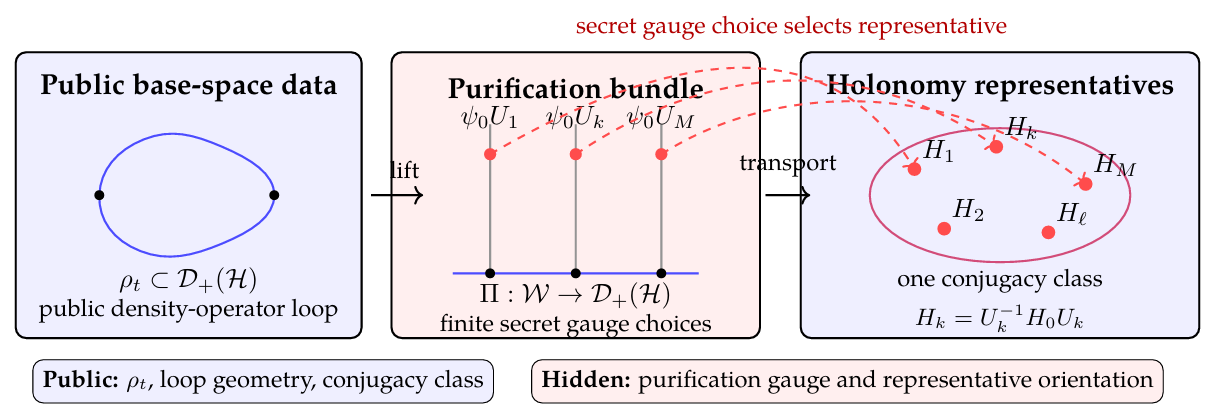
Geometric phases in quantum systems give rise to holonomies associated with cyclic evolution. In mixed-state settings, these holonomies arise from Uhlmann parallel transport on the purification bundle of density operators and depend on the global geometry of density-operator trajectories. In this work we introduce discretized mixed-state holonomy as a geometric encoding primitive. The public object is a density-operator trajectory, while the encoded information resides in a finite family of purification gauges associated with the same holonomy conjugacy class. By discretizing the gauge freedom of the purification bundle, continuous mixed-state holonomy is converted into finite alphabets suitable for discrete key spaces. We formalize the resulting primitive through an operational observation model and establish several structural properties. First, the holonomy representative cannot in general be reconstructed from the density-operator trajectory alone. Second, under conjugation-invariant observation channels, different encoded symbols are indistinguishable at the level of base-space observables. Third, discretized holonomy alphabets admit stable decoding under bounded perturbations of the underlying trajectory. The construction is illustrated through explicit qubit realizations based on isospectral mixed-state loops, together with representative-level decoding mechanisms and finite holonomy alphabets. We further discuss symmetry breaking, frame leakage, and limitations arising in realistic implementations. These results isolate a primitive-level geometric encoding mechanism based on mixed-state quantum geometry and provide a structural foundation for future cryptographic constructions involving representative-level holonomy information.
Graphical Abstract
Keywords
Data Availability Statement
Funding
Conflicts of Interest
AI Use Statement
Ethical Approval and Consent to Participate
References
- El Morsalani, M. (2026). Secret Holonomy and Public Geometry in Mixed-State Quantum Information. Journal of Quantum Cryptography, 1 (1), 35-54.
[CrossRef] [Google Scholar] - Berry, M. V. (1984). Quantal phase factors accompanying adiabatic changes. Proceedings of the Royal Society of London. Series A, Mathematical and Physical Sciences, 392 (1802), 45-57.
[CrossRef] [Google Scholar] - Wilczek, F., & Zee, A. (1984). Appearance of gauge structure in simple dynamical systems. Physical Review Letters, 52 (24), 2111-2114.
[CrossRef] [Google Scholar] - Uhlmann, A. (1986). Parallel transport and ``quantum holonomy'' along density operators. Reports on Mathematical Physics, 24 (2), 229-240.
[CrossRef] [Google Scholar] - Uhlmann, A. (1992). The metric of Bures and the geometric phase. In R. Gielerak, J. Lukierski, & Z. Popowicz (Eds.), Quantum Groups and Related Topics , pp. 267-274. Springer.
[CrossRef] [Google Scholar] - Bures, D. (1969). An extension of Kakutani's theorem on infinite product measures to the tensor product of semifinite w*-algebras. Transactions of the American Mathematical Society, 135 , 199-212.
[CrossRef] [Google Scholar] - H\"{u bner, M. (1992). Explicit computation of the Bures distance for density matrices. Physics Letters A, 163 (4), 239-242.
[CrossRef] [Google Scholar] - Braunstein, S. L., & Caves, C. M. (1994). Statistical distance and the geometry of quantum states. Physical Review Letters, 72 (22), 3439-3443.
[CrossRef] [Google Scholar] - Dittmann, J. (1999). The scalar curvature of the Bures metric on the space of density matrices. Journal of Geometry and Physics, 31 (1), 16-24.
[CrossRef] [Google Scholar] - Petz, D. (1996). Monotone metrics on matrix spaces. Linear Algebra and its Applications, 244 , 81-96.
[CrossRef] [Google Scholar] - Du, J., Zou, P., Shi, M., Kwek, L. C., Pan, J. W., Oh, C. H., ... & Ericsson, M. (2003). Observation of geometric phases for mixed states using NMR interferometry. Physical review letters, 91(10), 100403.
[CrossRef] [Google Scholar] - Sj\"{o qvist, E., Pati, A. K., Ekert, A., Anandan, J. S., Ericsson, M., Oi, D. K., & Vedral, V. (2000). Geometric phases for mixed states in interferometry. Physical Review Letters, 85 (14), 2845-2848.
[CrossRef] [Google Scholar] - Andersson, O. (2019). Holonomy in quantum information geometry. arXiv preprint arXiv:1910.08140.
[CrossRef] [Google Scholar] - Zanardi, P., & Rasetti, M. (1999). Holonomic quantum computation. Physics Letters A, 264 (2-3), 94-99.
[CrossRef] [Google Scholar] - Bennett, C. H., & Brassard, G. (1984/2014). Quantum cryptography: Public key distribution and coin tossing. Originally presented at IEEE International Conference on Computers, Systems and Signal Processing , Bangalore, India, pp.\ 175-179 (1984); reprinted in Theoretical Computer Science, 560 , 7-11 (2014).
[CrossRef] [Google Scholar] - Ekert, A. K. (1991). Quantum cryptography based on Bell's theorem. Physical Review Letters, 67 (6), 661-663.
[CrossRef] [Google Scholar] - Scarani, V., Bechmann-Pasquinucci, H., Cerf, N. J., Du\v{s ek, M., L\"{u tkenhaus, N., & Peev, M. (2009). The security of practical quantum key distribution. Reviews of Modern Physics, 81 (3), 1301-1350.
[CrossRef] [Google Scholar] - Bartlett, S. D., Rudolph, T., & Spekkens, R. W. (2007). Reference frames, superselection rules, and quantum information. Reviews of Modern Physics, 79 (2), 555-609.
[CrossRef] [Google Scholar] - Gour, G., & Spekkens, R. W. (2008). The resource theory of quantum reference frames: manipulations and monotones. New Journal of Physics, 10 (3), 033023.
[CrossRef] [Google Scholar]
Cite This Article
TY  - JOUR
AU  - Morsalani, Mohamed El
PY  - 2026
DA  - 2026/08/18
TI  - Discretized Holonomy as an Encoding Primitive for Quantum Cryptography
JO  - ICCK Transactions on Information Security and Cryptography
T2  - ICCK Transactions on Information Security and Cryptography
JF  - ICCK Transactions on Information Security and Cryptography
VL  - 2
IS  - 3
SP  - 119
EP  - 135
DO  - 10.62762/TISC.2026.243476
UR  - https://www.icck.org/article/abs/TISC.2026.243476
KW  - mixed-state holonomy
KW  - uhlmann holonomy
KW  - quantum information geometry
KW  - bures geometry
KW  - geometric encoding primitive
KW  - quantum cryptography
AB  - Geometric phases in quantum systems give rise to holonomies associated with cyclic evolution. In mixed-state settings, these holonomies arise from Uhlmann parallel transport on the purification bundle of density operators and depend on the global geometry of density-operator trajectories. In this work we introduce discretized mixed-state holonomy as a geometric encoding primitive. The public object is a density-operator trajectory, while the encoded information resides in a finite family of purification gauges associated with the same holonomy conjugacy class. By discretizing the gauge freedom of the purification bundle, continuous mixed-state holonomy is converted into finite alphabets suitable for discrete key spaces. We formalize the resulting primitive through an operational observation model and establish several structural properties. First, the holonomy representative cannot in general be reconstructed from the density-operator trajectory alone. Second, under conjugation-invariant observation channels, different encoded symbols are indistinguishable at the level of base-space observables. Third, discretized holonomy alphabets admit stable decoding under bounded perturbations of the underlying trajectory. The construction is illustrated through explicit qubit realizations based on isospectral mixed-state loops, together with representative-level decoding mechanisms and finite holonomy alphabets. We further discuss symmetry breaking, frame leakage, and limitations arising in realistic implementations. These results isolate a primitive-level geometric encoding mechanism based on mixed-state quantum geometry and provide a structural foundation for future cryptographic constructions involving representative-level holonomy information.
SN  - 3070-2429
PB  - Institute of Central Computation and Knowledge
LA  - English
ER  -
@article{Morsalani2026Discretize,
  author = {Mohamed El Morsalani},
  title = {Discretized Holonomy as an Encoding Primitive for Quantum Cryptography},
  journal = {ICCK Transactions on Information Security and Cryptography},
  year = {2026},
  volume = {2},
  number = {3},
  pages = {119-135},
  doi = {10.62762/TISC.2026.243476},
  url = {https://www.icck.org/article/abs/TISC.2026.243476},
  abstract = {Geometric phases in quantum systems give rise to holonomies associated with cyclic evolution. In mixed-state settings, these holonomies arise from Uhlmann parallel transport on the purification bundle of density operators and depend on the global geometry of density-operator trajectories. In this work we introduce discretized mixed-state holonomy as a geometric encoding primitive. The public object is a density-operator trajectory, while the encoded information resides in a finite family of purification gauges associated with the same holonomy conjugacy class. By discretizing the gauge freedom of the purification bundle, continuous mixed-state holonomy is converted into finite alphabets suitable for discrete key spaces. We formalize the resulting primitive through an operational observation model and establish several structural properties. First, the holonomy representative cannot in general be reconstructed from the density-operator trajectory alone. Second, under conjugation-invariant observation channels, different encoded symbols are indistinguishable at the level of base-space observables. Third, discretized holonomy alphabets admit stable decoding under bounded perturbations of the underlying trajectory. The construction is illustrated through explicit qubit realizations based on isospectral mixed-state loops, together with representative-level decoding mechanisms and finite holonomy alphabets. We further discuss symmetry breaking, frame leakage, and limitations arising in realistic implementations. These results isolate a primitive-level geometric encoding mechanism based on mixed-state quantum geometry and provide a structural foundation for future cryptographic constructions involving representative-level holonomy information.},
  keywords = {mixed-state holonomy, uhlmann holonomy, quantum information geometry, bures geometry, geometric encoding primitive, quantum cryptography},
  issn = {3070-2429},
  publisher = {Institute of Central Computation and Knowledge}
}
Article Metrics
Publisher's Note
ICCK stays neutral with regard to jurisdictional claims in published maps and institutional affiliations.
Rights and Permissions


Portico
