Enhancing Robotic Grasp Detection with a Novel Two-Stage Approach: From Conceptualization to Implementation






Article Information
Abstract
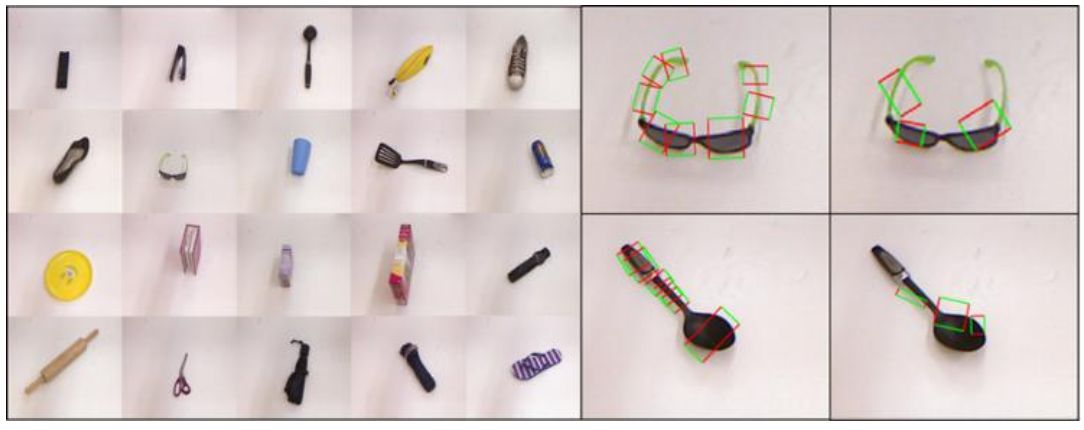
This study introduces a novel two-stage approach for robotic grasp detection, addressing the challenges faced by end-to-end deep learning methodologies, particularly those based on convolutional neural networks (CNNs) that require extensive and often impractical datasets. Our method first leverages a particle swarm optimizer (PSO) as a candidate estimator, followed by CNN-based verification to identify the most probable grasp points. This approach represents a significant advancement in the field, achieving an impressive accuracy of 92.8% on the Cornell Grasp Dataset. This positions it among the leading methods while maintaining real-time operational capability. Furthermore, with minor modifications, our technique can predict multiple grasp points per object, offering diverse grasping strategies. This adaptability and high performance suggest substantial potential for practical applications in robotic systems, enhancing their efficiency and reliability in dynamic environments.
Graphical Abstract
Keywords
Funding
References
- Lenz, I., Lee, H., & Saxena, A. (2015). Deep learning for detecting robotic grasps. The International Journal of Robotics Research, 34(4-5), 705-724.
[Google Scholar] - Asif, U., Bennamoun, M., & Sohel, F. A. (2017). RGB-D object recognition and grasp detection using hierarchical cascaded forests. IEEE Transactions on Robotics, 33(3), 547-564.
[Google Scholar] - Kumra, S., & Kanan, C. (2017, September). Robotic grasp detection using deep convolutional neural networks. In 2017 IEEE/RSJ International Conference on Intelligent Robots and Systems (IROS) (pp. 769-776).
[Google Scholar] - Redmon, J., & Angelova, A. (2015, May). Real-time grasp detection using convolutional neural networks. In 2015 IEEE International Conference on Robotics and Automation (ICRA) (pp. 1316-1322).
[Google Scholar] - Bicchi, A., & Kumar, V. (2000, April). Robotic grasping and contact: A review. In Proceedings 2000 ICRA. Millennium Conference. IEEE International Conference on Robotics and Automation. Symposia Proceedings (Cat. No. 00CH37065) (Vol. 1, pp. 348-353).
[Google Scholar] - Miller, A. T., & Allen, P. K. (2004). Graspit! a versatile simulator for robotic grasping. IEEE Robotics & Automation Magazine, 11(4), 110-122.
[Google Scholar] - Miller, A. T., Knoop, S., Christensen, H. I., & Allen, P. K. (2003, September). Automatic grasp planning using shape primitives. In 2003 IEEE International Conference on Robotics and Automation (Cat. No. 03CH37422) (Vol. 2, pp. 1824-1829).
[Google Scholar] - Pelossof, R., Miller, A., Allen, P., & Jebara, T. (2004, April). An SVM learning approach to robotic grasping. In IEEE International Conference on Robotics and Automation, 2004. Proceedings. ICRA’04. 2004 (Vol. 4, pp. 3512-3518).
[Google Scholar] - Wang, Z., Li, Z., Wang, B., & Liu, H. (2016). Robot grasp detection using multimodal deep convolutional neural networks. Advances in Mechanical Engineering, 8(9), 1687814016668077.
[Google Scholar] - Krizhevsky, A., Sutskever, I., & Hinton, G. E. (2012). Imagenet classification with deep convolutional neural networks. Advances in neural information processing systems, 25, 1097-1105.
[Google Scholar] - Jiang, Y., Moseson, S., & Saxena, A. (2011, May). Efficient grasping from rgbd images: Learning using a new rectangle representation. In 2011 IEEE International conference on robotics and automation (pp. 3304-3311).
[Google Scholar] - Guo, D., Sun, F., Liu, H., Kong, T., Fang, B., & Xi, N. (2017, May). A hybrid deep architecture for robotic grasp detection. In 2017 IEEE International Conference on Robotics and Automation (ICRA) (pp. 1609-1614).
[Google Scholar] - Wang, N., Fang, F., & Feng, M. (2014, May). Multi-objective optimal analysis of comfort and energy management for intelligent buildings. In The 26th Chinese control and decision conference (2014 CCDC) (pp. 2783-2788). IEEE.
[Google Scholar] - Fang, F., & Wu, X. (2020). A win–win mode: The complementary and coexistence of 5G networks and edge computing. IEEE Internet of Things Journal, 8(6), 3983-4003.
[Google Scholar] - Lv, Y., Fang, F. A. N. G., Yang, T., & Romero, C. E. (2020). An early fault detection method for induced draft fans based on MSET with informative memory matrix selection. ISA transactions, 102, 325-334.
[Google Scholar] - Fang, F., Jizhen, L., & Wen, T. (2004). Nonlinear internal model control for the boiler-turbine coordinate systems of power unit. PROCEEDINGS-CHINESE SOCIETY OF ELECTRICAL ENGINEERING, 24(4), 195-199.
[Google Scholar] - Fang, F. A. N. G., Tan, W., & Liu, J. Z. (2005). Tuning of coordinated controllers for boiler-turbine units. Acta Automatica Sinica, 31(2), 291-296.
[Google Scholar] - Wang, Y., Deng, J., Fang, Y., Li, H., & Li, X. (2017). Resilience-aware frequency tuning for neural-network-based approximate computing chips. IEEE Transactions on Very Large Scale Integration (VLSI) Systems, 25(10), 2736-2748.
[Google Scholar]
Cited By (2)
-
Bushra Ziafat, Jing Zhang, Sadeed Anwar, Hongliang Guo. .
2025 5th International Conference on Computer Science, Electronic Information Engineering and Intelligent Control Technology (CEI), 2025 .
[CrossRef] -
Xiaojun Wang, Jing Jiang, Alberto Marchisio. Illustration image style transfer method design based on improved cyclic consistent adversarial network.
PLOS ONE, 2025 , 20 (1).
[CrossRef]
Cite This Article
TY  - JOUR
AU  - Chu, Zhe
AU  - Hung, Mengkai
AU  - Chen, Xiangyu
PY  - 2024
DA  - 2024/07/27
TI  - Enhancing Robotic Grasp Detection with a Novel Two-Stage Approach: From Conceptualization to Implementation
JO  - ICCK Transactions on Intelligent Unmanned Systems
T2  - ICCK Transactions on Intelligent Unmanned Systems
JF  - ICCK Transactions on Intelligent Unmanned Systems
VL  - 1
IS  - 1
SP  - 44
EP  - 54
DO  - 10.62762/TIUS.2024.777385
UR  - https://www.icck.org/article/abs/tius.2024.777385
KW  - Robotic grasp detection
KW  - Convolutional neural network
KW  - Two-stage cascaded system
KW  - Particle swarm optimizer
AB  - This study introduces a novel two-stage approach for robotic grasp detection, addressing the challenges faced by end-to-end deep learning methodologies, particularly those based on convolutional neural networks (CNNs) that require extensive and often impractical datasets. Our method first leverages a particle swarm optimizer (PSO) as a candidate estimator, followed by CNN-based verification to identify the most probable grasp points. This approach represents a significant advancement in the field, achieving an impressive accuracy of 92.8% on the Cornell Grasp Dataset. This positions it among the leading methods while maintaining real-time operational capability. Furthermore, with minor modifications, our technique can predict multiple grasp points per object, offering diverse grasping strategies. This adaptability and high performance suggest substantial potential for practical applications in robotic systems, enhancing their efficiency and reliability in dynamic environments.
SN  - pending
PB  - Institute of Central Computation and Knowledge
LA  - English
ER  -
@article{Chu2024Enhancing,
  author = {Zhe Chu and Mengkai Hung and Xiangyu Chen},
  title = {Enhancing Robotic Grasp Detection with a Novel Two-Stage Approach: From Conceptualization to Implementation},
  journal = {ICCK Transactions on Intelligent Unmanned Systems},
  year = {2024},
  volume = {1},
  number = {1},
  pages = {44-54},
  doi = {10.62762/TIUS.2024.777385},
  url = {https://www.icck.org/article/abs/tius.2024.777385},
  abstract = {This study introduces a novel two-stage approach for robotic grasp detection, addressing the challenges faced by end-to-end deep learning methodologies, particularly those based on convolutional neural networks (CNNs) that require extensive and often impractical datasets. Our method first leverages a particle swarm optimizer (PSO) as a candidate estimator, followed by CNN-based verification to identify the most probable grasp points. This approach represents a significant advancement in the field, achieving an impressive accuracy of 92.8\% on the Cornell Grasp Dataset. This positions it among the leading methods while maintaining real-time operational capability. Furthermore, with minor modifications, our technique can predict multiple grasp points per object, offering diverse grasping strategies. This adaptability and high performance suggest substantial potential for practical applications in robotic systems, enhancing their efficiency and reliability in dynamic environments.},
  keywords = {Robotic grasp detection, Convolutional neural network, Two-stage cascaded system, Particle swarm optimizer},
  issn = {pending},
  publisher = {Institute of Central Computation and Knowledge}
}
Article Metrics
Publisher's Note
ICCK stays neutral with regard to jurisdictional claims in published maps and institutional affiliations.
Rights and Permissions


Portico