Advancing Sustainable Computing: A Systematic Literature Review of Software, Hardware, and Algorithmic Innovations




Article Information
Abstract
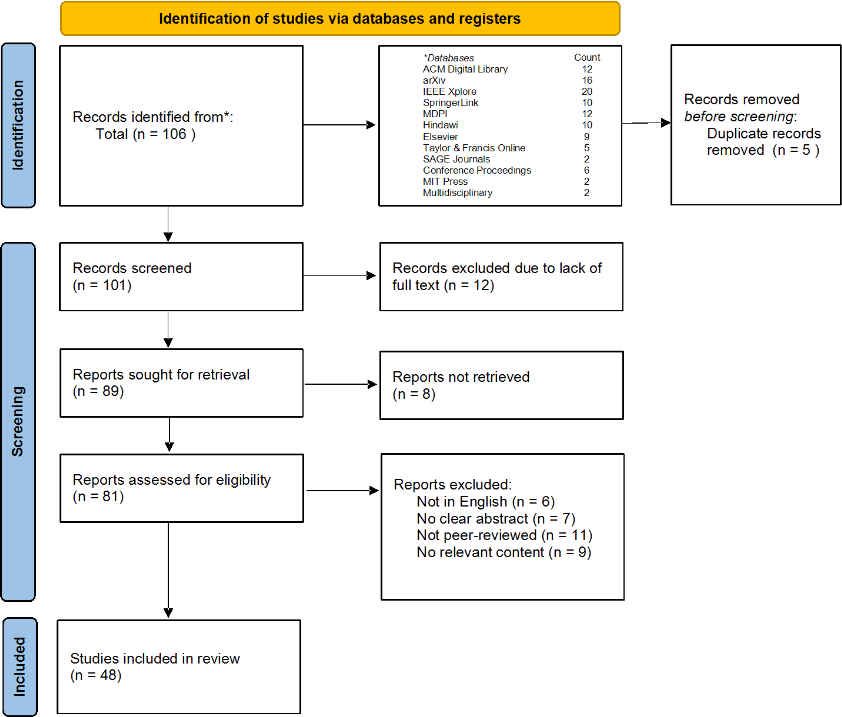
Sustainable computing has emerged as a critical field of study, addressing the environmental impact of computing systems through innovations in software, hardware, and algorithms. This systematic literature review consolidates recent advancements across these domains, focusing on energy-efficient software design, sustainable hardware architectures, and algorithmic optimizations. The review identifies key trends, such as low-carbon software engineering, processing-in-memory (PIM) architectures, and AI-driven energy management, while also highlighting the growing importance of green cloud computing, circular computing, and policy-driven sustainability initiatives. Despite significant progress, challenges remain, including scalability, integration across domains, and the lack of standardized evaluation frameworks. The paper proposes future research directions, emphasizing the need for interdisciplinary collaboration, the adoption of emerging technologies like quantum and edge computing, and the establishment of global standards for sustainable computing practices. By synthesizing 48 studies, this review provides a comprehensive understanding of the current state of sustainable computing and offers actionable insights for researchers, industry practitioners, and policymakers to drive further innovation in this vital area.
Graphical Abstract
Keywords
Data Availability Statement
Funding
Conflicts of Interest
Ethical Approval and Consent to Participate
References
- Ahmadilivani, M. H., Bosio, A., Deveautour, B., Santos, F. F. D., Balaguera, J. D. G., Jenihhin, M., ... & Traiola, M. (2022). Efficient hardware architectures for accelerating deep neural networks: survey. IEEE Access, 10, 131788–131828.
[CrossRef] [Google Scholar] - Almalki, F. A., Alsamhi, S. H., Sahal, R., Hassan, J., Hawbani, A., Rajput, N. S., ... & Breslin, J. (2021). Green IoT for Eco-Friendly and Sustainable Smart Cities: Future directions and opportunities. Mobile Networks and Applications, 28(1), 178–202.
[CrossRef] [Google Scholar] - Ansari, M., Safari, S., Khdr, H., Gohari-Nazari, P., Henkel, J., Ejlali, A., & Hessabi, S. (2022). Power-Aware checkpointing for multicore embedded systems. IEEE Transactions on Parallel and Distributed Systems, 1–15.
[CrossRef] [Google Scholar] - Arroba, P., Buyya, R., Cárdenas, R., Risco-Martín, J. L., & Moya, J. M. (2023). Sustainable edge Computing: challenges and future directions. arXiv (Cornell University).
[CrossRef] [Google Scholar] - Arroba, P., Buyya, R., Cárdenas, R., Risco‐Martín, J. L., & Moya, J. M. (2024). Sustainable edge computing: Challenges and future directions. Software Practice and Experience, 54(11), 2272–2296.
[CrossRef] [Google Scholar] - Bashir, N., Irwin, D., Shenoy, P., & Souza, A. (2023). Sustainable computing - without the hot air. ACM SIGEnergy Energy Informatics Review, 3(3), 47–52.
[CrossRef] [Google Scholar] - Bouali, E., Abid, M. R., Boufounas, E., Hamed, T. A., & Benhaddou, D. (2021). Renewable Energy Integration Into Cloud & IoT-Based Smart Agriculture. IEEE Access, 10, 1175–1191.
[CrossRef] [Google Scholar] - Calautit, K., Nasir, D. S., & Hughes, B. R. (2021). Low power energy harvesting systems: State of the art and future challenges. Renewable and Sustainable Energy Reviews, 147, 111230.
[CrossRef] [Google Scholar] - Chen, F. (2024). System Support for Environmentally Sustainable Computing in Data Centers. IEEE Access, 490–495.
[CrossRef] [Google Scholar] - D’Agostino, D., Merelli, I., Aldinucci, M., & Cesini, D. (2021). Hardware and software solutions for Energy-Efficient computing in scientific programming. Scientific Programming, 2021, 1–9.
[CrossRef] [Google Scholar] - Dash, S. (2025). Green AI: Enhancing sustainability and energy efficiency in AI-Integrated enterprise systems. IEEE Access, 1.
[CrossRef] [Google Scholar] - Deng, Z., Cao, D., Shen, H., Yan, Z., & Huang, H. (2021). Reliability-aware task scheduling for energy efficiency on heterogeneous multiprocessor systems. The Journal of Supercomputing, 77(10), 11643–11681.
[CrossRef] [Google Scholar] - Dowling, A., Jiang, L., Cheng, M., & Liu, Y. (2024). Regulating CPU temperature with thermal-aware scheduling using a reduced order learning thermal model. Future Generation Computer Systems, 107687.
[CrossRef] [Google Scholar] - Fraga-Lamas, P., Lopes, S. I., & Fernández-Caramés, T. M. (2021). Green IoT and Edge AI as Key Technological Enablers for a Sustainable Digital Transition towards a Smart Circular Economy: An Industry 5.0 Use Case. Sensors, 21(17), 5745.
[CrossRef] [Google Scholar] - Gao, X., Cui, N., Nian, J., Liang, Z., Gao, J., Liu, H., & Yang, M. (2024). ReBEC: A replacement-based energy-efficient fault-tolerance design for associative caches. Future Generation Computer Systems, 155, 39–52.
[CrossRef] [Google Scholar] - Gupta, A., Singh, P., Jain, D., Sharma, A. K., Vats, P., & Sharma, V. P. (2022). A sustainable green approach to the virtualized environment in cloud computing. In Lecture notes in networks and systems (pp. 751–760).
[CrossRef] [Google Scholar] - Gupta, U., Elgamal, M., Hills, G., Wei, G. Y., Lee, H. H. S., Brooks, D., & Wu, C. J. (2022, June). ACT: Designing sustainable computer systems with an architectural carbon modeling tool. In Proceedings of the 49th Annual International Symposium on Computer Architecture (pp. 784-799).
[CrossRef] [Google Scholar] - Gupta, U., Kim, Y. G., Lee, S., Tse, J., Lee, H. S., Wei, G., Brooks, D., & Wu, C. (2021). Chasing Carbon: The Elusive Environmental Footprint of Computing. 2021 IEEE International Symposium on High-Performance Computer Architecture (HPCA).
[CrossRef] [Google Scholar] - Hashem, I. a. T., Usmani, R. S. A., Almutairi, M. S., Ibrahim, A. O., Zakari, A., Alotaibi, F., Alhashmi, S. M., & Chiroma, H. (2023). Urban Computing for Sustainable Smart Cities: recent advances, taxonomy, and open research challenges. Sustainability, 15(5), 3916.
[CrossRef] [Google Scholar] - Hu, B. (2021). Research and application of combined algorithm based on sustainable computing and artificial intelligence. Mathematical Problems in Engineering, 2021, 1–9.
[CrossRef] [Google Scholar] - Huang, X., Chen, S., Xiong, D., Xu, C., & Yang, Z. (2022). Analysis and prediction of influence factors of green computing on carbon cycle process in smart City. Computational Intelligence and Neuroscience, 2022, 1–14.
[CrossRef] [Google Scholar] - IEA. (2022). IEA. Retrieved from https://www.iea.org/energy-system/buildings/data-centres-and-data-transmission-networks.
[Google Scholar] - Khlie, K., & Benmamoun, Z. (2024). Towards smarter and greener cities: Harnessing AI and green technology for urban sustainability. Journal of Infrastructure Policy and Development, 8(8), 6300.
[CrossRef] [Google Scholar] - Kim, H., Choi, J. S., Kim, J., & Ko, J. H. (2024). A DNN partitioning framework with controlled lossy mechanisms for edge-cloud collaborative intelligence. Future Generation Computer Systems, 154, 426–439.
[CrossRef] [Google Scholar] - Kocot, B., Czarnul, P., & Proficz, J. (2023). Energy-Aware Scheduling for High-Performance Computing Systems: A survey. Energies, 16(2), 890.
[CrossRef] [Google Scholar] - Kumar, N., Upreti, K., Jafri, S., Arora, I., Bhardwaj, R., Phogat, M., Srivastava, S., & Akorli, F. K. (2022). Sustainable Computing: a determinant of industry 4.0 for sustainable information Society. Journal of Nanomaterials, 2022(1).
[CrossRef] [Google Scholar] - Lee, B. C., Brooks, D., Arthur, V. B., Gupta, U., Hills, G., Liu, V., ... & Yu, M. (2024). Carbon Connect: an ecosystem for sustainable computing. arXiv (Cornell University).
[CrossRef] [Google Scholar] - Lee, J., & Yoo, H. (2021). An Overview of Energy-Efficient hardware Accelerators for On-Device Deep-Neural-Network training. IEEE Open Journal of the Solid-State Circuits Society, 1, 115–128.
[CrossRef] [Google Scholar] - Liu, B., Chen, R., Lin, W., Wu, W., Lin, J., & Li, K. (2023). Thermal-aware virtual machine placement based on multi-objective optimization. The Journal of Supercomputing, 79(11), 12563–12590.
[CrossRef] [Google Scholar] - Lou, H. (2025). Comparative analysis and enhancement of FPGA and ASIC performance in targeted applications. In Smart innovation, systems and technologies (pp. 295–308).
[CrossRef] [Google Scholar] - Mariscal-Melgar, J. C., Moritz, M., Redlich, T., & Wulfsberg, J. P. (2023). Sustainable Computing through Open Standard ISAs: Leveraging Tailor-Fit hardware designs for circular economies. In Lecture notes in production engineering (pp. 469–480).
[CrossRef] [Google Scholar] - Martin, M. J., Andersen, A., Tripp, C., & Munch, K. (2024). Integrating sustainable computing with sustainable energy research. arXiv (Cornell University).
[CrossRef] [Google Scholar] - Milczarek, A., & Możdżyński, K. (2024). A Unified Data Profile for Microgrid Loads, Power Electronics, and Sustainable Energy Management with IoT. Energies, 17(6), 1277.
[CrossRef] [Google Scholar] - Monserrate, S. G. (2022). The Cloud Is Material: On the Environmental Impacts of Computation and Data Storage. MIT Case Studies in Social and Ethical Responsibilities of Computing, Winter 2022.
[CrossRef] [Google Scholar] - Muralidhar, R., Borovica-Gajic, R., & Buyya, R. (2022). Energy Efficient computing systems: architectures, abstractions and modeling to techniques and standards. ACM Computing Surveys, 54(11s), 1–37.
[CrossRef] [Google Scholar] - Navardi, M., Ranjbar, B., Rohbani, N., Ejlali, A., & Kumar, A. (2022). Peak-Power aware Life-Time reliability improvement in Fault-Tolerant Mixed-Criticality systems. IEEE Open Journal of Circuits and Systems, 3, 199–215.
[CrossRef] [Google Scholar] - Nguyen, B., Goto, B., Selker, J. S., & Udell, C. (2021). Hypnos board: A low-cost all-in-one solution for environment sensor power management, data storage, and task scheduling. HardwareX, 10, e00213.
[CrossRef] [Google Scholar] - Ollivier, S., Li, S., Tang, Y., Chaudhuri, C., Zhou, P., Tang, X., Hu, J., & Jones, A. K. (2022). Sustainable AI processing at the edge. arXiv (Cornell University).
[CrossRef] [Google Scholar] - Page, M. J., McKenzie, J. E., Bossuyt, P. M., Boutron, I., Hoffmann, T. C., Mulrow, C. D., ... & Moher, D. (2021). The PRISMA 2020 statement: an updated guideline for reporting systematic reviews. BMJ, n71.
[CrossRef] [Google Scholar] - Pineda, A. F. V., Skov, I. R., Dahy, H., Arsanjani, J. J., Bonnevie, I. M., Børsen, T., & Teli, M. (2024). Sustainability Meets Information Technologies: recent developments and future perspectives. Sustainability, 16(11), 4499.
[CrossRef] [Google Scholar] - Pop, R., Dabija, D., Pelău, C., & Dinu, V. (2022). USAGE INTENTIONS, ATTITUDES, AND BEHAVIORS TOWARDS ENERGY-EFFICIENT APPLICATIONS DURING THE COVID-19 PANDEMIC. Journal of Business Economics and Management, 23(3), 668–689.
[CrossRef] [Google Scholar] - Qureshi, R., Mehboob, S. H., & Aamir, M. (2021). Sustainable green Fog computing for smart agriculture. Wireless Personal Communications, 121(2), 1379–1390.
[CrossRef] [Google Scholar] - Singh, G., Abowd, G. D., Chien, A. A., Jones, A., Islam, B., Dahiya, R., & Hester, J. (2023). Panel: Sustainability in Computing. 2023 IEEE International Conference on Pervasive Computing and Communications (PerCom), 14–16.
[CrossRef] [Google Scholar] - Smejkal, T., Khasanov, R., Castrillon, J., & Härtig, H. (2024). E-MappEr: Energy-Efficient resource allocation for traditional operating systems on heterogeneous processors. arXiv.org. https://arxiv.org/abs/2406.18980
[Google Scholar] - Sudarshan, C. C., Arora, A., & Chhabria, V. A. (2023). GreenFPGA: Evaluating FPGAs as Environmentally Sustainable Computing Solutions. arXiv (Cornell University).
[CrossRef] [Google Scholar] - Um-E-Habiba, N., Ahmed, I., Asif, M., Alhelou, H. H., & Khalid, M. (2024). A review on enhancing energy efficiency and adaptability through system integration for smart buildings. Journal of Building Engineering, 89, 109354.
[CrossRef] [Google Scholar] - UN. (2015). United Nations | THE 17 GOALS | Sustainable Development. Retrieved from https://sdgs.un.org/goals.
[Google Scholar] - Vanderbauwhede, W. (2023). Frugal Computing -- On the need for low-carbon and sustainable computing and the path towards zero-carbon computing. arXiv (Cornell University).
[CrossRef] [Google Scholar] - Venkataswamy, V., Grigsby, J., Grimshaw, A., & Qi, Y. (2022). RARE: Renewable Energy aware resource management in datacenters. arXiv.org. https://arxiv.org/abs/2211.05346
[Google Scholar] - Xu, J. (2024). Comparison and Application of FPGA and ASIC in Digital System Design. International Conference on Decision Science & Management, 216–220.
[CrossRef] [Google Scholar] - Yang, W., & Schmidt, H. (2021). Acoustic control of magnetism toward energy-efficient applications. Applied Physics Reviews, 8(2).
[CrossRef] [Google Scholar] - Yeo, R., Wu, W., Tomczak, N., Ji, R., Wang, S., Wang, X., ... & Zhu, Q. (2023). Tailoring surface reflectance through nanostructured materials design for energy-efficient applications. Materials Today Chemistry, 30, 101593.
[CrossRef] [Google Scholar] - You, X., Yang, H., Xuan, Z., Luan, Z., & Qian, D. (2022). PowerSpector: Towards Energy Efficiency with Calling-Context-Aware Profiling. 2022 IEEE International Parallel and Distributed Processing Symposium (IPDPS), 1272–1282.
[CrossRef] [Google Scholar] - Yuan, W., & Nahrstedt, K. (2006). Energy-efficient CPU scheduling for multimedia applications. ACM Transactions on Computer Systems, 24(3), 292–331.
[CrossRef] [Google Scholar] - Zhang, Z., Yu, D., Ibhadode, O., Meng, L., Gao, T., Zhu, J., & Zhang, W. (2025). TopADDPI: An affordable and sustainable Raspberry Pi cluster for Parallel-Computing topology optimization. Processes, 13(3), 633.
[CrossRef] [Google Scholar]
Cite This Article
TY  - JOUR
AU  - Kautish, Sandeep
AU  - Gurung, Dipesh
PY  - 2025
DA  - 2025/05/19
TI  - Advancing Sustainable Computing: A Systematic Literature Review of Software, Hardware, and Algorithmic Innovations
JO  - ICCK Transactions on Sustainable Computing
T2  - ICCK Transactions on Sustainable Computing
JF  - ICCK Transactions on Sustainable Computing
VL  - 1
IS  - 1
SP  - 1
EP  - 19
DO  - 10.62762/TSC.2025.767094
UR  - https://www.icck.org/article/abs/tsc.2025.767094
KW  - green computing
KW  - energy efficiency
KW  - hardware innovations
KW  - AI-driven optimization
KW  - circular computing
KW  - life cycle assessment
KW  - policy-driven sustainability
AB  - Sustainable computing has emerged as a critical field of study, addressing the environmental impact of computing systems through innovations in software, hardware, and algorithms. This systematic literature review consolidates recent advancements across these domains, focusing on energy-efficient software design, sustainable hardware architectures, and algorithmic optimizations. The review identifies key trends, such as low-carbon software engineering, processing-in-memory (PIM) architectures, and AI-driven energy management, while also highlighting the growing importance of green cloud computing, circular computing, and policy-driven sustainability initiatives. Despite significant progress, challenges remain, including scalability, integration across domains, and the lack of standardized evaluation frameworks. The paper proposes future research directions, emphasizing the need for interdisciplinary collaboration, the adoption of emerging technologies like quantum and edge computing, and the establishment of global standards for sustainable computing practices. By synthesizing 48 studies, this review provides a comprehensive understanding of the current state of sustainable computing and offers actionable insights for researchers, industry practitioners, and policymakers to drive further innovation in this vital area.
SN  - request pending
PB  - Institute of Central Computation and Knowledge
LA  - English
ER  -
@article{Kautish2025Advancing,
  author = {Sandeep Kautish and Dipesh Gurung},
  title = {Advancing Sustainable Computing: A Systematic Literature Review of Software, Hardware, and Algorithmic Innovations},
  journal = {ICCK Transactions on Sustainable Computing},
  year = {2025},
  volume = {1},
  number = {1},
  pages = {1-19},
  doi = {10.62762/TSC.2025.767094},
  url = {https://www.icck.org/article/abs/tsc.2025.767094},
  abstract = {Sustainable computing has emerged as a critical field of study, addressing the environmental impact of computing systems through innovations in software, hardware, and algorithms. This systematic literature review consolidates recent advancements across these domains, focusing on energy-efficient software design, sustainable hardware architectures, and algorithmic optimizations. The review identifies key trends, such as low-carbon software engineering, processing-in-memory (PIM) architectures, and AI-driven energy management, while also highlighting the growing importance of green cloud computing, circular computing, and policy-driven sustainability initiatives. Despite significant progress, challenges remain, including scalability, integration across domains, and the lack of standardized evaluation frameworks. The paper proposes future research directions, emphasizing the need for interdisciplinary collaboration, the adoption of emerging technologies like quantum and edge computing, and the establishment of global standards for sustainable computing practices. By synthesizing 48 studies, this review provides a comprehensive understanding of the current state of sustainable computing and offers actionable insights for researchers, industry practitioners, and policymakers to drive further innovation in this vital area.},
  keywords = {green computing, energy efficiency, hardware innovations, AI-driven optimization, circular computing, life cycle assessment, policy-driven sustainability},
  issn = {request pending},
  publisher = {Institute of Central Computation and Knowledge}
}
Article Metrics
Publisher's Note
ICCK stays neutral with regard to jurisdictional claims in published maps and institutional affiliations.
Rights and Permissions
 Copyright © 2025 by the Author(s). Published by Institute of Central Computation and Knowledge. This article is an open access article distributed under the terms and conditions of the Creative Commons Attribution (CC BY) license (https://creativecommons.org/licenses/by/4.0/), which permits use, sharing, adaptation, distribution and reproduction in any medium or format, as long as you give appropriate credit to the original author(s) and the source, provide a link to the Creative Commons licence, and indicate if changes were made.


Portico