

Slope Stability and Safety Assessment Based on Random Forest Enhanced under Multi-Strategy Pelican Optimization




Article Information
Abstract
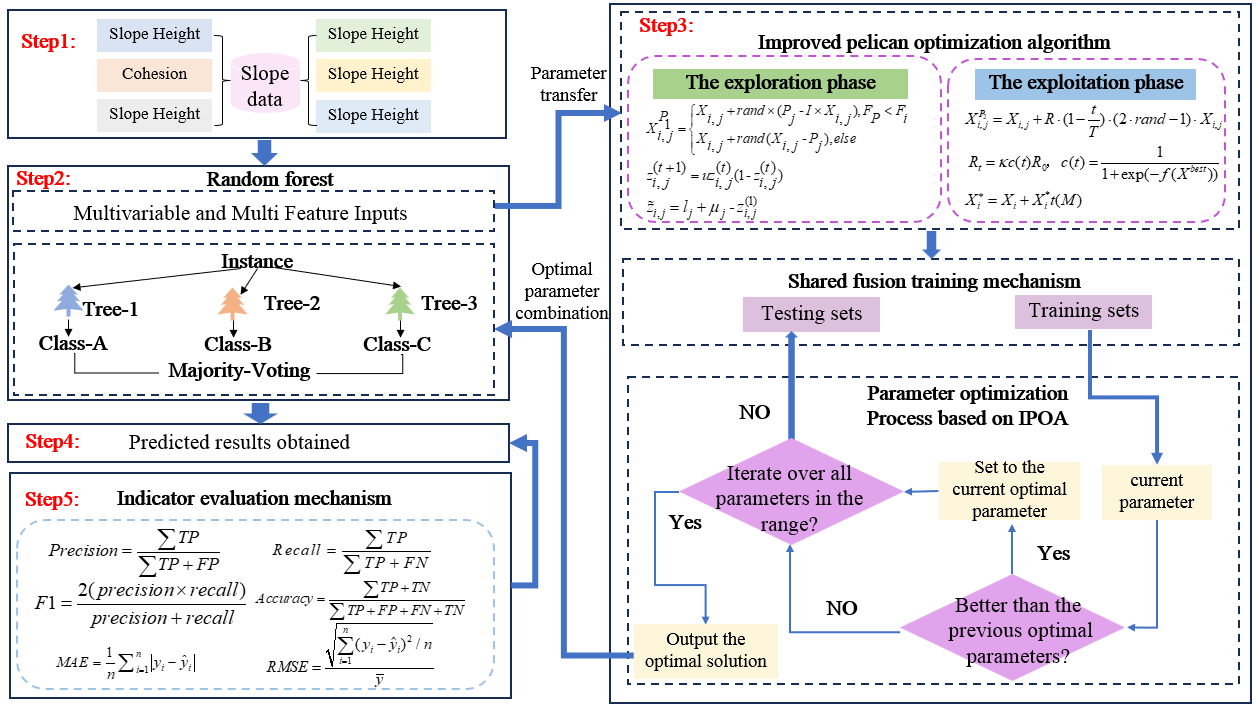
To improve the prediction accuracy of slope stability and prevent slope failure accidents, this study proposes a slope stability prediction model based on an improved pelican optimization algorithm optimized random forest (Improved Pelican Optimization Algorithm optimized Random Forest, IPOA-RF). First, according to 431 slope cases, the slope height, slope angle, unit weight, cohesion, internal friction angle, and pore water pressure ratio were selected as the main predictive features. Second, due to the issue of excessive hyperparameters in the traditional random forest (RF) model, the IPOA algorithm was employed to optimize the RF parameters using an optimal-guidance strategy, mutation operator, and dynamically adjusted search mechanism. Finally, compared with five other optimization algorithms, the proposed IPOA algorithm exhibited superior parameter optimization ability and convergence performance in ten benchmark test functions. The designed IPOA-RF model achieved an average prediction accuracy of 85.1%, approximately 10.4% higher than that of the traditional RF model (74.7%). The results demonstrate that the IPOA-RF model can rapidly and accurately identify slope stability conditions, effectively overcoming the limitations of conventional methods. This model not only provides an innovative solution for slope stability assessment but also offers technical support for enhancing the safety and operational efficiency of practical slope engineering projects.
Graphical Abstract
Keywords
Data Availability Statement
Funding
Conflicts of Interest
AI Use Statement
Ethical Approval and Consent to Participate
References
- Ullah, S., Khan, M. U., & Rehman, G. (2020). A brief review of the slope stability analysis methods. Geol. Behav, 4(2), 73-77.
[CrossRef] [Google Scholar] - Azarafza, M., Akgün, H., Ghazifard, A., Asghari-Kaljahi, E., Rahnamarad, J., & Derakhshani, R. (2021). Discontinuous rock slope stability analysis by limit equilibrium approaches–a review. International Journal of Digital Earth, 14(12), 1918-1941.
[CrossRef] [Google Scholar] - Sengani, F., & Mulenga, F. (2020). Application of limit equilibrium analysis and numerical modeling in a case of slope instability. Sustainability, 12(21), 8870.
[CrossRef] [Google Scholar] - Ureel, S., & Momayez, M. (2014). An investigation of the limit equilibrium method and numerical modeling for rock slope stability analysis. In Rock mechanics and its applications in civil, mining, and petroleum engineering (pp. 218-227).
[CrossRef] [Google Scholar] - Li, L. C., Tang, C. A., Zhu, W. C., & Liang, Z. Z. (2009). Numerical analysis of slope stability based on the gravity increase method. Computers and Geotechnics, 36(7), 1246-1258.
[CrossRef] [Google Scholar] - Gordan, B., Jahed Armaghani, D., Hajihassani, M., & Monjezi, M. (2016). Prediction of seismic slope stability through combination of particle swarm optimization and neural network. Engineering with computers, 32(1), 85-97.
[CrossRef] [Google Scholar] - Chakraborty, A., & Goswami, D. (2017). Prediction of slope stability using multiple linear regression (MLR) and artificial neural network (ANN). Arabian Journal of Geosciences, 10(17), 385.
[CrossRef] [Google Scholar] - Kasa, A., & Mohd, S. F. (2024). Performance Prediction Evaluation of Machine Learning Models for Slope Stability Analysis: A Comparison Between ANN, ANN-ICA and ANFIS. J. Electr. Syst, 20, 4364-4374.
[Google Scholar] - Huang, S., Huang, M., & Lyu, Y. (2020). An improved KNN‐based slope stability prediction model. Advances in Civil Engineering, 2020(1), 8894109.
[CrossRef] [Google Scholar] - Zhang, W., Li, H., Han, L., Chen, L., & Wang, L. (2022). Slope stability prediction using ensemble learning techniques: A case study in Yunyang County, Chongqing, China. Journal of Rock Mechanics and Geotechnical Engineering, 14(4), 1089-1099.
[CrossRef] [Google Scholar] - Demir, S., & Sahin, E. K. (2023). Random forest importance-based feature ranking and subset selection for slope stability assessment using the ranger implementation. Avrupa Bilim ve Teknoloji Dergisi, (48), 23-28.
[CrossRef] [Google Scholar] - Kurnaz, T. F., Erden, C., Dağdeviren, U., Demir, A. S., & Kökçam, A. H. (2024). Comparison of machine learning algorithms for slope stability prediction using an automated machine learning approach. Natural Hazards, 120(8), 6991-7014.
[CrossRef] [Google Scholar] - Huang, F., Xiong, H., Chen, S., Lv, Z., Huang, J., Chang, Z., & Catani, F. (2023). Slope stability prediction based on a long short-term memory neural network: comparisons with convolutional neural networks, support vector machines and random forest models. International Journal of Coal Science & Technology, 10(1), 18.
[CrossRef] [Google Scholar] - Rukhaiyar, S., Alam, M. N., & Samadhiya, N. K. (2018). A PSO-ANN hybrid model for predicting factor of safety of slope. International Journal of Geotechnical Engineering, 12(6), 556-566.
[CrossRef] [Google Scholar] - Zhou, J., Li, E., Yang, S., Wang, M., Shi, X., Yao, S., & Mitri, H. S. (2019). Slope stability prediction for circular mode failure using gradient boosting machine approach based on an updated database of case histories. Safety Science, 118, 505-518.
[CrossRef] [Google Scholar] - Li, M., Li, K., Qin, Q., & Yue, R. (2023). Slope stability prediction based on IPOARF algorithm: A case study of Lala Copper Mine, Sichuan, China. Expert Systems with Applications, 229, 120595.
[CrossRef] [Google Scholar] - Xie, H., Dong, J., Deng, Y., & Dai, Y. (2022). Prediction model of the slope angle of rocky slope stability based on random forest algorithm. Mathematical problems in engineering, 2022(1), 9441411.
[CrossRef] [Google Scholar] - Boser, B. E., Guyon, I. M., & Vapnik, V. N. (1992, July). A training algorithm for optimal margin classifiers. In Proceedings of the fifth annual workshop on Computational learning theory (pp. 144-152).
[CrossRef] [Google Scholar] - Yang, Y., Zhou, W., Jiskani, I. M., Lu, X., Wang, Z., & Luan, B. (2023). Slope stability prediction method based on intelligent optimization and machine learning algorithms. Sustainability, 15(2), 1169.
[CrossRef] [Google Scholar] - Trojovský, P., & Dehghani, M. (2022). Pelican optimization algorithm: A novel nature-inspired algorithm for engineering applications. Sensors, 22(3), 855.
[CrossRef] [Google Scholar] - Csillik, O., Evans, I. S., & Drăguţ, L. (2015). Transformation (normalization) of slope gradient and surface curvatures, automated for statistical analyses from DEMs. Geomorphology, 232, 65-77.
[CrossRef] [Google Scholar] - Pan, C. (2025). Novel and hybrid model of pelican optimization algorithm with light gradient boosting model for smart infrastructure: A high-precision approach to occupancy and failure prediction. Green Technologies and Sustainability, 100323.
[CrossRef] [Google Scholar] - Khajehzadeh, M., & Keawsawasvong, S. (2023). Predicting slope safety using an optimized machine learning model. Heliyon, 9(12), e23012.
[CrossRef] [Google Scholar] - Cortes, C., & Vapnik, V. (1995). Support-vector networks. Machine learning, 20(3), 273-297.
[CrossRef] [Google Scholar] - Chen, T., & Guestrin, C. (2016, August). Xgboost: A scalable tree boosting system. In Proceedings of the 22nd acm sigkdd international conference on knowledge discovery and data mining (pp. 785-794).
[CrossRef] [Google Scholar]
Cited By (1)
-
Wei Xiong, Jie Xia, YiBo Yu, SanMing Xiong, HaiYang Hu, Peng Wan, Dan Li, Agbotiname Lucky Imoize. TransGrid-CostOpt: A hybrid transformer framework for cost prediction and optimization of distribution network assets.
PLOS One, 2026 , 21 (5).
[CrossRef]
Cite This Article
TY  - JOUR
AU  - Zhao, Huanhuan
AU  - Zhao, Xiaole
AU  - Wen, Xueyi
AU  - Yan, Rongfang
AU  - Zhang, Jiandong
PY  - 2026
DA  - 2026/04/03
TI  - Slope Stability and Safety Assessment Based on Random Forest Enhanced under Multi-Strategy Pelican Optimization
JO  - ICCK Transactions on Systems Safety and Reliability
T2  - ICCK Transactions on Systems Safety and Reliability
JF  - ICCK Transactions on Systems Safety and Reliability
VL  - 2
IS  - 2
SP  - 82
EP  - 100
DO  - 10.62762/TSSR.2026.963232
UR  - https://www.icck.org/article/abs/TSSR.2026.963232
KW  - slope stability prediction
KW  - visualization analysis
KW  - RF
KW  - IPOA-RF
AB  - To improve the prediction accuracy of slope stability and prevent slope failure accidents, this study proposes a slope stability prediction model based on an improved pelican optimization algorithm optimized random forest (Improved Pelican Optimization Algorithm optimized Random Forest, IPOA-RF). First, according to 431 slope cases, the slope height, slope angle, unit weight, cohesion, internal friction angle, and pore water pressure ratio were selected as the main predictive features. Second, due to the issue of excessive hyperparameters in the traditional random forest (RF) model, the IPOA algorithm was employed to optimize the RF parameters using an optimal-guidance strategy, mutation operator, and dynamically adjusted search mechanism. Finally, compared with five other optimization algorithms, the proposed IPOA algorithm exhibited superior parameter optimization ability and convergence performance in ten benchmark test functions. The designed IPOA-RF model achieved an average prediction accuracy of 85.1%, approximately 10.4% higher than that of the traditional RF model (74.7%). The results demonstrate that the IPOA-RF model can rapidly and accurately identify slope stability conditions, effectively overcoming the limitations of conventional methods. This model not only provides an innovative solution for slope stability assessment but also offers technical support for enhancing the safety and operational efficiency of practical slope engineering projects.
SN  - 3069-1087
PB  - Institute of Central Computation and Knowledge
LA  - English
ER  -
@article{Zhao2026Slope,
  author = {Huanhuan Zhao and Xiaole Zhao and Xueyi Wen and Rongfang Yan and Jiandong Zhang},
  title = {Slope Stability and Safety Assessment Based on Random Forest Enhanced under Multi-Strategy Pelican Optimization},
  journal = {ICCK Transactions on Systems Safety and Reliability},
  year = {2026},
  volume = {2},
  number = {2},
  pages = {82-100},
  doi = {10.62762/TSSR.2026.963232},
  url = {https://www.icck.org/article/abs/TSSR.2026.963232},
  abstract = {To improve the prediction accuracy of slope stability and prevent slope failure accidents, this study proposes a slope stability prediction model based on an improved pelican optimization algorithm optimized random forest (Improved Pelican Optimization Algorithm optimized Random Forest, IPOA-RF). First, according to 431 slope cases, the slope height, slope angle, unit weight, cohesion, internal friction angle, and pore water pressure ratio were selected as the main predictive features. Second, due to the issue of excessive hyperparameters in the traditional random forest (RF) model, the IPOA algorithm was employed to optimize the RF parameters using an optimal-guidance strategy, mutation operator, and dynamically adjusted search mechanism. Finally, compared with five other optimization algorithms, the proposed IPOA algorithm exhibited superior parameter optimization ability and convergence performance in ten benchmark test functions. The designed IPOA-RF model achieved an average prediction accuracy of 85.1\%, approximately 10.4\% higher than that of the traditional RF model (74.7\%). The results demonstrate that the IPOA-RF model can rapidly and accurately identify slope stability conditions, effectively overcoming the limitations of conventional methods. This model not only provides an innovative solution for slope stability assessment but also offers technical support for enhancing the safety and operational efficiency of practical slope engineering projects.},
  keywords = {slope stability prediction, visualization analysis, RF, IPOA-RF},
  issn = {3069-1087},
  publisher = {Institute of Central Computation and Knowledge}
}
Publisher's Note
ICCK stays neutral with regard to jurisdictional claims in published maps and institutional affiliations.
Rights and Permissions


Portico
