

Machine Learning for Lyapunov Function Synthesis: A Comprehensive Review


Article Information
Abstract
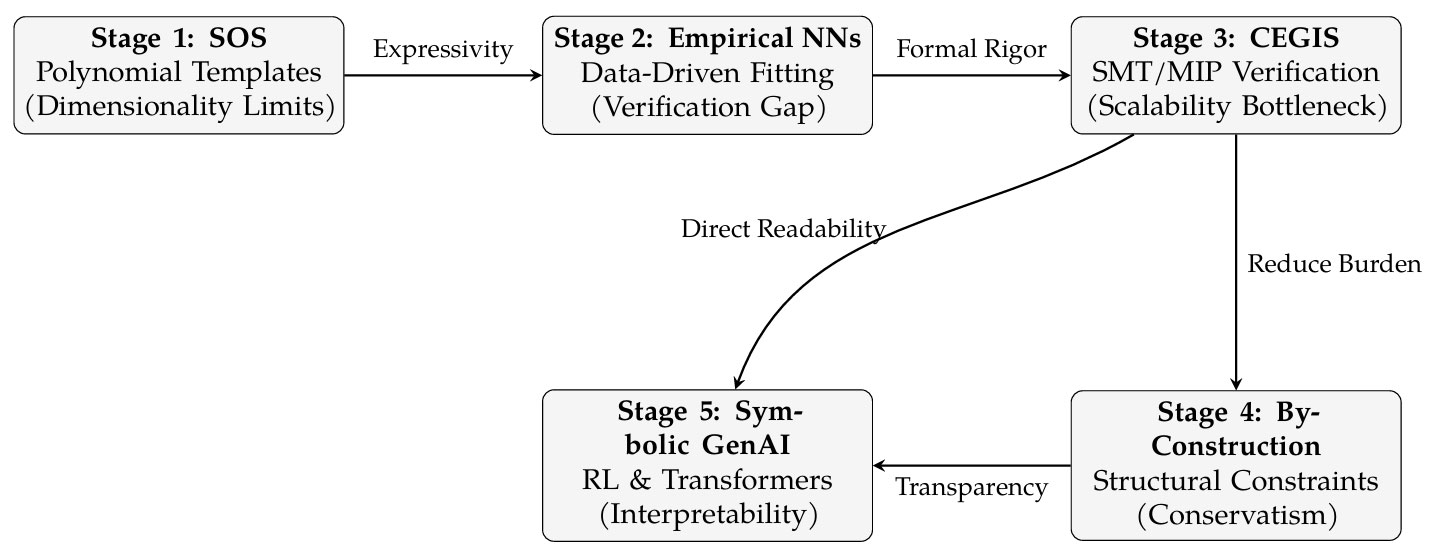
Lyapunov functions underpin the stability analysis and controller synthesis for aerospace vehicles, from spacecraft attitude control to autonomous flight systems and UAV swarm coordination. This review discusses the development of computational Lyapunov function synthesis methods. Within this scope, it traces the evolution from traditional Sum-of-Squares (SOS) programming to artificial intelligence symbolic discovery technologies, prompted by the increasing complexity of nonlinear systems. Specifically, the following stages can be identified: computational relaxation methods constrained by polynomial templates; data-driven paradigms leveraging neural network-based empirical approximations; and the fusion of machine learning fitting and formal verification through the Counter-Example Guided Inductive Synthesis (CEGIS) framework. Subsequently, researchers developed construction-based network architectures and hybrid scalable verification mechanisms to address bottlenecks in computational verification. Interestingly, the use of generative models and reinforcement learning to explore analytically expressible expressions with physical interpretability is emerging as an active research area in this field. To date, these tools have been extended to various dynamic scenarios, such as stochastic systems, decentralized multi-agent topologies (e.g., unmanned aerial vehicle swarms and satellite constellations), safe reinforcement learning for autonomous flight control, and partial differential equation (PDE) solving. This review evaluates the aforementioned methodological stages, with a focus on analyzing the trade-offs among model expressivity, computational scalability, and the rigor of formal guarantees across different technical routes.
Graphical Abstract
Keywords
Data Availability Statement
Funding
Conflicts of Interest
AI Use Statement
Ethical Approval and Consent to Participate
References
- Khalil, H. K. (2002). Nonlinear systems (3rd ed.). Prentice Hall. ISBN: 978-0-13-067389-3.
[Google Scholar] - Wu, Y. Y., Zhang, Y., & Wu, A. G. (2022). Finite‐time attitude stabilization of rigid spacecrafts based on control Lyapunov functions. IET Control Theory & Applications, 16(7), 663-673.
[CrossRef] [Google Scholar] - Li, B., Wen, S., Yan, Z., Wen, G., & Huang, T. (2023). A survey on the control lyapunov function and control barrier function for nonlinear-affine control systems. IEEE/CAA Journal of Automatica Sinica, 10(3), 584-602.
[CrossRef] [Google Scholar] - Chang, Y. C., Roohi, N., & Gao, S. (2019). Neural lyapunov control. Advances in neural information processing systems, 32. https://proceedings.neurips.cc/paper_files/paper/2019/hash/2647c1dba23bc0e0f9cdf75339e120d2-Abstract.html
[Google Scholar] - Alfarano, A., Charton, F., & Hayat, A. (2024). Global lyapunov functions: a long-standing open problem in mathematics, with symbolic transformers. Advances in Neural Information Processing Systems, 37, 93643-93670.
[Google Scholar] - Ahmadi, A. A., Krstic, M., & Parrilo, P. A. (2011, December). A globally asymptotically stable polynomial vector field with no polynomial Lyapunov function. In 2011 50th IEEE Conference on Decision and Control and European Control Conference (pp. 7579-7580). IEEE.
[CrossRef] [Google Scholar] - Serpen, G. (2005, July). Empirical approximation for Lyapunov functions with artificial neural nets. In Proceedings. 2005 IEEE International Joint Conference on Neural Networks, 2005. (Vol. 2, pp. 735-740). IEEE.
[CrossRef] [Google Scholar] - Noroozi, N., Karimaghaee, P., Safaei, F., & Javadi, H. (2008). Generation of Lyapunov functions by neural networks. In Proceedings of the World Congress on Engineering (Vol. 2008). https://www.iaeng.org/publication/WCE2008/WCE2008_pp61-65.pdf
[Google Scholar] - Abate, A., Ahmed, D., Giacobbe, M., & Peruffo, A. (2020). Formal synthesis of Lyapunov neural networks. IEEE Control Systems Letters, 5(3), 773-778.
[CrossRef] [Google Scholar] - Dai, H., Landry, B., Yang, L., Pavone, M., & Tedrake, R. (2021). Lyapunov-stable neural-network control. arXiv preprint arXiv:2109.14152.
[CrossRef] [Google Scholar] - Wu, J., Clark, A., Kantaros, Y., & Vorobeychik, Y. (2023). Neural lyapunov control for discrete-time systems. Advances in neural information processing systems, 36, 2939-2955.
[Google Scholar] - Dawson, C., Gao, S., & Fan, C. (2023). Safe control with learned certificates: A survey of neural lyapunov, barrier, and contraction methods for robotics and control. IEEE Transactions on Robotics, 39(3), 1749-1767.
[CrossRef] [Google Scholar] - Zhao, H., Qi, N., Ren, M., Liu, B., Shi, S., & Yang, Z. (2025). Learning-enabled Polynomial Lyapunov Function Synthesis via High-Accuracy Counterexample-Guided Framework. In Proceedings of the Computer Vision and Pattern Recognition Conference (pp. 10275-10284).
[CrossRef] [Google Scholar] - Yang, L., Dai, H., Shi, Z., Hsieh, C. J., Tedrake, R., & Zhang, H. (2024). Lyapunov-stable neural control for state and output feedback: A novel formulation. arXiv preprint arXiv:2404.07956.
[CrossRef] [Google Scholar] - Tran, H. D., Yang, X., Manzanas Lopez, D., Musau, P., Nguyen, L. V., Xiang, W., ... & Johnson, T. T. (2020, July). NNV: the neural network verification tool for deep neural networks and learning-enabled cyber-physical systems. In International conference on computer aided verification (pp. 3-17). Cham: Springer International Publishing.
[CrossRef] [Google Scholar] - Richards, S. M., Berkenkamp, F., & Krause, A. (2018, October). The lyapunov neural network: Adaptive stability certification for safe learning of dynamical systems. In Conference on robot learning (pp. 466-476). PMLR.
[Google Scholar] - Gaby, N., Zhang, F., & Ye, X. (2022, December). Lyapunov-net: A deep neural network architecture for Lyapunov function approximation. In 2022 IEEE 61st Conference on Decision and Control (CDC) (pp. 2091-2096). IEEE.
[CrossRef] [Google Scholar] - Kolter, J. Z., & Manek, G. (2019). Learning stable deep dynamics models. Advances in neural information processing systems, 32.
[Google Scholar] - Min, Y., Richards, S. M., & Azizan, N. (2023, December). Data-driven control with inherent lyapunov stability. In 2023 62nd IEEE Conference on Decision and Control (CDC) (pp. 6032-6037). IEEE.
[CrossRef] [Google Scholar] - Zou, H., Feng, J., Zhao, H., & Shi, Y. (2025). Analytical lyapunov function discovery: An rl-based generative approach. arXiv preprint arXiv:2502.02014.
[CrossRef] [Google Scholar] - Ho, J., Jain, A., & Abbeel, P. (2020). Denoising diffusion probabilistic models. Advances in neural information processing systems, 33, 6840-6851.
[Google Scholar] - Lipman, Y., Chen, R. T., Ben-Hamu, H., Nickel, M., & Le, M. (2022). Flow matching for generative modeling. arXiv preprint arXiv:2210.02747.
[CrossRef] [Google Scholar] - Romera-Paredes, B., Barekatain, M., Novikov, A., Balog, M., Kumar, M. P., Dupont, E., ... & Fawzi, A. (2024). Mathematical discoveries from program search with large language models. Nature, 625(7995), 468-475.
[CrossRef] [Google Scholar] - Zhang, J., Zhu, Q., & Lin, W. (2022). Neural stochastic control. Advances in neural information processing systems, 35, 9098-9110.
[Google Scholar] - Dey, B. S., Basu, A., & Jagtap, P. (2026). Input-to-State Stabilizing Neural Controllers for Unknown Switched Nonlinear Systems within Compact Sets. arXiv preprint arXiv:2601.14643.
[CrossRef] [Google Scholar] - Grüne, L. (2021). Computing Lyapunov functions using deep neural networks. Journal of Computational Dynamics, 8(2), 131-152.
[CrossRef] [Google Scholar] - Liu, J., Meng, Y., Fitzsimmons, M., & Zhou, R. (2024, July). Compositionally verifiable vector neural Lyapunov functions for stability analysis of interconnected nonlinear systems. In 2024 American Control Conference (ACC) (pp. 4789-4794). IEEE.
[CrossRef] [Google Scholar] - Dawson, C., Qin, Z., Gao, S., & Fan, C. (2022, January). Safe nonlinear control using robust neural lyapunov-barrier functions. In Conference on Robot Learning (pp. 1724-1735). PMLR.
[Google Scholar] - Jena, A., Huang, T., Sivaranjani, S., Kalathil, D., & Xie, L. (2022). Distributed learning of neural Lyapunov functions for large-scale networked dissipative systems. arXiv preprint arXiv:2207.07731.
[CrossRef] [Google Scholar] - Qin, Z., Zhang, K., Chen, Y., Chen, J., & Fan, C. (2021). Learning safe multi-agent control with decentralized neural barrier certificates. arXiv preprint arXiv:2101.05436.
[CrossRef] [Google Scholar] - Liu, J., Meng, Y., Fitzsimmons, M., & Zhou, R. (2025). Physics-informed neural network Lyapunov functions: PDE characterization, learning, and verification. Automatica, 175, 112193.
[CrossRef] [Google Scholar] - Sitzmann, V., Martel, J., Bergman, A., Lindell, D., & Wetzstein, G. (2020). Implicit neural representations with periodic activation functions. Advances in neural information processing systems, 33, 7462-7473.
[Google Scholar] - Bansal, S., & Tomlin, C. J. (2021, May). Deepreach: A deep learning approach to high-dimensional reachability. In 2021 IEEE International Conference on Robotics and Automation (ICRA) (pp. 1817-1824). IEEE.
[CrossRef] [Google Scholar] - Zinage, V., & Bakolas, E. (2023). Neural koopman lyapunov control. Neurocomputing, 527, 174-183.
[CrossRef] [Google Scholar] - Tsukamoto, H., Chung, S. J., & Slotine, J. J. E. (2021). Contraction theory for nonlinear stability analysis and learning-based control: A tutorial overview. Annual Reviews in Control, 52, 135-169.
[CrossRef] [Google Scholar] - Long, K., Yi, Y., Cortés, J., & Atanasov, N. (2023, June). Distributionally robust Lyapunov function search under uncertainty. In Learning for Dynamics and Control Conference (pp. 864-877). PMLR.
[Google Scholar] - Xiong, Z., Eappen, J., Qureshi, A. H., & Jagannathan, S. (2022, October). Model-free neural lyapunov control for safe robot navigation. In 2022 IEEE/RSJ International Conference on Intelligent Robots and Systems (IROS) (pp. 5572-5579). IEEE.
[CrossRef] [Google Scholar] - Berkenkamp, F., Turchetta, M., Schoellig, A., & Krause, A. (2017). Safe model-based reinforcement learning with stability guarantees. Advances in neural information processing systems, 30. https://proceedings.neurips.cc/paper_files/paper/2017/hash/766ebcd59621e305170616ba3d3dac32-Abstract.html
[Google Scholar] - Robey, A., Hu, H., Lindemann, L., Zhang, H., Dimarogonas, D. V., Tu, S., & Matni, N. (2020, December). Learning control barrier functions from expert demonstrations. In 2020 59th IEEE Conference on Decision and Control (CDC) (pp. 3717-3724). IEEE.
[CrossRef] [Google Scholar] - Hu, H., Yang, Y., Wei, T., & Liu, C. (2025, January). Verification of Neural Control Barrier Functions with Symbolic Derivative Bounds Propagation. In Conference on Robot Learning (pp. 1797-1814). PMLR.
[Google Scholar] - Choi, J., Castaneda, F., Tomlin, C. J., & Sreenath, K. (2020). Reinforcement learning for safety-critical control under model uncertainty, using control lyapunov functions and control barrier functions. arXiv preprint arXiv:2004.07584.
[CrossRef] [Google Scholar] - So, O., Serlin, Z., Mann, M., Gonzales, J., Rutledge, K., Roy, N., & Fan, C. (2024, May). How to train your neural control barrier function: Learning safety filters for complex input-constrained systems. In 2024 IEEE International Conference on Robotics and Automation (ICRA) (pp. 11532-11539). IEEE.
[CrossRef] [Google Scholar] - Cheng, R., Orosz, G., Murray, R. M., & Burdick, J. W. (2019, July). End-to-end safe reinforcement learning through barrier functions for safety-critical continuous control tasks. In Proceedings of the AAAI conference on artificial intelligence (Vol. 33, No. 01, pp. 3387-3395).
[CrossRef] [Google Scholar] - Umlauft, J., & Hirche, S. (2017, July). Learning stable stochastic nonlinear dynamical systems. In International Conference on Machine Learning (pp. 3502-3510). PMLR.
[Google Scholar]
Cite This Article
TY  - JOUR
AU  - Zhao, Lanhao
AU  - Liu, Shuai
PY  - 2026
DA  - 2026/08/11
TI  - Machine Learning for Lyapunov Function Synthesis: A Comprehensive Review
JO  - Aerospace Engineering Communications
T2  - Aerospace Engineering Communications
JF  - Aerospace Engineering Communications
VL  - 1
IS  - 3
SP  - 100
EP  - 109
DO  - 10.62762/AEC.2026.822279
UR  - https://www.icck.org/article/abs/AEC.2026.822279
KW  - lyapunov function
KW  - computational relaxation method
KW  - data-driven paradigms
KW  - reinforcement learning
KW  - generative models
AB  - Lyapunov functions underpin the stability analysis and controller synthesis for aerospace vehicles, from spacecraft attitude control to autonomous flight systems and UAV swarm coordination. This review discusses the development of computational Lyapunov function synthesis methods. Within this scope, it traces the evolution from traditional Sum-of-Squares (SOS) programming to artificial intelligence symbolic discovery technologies, prompted by the increasing complexity of nonlinear systems. Specifically, the following stages can be identified: computational relaxation methods constrained by polynomial templates; data-driven paradigms leveraging neural network-based empirical approximations; and the fusion of machine learning fitting and formal verification through the Counter-Example Guided Inductive Synthesis (CEGIS) framework. Subsequently, researchers developed construction-based network architectures and hybrid scalable verification mechanisms to address bottlenecks in computational verification. Interestingly, the use of generative models and reinforcement learning to explore analytically expressible expressions with physical interpretability is emerging as an active research area in this field. To date, these tools have been extended to various dynamic scenarios, such as stochastic systems, decentralized multi-agent topologies (e.g., unmanned aerial vehicle swarms and satellite constellations), safe reinforcement learning for autonomous flight control, and partial differential equation (PDE) solving. This review evaluates the aforementioned methodological stages, with a focus on analyzing the trade-offs among model expressivity, computational scalability, and the rigor of formal guarantees across different technical routes.
SN  - 3071-1967
PB  - Institute of Central Computation and Knowledge
LA  - English
ER  -
@article{Zhao2026Machine,
  author = {Lanhao Zhao and Shuai Liu},
  title = {Machine Learning for Lyapunov Function Synthesis: A Comprehensive Review},
  journal = {Aerospace Engineering Communications},
  year = {2026},
  volume = {1},
  number = {3},
  pages = {100-109},
  doi = {10.62762/AEC.2026.822279},
  url = {https://www.icck.org/article/abs/AEC.2026.822279},
  abstract = {Lyapunov functions underpin the stability analysis and controller synthesis for aerospace vehicles, from spacecraft attitude control to autonomous flight systems and UAV swarm coordination. This review discusses the development of computational Lyapunov function synthesis methods. Within this scope, it traces the evolution from traditional Sum-of-Squares (SOS) programming to artificial intelligence symbolic discovery technologies, prompted by the increasing complexity of nonlinear systems. Specifically, the following stages can be identified: computational relaxation methods constrained by polynomial templates; data-driven paradigms leveraging neural network-based empirical approximations; and the fusion of machine learning fitting and formal verification through the Counter-Example Guided Inductive Synthesis (CEGIS) framework. Subsequently, researchers developed construction-based network architectures and hybrid scalable verification mechanisms to address bottlenecks in computational verification. Interestingly, the use of generative models and reinforcement learning to explore analytically expressible expressions with physical interpretability is emerging as an active research area in this field. To date, these tools have been extended to various dynamic scenarios, such as stochastic systems, decentralized multi-agent topologies (e.g., unmanned aerial vehicle swarms and satellite constellations), safe reinforcement learning for autonomous flight control, and partial differential equation (PDE) solving. This review evaluates the aforementioned methodological stages, with a focus on analyzing the trade-offs among model expressivity, computational scalability, and the rigor of formal guarantees across different technical routes.},
  keywords = {lyapunov function, computational relaxation method, data-driven paradigms, reinforcement learning, generative models},
  issn = {3071-1967},
  publisher = {Institute of Central Computation and Knowledge}
}
Article Metrics
Publisher's Note
ICCK stays neutral with regard to jurisdictional claims in published maps and institutional affiliations.
Rights and Permissions
 Copyright © 2026 by the Author(s). Published by Institute of Central Computation and Knowledge. This article is an open access article distributed under the terms and conditions of the Creative Commons Attribution (CC BY) license (https://creativecommons.org/licenses/by/4.0/), which permits use, sharing, adaptation, distribution and reproduction in any medium or format, as long as you give appropriate credit to the original author(s) and the source, provide a link to the Creative Commons licence, and indicate if changes were made.


Portico
