

Adaptive Finite-Time Attitude Control Based on Time-Varying Sliding Mode




Article Information
Abstract
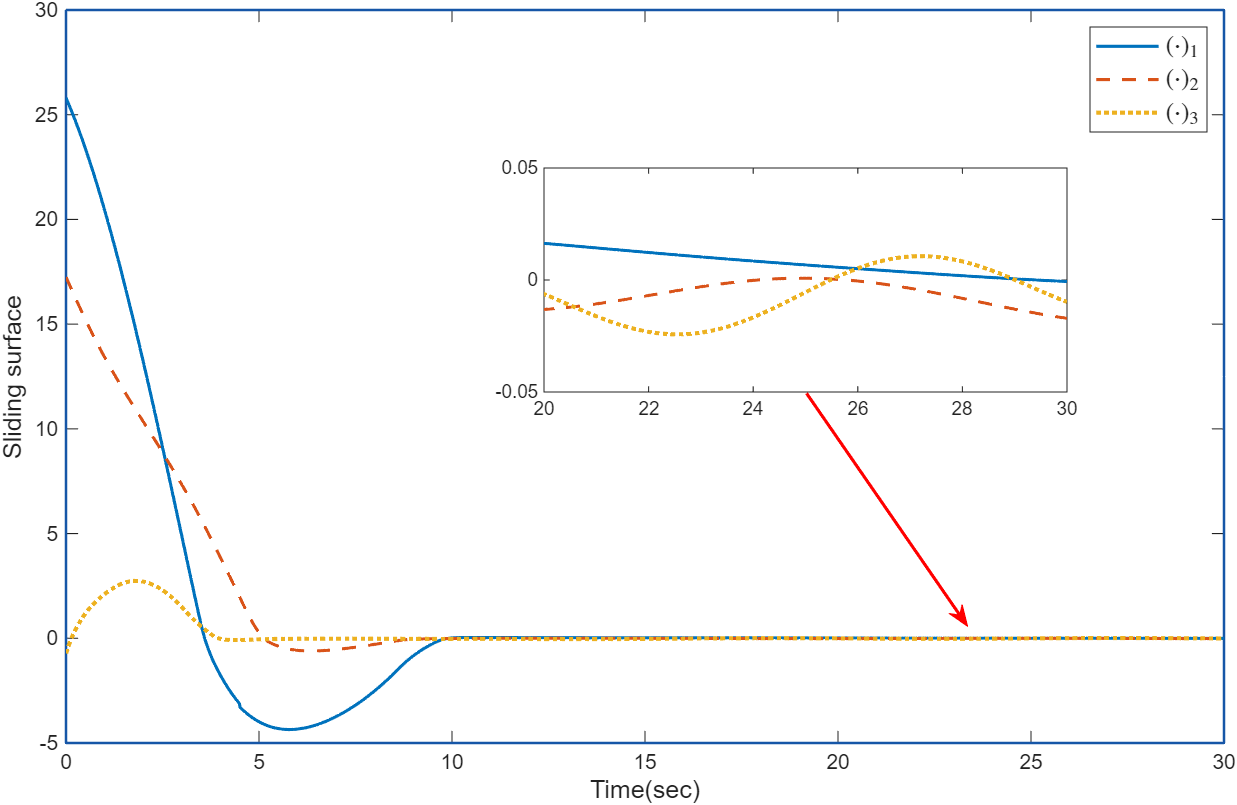
This study investigates the finite-time attitude tracking problem of spacecraft. We employ finite-time control methods to develop a novel adaptive controller. The controller utilizes a time-varying non-singular adaptive fast terminal sliding mode. The time-varying sliding mode dynamically adjusts the sliding surface morphology. This adjustment enables precise control performance tuning. Additionally, adaptive methods estimate the upper bound of generalized disturbances. This estimation reduces the computational load of the controller. The proposed controller demonstrates high robustness against external disturbances and inertia uncertainties. Lyapunov methods prove the stability of the controller. Numerical simulations validate the effectiveness of the proposed control algorithm. The simulation results exhibit high precision and confirm the algorithm's performance.
Graphical Abstract
Keywords
Data Availability Statement
Funding
Conflicts of Interest
AI Use Statement
Ethical Approval and Consent to Participate
References
- Yin, S., Xiao, B., Ding, S. X., & Zhou, D. (2016). A review on recent development of spacecraft attitude fault tolerant control system. IEEE Transactions on Industrial Electronics, 63(5), 3311-3320.
[CrossRef] [Google Scholar] - Hu, Q., Chen, W., Guo, L., & Biggs, J. D. (2021). Adaptive fixed-time attitude tracking control of spacecraft with uncertainty-rejection capability. IEEE Transactions on Systems, Man, and Cybernetics: Systems, 52(7), 4634-4647.
[CrossRef] [Google Scholar] - Suleiman, H. U., Mu’azu, M. B., Zarma, T. A., Salawudeen, A. T., Thomas, S., & Galadima, A. A. (2018, August). Methods of chattering reduction in sliding mode control: a case study of ball and plate system. In 2018 IEEE 7th international conference on adaptive science & technology (ICAST) (pp. 1-8). IEEE.
[CrossRef] [Google Scholar] - Thakur, D., Srikant, S., & Akella, M. R. (2015). Adaptive attitude-tracking control of spacecraft with uncertain time-varying inertia parameters. Journal of guidance, control, and dynamics, 38(1), 41-52.
[CrossRef] [Google Scholar] - Levant, A., & Fridman, L. (2004). Robustness issues of 2-sliding mode control. Variable structure systems: from principles to implementation, 66, 131.
[Google Scholar] - Zhu, Y., Ning, X., Wang, S., & Wang, Z. (2024). Fixed-time fuzzy disturbance observer–based adaptive integral sliding-mode spacecraft attitude control under time-varying output constraints. Proceedings of the Institution of Mechanical Engineers, Part I: Journal of Systems and Control Engineering, 238(5), 779-790.
[CrossRef] [Google Scholar] - Guo, Z., Wang, Z., & Li, S. (2022). Global finite-time set stabilization of spacecraft attitude with disturbances using second-order sliding mode control. Nonlinear Dynamics, 108(2), 1305-1318.
[CrossRef] [Google Scholar] - Xiao, B., Hu, Q., & Zhang, Y. (2014). Finite-time attitude tracking of spacecraft with fault-tolerant capability. IEEE Transactions on Control Systems Technology, 23(4), 1338-1350.
[CrossRef] [Google Scholar] - Zhao, L., & Jia, Y. (2015). Finite-time attitude tracking control for a rigid spacecraft using time-varying terminal sliding mode techniques. International Journal of Control, 88(6), 1150-1162.
[CrossRef] [Google Scholar] - Sun, S., Zhao, L., & Jia, Y. (2016). Finite‐time output feedback attitude stabilisation for rigid spacecraft with input constraints. IET Control Theory & Applications, 10(14), 1740-1750.
[CrossRef] [Google Scholar] - Shao, X., & Hu, Q. (2016, July). Adaptive finite-time attitude tracking control for rigid spacecraft with actuator saturation constraints. In 2016 35th Chinese Control Conference (CCC) (pp. 3321-3326). IEEE.
[CrossRef] [Google Scholar] - Hu, Q., & Shao, X. (2016). Smooth finite-time fault-tolerant attitude tracking control for rigid spacecraft. Aerospace Science and Technology, 55, 144-157.
[CrossRef] [Google Scholar] - Zhou, N., Xia, Y., Wang, M., & Fu, M. (2015). Finite‐time attitude control of multiple rigid spacecraft using terminal sliding mode. International Journal of Robust and Nonlinear Control, 25(12), 1862-1876.
[CrossRef] [Google Scholar] - Zhou, N., Xia, Y., Lu, K., & Li, Y. (2015). Decentralised finite-time attitude synchronisation and tracking control for rigid spacecraft. International Journal of Systems Science, 46(14), 2493-2509.
[CrossRef] [Google Scholar] - Zhang, C., Lu, W., Zhao, S., Wu, J., Zhu, X., Liu, Z., & He, W. (2024). Enhancing attitude tracking with self-learning control using tanh-type learning intensity. IEEE Transactions on Automation Science and Engineering, 22, 16976–16986.
[CrossRef] [Google Scholar] - Zhang, C., Ahn, C. K., Wu, J., & He, W. (2024). Online-learning control with weakened saturation response to attitude tracking: A variable learning intensity approach. Aerospace Science and Technology, 117, 106981.
[CrossRef] [Google Scholar] - Lewis, F. L., & Vrabie, D. (2009). Reinforcement learning and adaptive dynamic programming for feedback control. IEEE circuits and systems magazine, 9(3), 32-50.
[CrossRef] [Google Scholar]
Cite This Article
TY  - JOUR
AU  - Pan, Wei
AU  - Shen, Zitong
AU  - Fang, Tianshuo
AU  - Tang, Ruochen
AU  - Dai, Rui
AU  - Xia, Rui
AU  - Ni, Yiyang
AU  - Li, Quan
PY  - 2026
DA  - 2026/01/25
TI  - Adaptive Finite-Time Attitude Control Based on Time-Varying Sliding Mode
JO  - Aerospace Engineering Communications
T2  - Aerospace Engineering Communications
JF  - Aerospace Engineering Communications
VL  - 1
IS  - 1
SP  - 28
EP  - 35
DO  - 10.62762/AEC.2025.182476
UR  - https://www.icck.org/article/abs/AEC.2025.182476
KW  - spacecraft attitude control
KW  - finite-time control
KW  - time-varying sliding mode
KW  - adaptive control
AB  - This study investigates the finite-time attitude tracking problem of spacecraft. We employ finite-time control methods to develop a novel adaptive controller. The controller utilizes a time-varying non-singular adaptive fast terminal sliding mode. The time-varying sliding mode dynamically adjusts the sliding surface morphology. This adjustment enables precise control performance tuning. Additionally, adaptive methods estimate the upper bound of generalized disturbances. This estimation reduces the computational load of the controller. The proposed controller demonstrates high robustness against external disturbances and inertia uncertainties. Lyapunov methods prove the stability of the controller. Numerical simulations validate the effectiveness of the proposed control algorithm. The simulation results exhibit high precision and confirm the algorithm's performance.
SN  - 3071-1967
PB  - Institute of Central Computation and Knowledge
LA  - English
ER  -
@article{Pan2026Adaptive,
  author = {Wei Pan and Zitong Shen and Tianshuo Fang and Ruochen Tang and Rui Dai and Rui Xia and Yiyang Ni and Quan Li},
  title = {Adaptive Finite-Time Attitude Control Based on Time-Varying Sliding Mode},
  journal = {Aerospace Engineering Communications},
  year = {2026},
  volume = {1},
  number = {1},
  pages = {28-35},
  doi = {10.62762/AEC.2025.182476},
  url = {https://www.icck.org/article/abs/AEC.2025.182476},
  abstract = {This study investigates the finite-time attitude tracking problem of spacecraft. We employ finite-time control methods to develop a novel adaptive controller. The controller utilizes a time-varying non-singular adaptive fast terminal sliding mode. The time-varying sliding mode dynamically adjusts the sliding surface morphology. This adjustment enables precise control performance tuning. Additionally, adaptive methods estimate the upper bound of generalized disturbances. This estimation reduces the computational load of the controller. The proposed controller demonstrates high robustness against external disturbances and inertia uncertainties. Lyapunov methods prove the stability of the controller. Numerical simulations validate the effectiveness of the proposed control algorithm. The simulation results exhibit high precision and confirm the algorithm's performance.},
  keywords = {spacecraft attitude control, finite-time control, time-varying sliding mode, adaptive control},
  issn = {3071-1967},
  publisher = {Institute of Central Computation and Knowledge}
}
Article Metrics
Publisher's Note
ICCK stays neutral with regard to jurisdictional claims in published maps and institutional affiliations.
Rights and Permissions
 Copyright © 2026 by the Author(s). Published by Institute of Central Computation and Knowledge. This article is an open access article distributed under the terms and conditions of the Creative Commons Attribution (CC BY) license (https://creativecommons.org/licenses/by/4.0/), which permits use, sharing, adaptation, distribution and reproduction in any medium or format, as long as you give appropriate credit to the original author(s) and the source, provide a link to the Creative Commons licence, and indicate if changes were made.


Portico
