

Advanced Barrier Function-Based Robust Prescribed Performance Control with Actuator Fault


Article Information
Abstract
This paper investigates prescribed performance control (PPC) using an advanced barrier function (ABF) based adaptive super-twisting control scheme with non-fragility. The specialty of the proposed scheme is that it removes the error transformation process, and therefore simplifies the design of PPC. Furthermore, the ABF is combined with an online adaptation law to solve the problem of fragility inherent to the traditional PPC. The proposed method is robust to actuator faults, unknown initial states, and sudden disturbances. The stability of the system is proved via the Lyapunov framework. Finally, experiments on a two-degree-of-freedom (2-DOF) helicopter platform are conducted to verify the effectiveness of the control strategy.
Graphical Abstract
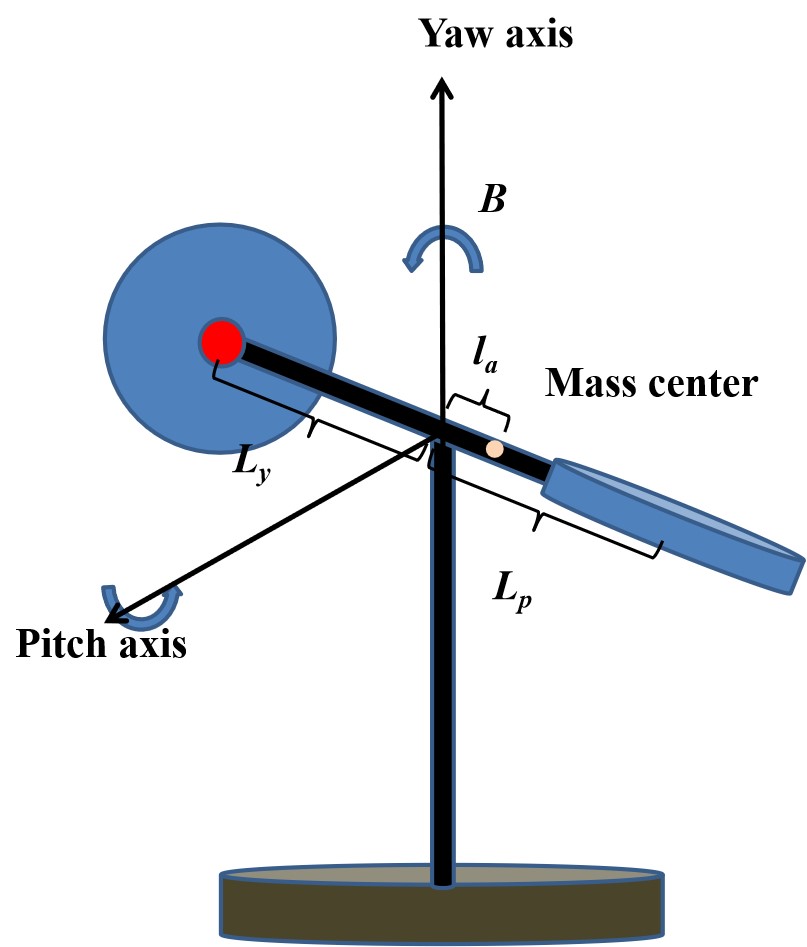
Keywords
Data Availability Statement
Funding
Conflicts of Interest
AI Use Statement
Ethical Approval and Consent to Participate
References
- Bechlioulis, C. P., & Rovithakis, G. A. (2011). Robust partial-state feedback prescribed performance control of cascade systems with unknown nonlinearities. IEEE Transactions on Automatic Control, 56(9), 2224-2230.
[CrossRef] [Google Scholar] - Zhu, X., Chen, J., & Zhu, Z. H. (2021). Adaptive sliding mode disturbance observer-based control for rendezvous with non-cooperative spacecraft. Acta Astronautica, 183, 59-74.
[CrossRef] [Google Scholar] - Guo, J., Pang, Z., & Du, Z. (2025). Combined trajectory and time-planning strategy for rendezvous missions using low-thrust transfer. Astrodynamics, 9(4), 481-493.
[CrossRef] [Google Scholar] - Wang, J., Zhang, C., & Zhang, J. (2021). Analytical solution of satellite formation impulsive reconfiguration considering passive safety constraints. Aerospace Science and Technology, 119, 107108.
[CrossRef] [Google Scholar] - Pavanello, Z., Pirovano, L., Armellin, R., De Vittori, A., & Di Lizia, P. (2025). Collision avoidance maneuver optimization during low-thrust propelled trajectories. Astrodynamics, 9(2), 247-271.
[CrossRef] [Google Scholar] - Zhang, W., Zhao, Y., & Li, D. (2026). Disturbance-Free Payload spacecraft modeling and control: Non-contact architecture for high-precision space missions. Astrodynamics, 1-24.
[CrossRef] [Google Scholar] - Bechlioulis, C. P., Doulgeri, Z., & Rovithakis, G. A. (2012). Guaranteeing prescribed performance and contact maintenance via an approximation free robot force/position controller. Automatica, 48(2), 360-365.
[CrossRef] [Google Scholar] - Shao, X., Hu, Q., Shi, Y., & Jiang, B. (2018). Fault-tolerant prescribed performance attitude tracking control for spacecraft under input saturation. IEEE Transactions on Control Systems Technology, 28(2), 574-582.
[CrossRef] [Google Scholar] - Zhu, X., Chen, J., & Zhu, Z. H. (2021). Adaptive learning observer for spacecraft attitude control with actuator fault. Aerospace Science and Technology, 108, 106389.
[CrossRef] [Google Scholar] - Sun, R., Shan, A., Zhang, C., Wu, J., & Jia, Q. (2021). Quantized fault-tolerant control for attitude stabilization with fixed-time disturbance observer. Journal of Guidance, Control, and Dynamics, 44(2), 449-455.
[CrossRef] [Google Scholar] - Liu, C., Luo, Y., Lyu, B., & Shi, K. (2025). Observer-based dual hybrid nonfragile tracking control for satellite swarm reconstruction. Astrodynamics, 9(5), 643-656.
[CrossRef] [Google Scholar] - Chen, J., Yu, Y., Zheng, Z., & Yuan, J. (2025). Distributed composite state observer-based cooperative control for spacecraft swarm. Astrodynamics, 9(6), 821-835.
[CrossRef] [Google Scholar] - Shao, X., Hu, Q., & Shi, Y. (2020). Adaptive pose control for spacecraft proximity operations with prescribed performance under spatial motion constraints. IEEE Transactions on Control Systems Technology, 29(4), 1405-1419.
[CrossRef] [Google Scholar] - Wei, C., Luo, J., Dai, H., & Duan, G. (2018). Learning-based adaptive attitude control of spacecraft formation with guaranteed prescribed performance. IEEE transactions on cybernetics, 49(11), 4004-4016.
[CrossRef] [Google Scholar] - Shi, X. N., Chen, W., Li, R., Zhou, Z. G., & Wen, K. (2020, July). Prescribed Performance Attitude Tracking Control for Spacecraft under Multi-Constraint. In 2020 39th Chinese Control Conference (CCC) (pp. 270-275). IEEE.
[CrossRef] [Google Scholar] - Liu, Y., Qin, K., Li, W., Shi, M., Lin, B., & Cao, L. (2022). Prescribed performance rotating formation control of multi-spacecraft systems with uncertainties. Drones, 6(11), 348.
[CrossRef] [Google Scholar] - Yang, D., Yang, Y., Zong, G., & Sun, H. (2024). Prescribed performance adaptive fault‐tolerant control for nonlinear systems with actuator faults and input dead‐zone. International Journal of Robust and Nonlinear Control, 34(9), 5949-5965.
[CrossRef] [Google Scholar] - Sun, R., Ahn, C. K., Liu, D., Wang, W., & Zhang, C. (2025). Near-asteroid spacecraft formation control with prescribed-performance: A dynamic event-triggered reinforcement learning control approach. Aerospace Science and Technology, 161, 110138.
[CrossRef] [Google Scholar] - Zhang, W., Wang, Y., & Zhang, Y. (2025). Attention-driven reinforcement learning for multi-satellite collaborative orbital interception strategy solution. Astrodynamics, 9(5), 657-669.
[CrossRef] [Google Scholar] - Holt, H., Baresi, N., & Armellin, R. (2024). Reinforced Lyapunov controllers for low-thrust lunar transfers. Astrodynamics, 8(4), 633-656.
[CrossRef] [Google Scholar] - Li, B., Chen, M., Xia, J., Wu, J., & Guo, H. (2026). Switched Prescribed Performance-based Fault-Tolerant Attitude Tracking Control for Satellite. IEEE Transactions on Automation Science and Engineering.
[CrossRef] [Google Scholar] - Zhang, C., Lu, W., Zhao, S., Wu, J., Zhu, X., Liu, Z., & He, W. (2025). Enhancing Attitude Tracking With Self-Learning Control Using Tanh-Type Learning Intensity. IEEE Transactions on Automation Science and Engineering, 22, 16976-16986.
[CrossRef] [Google Scholar] - Zhang, C., Xiao, B., Wu, J., & Li, B. (2021). On low-complexity control design to spacecraft attitude stabilization: An online-learning approach. Aerospace Science and Technology, 110, 106441.
[CrossRef] [Google Scholar] - Zhang, C., Ma, G., Sun, Y., & Li, C. (2019). Observer-based prescribed performance attitude control for flexible spacecraft with actuator saturation. ISA transactions, 89, 84-95.
[CrossRef] [Google Scholar] - Ma, G., Wu, H., Zhao, Z., Zou, T., & Hong, K.-S. (2022). Adaptive neural network control of a non-linear two-degree-of-freedom helicopter system with prescribed performance. IET Control Theory & Applications, 17(13), 1789-1799.
[CrossRef] [Google Scholar] - Mu, Q., Long, F., & Li, B. (2023). Adaptive neural network prescribed performance control for dual switching nonlinear time-delay system. Scientific Reports, 13(1), 8132.
[CrossRef] [Google Scholar] - Xu, L. X., Wang, Y. L., Wang, X., & Peng, C. (2022). Decentralized event-triggered adaptive control for interconnected nonlinear systems with actuator failures. IEEE Transactions on Fuzzy Systems, 31(1), 148-159.
[CrossRef] [Google Scholar] - Bu, X., Lv, M., Lei, H., & Cao, J. (2023). Fuzzy Neural Pseudo Control With Prescribed Performance for Waverider Vehicles: A Fragility-Avoidance Approach. IEEE Transactions on Cybernetics, 53(8), 4986-4999.
[CrossRef] [Google Scholar] - Han, S. I., & Lee, J. M. (2013). Improved prescribed performance constraint control for a strict feedback non-linear dynamic system. IET Control Theory & Applications, 7(14), 1818-1827.
[CrossRef] [Google Scholar] - Bu, X., Wu, X., Zhu, F., Huang, J., Ma, Z., & Zhang, R. (2015). Novel prescribed performance neural control of a flexible air-breathing hypersonic vehicle with unknown initial errors. ISA transactions, 59, 149-159.
[CrossRef] [Google Scholar] - Lei, J., Meng, T., Wang, W., Li, H., & Jin, Z. (2023). Singularity-Avoidance Prescribed Performance Control for Spacecraft Attitude Tracking. IEEE Transactions on Aerospace and Electronic Systems, 59(5), 5405-5421.
[CrossRef] [Google Scholar] - Liu, Q., Zhang, K., & Jiang, B. (2022). Fixed-time fault estimation and prescribed performance fault-tolerant control for interconnected systems. IEEE Transactions on Cybernetics, 54(2), 1084-1095.
[CrossRef] [Google Scholar] - Bu, X., Jiang, B., & Lei, H. (2022). Nonfragile quantitative prescribed performance control of waverider vehicles with actuator saturation. IEEE Transactions on Aerospace and Electronic Systems, 58(4), 3538-3548.
[CrossRef] [Google Scholar] - Mehdifar, F., Bechlioulis, C. P., Hashemzadeh, F., & Baradarannia, M. (2020). Prescribed performance distance-based formation control of multi-agent systems. Automatica, 119, 109086.
[CrossRef] [Google Scholar] - Rodrigues, V. H. P., Hsu, L., Oliveira, T. R., & Fridman, L. (2022). Adaptive sliding mode control with guaranteed performance based on monitoring and barrier functions. International Journal of Adaptive Control and Signal Processing, 36(6), 1252-1271.
[CrossRef] [Google Scholar] - Obeid, H., Fridman, L. M., Laghrouche, S., & Harmouche, M. (2018). Barrier function-based adaptive sliding mode control. Automatica, 93, 540-544.
[CrossRef] [Google Scholar] - Cruz-Ancona, C. D., Fridman, L., Obeid, H., Laghrouche, S., & Pérez-Pinacho, C. A. (2023). A uniform reaching phase strategy in adaptive sliding mode control. Automatica, 150, 110854.
[CrossRef] [Google Scholar] - Laghrouche, S., Harmouche, M., Chitour, Y., Obeid, H., & Fridman, L. M. (2021). Barrier function-based adaptive higher order sliding mode controllers. Automatica, 123, 109355.
[CrossRef] [Google Scholar] - Obeid, H., Laghrouche, S., Fridman, L., Chitour, Y., & Harmouche, M. (2020). Barrier function-based adaptive super-twisting controller. IEEE Transactions on Automatic Control, 65(11), 4928-4933.
[CrossRef] [Google Scholar] - Zhao, Z., Wu, J., Liu, Z., He, W., & Chen, C. P. (2024). Adaptive neural network control of a 2-DOF helicopter system considering input constraints and global prescribed performance. Science China Information Sciences, 67(7), 172202.
[CrossRef] [Google Scholar] - Zhao, Z., Zhang, J., Liu, Z., Li, H. X., & Chen, C. P. (2024). Event-triggered adaptive neural fault-tolerant control for a 2-DOF helicopter system with prescribed performance. Automatica, 162, 111511.
[CrossRef] [Google Scholar] - Wu, B. (2016). Spacecraft attitude control with input quantization. Journal of Guidance, Control, and Dynamics, 39(1), 176-181.
[CrossRef] [Google Scholar] - Utkin, V. (2013). On convergence time and disturbance rejection of super-twisting control. IEEE Transactions on Automatic Control, 58(8), 2013-2017.
[CrossRef] [Google Scholar] - Kim, S.-K., & Ahn, C. K. (2021). Performance-boosting attitude control for 2-DOF helicopter applications via surface stabilization approach. IEEE Transactions on Industrial Electronics, 69(7), 7234-7243.
[CrossRef] [Google Scholar]
Cited By (2)
-
Xiaoyu Zhu, Kangyi Zhang, Xiaoliang Wang, Qiang Shen, Chengxi Zhang, Dezhi Xu. Variable barrier function-based prescribed performance for attitude tracking with arbitrary initial conditions.
Acta Astronautica, 2026 , 248 .
[CrossRef] -
Lulu Wang, Ao Xu, Mingxiao Sun, Tiantian Luan. Autonomous safety control of unmanned surface vessels formation driven by prescribed performance.
Ocean Engineering, 2026 , 368 .
[CrossRef]
Cite This Article
TY  - JOUR
AU  - Zhu, Xiaoyu
AU  - Sun, Ran
AU  - Wang, Jihe
AU  - Lu, Pukun
PY  - 2026
DA  - 2026/04/22
TI  - Advanced Barrier Function-Based Robust Prescribed Performance Control with Actuator Fault
JO  - Aerospace Engineering Communications
T2  - Aerospace Engineering Communications
JF  - Aerospace Engineering Communications
VL  - 1
IS  - 2
SP  - 68
EP  - 80
DO  - 10.62762/AEC.2026.303859
UR  - https://www.icck.org/article/abs/AEC.2026.303859
KW  - advanced barrier function
KW  - prescribed  performance
KW  - super-twisting control
AB  - This paper investigates prescribed performance control (PPC) using an advanced barrier function (ABF) based adaptive super-twisting control scheme with non-fragility. The specialty of the proposed scheme is that it removes the error transformation process, and therefore simplifies the design of PPC. Furthermore, the ABF is combined with an online adaptation law to solve the problem of fragility inherent to the traditional PPC. The proposed method is robust to actuator faults, unknown initial states, and sudden disturbances. The stability of the system is proved via the Lyapunov framework. Finally, experiments on a two-degree-of-freedom (2-DOF) helicopter platform are conducted to verify the effectiveness of the control strategy.
SN  - 3071-1967
PB  - Institute of Central Computation and Knowledge
LA  - English
ER  -
@article{Zhu2026Advanced,
  author = {Xiaoyu Zhu and Ran Sun and Jihe Wang and Pukun Lu},
  title = {Advanced Barrier Function-Based Robust Prescribed Performance Control with Actuator Fault},
  journal = {Aerospace Engineering Communications},
  year = {2026},
  volume = {1},
  number = {2},
  pages = {68-80},
  doi = {10.62762/AEC.2026.303859},
  url = {https://www.icck.org/article/abs/AEC.2026.303859},
  abstract = {This paper investigates prescribed performance control (PPC) using an advanced barrier function (ABF) based adaptive super-twisting control scheme with non-fragility. The specialty of the proposed scheme is that it removes the error transformation process, and therefore simplifies the design of PPC. Furthermore, the ABF is combined with an online adaptation law to solve the problem of fragility inherent to the traditional PPC. The proposed method is robust to actuator faults, unknown initial states, and sudden disturbances. The stability of the system is proved via the Lyapunov framework. Finally, experiments on a two-degree-of-freedom (2-DOF) helicopter platform are conducted to verify the effectiveness of the control strategy.},
  keywords = {advanced barrier function, prescribed  performance, super-twisting control},
  issn = {3071-1967},
  publisher = {Institute of Central Computation and Knowledge}
}
Publisher's Note
ICCK stays neutral with regard to jurisdictional claims in published maps and institutional affiliations.
Rights and Permissions
 Copyright © 2026 by the Author(s). Published by Institute of Central Computation and Knowledge. This article is an open access article distributed under the terms and conditions of the Creative Commons Attribution (CC BY) license (https://creativecommons.org/licenses/by/4.0/), which permits use, sharing, adaptation, distribution and reproduction in any medium or format, as long as you give appropriate credit to the original author(s) and the source, provide a link to the Creative Commons licence, and indicate if changes were made.


Portico
