
Volume 2, Issue 3


Volume 2, Issue 3 (September, 2026) – 5 articles
Citations: Crossref logo 0,   0   |   Viewed: 2776, Download: 1112

Table of Contents

Open Access | Research Article | 04 September 2026
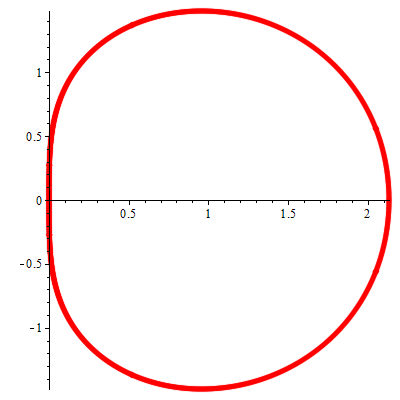
A Modified Third-Order Block Numerical Integration Technique for First Order Stiff and Oscillatory Differential Equations
ICCK Journal of Applied Mathematics | Volume 2, Issue 3: 242-250, 2026 | DOI: 10.62762/JAM.2026.326643
Abstract
This paper proposes a modified two-point block backward differentiation formula (MBBDF) for the numerical solution of highly stiff and oscillatory ordinary differential equations. The method achieves third-order accuracy with a reduced error constant and computes two solution values simultaneously at each step. For the selected parameter value $\rho=-\dfrac{7}{8}$, stability analysis shows that the resulting scheme is A-stable, making it suitable for the numerical integration of stiff initial value problems. The method is also consistent and zero-stable, and hence convergent. Numerical experiments on benchmark stiff problems show that the relative accuracy of the considered methods depends o... More >

Graphical Abstract
A Modified Third-Order Block Numerical Integration Technique for First Order Stiff and Oscillatory Differential Equations
Open Access | Research Article | 31 August 2026
On the Convergence and Order of An Extended 2-Point Super Class BBDF with Two Intermediate Points for Solving Stiff IVPs
ICCK Journal of Applied Mathematics | Volume 2, Issue 3: 233-241, 2026 | DOI: 10.62762/JAM.2026.599481
Abstract
This study investigates the order and convergence properties of an extended two-point superclass Block Backward Differentiation Formula (BBDF) incorporating two intermediate (off-step) points for the numerical solution of stiff initial value problems (IVPs). Stiff systems frequently arise in scientific and engineering applications and require numerical methods that combine stability, accuracy, and computational efficiency. While classical Backward Differentiation Formula (BDF) methods are well known for their stability, their sequential nature limits efficiency, particularly for large-scale problems. To address these limitations, the proposed framework extends the BBDF approach by introducin... More >
Open Access | Research Article | 13 August 2026
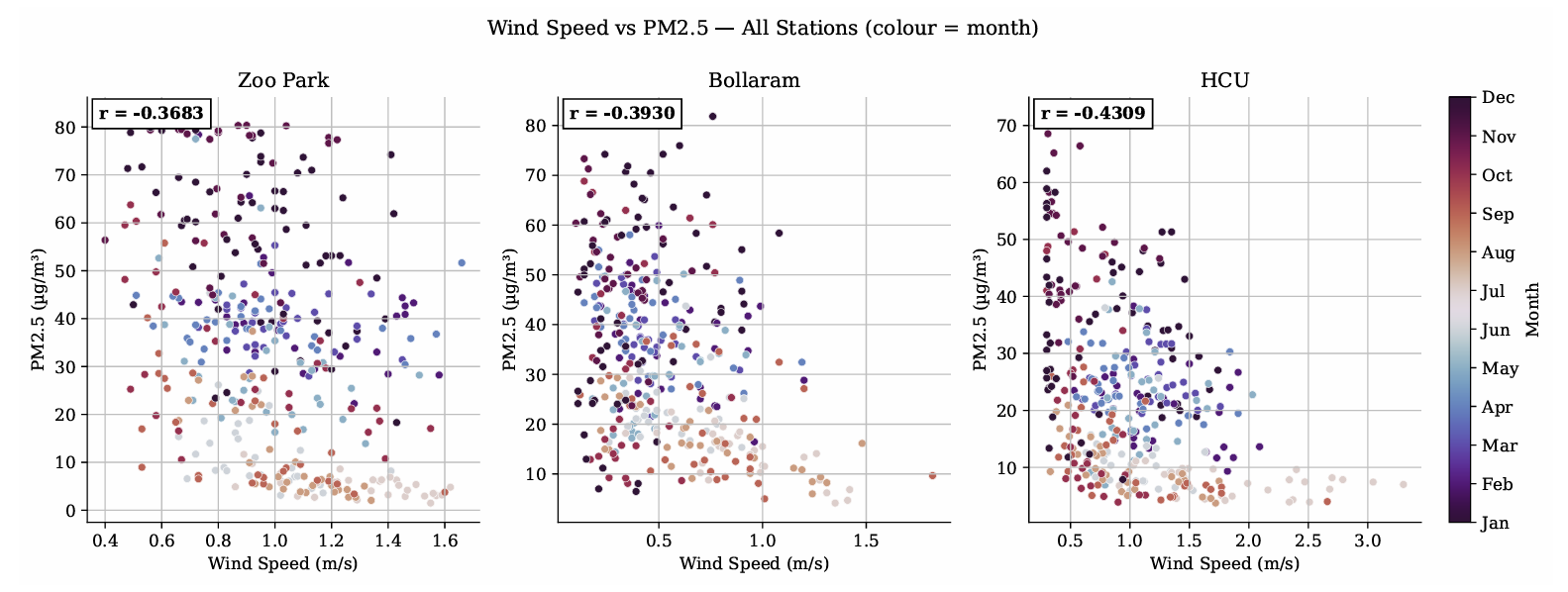
Mathematical Modelling of PM2.5 Dynamics in Hyderabad: A First-Order ODE Approach with Wind-Driven Removal
ICCK Journal of Applied Mathematics | Volume 2, Issue 3: 221-232, 2026 | DOI: 10.62762/JAM.2026.575197
Abstract
Daily mean PM\(_{2.5}\) concentrations in Hyderabad routinely exceed both the 24-hour (\(60\,\mu\text{g/m}^3\)) and the annual (\(40\,\mu\text{g/m}^3\)) National Ambient Air Quality Standards, motivating the development of transparent and inexpensive descriptive models of their seasonal behaviour. To this end, we develop and calibrate a parsimonious first-order linear ordinary differential equation (ODE) that describes the daily evolution of ambient PM\(_{2.5}\) as the balance between a seasonally varying emission source \(E(t)=E_{0}+A\cos(2\pi(t-\varphi)/365)\) and a wind-driven first-order removal \(\lambda(t)=\alpha v(t)+\lambda_{0}\). The five parameters are estimated by Differential Evo... More >

Graphical Abstract
Mathematical Modelling of PM2.5 Dynamics in Hyderabad: A First-Order ODE Approach with Wind-Driven Removal
Open Access | Research Article | 03 August 2026
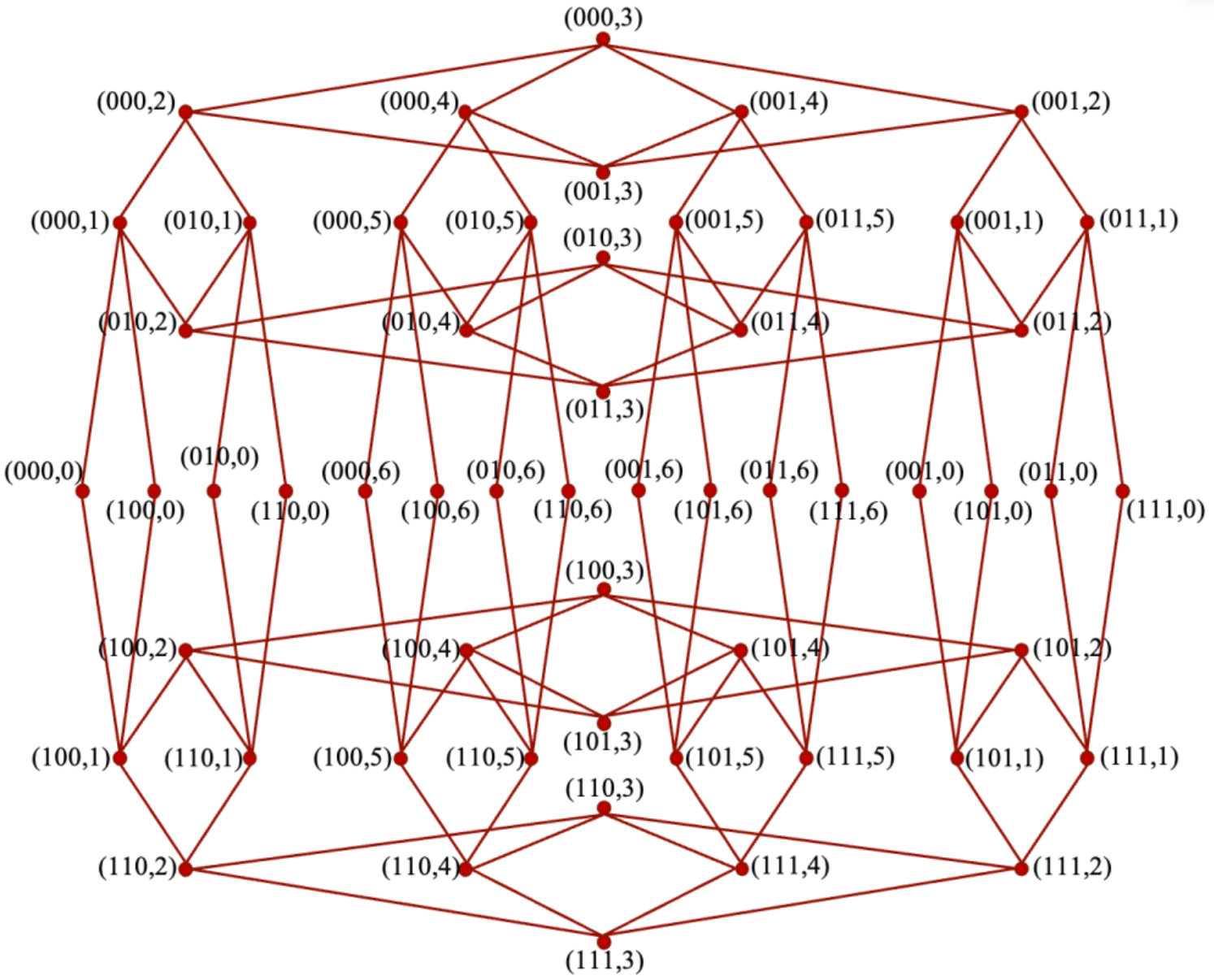
A New Variant of Benes Network: Its Topological Characterisation and Comparative Analysis
ICCK Journal of Applied Mathematics | Volume 2, Issue 3: 204-220, 2026 | DOI: 10.62762/JAM.2026.846434
Abstract
The modern era is characterized by rapid advancements in technology, wherein the design and topology of interconnection networks play a pivotal role in enabling efficient communication systems. The analysis of topological and structural characteristics of interconnection networks, however, remains a challenging task. Graph theory facilitates this process by enabling analytical and efficient solutions through the use of numerical parameters known as topological descriptors. These descriptors have proven to be highly significant, with applications spanning computer science, chemistry, biology, and related domains. This paper deals with the evaluation of topological descriptors for an $n$-dimen... More >

Graphical Abstract
A New Variant of Benes Network: Its Topological Characterisation and Comparative Analysis
Open Access | Research Article | 08 May 2026
The Economic Singularity: Core Mathematical Model
ICCK Journal of Applied Mathematics | Volume 2, Issue 3: 195-203, 2026 | DOI: 10.62762/JAM.2026.366725
Abstract
This paper develops a dynamical systems model of an economy with recursively self-improving artificial intelligence and financialization. The model features quadratic self-amplification in both AI capability ($\lambda A^2$) and financial capital ($\gamma_F K_f^2$), coupled through investment flows. It is shown that under mild conditions, the system exhibits a finite-time singularity where AI capability, AI capital, and financial capital diverge. Near the singularity, the wealth ratio between capital owners and workers diverges super-exponentially, with financialization amplifying the exponent by a factor $\gamma_F/\eta$. Introducing taxes on AI returns ($\tau_{ai}$) and financial gains ($\ta... More >