


A New Variant of Benes Network: Its Topological Characterisation and Comparative Analysis


Article Information
Abstract
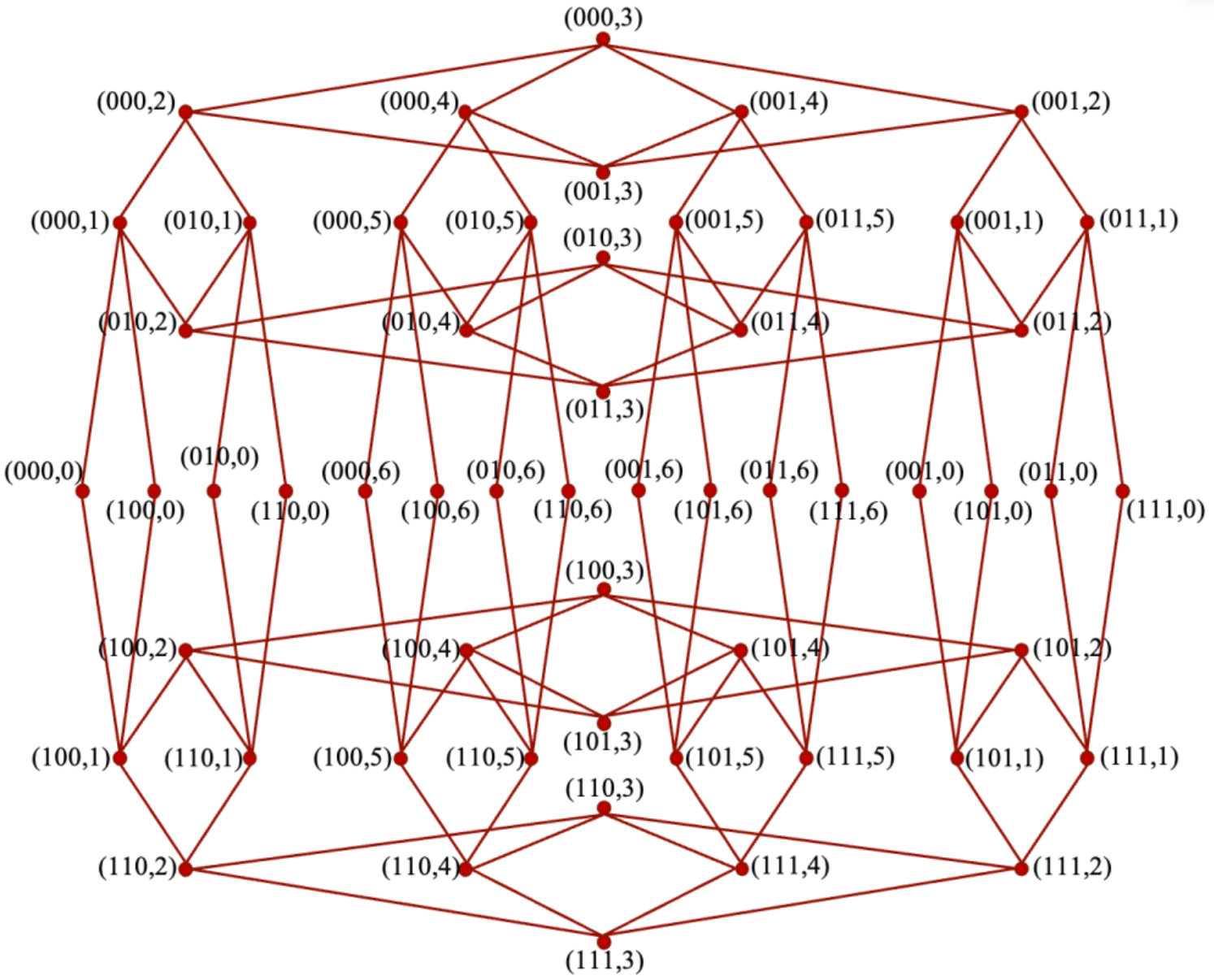
The modern era is characterized by rapid advancements in technology, wherein the design and topology of interconnection networks play a pivotal role in enabling efficient communication systems. The analysis of topological and structural characteristics of interconnection networks, however, remains a challenging task. Graph theory facilitates this process by enabling analytical and efficient solutions through the use of numerical parameters known as topological descriptors. These descriptors have proven to be highly significant, with applications spanning computer science, chemistry, biology, and related domains. This paper deals with the evaluation of topological descriptors for an $n$-dimensional multistage interconnection network, namely the benes network, denoted as $BB(n)$. Additionally, a new variant of the interconnection network is derived from the benes network, called the augmented benes network and denoted as $BB^{*}(n)$. The topological descriptors for the derived network are also determined in this work. Furthermore, the benes network and the augmented benes network undergo a comparative analysis based on selected network parameters, which helps in understanding the efficiency of the newly derived network. A broadcasting algorithm for the augmented benes network is also presented.
Graphical Abstract
Keywords
Data Availability Statement
Funding
Conflicts of Interest
AI Use Statement
Ethical Approval and Consent to Participate
References
- Therese, S. K., Xavier, D. A., & Arokiaraj, A. (2020). Bloom torus: A potential fixed interconnection architecture. Malaya Journal of Matematik (MJM), (1, 2020), 58-65.
[CrossRef] [Google Scholar] - Wiener, H. (1947). Structural determination of paraffin boiling points. Journal of the American Chemical Society, 69(1), 17-20.
[CrossRef] [Google Scholar] - Manuel, P. D., Abd-El-Barr, M. I., Rajasingh, I., & Rajan, B. (2008). An efficient representation of Benes networks and its applications. Journal of Discrete Algorithms, 6(1), 11-19.
[CrossRef] [Google Scholar] - Klavžar, S., & Gutman, I. (1997). Wiener number of vertex-weighted graphs and a chemical application. Discrete applied mathematics, 80(1), 73-81.
[CrossRef] [Google Scholar] - Dobrynin, A. A., Entringer, R., & Gutman, I. (2001). Wiener index of trees: theory and applications. Acta Applicandae Mathematica, 66(3), 211-249.
[CrossRef] [Google Scholar] - Xu, J. (2013). Topological structure and analysis of interconnection networks (Vol. 7). Springer Science and Business Media.
[CrossRef] [Google Scholar] - Yang, J., Fahad, A., Mukhtar, M., Anees, M., Shahzad, A., & Iqbal, Z. (2023). Complexity analysis of Benes network and its derived classes via information functional based entropies. Symmetry, 15(3), 761.
[CrossRef] [Google Scholar] - Zhao, L., Li, Z., & Ma, T. (2024). Making path selection bright: A routing algorithm for on-chip benes networks. Electronics, 13(5), 981.
[CrossRef] [Google Scholar] - Nadjafi-Arani, M. J., Khodashenas, H., & Ashrafi, A. R. (2011). On the differences between Szeged and Wiener indices of graphs. Discrete mathematics, 311(20), 2233-2237.
[CrossRef] [Google Scholar] - Khati, A., & Bisht, S. (2025). Reliability analysis of interconnection networks: A comprehensive review of Shuffle-exchange, Benes, and Gamma networks. Reliability Assessment and Optimization of Complex Systems, 287-308.
[CrossRef] [Google Scholar] - Imran, M., Hayat, S., & Malik, M. Y. H. (2014). On topological indices of certain interconnection networks. Applied Mathematics and Computation, 244, 936-951.
[CrossRef] [Google Scholar] - Numan, M., Naz, N., & Uddin, F. (2020). New results on topological indices for Benes and butterfly networks. University Politehnica of Bucharest Scientific Bulletin-Series A-Applied Mathematics and Physics, 82(3), 33-42. https://www.scientificbulletin.upb.ro/static/pdfs/fulle43_753919.pdf
[Google Scholar] - Siddiqui, H. A. J. R. A., & Farahani, M. (2017). Forgotten polynomial and forgotten index of certain interconnection networks. Open Journal of Mathematical Analysis (OMA), 1, 44-59. https://www.doi.org/10.30538/psrp-oma2017.0005
[Google Scholar] - Klavžar, S., Manuel, P., Nadjafi-Arani, M. J., Rajan, R. S., Grigorious, C., & Stephen, S. (2016). Average distance in interconnection networks via reduction theorems for vertex-weighted graphs. The Computer Journal, 59(12), 1900-1910.
[CrossRef] [Google Scholar] - Hussain, A., Numan, M., Naz, N., Butt, S. I., Aslam, A., & Fahad, A. (2021). On topological indices for new classes of benes network. Journal of Mathematics, 2021(1), 6690053.
[CrossRef] [Google Scholar] - Wang, W., Arshad, H., Fahad, A., & Javaid, I. (2022). On Some Ev-Degree and Ve-Degree Dependent Indices of Benes Network and Its Derived Classes. CMES-Computer Modeling in Engineering and Sciences, 135(2), 1685-1699.
[CrossRef] [Google Scholar] - Bondy, J. A., & Murty, U. S. R. (1976). Graph theory with applications. London: Macmillan. https://www.iro.umontreal.ca/~hahn/IFT3545/GTWA.pdf
[Google Scholar] - Klavžar, S., & Nadjafi-Arani, M. J. (2014). Wiener index in weighted graphs via unification of $\Theta^*$-classes. European Journal of Combinatorics, 36, 71-76.
[CrossRef] [Google Scholar] - Bondy, J. A., & Murty, U. S. R. (2008). Graph theory. Springer Publishing Company, Incorporated. https://dl.acm.org/doi/abs/10.5555/1481153
[Google Scholar] - Lin, B. C. (2023). Fault-Tolerant General Beneš Networks. IEEE Transactions on Communications, 71(12), 6928-6938.
[CrossRef] [Google Scholar]
Cite This Article
TY  - JOUR
AU  - Ullah, Muhammad Qadeer
AU  - Baby, Annmaria
AU  - Ali, Haidar
AU  - Xavier, D. Antony
AU  - Varghese, Eddith Sarah
AU  - Nair, A. Theertha
PY  - 2026
DA  - 2026/08/03
TI  - A New Variant of Benes Network: Its Topological Characterisation and Comparative Analysis
JO  - ICCK Journal of Applied Mathematics
T2  - ICCK Journal of Applied Mathematics
JF  - ICCK Journal of Applied Mathematics
VL  - 2
IS  - 3
SP  - 204
EP  - 220
DO  - 10.62762/JAM.2026.846434
UR  - https://www.icck.org/article/abs/JAM.2026.846434
KW  - complex networks
KW  - benes network
KW  - augmented benes network
KW  - distance based descriptors
KW  - Network parameters
KW  - broadcasting algorithm
KW  - network structures
AB  - The modern era is characterized by rapid advancements in technology, wherein the design and topology of interconnection networks play a pivotal role in enabling efficient communication systems. The analysis of topological and structural characteristics of interconnection networks, however, remains a challenging task. Graph theory facilitates this process by enabling analytical and efficient solutions through the use of numerical parameters known as topological descriptors. These descriptors have proven to be highly significant, with applications spanning computer science, chemistry, biology, and related domains. This paper deals with the evaluation of topological descriptors for an $n$-dimensional multistage interconnection network, namely the benes network, denoted as $BB(n)$. Additionally, a new variant of the interconnection network is derived from the benes network, called the augmented benes network and denoted as $BB^{*}(n)$. The topological descriptors for the derived network are also determined in this work. Furthermore, the benes network and the augmented benes network undergo a comparative analysis based on selected network parameters, which helps in understanding the efficiency of the newly derived network. A broadcasting algorithm for the augmented benes network is also presented.
SN  - 3068-5656
PB  - Institute of Central Computation and Knowledge
LA  - English
ER  -
@article{Ullah2026A,
  author = {Muhammad Qadeer Ullah and Annmaria Baby and Haidar Ali and D. Antony Xavier and Eddith Sarah Varghese and A. Theertha Nair},
  title = {A New Variant of Benes Network: Its Topological Characterisation and Comparative Analysis},
  journal = {ICCK Journal of Applied Mathematics},
  year = {2026},
  volume = {2},
  number = {3},
  pages = {204-220},
  doi = {10.62762/JAM.2026.846434},
  url = {https://www.icck.org/article/abs/JAM.2026.846434},
  abstract = {The modern era is characterized by rapid advancements in technology, wherein the design and topology of interconnection networks play a pivotal role in enabling efficient communication systems. The analysis of topological and structural characteristics of interconnection networks, however, remains a challenging task. Graph theory facilitates this process by enabling analytical and efficient solutions through the use of numerical parameters known as topological descriptors. These descriptors have proven to be highly significant, with applications spanning computer science, chemistry, biology, and related domains. This paper deals with the evaluation of topological descriptors for an \$n\$-dimensional multistage interconnection network, namely the benes network, denoted as \$BB(n)\$. Additionally, a new variant of the interconnection network is derived from the benes network, called the augmented benes network and denoted as \$BB^{*}(n)\$. The topological descriptors for the derived network are also determined in this work. Furthermore, the benes network and the augmented benes network undergo a comparative analysis based on selected network parameters, which helps in understanding the efficiency of the newly derived network. A broadcasting algorithm for the augmented benes network is also presented.},
  keywords = {complex networks, benes network, augmented benes network, distance based descriptors, Network parameters, broadcasting algorithm, network structures},
  issn = {3068-5656},
  publisher = {Institute of Central Computation and Knowledge}
}
Article Metrics
Publisher's Note
ICCK stays neutral with regard to jurisdictional claims in published maps and institutional affiliations.
Rights and Permissions
 Copyright © 2026 by the Author(s). Published by Institute of Central Computation and Knowledge. This article is an open access article distributed under the terms and conditions of the Creative Commons Attribution (CC BY) license (https://creativecommons.org/licenses/by/4.0/), which permits use, sharing, adaptation, distribution and reproduction in any medium or format, as long as you give appropriate credit to the original author(s) and the source, provide a link to the Creative Commons licence, and indicate if changes were made.

