


Modified Hiemenz Stagnation Point Flow of Second Grade Nano Fluid



Article Information
Abstract
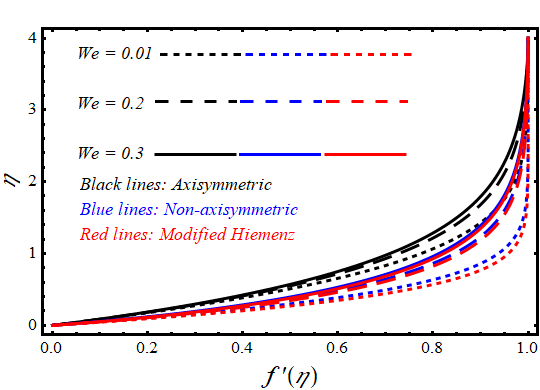
Three-dimensional (3D) flow of a viscoelastic fluid in the neighborhood of new family of modified stagnation point depending on shear to strain ratio over a flat surface is numerically investigated. Similarity equations are obtained from the fundamental conservation laws of mass, momentum, energy and nanoparticle concentration. The resulting set of nonlinear equations are solved numerically using an implicit finite difference scheme known as Keller-Box Method. A comparative analysis for modified Hiemenz flow, non-axisymmetric stagnation point and axisymmetric stagnation point flow is carried out. Velocity, temperature and concentration profiles, skin frictions local Nusselt and Sherwood numbers are graphically presented and their variation with involved parameters is discussed in detail. We found that velocity concentration and temperature profiles increase by an increasing the values of We.
Graphical Abstract
Keywords
Data Availability Statement
Funding
Conflicts of Interest
Ethical Approval and Consent to Participate
References
- Hiemenz, K. (1911). Die Grenzschicht an einem in den gleichformigen Flussigkeitsstrom eingetauchten geraden kreiszylinder. Gottingen dissertation. Dingler's polytech. J, 326, 311.
[Google Scholar] - Ariel, P. D. (1995). A numerical algorithm for computing the stagnation point flow of a second grade fluid with/without suction. Journal of Computational and Applied Mathematics, 59(1), 9-24.
[CrossRef] [Google Scholar] - Ariel, P. D. (2001). Axisymmetric flow of a second grade fluid past a stretching sheet. International Journal of Engineering Science, 39(5), 529-553.
[CrossRef] [Google Scholar] - Ariel, P. D. (2002). On extra boundary condition in the stagnation point flow of a second grade fluid. International Journal of Engineering Science, 40(2), 145-162.
[CrossRef] [Google Scholar] - Attia, H. A. (2003). Homann magnetic flow and heat transfer with uniform suction or injection. Canadian Journal of Physics, 81(10), 1223-1230.
[CrossRef] [Google Scholar] - Barış, S., & Dokuz, M. S. (2006). Three-dimensional stagnation point flow of a second grade fluid towards a moving plate. International Journal of Engineering Science, 44(1-2), 49-58.
[CrossRef] [Google Scholar] - Dunn, J. E., & Fosdick, R. L. (1974). Thermodynamics, stability, and boundedness of fluids of complexity 2 and fluids of second grade. Archive for Rational mechanics and Analysis, 56(3), 191-252.
[CrossRef] [Google Scholar] - Gorla, R. S. R. (1978). Nonsimilar axisymmetric stagnation flow on a moving cylinder. International Journal of Engineering Science, 16(6), 397-400.
[CrossRef] [Google Scholar] - Hayat, T., Anwar, M. S., Farooq, M., & Alsaedi, A. (2014). MHD stagnation point flow of second grade fluid over a stretching cylinder with heat and mass transfer. International Journal of Nonlinear Sciences and Numerical Simulation, 15(6), 365-376.
[CrossRef] [Google Scholar] - Ahmad, M., Ahmad, I., & Sajid, M. (2016). Heat transfer analysis in an axisymmetric stagnation-point flow of second grade fluid over a lubricated surface. American Journal of Heat and Mass Transfer, 3(1), 1-14.
[Google Scholar] - Homann, F. (1936). Einfluß großer zähigkeit bei strömung um zylinder. Forschung auf dem Gebiet des Ingenieurwesens A, 7(1), 1-10.
[CrossRef] [Google Scholar] - Ishihara, Y., & Paullet, J. E. (2008). Dual solutions for axisymmetric stagnation point flow over a lubricated surface. Communications in Applied Analysis, 12(3), 289-296.
[Google Scholar] - Khan, M., El Shafey, A. M., Salahuddin, T., & Khan, F. (2020). Chemically Homann stagnation point flow of Carreau fluid. Physica A: Statistical Mechanics and its Applications, 551, 124066.
[CrossRef] [Google Scholar] - Khan, M., Sarfraz, M., Ahmed, J., Ahmad, L., & Fetecau, C. (2020). Non-axisymmetric Homann stagnation-point flow of Walter’s B nanofluid over a cylindrical disk. Applied Mathematics and Mechanics, 41(5), 725-740.
[CrossRef] [Google Scholar] - Labropulu, F., & Li, D. (2008). Stagnation-point flow of a second-grade fluid with slip. International Journal of Non-Linear Mechanics, 43(9), 941-947.
[CrossRef] [Google Scholar] - Libby, P. A. (1962). The homogeneous boundary layer at an axisymmetric stagnation point with large rates of injection. Journal of the Aerospace Sciences, 29(1), 48-60.
[CrossRef] [Google Scholar] - Lin, T. C., & Schaaf, S. A. (1951). Effect of slip on flow near a stagnation point and in a boundary layer (No. NACA-TN-2568).
[Google Scholar] - Mahabaleshwar, U. S., Nagaraju, K. R., Nadagoud, M. N., Bennacer, R., & Baleanu, D. (2020). An MHD viscous liquid stagnation point flow and heat transfer with thermal radiation and transpiration. Thermal Science and Engineering Progress, 16, 100379.
[CrossRef] [Google Scholar] - Nadeem, S., Ishtiaq, B., Almutairi, S., & Ghazwani, H. A. (2022). Impact of Cattaneo–Christov double diffusion on 3d stagnation point axisymmetric flow of second-grade nanofluid towards a riga plate. International Journal of Modern Physics B, 36(29), 2250205.
[CrossRef] [Google Scholar] - Nawaz, M., Alsaedi, A., Hayat, T., & Alhothauli, M. S. (2013). Dufour and Soret effects in an axisymmetric stagnation point flow of second grade fluid with newtonian heating. Journal of Mechanics, 29(1), 27-34.
[CrossRef] [Google Scholar] - Rahimi, A. B., & Saleh, R. (2007). Axisymmetric Stagnation—Point Flow and Heat Transfer of a Viscous Fluid on a Rotating Cylinder With Time-Dependent Angular Velocity and Uniform Transpiration. Journal of Fluids Engineering, 129(1), 106-115.
[CrossRef] [Google Scholar] - Rott, N. (1956). Unsteady viscous flow in the vicinity of a stagnation point. Quarterly of Applied Mathematics, 13(4), 444-451.
[Google Scholar] - Sahoo, B., & Labropulu, F. (2012). Steady Homann flow and heat transfer of an electrically conducting second grade fluid. Computers & Mathematics with Applications, 63(7), 1244-1255.
[CrossRef] [Google Scholar] - Saif, R. S., Hayat, T., Ellahi, R., Muhammad, T., & Alsaedi, A. (2017). Stagnation-point flow of second grade nanofluid towards a nonlinear stretching surface with variable thickness. Results in physics, 7, 2821-2830.
[CrossRef] [Google Scholar] - Sajid, M., Mahmood, K., & Abbas, Z. (2012). Axisymmetric stagnation-point flow with a general slip boundary condition over a lubricated surface. Chinese Physics Letters, 29(2), 024702.
[CrossRef] [Google Scholar] - Saleh, R., & Rahimi, A. B. (2004). Axisymmetric stagnation-point flow and heat transfer of a viscous fluid on a moving cylinder with time-dependent axial velocity and uniform transpiration. Journal of Fluids Engineering, 126(6), 997-1005.
[CrossRef] [Google Scholar] - Santra, B., Dandapat, B. S., & Andersson, H. I. (2007). Axisymmetric stagnation-point flow over a lubricated surface. Acta Mechanica, 194(1), 1-10.
[CrossRef] [Google Scholar] - Takhar, H. S., Chamkha, A. J., & Nath, G. (1999). Unsteady axisymmetric stagnation-point flow of a viscous fluid on a cylinder. International Journal of Engineering Science, 37(15), 1943-1957.
[CrossRef] [Google Scholar] - Wang, C. Y. (1973). Axisymmetric stagnation flow towards a moving plate. AIChE Journal, 19(5), 1080-1081.
[CrossRef] [Google Scholar] - Weidman, P. (2014). Axisymmetric stagnation-point flow on a spiraling disk. Physics of Fluids, 26(7).
[CrossRef] [Google Scholar] - Weidman, P. D., & Mahalingam, S. (1997). Axisymmetric stagnation-point flow impinging on a transversely oscillating plate with suction. Journal of Engineering Mathematics, 31(2), 305-318.
[CrossRef] [Google Scholar] - Weidman, P. D. (2021). Three‐dimensional Hiemenz stagnation‐point flows. ZAMM‐Journal of Applied Mathematics and Mechanics/Zeitschrift für Angewandte Mathematik und Mechanik, 101(2), e201900319.
[CrossRef] [Google Scholar] - Zhong, Y., & Fang, T. (2011). Unsteady stagnation-point flow over a plate moving along the direction of flow impingement. International journal of heat and mass transfer, 54(15-16), 3103-3108.
[CrossRef] [Google Scholar] - Ziabakhsh, Z., Domairry, G., & Ghazizadeh, H. R. (2009). Analytical solution of the stagnation-point flow in a porous medium by using the homotopy analysis method. Journal of the Taiwan Institute of Chemical Engineers, 40(1), 91-97.
[CrossRef] [Google Scholar]
Cited By (7)
-
S. Ravikumar, Ali B.M. Ali, Raghunath Kodi, Ghulam Rasool, Umid Turdialiyev, Dilsora Abduvalieva, M.Ijaz Khan, Nidhal Ben Khedher. Computational modeling of peristaltic blood flow in a tapered channel with radiative heat flux and reaction mechanisms.
South African Journal of Chemical Engineering, 2026 , 55 .
[CrossRef] -
Sana Altaf, Aamar Abbasi, Waseh Farooq. Nonlinear Radiative Oblique Stagnation‐Point Flow of Jeffrey Fluid Over Stretching Cylinder.
Heat Transfer, 2026 , 55 (1).
[CrossRef] -
Ghulam Rasool, Ali B. M. Ali, Yahia Said, Salah Saadaoui, Oumaima Saidani, Rasan Sarbast Faisal, Shoira Formanova, M. Ijaz Khan. Pre-heating Li-battery model for extremely low temperature conditions and role of phase change materials.
Journal of Thermal Analysis and Calorimetry, 2026 , 151 (1).
[CrossRef] -
Asad Ullah, Laila A. AL-Essa, Bilal Ahmad Khan. A neural network-based analysis of thermal slip and heat transfer in steady non-axisymmetric stagnation-point penta hybrid nanofluid flows.
Thermal Science and Engineering Progress, 2026 , 76 .
[CrossRef] -
M. Salman Kausar, Ali B.M. Ali, Talha Anwar, M. Nasir, S. Saleem, M. Waqas, Tadesse Walelign. Thermal energy optimization in Darcy-Forchheimer slip flow featuring viscoplastic (Casson) model subjected to diffusion of chemically reactive species.
Case Studies in Thermal Engineering, 2025 , 76 .
[CrossRef] -
F. Shahzad, Ali B.M. Ali, M. Waqas, Gaganjot Kaur, Ramneek Sidhu, Tadesse Walelign, Umid Turdialiyev, Nidhal Ben Khedher. Thermo-magnetic stratified flow capturing Soret-Dufour impacts in rate type reactive material under varying liquid aspects and stratifications.
International Journal of Thermofluids, 2025 , 30 .
[CrossRef] -
T. Salahuddin, A. Maqsood, Muhammad Awais, Mair Khan, Anum Tanveer, Samia Elattar. Double-layer stratification of Cross fluid flow with viscous dissipation and variable thermal conductivity.
Dynamics of Atmospheres and Oceans, 2025 , 112 .
[CrossRef]
Cite This Article
TY  - JOUR
AU  - Abbasi, Aamar Kamal
AU  - Ali, Ali B. M.
AU  - Naseer, Misbah
AU  - Farooq, Waseh
AU  - Ali, Shahid
AU  - Rafiq, Muhammad
PY  - 2025
DA  - 2025/08/26
TI  - Modified Hiemenz Stagnation Point Flow of Second Grade Nano Fluid
JO  - ICCK Journal of Applied Mathematics
T2  - ICCK Journal of Applied Mathematics
JF  - ICCK Journal of Applied Mathematics
VL  - 1
IS  - 2
SP  - 66
EP  - 85
DO  - 10.62762/JAM.2025.411313
UR  - https://www.icck.org/article/abs/JAM.2025.411313
KW  - modified hiemenz flow
KW  - second grade fluid
KW  - numerical solution
KW  - nanofluid
KW  - Keller-Box method
AB  - Three-dimensional (3D) flow of a viscoelastic fluid in the neighborhood of new family of modified stagnation point depending on shear to strain ratio over a flat surface is numerically investigated. Similarity equations are obtained from the fundamental conservation laws of mass, momentum, energy and nanoparticle concentration. The resulting set of nonlinear equations are solved numerically using an implicit finite difference scheme known as Keller-Box Method. A comparative analysis for modified Hiemenz flow, non-axisymmetric stagnation point and axisymmetric stagnation point flow is carried out. Velocity, temperature and concentration profiles, skin frictions local Nusselt and Sherwood numbers are graphically presented and their variation with involved parameters is discussed in detail. We found that velocity concentration and temperature profiles increase by an increasing the values of We.
SN  - 3068-5656
PB  - Institute of Central Computation and Knowledge
LA  - English
ER  -
@article{Abbasi2025Modified,
  author = {Aamar Kamal Abbasi and Ali B. M. Ali and Misbah Naseer and Waseh Farooq and Shahid Ali and Muhammad Rafiq},
  title = {Modified Hiemenz Stagnation Point Flow of Second Grade Nano Fluid},
  journal = {ICCK Journal of Applied Mathematics},
  year = {2025},
  volume = {1},
  number = {2},
  pages = {66-85},
  doi = {10.62762/JAM.2025.411313},
  url = {https://www.icck.org/article/abs/JAM.2025.411313},
  abstract = {Three-dimensional (3D) flow of a viscoelastic fluid in the neighborhood of new family of modified stagnation point depending on shear to strain ratio over a flat surface is numerically investigated. Similarity equations are obtained from the fundamental conservation laws of mass, momentum, energy and nanoparticle concentration. The resulting set of nonlinear equations are solved numerically using an implicit finite difference scheme known as Keller-Box Method. A comparative analysis for modified Hiemenz flow, non-axisymmetric stagnation point and axisymmetric stagnation point flow is carried out. Velocity, temperature and concentration profiles, skin frictions local Nusselt and Sherwood numbers are graphically presented and their variation with involved parameters is discussed in detail. We found that velocity concentration and temperature profiles increase by an increasing the values of We.},
  keywords = {modified hiemenz flow, second grade fluid, numerical solution, nanofluid, Keller-Box method},
  issn = {3068-5656},
  publisher = {Institute of Central Computation and Knowledge}
}
Publisher's Note
ICCK stays neutral with regard to jurisdictional claims in published maps and institutional affiliations.
Rights and Permissions
 Copyright © 2025 by the Author(s). Published by Institute of Central Computation and Knowledge. This article is an open access article distributed under the terms and conditions of the Creative Commons Attribution (CC BY) license (https://creativecommons.org/licenses/by/4.0/), which permits use, sharing, adaptation, distribution and reproduction in any medium or format, as long as you give appropriate credit to the original author(s) and the source, provide a link to the Creative Commons licence, and indicate if changes were made.

