

Bifurcation and Stability Analysis of Transmission Dynamics of Ebola Virus Using Seirvh Model



Article Information
Abstract
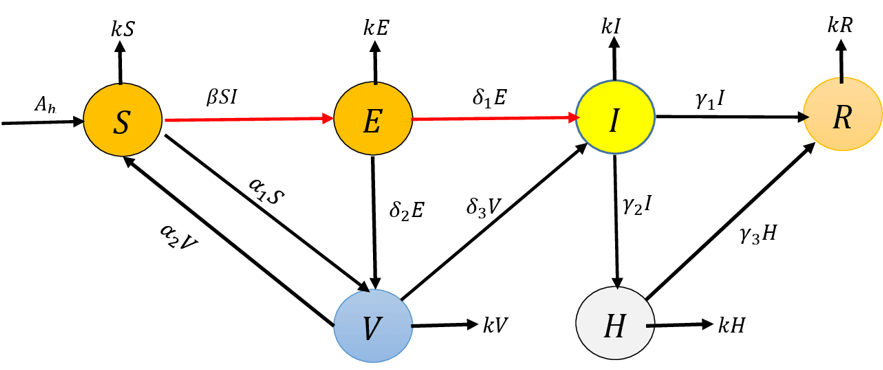
This study presents a mathematical framework to analyze the transmission dynamics of the Ebola Virus Disease (EVD) using an extended SEIRVH model. The model incorporates vaccinated and hospitalized compartments, addressing critical factors such as vaccination efficacy, healthcare interventions, and natural disease progression. Differential equations describe the transitions between six population compartments. The study evaluates model stability and bifurcation through well-posedness, positivity, and boundedness analyzes, ensuring realistic and biologically valid solutions. The basic reproduction number, R0, derived from the next generation matrix, serves as a threshold for outbreak control. Local and global stability analyzes of disease-free and endemic equilibria reveal critical insights into epidemic thresholds and long-term dynamics. Furthermore, sensitivity analysis highlights key parameters that influence R0, emphasizing the importance of vaccination and hospitalization in mitigating EVD outbreaks. Numerical simulations validate theoretical findings, underscoring the model's utility in informing effective public health strategies, such as vaccination campaigns and hospitalization measures, for controlling EVD transmission. This research provides a robust analytical and computational tool for understanding and managing the spread of Ebola and similar infectious diseases.
Graphical Abstract
Keywords
Data Availability Statement
Funding
Conflicts of Interest
Ethical Approval and Consent to Participate
References
- Piot, P., Sureau, P., Breman, G., Heymann, D., Kintoki, V., Masamba, M., & Mbuy, M. (1978). Clinical aspects of Ebola virus infection in Yambuku area, Zaire 1976. African Journal of Infectious Diseases, 210(96), 34–51.
[Google Scholar] - Chretien, J. P., Riley, S., & George, D. B. (2015). Mathematical modeling of the West Africa Ebola epidemic. Elife, 4, e09186.
[CrossRef] [Google Scholar] - Durojaye, M., & Ajie, J. (2017). Mathematical model of the spread and control of Ebola virus disease. Applied Mathematics, 7, 23–31.
[Google Scholar] - Mbah, G. C., Sunday, O. I., Ojoma, A. Q., Christopher, A., & Chukwudi, O. (2023). Mathematical modelling approach of the study of Ebola virus disease transmission dynamics in a developing country. African Journal of Infectious Diseases, 17(1), 10–26.
[Google Scholar] - Tadmon, C., & Kengne, J. N. (2022). Mathematical analysis of a model of Ebola disease with control measures. International Journal of Biomathematics, 15(07), 2250048.
[CrossRef] [Google Scholar] - Djiomba Njankou, S. D. (2019). Mathematical models of Ebola virus disease with socio-economic dynamics (Doctoral dissertation, Stellenbosch: Stellenbosch University).
[Google Scholar] - Ahmad, W., & Abbas, M. (2021). Effect of quarantine on transmission dynamics of Ebola virus epidemic: a mathematical analysis. The European Physical Journal Plus, 136(4), 1-33.
[CrossRef] [Google Scholar] - La Salle, J. P. (1976). The stability of dynamical systems. Society for Industrial and Applied Mathematics.
[Google Scholar] - Shah, I., Alrabaiah, H., & Ozdemir, B. (2023). Using advanced analysis together with fractional order derivative to investigate a smoking tobacco cancer model. Results in Physics, 51, 106700.
[CrossRef] [Google Scholar] - Juga, M. L., Nyabadza, F., & Chirove, F. (2021). An Ebola virus disease model with fear and environmental transmission dynamics. Infectious Disease Modelling, 6, 545-559.
[CrossRef] [Google Scholar] - Funk, S., Gilad, E., Watkins, C., & Jansen, V. A. A. (2009). The spread of awareness and its impact on epidemic outbreaks. Proceedings of the National Academy of Sciences, 106(16), 6872–6877.
[CrossRef] [Google Scholar] - Chamchod, F., & Britton, N. F. (2012). On the dynamics of a two-strain influenza model with isolation. Mathematical Modelling of Natural Phenomena, 7(3), 49–61.
[CrossRef] [Google Scholar] - Day, T., Park, A., Madras, N., Gumel, A. B., & Wu, J. (2006). When is quarantine a useful control strategy for emerging infectious diseases? American Journal of Epidemiology, 163(5), 479–485.
[CrossRef] [Google Scholar] - Safi, M., & Gumel, A. B. (2013). Dynamics of a model with quarantine-adjusted incidence and quarantine of susceptible individuals. Journal of Mathematical Analysis and Applications, 399(2), 565–575.
[CrossRef] [Google Scholar] - Zakary, O., Rachik, M., & Elmouki, I. (2017). On the analysis of a multi-regions discrete SIR epidemic model: An optimal control approach. International Journal of Dynamics and Control, 5(3), 917–930.
[CrossRef] [Google Scholar] - Brauer, F., Castillo-Chavez, C., & Castillo-Chavez, C. (2012). Mathematical models in population biology and epidemiology (Vol. 2, No. 10). New York: springer.
[Google Scholar] - Chavez, C. C., Feng, Z., & Huang, W. (2002). On the computation of R0 and its role on global stability. Mathematical approaches for emerging and re-emerging infection diseases: An introduction, 125, 31-65.
[Google Scholar] - Thabet, S. T., Abdo, M. S., Shah, K., & Abdeljawad, T. (2020). Study of transmission dynamics of COVID-19 mathematical model under ABC fractional order derivative. Results in Physics, 19, 103507.
[CrossRef] [Google Scholar] - Aja, R. O., Omale, D., & Mbah, G. C. E. (2017). Sensitivity Analysis of the Mathematical Model on the Control of HBV-HDV co-infection Transmission Dynamics in a Given Population. Journal of the Nigerian Association of Mathematical Physics, 39, 457-470.
[Google Scholar] - Kotola, B. S., Teklu, S., & Abebaw, Y. F. (2023). Bifurcation and optimal control analysis of HIV/AIDS and COVID-19 co-infection model with numerical simulation. PLoS ONE, 18(5), e0284759.
[CrossRef] [Google Scholar] - Chitnis, N., Hyman, J. M., & Cushing, J. M. (2008). Determining important parameters in the spread of malaria through the sensitivity analysis of a mathematical model. Bulletin of Mathematical Biology, 70(5), 1272–1296.
[CrossRef] [Google Scholar] - Van den Driessche, P., & Watmough, J. (2008). Further notes on the basic reproduction number. Journal of Mathematical Biology, 56(1), 159–178.
[CrossRef] [Google Scholar] - Delamater, P. L., Street, E. J., Leslie, T. F., Yang, Y. T., & Jacobsen, K. H. (2019). Complexity of the basic reproduction number \(R_0\). Emerging Infectious Diseases, 25(1), 1–4.
[CrossRef] [Google Scholar] - Mahardika, R., Widowati, & Sumanto, Y. D. (2019, May). Routh-hurwitz criterion and bifurcation method for stability analysis of tuberculosis transmission model. In Journal of physics: Conference series (Vol. 1217, No. 1, p. 012056). IOP Publishing.
[CrossRef] [Google Scholar] - Brettin, A., Goldthorpe, R., Weishaar, K., & Erovenko, I. V. (2018). Ebola could be eradicated through voluntary vaccination. Royal Society Open Science, 5(5), 171591.
[CrossRef] [Google Scholar]
Cited By (1)
-
Shahid Rafiq, Ali B. M. Ali, Salma Aslam, F. F. Al-Harbi, Hameed Ullah, Dilsora Abduvalieva, Nadia Batool. Modeling and Simulation of Radiated Upper Convected Maxwell Fluid Flow in a Parallel Plate Channel.
Journal of Vibration Engineering & Technologies, 2025 , 13 (8).
[CrossRef]
Cite This Article
TY  - JOUR
AU  - Ahmad, Imtiaz
AU  - Ullah, Wali
AU  - Islam, Saeed
AU  - Ali, Nigar
AU  - Younas, Hazrat
AU  - Khan, Muhammad Ijaz
PY  - 2025
DA  - 2025/07/27
TI  - Bifurcation and Stability Analysis of Transmission Dynamics of Ebola Virus Using Seirvh Model
JO  - ICCK Journal of Applied Mathematics
T2  - ICCK Journal of Applied Mathematics
JF  - ICCK Journal of Applied Mathematics
VL  - 1
IS  - 2
SP  - 41
EP  - 51
DO  - 10.62762/JAM.2025.550087
UR  - https://www.icck.org/article/abs/JAM.2025.550087
KW  - EBOLA
KW  - stability analysis
KW  - sensitivity analysis
KW  - bifurcation analysis
KW  - RK-4 method
AB  - This study presents a mathematical framework to analyze the transmission dynamics of the Ebola Virus Disease (EVD) using an extended SEIRVH model. The model incorporates vaccinated and hospitalized compartments, addressing critical factors such as vaccination efficacy, healthcare interventions, and natural disease progression. Differential equations describe the transitions between six population compartments. The study evaluates model stability and bifurcation through well-posedness, positivity, and boundedness analyzes, ensuring realistic and biologically valid solutions. The basic reproduction number, R0, derived from the next generation matrix, serves as a threshold for outbreak control. Local and global stability analyzes of disease-free and endemic equilibria reveal critical insights into epidemic thresholds and long-term dynamics. Furthermore, sensitivity analysis highlights key parameters that influence R0, emphasizing the importance of vaccination and hospitalization in mitigating EVD outbreaks. Numerical simulations validate theoretical findings, underscoring the model's utility in informing effective public health strategies, such as vaccination campaigns and hospitalization measures, for controlling EVD transmission. This research provides a robust analytical and computational tool for understanding and managing the spread of Ebola and similar infectious diseases.
SN  - 3068-5656
PB  - Institute of Central Computation and Knowledge
LA  - English
ER  -
@article{Ahmad2025Bifurcatio,
  author = {Imtiaz Ahmad and Wali Ullah and Saeed Islam and Nigar Ali and Hazrat Younas and Muhammad Ijaz Khan},
  title = {Bifurcation and Stability Analysis of Transmission Dynamics of Ebola Virus Using Seirvh Model},
  journal = {ICCK Journal of Applied Mathematics},
  year = {2025},
  volume = {1},
  number = {2},
  pages = {41-51},
  doi = {10.62762/JAM.2025.550087},
  url = {https://www.icck.org/article/abs/JAM.2025.550087},
  abstract = {This study presents a mathematical framework to analyze the transmission dynamics of the Ebola Virus Disease (EVD) using an extended SEIRVH model. The model incorporates vaccinated and hospitalized compartments, addressing critical factors such as vaccination efficacy, healthcare interventions, and natural disease progression. Differential equations describe the transitions between six population compartments. The study evaluates model stability and bifurcation through well-posedness, positivity, and boundedness analyzes, ensuring realistic and biologically valid solutions. The basic reproduction number, R0, derived from the next generation matrix, serves as a threshold for outbreak control. Local and global stability analyzes of disease-free and endemic equilibria reveal critical insights into epidemic thresholds and long-term dynamics. Furthermore, sensitivity analysis highlights key parameters that influence R0, emphasizing the importance of vaccination and hospitalization in mitigating EVD outbreaks. Numerical simulations validate theoretical findings, underscoring the model's utility in informing effective public health strategies, such as vaccination campaigns and hospitalization measures, for controlling EVD transmission. This research provides a robust analytical and computational tool for understanding and managing the spread of Ebola and similar infectious diseases.},
  keywords = {EBOLA, stability analysis, sensitivity analysis, bifurcation analysis, RK-4 method},
  issn = {3068-5656},
  publisher = {Institute of Central Computation and Knowledge}
}
Publisher's Note
ICCK stays neutral with regard to jurisdictional claims in published maps and institutional affiliations.
Rights and Permissions
 Copyright © 2025 by the Author(s). Published by Institute of Central Computation and Knowledge. This article is an open access article distributed under the terms and conditions of the Creative Commons Attribution (CC BY) license (https://creativecommons.org/licenses/by/4.0/), which permits use, sharing, adaptation, distribution and reproduction in any medium or format, as long as you give appropriate credit to the original author(s) and the source, provide a link to the Creative Commons licence, and indicate if changes were made.