

Results on Domination and Chromatic Numbers of Rhombus Silicate Molecular Structure



Article Information
Abstract
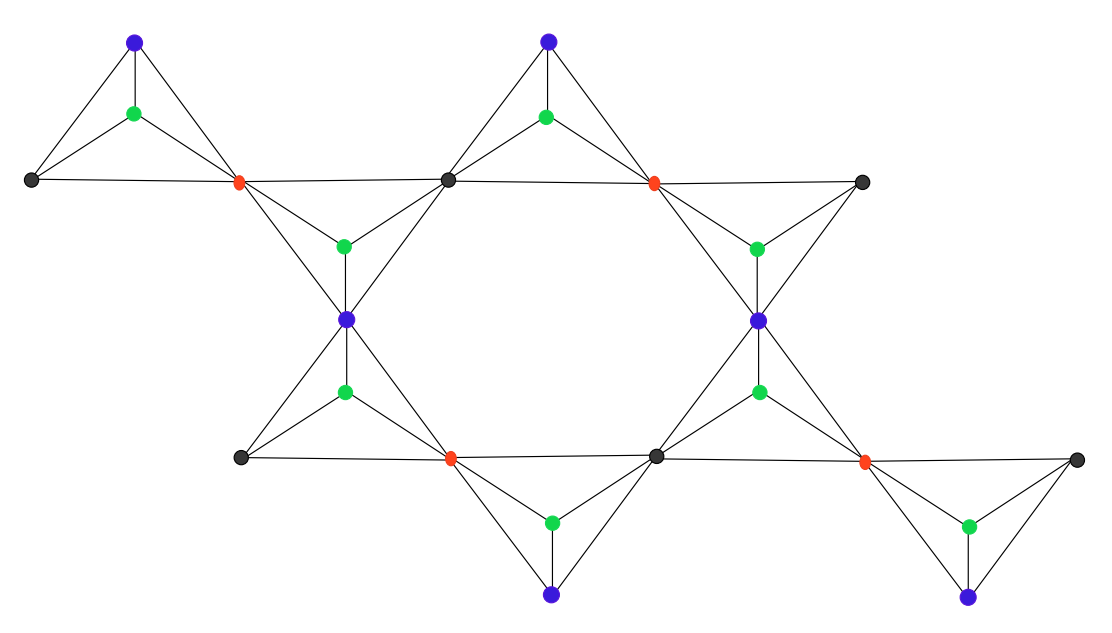
In this article, we specially focused on rhombus silicate molecular structure. Graph is a data structure for describing complex systems, which contains a set of objects and relationships. A molecular graph, also known as a chemical graph, is a graph-theoretic representation of the structural formula of a chemical compound used in chemical graph theory and mathematical chemistry. A chemical graph is a labelled graph whose edges represent covalent bonds and vertices represent the atoms. A set of vertices (atoms) of a graph G is known as its dominating set with respect to the vertices, if every vertex other than that set is adjacent to some vertex in set. The vertex and edge dominating sets, total domination and chromatic number of rhombus silicate structure has been discussed in this article.
Graphical Abstract
Keywords
Data Availability Statement
Funding
Conflicts of Interest
Ethical Approval and Consent to Participate
References
- Mowshowitz, A. (1972). The characteristic polynomial of a graph. Journal of Combinatorial Theory, Series B, 12(2), 177-193.
[CrossRef] [Google Scholar] - Allan, R. B., Laskar, R., & Hedetniemi, S. (1984). A note on total domination. Discrete Mathematics, 49(1), 7–13.
[CrossRef] [Google Scholar] - Annida, K., Khabibah, S., Utomo, R. H. S., & Ratnasari, L. (2024). 2-Distance and 3-Distance Domination Numbers of the Sierpinski Star Graph. Journal of Mathematics Research, 16(3), 1–49.
[CrossRef] [Google Scholar] - Arumugam, S., & Velanmal, S. (1998). Edge domination in graphs. Taiwanese Journal of Mathematics, 9(4), 173–179.
[CrossRef] [Google Scholar] - Bondy, J. A., & Hell, P. (1990). A note on the star chromatic number. Journal of Graph Theory, 14(4), 479–482.
[CrossRef] [Google Scholar] - Caro, Y., & Roditty, Y. (1990). A note on the k-domination number of a graph. International Journal of Mathematics and Mathematical Sciences, 13(1), 205–206.
[CrossRef] [Google Scholar] - Cockayne, E. J., Dawes, R. M., & Hedetniemi, S. T. (1980). Total domination in graphs. Networks, 10(3), 211–219.
[CrossRef] [Google Scholar] - Dayan, F., Ahmad, B., Zulqarnain, M., Ali, U., Ahmad, Y., & Zia, T. J. (2018). On some topological indices of triangular silicate and triangular oxide networks. International Journal of Pharmaceutical Sciences and Research, 9(10), 4326–4331.
[Google Scholar] - Enomoto, H., Hornak, M., & Jendrol, S. (2001). Cyclic chromatic number of 3-connected plane graphs. SIAM Journal on Discrete Mathematics, 14(1), 121–137.
[CrossRef] [Google Scholar] - Gupta, P. (2013). Domination in graph with application. Indian Journal of Research, 2(3), 115–117.
[Google Scholar] - Alikhani, S., Bakhshesh, D., & Golmohammadi, H. (2024). Total coalitions in graphs. Quaestiones Mathematicae, 47(11), 2283–2294.
[CrossRef] [Google Scholar] - Hargittai, I., Schultz, G., Tremmel, J., Kagramanov, N. D., Maltsev, A. K., & Nefedov, O. M. (1983). Molecular structure of silicon dichloride and silicon dibromide from electron diffraction combined with mass spectrometry. Journal of the American Chemical Society, 105(9), 2895–2896.
[CrossRef] [Google Scholar] - Javaid, M., Rehman, M. U., & Cao, J. (2017). Topological indices of rhombus type silicate and oxide networks. Canadian Journal of Chemistry, 95(2), 134–143.
[CrossRef] [Google Scholar] - Laskar, R., & Walikar, H. B. (2006, October). On domination related concepts in graph theory. In Combinatorics and Graph Theory: Proceedings of the Symposium Held at the Indian Statistical Institute, Calcutta, February 25–29, 1980 (pp. 308-320). Berlin, Heidelberg: Springer Berlin Heidelberg.
[CrossRef] [Google Scholar] - MacGillivray, G., & Seyffarth, K. (1996). Domination numbers of planar graphs. Journal of Graph Theory, 22(3), 213–229.
[CrossRef] [Google Scholar] - Padmapriya, P., & Mathad, V. (2022). Topological Indices of Sierpinski Gasket and Sierpinski Gasket Rhombus Graphs. TWMS Journal of Applied and Engineering Mathematics, 12(1), 136.
[Google Scholar] - Henning, M. A. (2000). Graphs with large total domination number. Journal of Graph Theory, 35(1), 21-45.
[CrossRef] [Google Scholar] - Rather, B. A. (2025). On domination polynomials of some graphs. Journal of Combinatorial Mathematics and Combinatorial Computing, 126(279), 289.
[CrossRef] [Google Scholar] - Sampathkumar, E., & Latha, L. P. (1996). Strong weak domination and domination balance in a graph. Discrete Mathematics, 161(1-3), 235–242.
[CrossRef] [Google Scholar] - Katritzky, A. R., Maran, U., Lobanov, V. S., & Karelson, M. (2000). Structurally diverse quantitative structure-property relationship correlations of technologically relevant physical properties. Journal of chemical information and computer sciences, 40(1), 1-18.
[CrossRef] [Google Scholar] - Szekeres, G., & Wilf, H. S. (1968). An inequality for the chromatic number of a graph. Journal of Combinatorial Theory, 4(1), 1–3.
[CrossRef] [Google Scholar] - Hashizume, H. (2022). Natural Mineral Materials. Springer Japan.
[Google Scholar] - Hawthorne, F. C., Uvarova, Y. A., & Sokolova, E. (2019). A structure hierarchy for silicate minerals: sheet silicates. Mineralogical Magazine, 83(1), 3-55.
[CrossRef] [Google Scholar]
Cite This Article
TY  - JOUR
AU  - Roman, Hira
AU  - Sohail, Amir
AU  - Rafiq, Aneela
AU  - Ali, Haidar
PY  - 2025
DA  - 2025/09/15
TI  - Results on Domination and Chromatic Numbers of Rhombus Silicate Molecular Structure
JO  - ICCK Journal of Applied Mathematics
T2  - ICCK Journal of Applied Mathematics
JF  - ICCK Journal of Applied Mathematics
VL  - 1
IS  - 2
SP  - 86
EP  - 96
DO  - 10.62762/JAM.2025.445811
UR  - https://www.icck.org/article/abs/JAM.2025.445811
KW  - domination set $\Upsilon$(G)
KW  - domination number with respect to vertices
KW  - total domination $\Upsilon_{t}$(G)
KW  - edge domination number $\Upsilon^{'}$(G)
KW  - chromatic number
KW  - rhombus network
AB  - In this article, we specially focused on rhombus silicate molecular structure. Graph is a data structure for describing complex systems, which contains a set of objects and relationships. A molecular graph, also known as a chemical graph, is a graph-theoretic representation of the structural formula of a chemical compound used in chemical graph theory and mathematical chemistry. A chemical graph is a labelled graph whose edges represent covalent bonds and vertices represent the atoms. A set of vertices (atoms) of a graph G is known as its dominating set with respect to the vertices, if every vertex other than that set is adjacent to some vertex in set. The vertex and edge dominating sets, total domination and chromatic number of rhombus silicate structure has been discussed in this article.
SN  - 3068-5656
PB  - Institute of Central Computation and Knowledge
LA  - English
ER  -
@article{Roman2025Results,
  author = {Hira Roman and Amir Sohail and Aneela Rafiq and Haidar Ali},
  title = {Results on Domination and Chromatic Numbers of Rhombus Silicate Molecular Structure},
  journal = {ICCK Journal of Applied Mathematics},
  year = {2025},
  volume = {1},
  number = {2},
  pages = {86-96},
  doi = {10.62762/JAM.2025.445811},
  url = {https://www.icck.org/article/abs/JAM.2025.445811},
  abstract = {In this article, we specially focused on rhombus silicate molecular structure. Graph is a data structure for describing complex systems, which contains a set of objects and relationships. A molecular graph, also known as a chemical graph, is a graph-theoretic representation of the structural formula of a chemical compound used in chemical graph theory and mathematical chemistry. A chemical graph is a labelled graph whose edges represent covalent bonds and vertices represent the atoms. A set of vertices (atoms) of a graph G is known as its dominating set with respect to the vertices, if every vertex other than that set is adjacent to some vertex in set. The vertex and edge dominating sets, total domination and chromatic number of rhombus silicate structure has been discussed in this article.},
  keywords = {domination set \$\Upsilon\$(G), domination number with respect to vertices, total domination \$\Upsilon\_{t}\$(G), edge domination number \$\Upsilon^{'}\$(G), chromatic number, rhombus network},
  issn = {3068-5656},
  publisher = {Institute of Central Computation and Knowledge}
}
Article Metrics
Publisher's Note
ICCK stays neutral with regard to jurisdictional claims in published maps and institutional affiliations.
Rights and Permissions
 Copyright © 2025 by the Author(s). Published by Institute of Central Computation and Knowledge. This article is an open access article distributed under the terms and conditions of the Creative Commons Attribution (CC BY) license (https://creativecommons.org/licenses/by/4.0/), which permits use, sharing, adaptation, distribution and reproduction in any medium or format, as long as you give appropriate credit to the original author(s) and the source, provide a link to the Creative Commons licence, and indicate if changes were made.

