


Electrostatic Freak Waves in Pair-Ion and Pair-Ion-Electron Plasmas


Article Information
Abstract
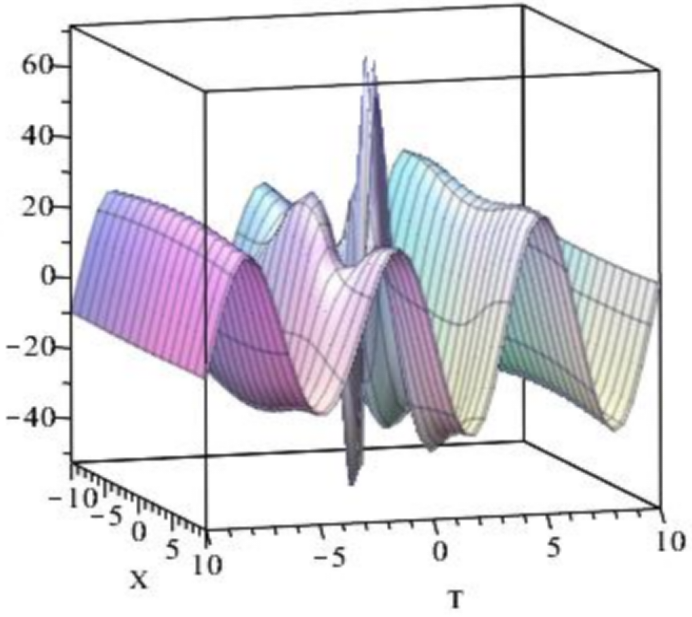
This work investigates the formation and dynamics of electrostatic freak waves in pair-ion (PI) and pair-ion--electron (PIE) plasmas. The analysis begins with the derivation of the Korteweg--de Vries (KdV) equations for both plasma configurations, from which the corresponding nonlinear and dispersive coefficients are obtained. By employing the wave superposition principle, the KdV equations are systematically reduced to the nonlinear Schrödinger equation (NLSE), enabling the exploration of modulation instability and rogue wave generation. Analytical solutions of the NLSE are utilized to construct parametric plots that elucidate the evolution of freak waves in PI and PIE plasmas. Comparative analysis reveals pronounced differences in the amplitude, localization, and structural properties of the freak waves in the two plasma environments, highlighting the critical role of electron contributions in shaping nonlinear wave phenomena.
Graphical Abstract
Keywords
Data Availability Statement
Funding
Conflicts of Interest
Ethical Approval and Consent to Participate
References
- Chalikov, D. (2009). Freak waves: Their occurrence and probability. Physics of Fluids, 21(7).
[CrossRef] [Google Scholar] - Kharif, C., Pelinovsky, E., & Slunyaev, A. (2008). Rogue waves in the ocean. Springer Science & Business Media.
[Google Scholar] - Yim, S. C., Osborne, A. R., & Mohtat, A. (2017, June). Nonlinear ocean wave models and laboratory simulation of high seastates and rogue waves. In International Conference on Offshore Mechanics and Arctic Engineering (Vol. 57748, p. V07BT06A056). American Society of Mechanical Engineers.
[CrossRef] [Google Scholar] - Liu, W. (2017). High-order rogue waves of the Benjamin–Ono equation and the nonlocal nonlinear Schrödinger equation. Modern Physics Letters B, 31(29), 1750269.
[CrossRef] [Google Scholar] - Weilnau, C., Ahles, M., Petter, J., Träger, D., Schröder, J., & Denz, C. (2002). Spatial optical (2+ 1)‐dimensional scalar‐and vector‐solitons in saturable nonlinear media. Annalen der Physik, 514(8), 573-629.
[CrossRef] [Google Scholar] - Sethi, P., Singh, K., & Saini, N. S. (2019). Magnetoacoustic Nonlinear Solitary and Freak Waves in Pair-Ion Plasma. Zeitschrift für Naturforschung A, 74(9), 777-786.
[CrossRef] [Google Scholar] - Sikdar, A., Adak, A., Ghosh, S., & Khan, M. (2018). Electrostatic wave modulation in collisional pair-ion plasmas. Physics of Plasmas, 25(5).
[CrossRef] [Google Scholar] - Noman, A. A., Islam, M. K., Hassan, M., Banik, S., Chowdhury, N. A., Mannan, A., & Mamun, A. A. (2021). Dust-ion-acoustic rogue waves in a dusty plasma having super-thermal electrons. Gases, 1(2), 106-116.
[CrossRef] [Google Scholar] - Hassan, M., Rahman, M. H., Chowdhury, N. A., Mannan, A., & Mamun, A. A. (2019). Ion-acoustic rogue waves in multi-ion plasmas. Communications in Theoretical Physics, 71(8), 1017.
[CrossRef] [Google Scholar] - El-Taibany, W. F., Karmakar, P. K., Beshara, A. A., El-Borie, M. A., Gwaily, S. A., & Atteya, A. (2022). Comparison study of the energy and instability of ion-acoustic solitary waves in magnetized electron–positron–ion quantum plasma. Scientific Reports, 12(1), 19078.
[CrossRef] [Google Scholar] - Batool, N., Masood, W., Al Huwayz, M., Almuqrin, A. H., & El-Tantawy, S. A. (2025). Interaction of two-dimensional electron-acoustic solitary waves in a cylindrical geometry and their applications in space plasmas. Physics of Plasmas, 32(4).
[CrossRef] [Google Scholar] - Lebedev, Y. A. (2015). Microwave discharges at low pressures and peculiarities of the processes in strongly non-uniform plasma. Plasma Sources Science and Technology, 24(5), 053001.
[CrossRef] [Google Scholar] - Shisen, R., Shan, W., & Cheng, Z. (2013). Magnetoacoustic solitary waves in pair ion–electron plasmas. Physica Scripta, 87(4), 045503.
[CrossRef] [Google Scholar] - Abdelsalam, U. M. (2013). Solitary and freak waves in superthermal plasma with ion jet. Journal of Plasma Physics, 79(3), 287-294.
[CrossRef] [Google Scholar] - Ali Shan, S., & El-Tantawy, S. A. (2016). The impact of positrons beam on the propagation of super freak waves in electron-positron-ion plasmas. Physics of Plasmas, 23(7).
[CrossRef] [Google Scholar] - Saberian, E. (2022). The invariant ion-acoustic waves in the plasma. Scientific Reports, 12(1), 21766.
[CrossRef] [Google Scholar] - Mahmood, S., Ur-Rehman, H., & Saleem, H. (2009). Electrostatic Korteweg-de Vries solitons in pure pair-ion and pair-ion-electron plasmas. Physica Scripta, 80(3), 035502.
[CrossRef] [Google Scholar] - Abdelsalam, U. M., Moslem, W. M., Khater, A. H., & Shukla, P. K. (2011). Solitary and freak waves in a dusty plasma with negative ions. Physics of Plasmas, 18(9).
[CrossRef] [Google Scholar]
Cite This Article
TY  - JOUR
AU  - Khan, Muhammad Yaqoob
AU  - Ahmed, Muhammad Waqar
PY  - 2025
DA  - 2025/10/29
TI  - Electrostatic Freak Waves in Pair-Ion and Pair-Ion-Electron Plasmas
JO  - ICCK Journal of Applied Mathematics
T2  - ICCK Journal of Applied Mathematics
JF  - ICCK Journal of Applied Mathematics
VL  - 1
IS  - 3
SP  - 120
EP  - 128
DO  - 10.62762/JAM.2025.698605
UR  - https://www.icck.org/article/abs/JAM.2025.698605
KW  - wave phenomena
KW  - freak waves
KW  - Pair-Ion plasmas
KW  - Pair-Ion--Electron plasmas
KW  - NLS equation
KW  - reductive perturbation method
AB  - This work investigates the formation and dynamics of electrostatic freak waves in pair-ion (PI) and pair-ion--electron (PIE) plasmas. The analysis begins with the derivation of the Korteweg--de Vries (KdV) equations for both plasma configurations, from which the corresponding nonlinear and dispersive coefficients are obtained. By employing the wave superposition principle, the KdV equations are systematically reduced to the nonlinear Schrödinger equation (NLSE), enabling the exploration of modulation instability and rogue wave generation. Analytical solutions of the NLSE are utilized to construct parametric plots that elucidate the evolution of freak waves in PI and PIE plasmas. Comparative analysis reveals pronounced differences in the amplitude, localization, and structural properties of the freak waves in the two plasma environments, highlighting the critical role of electron contributions in shaping nonlinear wave phenomena.
SN  - 3068-5656
PB  - Institute of Central Computation and Knowledge
LA  - English
ER  -
@article{Khan2025Electrosta,
  author = {Muhammad Yaqoob Khan and Muhammad Waqar Ahmed},
  title = {Electrostatic Freak Waves in Pair-Ion and Pair-Ion-Electron Plasmas},
  journal = {ICCK Journal of Applied Mathematics},
  year = {2025},
  volume = {1},
  number = {3},
  pages = {120-128},
  doi = {10.62762/JAM.2025.698605},
  url = {https://www.icck.org/article/abs/JAM.2025.698605},
  abstract = {This work investigates the formation and dynamics of electrostatic freak waves in pair-ion (PI) and pair-ion--electron (PIE) plasmas. The analysis begins with the derivation of the Korteweg--de Vries (KdV) equations for both plasma configurations, from which the corresponding nonlinear and dispersive coefficients are obtained. By employing the wave superposition principle, the KdV equations are systematically reduced to the nonlinear Schrödinger equation (NLSE), enabling the exploration of modulation instability and rogue wave generation. Analytical solutions of the NLSE are utilized to construct parametric plots that elucidate the evolution of freak waves in PI and PIE plasmas. Comparative analysis reveals pronounced differences in the amplitude, localization, and structural properties of the freak waves in the two plasma environments, highlighting the critical role of electron contributions in shaping nonlinear wave phenomena.},
  keywords = {wave phenomena, freak waves, Pair-Ion plasmas, Pair-Ion--Electron plasmas, NLS equation, reductive perturbation method},
  issn = {3068-5656},
  publisher = {Institute of Central Computation and Knowledge}
}
Article Metrics
Publisher's Note
ICCK stays neutral with regard to jurisdictional claims in published maps and institutional affiliations.
Rights and Permissions
 Copyright © 2025 by the Author(s). Published by Institute of Central Computation and Knowledge. This article is an open access article distributed under the terms and conditions of the Creative Commons Attribution (CC BY) license (https://creativecommons.org/licenses/by/4.0/), which permits use, sharing, adaptation, distribution and reproduction in any medium or format, as long as you give appropriate credit to the original author(s) and the source, provide a link to the Creative Commons licence, and indicate if changes were made.

