


Numerical Study of Nonlinear Third-Grade Nanofluid with Generalized Heat and Mass Flux in Mixed Convective Flow


Article Information
Abstract
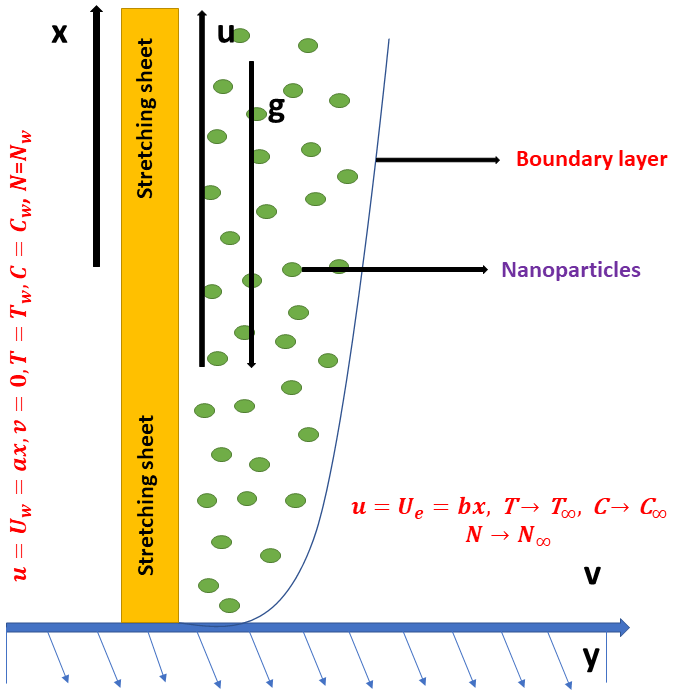
This paper investigates the bio-convective behavior of a third-grade non-Newtonian nanofluid over a stretching sheet. While the influence of Newtonian fluid flow based on classical Fourier and Fick’s laws has been widely discussed in previous studies, this work focuses on a novel third-grade nanofluid model incorporating various physical effects. Notably, the classical Fourier law is replaced by the Cattaneo–Christov (CC) theory for both heat and mass fluxes, capturing relaxation phenomena in the presence of bioconvective effects. Heat and mass transport are modeled using the CC framework, and nanoscale mechanisms are described via the Buongiorno nanofluid model. The influences of thermophoresis and Brownian motion are analyzed alongside dissipative and radiative effects. The Optimal Homotopy Asymptotic Method (OHAM) is employed to solve the resulting nonlinear equations. Graphical representations of key parameters are presented. Results reveal that the velocity profile increases with higher values of material parameters but decreases with an increase in the Reynolds number. The temperature decreases with higher Prandtl number but increases with greater radiation parameter. The concentration profile is found to decline with increasing Schmidt number.
Graphical Abstract
Keywords
Data Availability Statement
Funding
Conflicts of Interest
Ethical Approval and Consent to Participate
References
- Fosdick, R. L., & Rajagopal, K. R. (1980). Thermodynamics and stability of fluids of third grade. Proceedings of the Royal Society of London. A. Mathematical and Physical Sciences, 369(1738), 351-377.
[CrossRef] [Google Scholar] - Adesanya, S. O., & Makinde, O. D. (2015). Thermodynamic analysis for a third grade fluid through a vertical channel with internal heat generation. Journal of Hydrodynamics, 27(2), 264-272.
[CrossRef] [Google Scholar] - Ellahi, R., & Riaz, A. (2010). Analytical solutions for MHD flow in a third-grade fluid with variable viscosity. Mathematical and Computer Modelling, 52(9-10), 1783-1793.
[CrossRef] [Google Scholar] - Hayat, T., Nazar, H., Imtiaz, M., Alsaedi, A., & Ayub, M. (2017). Axisymmetric squeezing flow of third grade fluid in presence of convective conditions. Chinese Journal of Physics, 55(3), 738-754.
[CrossRef] [Google Scholar] - Sajid, M., Mughees, M., Ali, N., & Shahzad, H. (2019). A theoretical analysis of blade coating for third-grade fluid. Journal of Plastic Film & Sheeting, 35(3), 218-238.
[CrossRef] [Google Scholar] - Hayat, T., Naz, R., Asghar, S., & Mesloub, S. (2012). Soret–Dufour effects on three-dimensional flow of third grade fluid. Nuclear engineering and design, 243, 1-14.
[CrossRef] [Google Scholar] - Choi, S. U., & Eastman, J. A. (1995). Enhancing thermal conductivity of fluids with nanoparticles (No. ANL/MSD/CP-84938; CONF-951135-29). Argonne National Lab.(ANL), Argonne, IL (United States).
[Google Scholar] - Buongiorno, J. (2006). Convective transport in nanofluids.
[CrossRef] [Google Scholar] - Hayat, T., Shah, F., Khan, M. I., Khan, M. I., & Alsaedi, A. (2018). Entropy analysis for comparative study of effective Prandtl number and without effective Prandtl number via $\gamma$Al2O3-H2O and $\gamma$Al2O3-C2H6O2 nanoparticles. Journal of Molecular Liquids, 266, 814-823.
[CrossRef] [Google Scholar] - Ahmad, S., Khan, M. I., Hayat, T., Khan, M. I., & Alsaedi, A. (2018). Entropy generation optimization and unsteady squeezing flow of viscous fluid with five different shapes of nanoparticles. Colloids and Surfaces A: Physicochemical and Engineering Aspects, 554, 197-210.
[CrossRef] [Google Scholar] - Fourier, J. B. J. (1888). Théorie analytique de la chaleur. Gauthier-Villars et fils.
[Google Scholar] - Cattaneo, C. (1948). Sulla conduzione del calore. Atti Sem. Mat. Fis. Univ. Modena, 3, 83-101.
[Google Scholar] - Christov, C. I. (2009). On frame indifferent formulation of the Maxwell–Cattaneo model of finite-speed heat conduction. Mechanics research communications, 36(4), 481-486.
[CrossRef] [Google Scholar] - Ciarletta, M., & Straughan, B. (2010). Uniqueness and structural stability for the Cattaneo–Christov equations. Mechanics Research Communications, 37(5), 445-447.
[CrossRef] [Google Scholar] - Haddad, S. A. M. (2014). Thermal instability in Brinkman porous media with Cattaneo–Christov heat flux. International journal of heat and mass transfer, 68, 659-668.
[CrossRef] [Google Scholar] - Yusuf, A., Bhatti, M. M., & Khalique, C. M. (2025). Computational study of the thermophysical properties of graphene oxide/vacuum residue nanofluids for enhanced oil recovery. Journal of Thermal Analysis and Calorimetry, 150(1), 771-783.
[CrossRef] [Google Scholar] - Shah, F., Fall, I., & Zhang, D. (2025). Breakage and coalescence mechanisms in multiphase flow comprehensive PBM-CFD review with turbulence modelling insights for gas-liquid system. International Communications in Heat and Mass Transfer, 165, 109093.
[CrossRef] [Google Scholar] - Shah, F., Zhang, D., & Geng, L. (2025). A computational review of various inter-facial forces in fully developed multiphase fluid under different flow patterns in vertical column. Propulsion and Power Research.
[CrossRef] [Google Scholar] - Ahmad, A., Asghar, S., & Afzal, S. (2016). Flow of nanofluid past a Riga plate. Journal of Magnetism and Magnetic materials, 402, 44-48.
[CrossRef] [Google Scholar] - Liao, S. (2012). Homotopy analysis method in nonlinear differential equations (Vol. 153). Beijing: Higher education press.
[CrossRef] [Google Scholar] - Sheikholeslami, M., Hatami, M., & Ganji, D. D. (2013). Analytical investigation of MHD nanofluid flow in a semi-porous channel. Powder Technology, 246, 327-336.
[CrossRef] [Google Scholar] - Zheng, L., Wang, L., & Zhang, X. (2011). Analytic solutions of unsteady boundary flow and heat transfer on a permeable stretching sheet with non-uniform heat source/sink. Communications in Nonlinear Science and Numerical Simulation, 16(2), 731-740.
[CrossRef] [Google Scholar] - Hayat, T., Shah, F., Hussain, Z., & Alsaedi, A. (2018). Outcomes of double stratification in Darcy–Forchheimer MHD flow of viscoelastic nanofluid. Journal of the Brazilian Society of Mechanical Sciences and Engineering, 40(3), 145.
[CrossRef] [Google Scholar]
Cited By (9)
-
Nadeem Ahmad Sheikh, Zulkhibri Bin Ismail, Ilyas Khan, Ghada R. Elnaggar, S. W. Teklu. Regression and statistical analysis of heat transfer enhancement in water/ethylene glycol (40/60) base molybdenum carbide (Mo2C) MXene nanofluid using a transient fractional model.
Discover Nano, 2026 , 21 (1).
[CrossRef] -
Shuke Li, Qadeer Raza, Tahir Mushtaq, Junfeng Zhao, Xiaodong Wang, Faisal, Bagh Ali. Physics-informed FEM-ANN-GNN framework for nonlinear buoyancy-driven convection and cross-diffusion in a semi-circular cavity.
International Communications in Heat and Mass Transfer, 2026 , 175 .
[CrossRef] -
B. Shankar Goud. Computation study of time-dependent MHD Cu-H2O nanofluid transport over an inclined vertical plate with heat source and viscous dissipation impact.
Thermal Advances, 2026 , 7 .
[CrossRef] -
Mostafa Mohamed Okasha, Seerwan Hamadameen Sulaiman, Sherzod Abdullaev, Saba Liaqat, Munawar Abbas, Mohamed Abbas El-Naggar. Design-oriented modeling of two-phase palm oil nanomaterial flow with application of Cattaneo-Christov model using STG model.
MethodsX, 2026 , 17 .
[CrossRef] -
Muhammad Rooman, Zahir Shah, Ghadah Alhawael, Muhammad Asif. FDM versus machine learning analysis and thermal optimization of magnetized Cross hybrid nanofluids flow over solar-heated surfaces with variable thermal conductivity.
International Communications in Heat and Mass Transfer, 2026 , 172 .
[CrossRef] -
Muhammad Irfan Qadir, Ali B.M. Ali, Hakim AL Garalleh, Usman Majeed, Faheem ul Islam, Ali Raza, Sami Ullah Khan, Nodira Nazarova, Manish Gupta, M. Waqas, M. Ijaz Khan. Heat transfer enhancement in fractional Brinkman nanofluids: Effects of thermal and nanoparticle geometry.
South African Journal of Chemical Engineering, 2026 , 55 .
[CrossRef] -
B.J. Akinbo, Ibhadode Oisehoemomen, T.W. Akaje, A.T. Adeosun. Simulation of nonlinear radiation and Cattaneo-Christov heat flux on gyrotactic bioconvection Walters’ B nanofluid through a porous medium with viscous dissipation.
Thermal Advances, 2026 , 7 .
[CrossRef] -
M.O. Mohammed, O.A. Ajala, A.K. Jimoh, A.O. Akindele, A.A. Waheed, S.O. Sangoniyi, M.O. Afolabi, A.O. Areo. MHD Oldroyd-B nanofluid flow with motile microorganisms over a Riga plate under double-diffusion.
Thermal Advances, 2026 , 7 .
[CrossRef] -
Avinash B. Raut, Jagadish V. Tawade, Pradeep G. Janthe, Sameer S. Gajghate, Muhamad M. Noor, Milon Selvam Dennison. Thermal Behavior of Radiative Darcy–Forchheimer Nanofluid Flow With Heat Source/Sink Effects.
Engineering Reports, 2026 , 8 (9).
[CrossRef]
Cite This Article
TY  - JOUR
AU  - Shah, Faisal
PY  - 2025
DA  - 2025/08/03
TI  - Numerical Study of Nonlinear Third-Grade Nanofluid with Generalized Heat and Mass Flux in Mixed Convective Flow
JO  - ICCK Journal of Applied Mathematics
T2  - ICCK Journal of Applied Mathematics
JF  - ICCK Journal of Applied Mathematics
VL  - 1
IS  - 2
SP  - 52
EP  - 61
DO  - 10.62762/JAM.2025.671250
UR  - https://www.icck.org/article/abs/JAM.2025.671250
KW  - modified fourier and fick's law
KW  - third-grade nano-fluid
KW  - MHD
KW  - viscous dissipation
AB  - This paper investigates the bio-convective behavior of a third-grade non-Newtonian nanofluid over a stretching sheet. While the influence of Newtonian fluid flow based on classical Fourier and Fick’s laws has been widely discussed in previous studies, this work focuses on a novel third-grade nanofluid model incorporating various physical effects. Notably, the classical Fourier law is replaced by the Cattaneo–Christov (CC) theory for both heat and mass fluxes, capturing relaxation phenomena in the presence of bioconvective effects. Heat and mass transport are modeled using the CC framework, and nanoscale mechanisms are described via the Buongiorno nanofluid model. The influences of thermophoresis and Brownian motion are analyzed alongside dissipative and radiative effects. The Optimal Homotopy Asymptotic Method (OHAM) is employed to solve the resulting nonlinear equations. Graphical representations of key parameters are presented. Results reveal that the velocity profile increases with higher values of material parameters but decreases with an increase in the Reynolds number. The temperature decreases with higher Prandtl number but increases with greater radiation parameter. The concentration profile is found to decline with increasing Schmidt number.
SN  - 3068-5656
PB  - Institute of Central Computation and Knowledge
LA  - English
ER  -
@article{Shah2025Numerical,
  author = {Faisal Shah},
  title = {Numerical Study of Nonlinear Third-Grade Nanofluid with Generalized Heat and Mass Flux in Mixed Convective Flow},
  journal = {ICCK Journal of Applied Mathematics},
  year = {2025},
  volume = {1},
  number = {2},
  pages = {52-61},
  doi = {10.62762/JAM.2025.671250},
  url = {https://www.icck.org/article/abs/JAM.2025.671250},
  abstract = {This paper investigates the bio-convective behavior of a third-grade non-Newtonian nanofluid over a stretching sheet. While the influence of Newtonian fluid flow based on classical Fourier and Fick’s laws has been widely discussed in previous studies, this work focuses on a novel third-grade nanofluid model incorporating various physical effects. Notably, the classical Fourier law is replaced by the Cattaneo–Christov (CC) theory for both heat and mass fluxes, capturing relaxation phenomena in the presence of bioconvective effects. Heat and mass transport are modeled using the CC framework, and nanoscale mechanisms are described via the Buongiorno nanofluid model. The influences of thermophoresis and Brownian motion are analyzed alongside dissipative and radiative effects. The Optimal Homotopy Asymptotic Method (OHAM) is employed to solve the resulting nonlinear equations. Graphical representations of key parameters are presented. Results reveal that the velocity profile increases with higher values of material parameters but decreases with an increase in the Reynolds number. The temperature decreases with higher Prandtl number but increases with greater radiation parameter. The concentration profile is found to decline with increasing Schmidt number.},
  keywords = {modified fourier and fick's law, third-grade nano-fluid, MHD, viscous dissipation},
  issn = {3068-5656},
  publisher = {Institute of Central Computation and Knowledge}
}
Publisher's Note
ICCK stays neutral with regard to jurisdictional claims in published maps and institutional affiliations.
Rights and Permissions
 Copyright © 2025 by the Author(s). Published by Institute of Central Computation and Knowledge. This article is an open access article distributed under the terms and conditions of the Creative Commons Attribution (CC BY) license (https://creativecommons.org/licenses/by/4.0/), which permits use, sharing, adaptation, distribution and reproduction in any medium or format, as long as you give appropriate credit to the original author(s) and the source, provide a link to the Creative Commons licence, and indicate if changes were made.

