

Abstract
Graphical Abstract
Click image to view fullscreen
Keywords
1. Introduction
Third grade (3rd) fluid is a subcategory of differential types that can explain the impacts of both shear thickening and thinning phenomena. The stability of third grade (3rd) liquid is explored by Fosdick and Rajagopal [1]. Viscoelastic mixed convective flow is developed by Mastroberardino [1] caused by stretchable surfaces. The study of thermodynamics for the third grade (3rd) liquid with heat generation has been done by Adesanya and Makinde [2]. Ellahi and Riaz [3] systematically thought about third grade (3rd) fluid flow with variable viscosity. Third grade squeezing flow is securitized by Hayat et al. [4]. Sajid et al. [5] investigated the coating process of a non-Newtonian material. Hayat et al. [6] evaluate Soret Dufour's effects on third-grade fluid.
| Velocity component along -axis | |
|---|---|
| Velocity component along -axis | |
| Stretching/shrinking constant | |
| Gravity | |
| Magnetic field constant | |
| Temperature | |
| Temperature of the wall | |
| Ambient temperature of the nanofluid | |
| Ambient concentration of the hybrid nanofluid | |
| Density of the fluid | |
| Drag coefficient | |
| Kinematic viscosity of the base fluid | |
| Viscosity of the fluid | |
| Porous medium permeability | |
| Heat generation rates | |
| Brownian motion | |
| Absorption coefficient | |
| Thermophoresis variable | |
| Material constant for third grade fluid | |
| Stefan Boltzmann constant | |
| Dimensionless temperature | |
| Similarity variable | |
| Radiative heat flux | |
| Prandtl number | |
| Radiation variable | |
| Magnetic parameter | |
| Material Parameter for third grade fluid | |
| Magnetic parameter | |
| Thermal diffusivity | |
| Ratio of rates | |
| Brownian motion parameter | |
| Schmidt number | |
| Thermophoresis parameter | |
| Heat generation parameter | |
| Mixed convection parameter | |
| Eckert number | |
| Thermal relaxation variable | |
| Solutal relaxation parameter | |
| Skin friction coefficient | |
| Reynold number |
Nano fluids are produced by dispersing solid particles of a nano-meter size into various conventional liquids such as water, gasoline and ethylene glycol respectively. Nano-liquids have numerous applications in manufacturing and automotive cooling, sensing, production of new types of fuels, microelectronic cooling, hybrid-powered engine efficiency and home appliance heating/cooling etc. Choi [7] discovered the term nano fluid. The infusion of metallic nano particles hooked on conventional liquids would greatly improve the thermal efficiencies of those liquids as explained by him. The Nano fluid convective transportation model with the Brownian and thermophoresis effects was analysed by Buongiorno [8]. Non-effective Prandtl numbers by considering nanoparticles and entropy analysis are researched by Hayat et al. [9]. Entropy optimization with different fluid models is studied by Ahmad et al. [10].
Fourier heat conduction expression [11] give much information about heat transfer through the flux. The paradox of heat conduction is leads by this expression. The Cattaneo [12] has revised the relation of thermal relaxation time. Suggestions about the Oldroyed upper convected derivatives should be considered in Ref. [13, 14] instead of material differentiations are given by Christov. Thermal variability in a porous medium by the retentive Cattaneo-Christov (CC) model is analysed by Haddad [15]. The impact of Cattaneo-Christov model considering different fluid models is discussed by some researchers [16, 17, 18, 19].
Here, third grade (3rd) nano liquid flow towards a stretchable sheet is discussed. Bio-convection, radiative heat, dissipative impacts and heat generation are also discussed. By using the optimal method [20, 21, 22, 23] obtained the analytical solution of the governing equations. The results for various physical variables are discussed through graphs.
The simultaneous study of generalized (non-Fourier, non-Fick) heat and mass flux conditions inside a mixed convective flow regime and nonlinear third-grade nanofluid behavior is what makes this work innovative. The integration of third-grade fluids and nanofluid dynamics under nonlinear rheological behavior has not been extensively studied, particularly when generalized boundary conditions that take into consideration thermal and solutal relaxation effects are present. Furthermore, by considering both buoyancy-driven and forced convective effects both of which are crucial in real-world applications including industrial heat exchangers, biomedical flows, and electronic device cooling—this work integrates a realistic description of mixed convection.
2. Physical Model
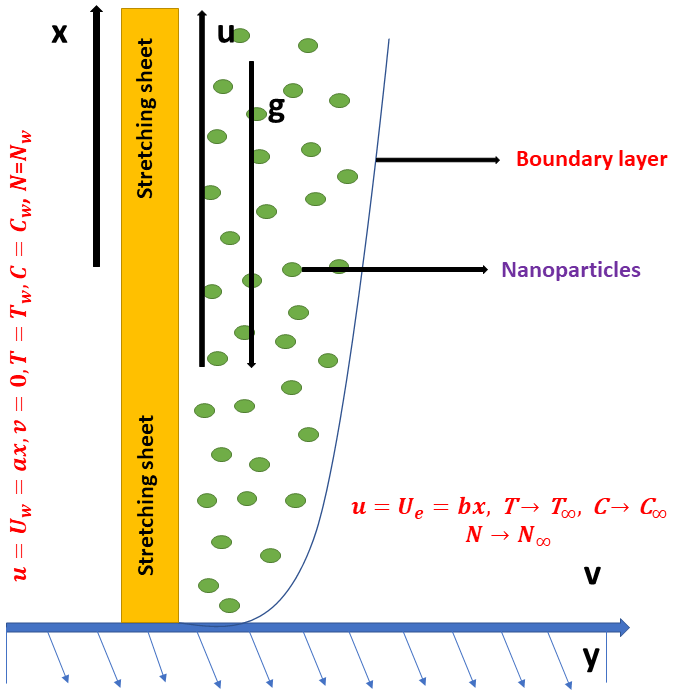
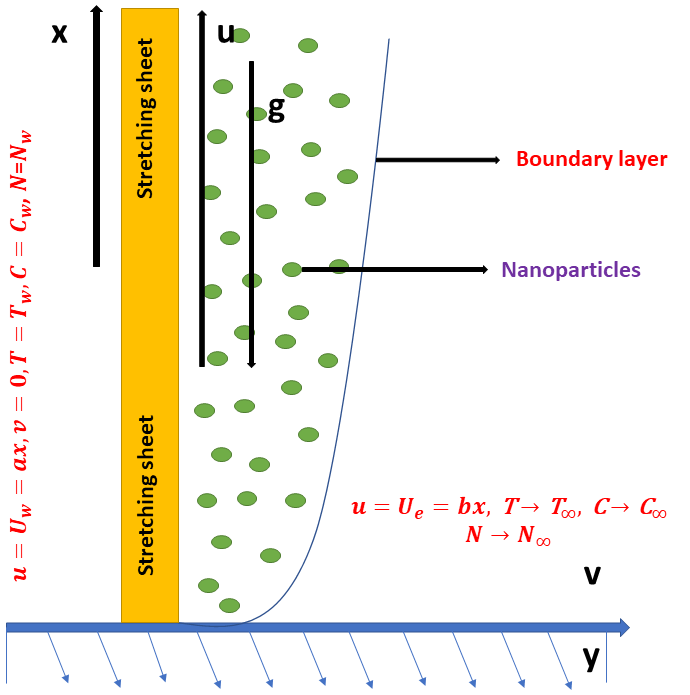
In this study, a two-dimensional incompressible non-Newtonian fluid flow over a stretching sheet is considered. Both mixed convection and bioconvective effects are taken into account. The sheet is stretched along the -axis with a linear stretching velocity . The surface temperature and concentration are denoted by and , respectively, while and represent the ambient temperature and concentration far from the surface. The free stream velocity outside the boundary layer is represented by . The schematic diagram of the flow configuration is illustrated in Figure 1.
3. Formulation of governing equations
In this work, a mixed convective, laminar, two-dimensional flow over a moving surface is investigated. The analysis incorporates a third-grade non-Newtonian fluid model in the presence of gyrotactic micro-organisms. Heat and mass transport are examined using the Cattaneo–Christov (CC) flux model, which accounts for relaxation effects beyond the classical laws. Furthermore, the influences of Brownian motion and thermophoresis are considered to capture nanoscale transport phenomena. Thermal radiation and viscous dissipation are included as additional heat sources in the energy equation. The governing equations relevant to this study are presented below.
The relevant periphery conditions are:
Drag force is:
here:
The energy and concentration expression for Cattaneo-Christove (CC) model are:
here is given by:
here is given as:
The relevant conditions are:
In above equation , denotes Brownian and thermosphere quantity, be the heat generation rate, the Boltzmann constant is denote the coefficient of mean absorption and the specific heat is the .
4. Non-Dimensional formulation
Considering transformations:
the eq. (1) is satisfied while others eqs. (2)-(11) are:
Dimensionless form of skin friction is given as:
where is Prandtl number, Hartman number , ratio of rates is the , thermophoresis parameter , the radiation parameter is , Schmidt number is , Brownian motion parameter , the third grade fluid parameters are , heat generation parameter , mixed convective parameter, Eckert number is , thermal relaxation parameter and solutal concentration parameter .
5. Methodology
We determined the series solutions by using homotopy analysis:
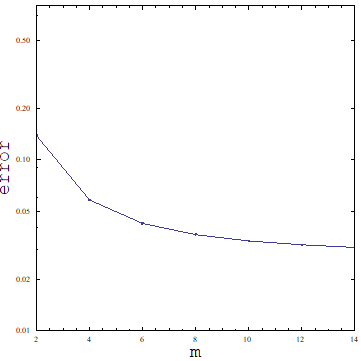
where the total square residual error is represented by . When and Then the total usual squared residual error is abated by employing Mathematica BVPh2.0. The optimal values of convergence control variables are , and . The total residual error is . The variation of the total residual error with respect to the approximation order is illustrated in Figure 2.
| 2 | 0.346508 | 0.016186 | 0.0881337 |
|---|---|---|---|
| 4 | 0.0326625 | 0.00574157 | 0.0198452 |
| 8 | 0.307458 | 0.00163756 | 0.00411318 |
| 10 | 0.300818 | 0.00104241 | 0.002397 |
| 12 | 0.029512 | 0.000708731 | 0.00159226 |
| 14 | 0.0290089 | 0.000506021 | 0.00119825 |
6. Discussion
6.1 Velocity Distribution:
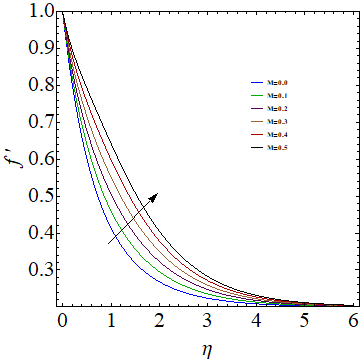
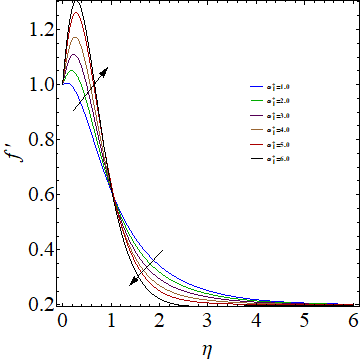
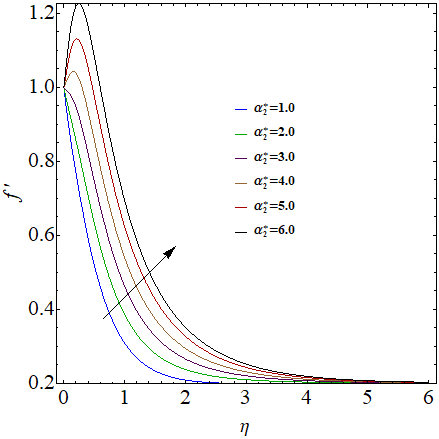
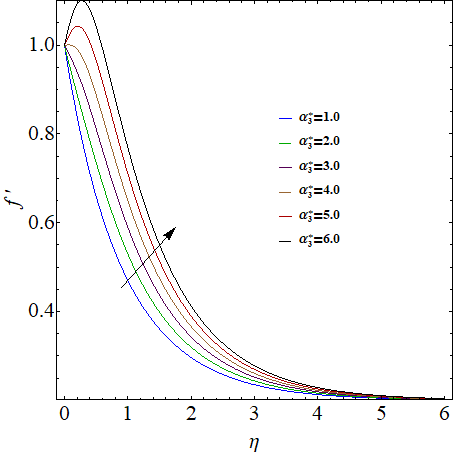
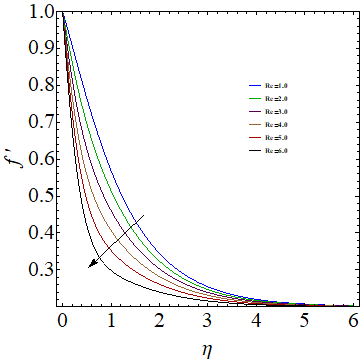
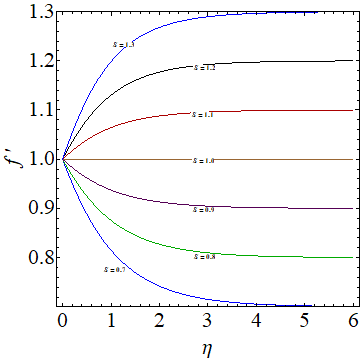
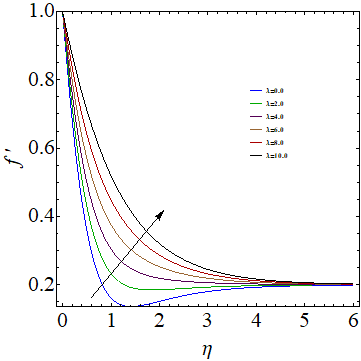
Figure 3 illustrates the variation of the magnetic parameter (M) on , where increases with . Because magnetic field produces resistive forces between fluid elements therefore reduces velocity. Figures 4, 5, and 6 illustrate the influence of and respectively on velocity profile. It displays that a inverse inclination is followed by a transition at when increase of liquid velocity trivializes adjacent the plate. On the fact material variables are converse relation to viscosity. So, increase in and moderate the fluid viscosity down and thus augment the liquefied motion. Figure 7 illustrates the influence of the Reynolds number on the velocity profile . It is observed that the fluid velocity decreases as the Reynolds number increases. Figure 8 presents the variation of with respect to the ratio parameter . As increases, the fluid velocity also increases. This is because a higher value of corresponds to a stronger ambient flow, which enhances the overall fluid motion. The effect of the stretching parameter on the velocity is shown in Figure 9. For higher of the enhances. Physically viscous forces reduce for greater estimation of and so velocity improves.
6.2 Temperature Distribution:
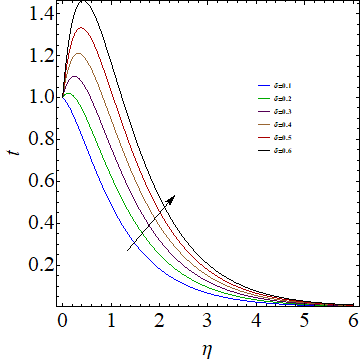
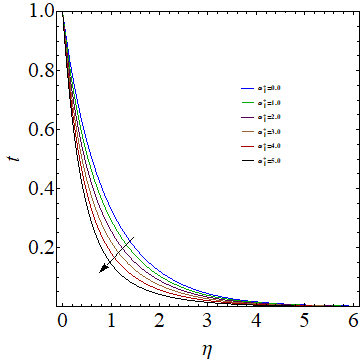
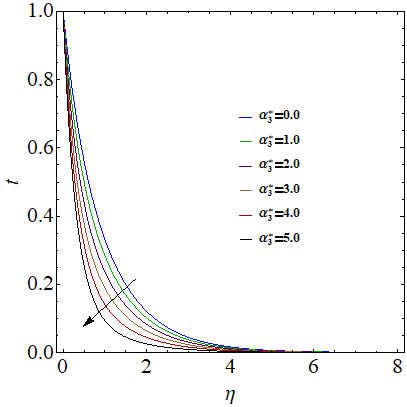
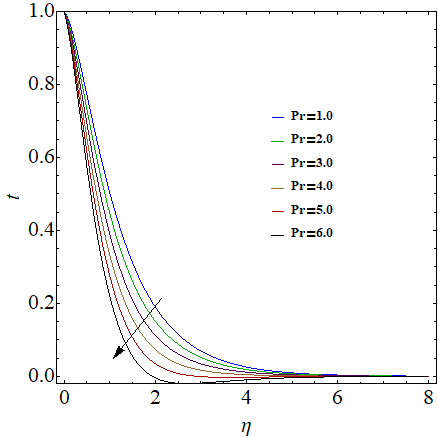
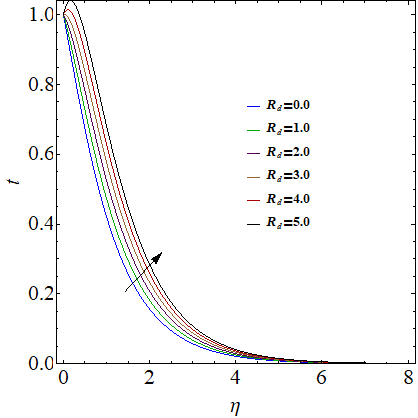
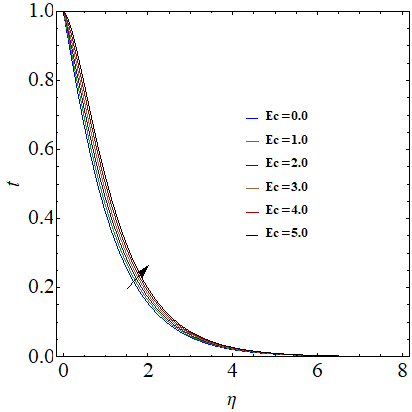
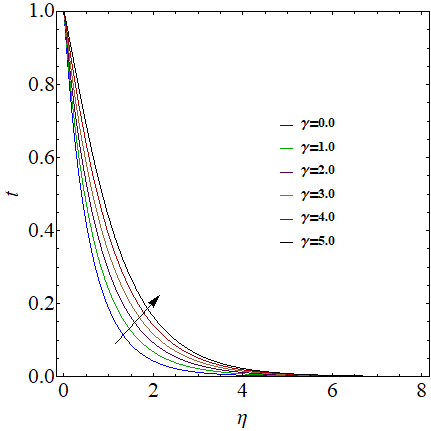
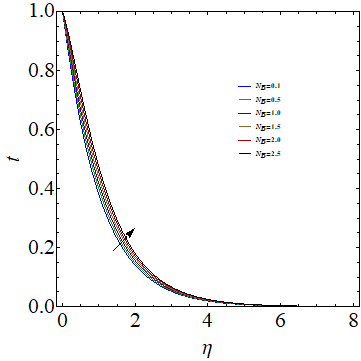
Figure 10 examines the effect of the thermal generation parameter on the temperature profile , showing that temperature increases as increases due to enhanced heat generation. Figures 11 and 12 indicate that higher values of the material parameters and , which represent normal stresses and viscous forces, lead to a decrease in temperature; this occurs because stronger material parameters reduce viscous forces while increasing normal stresses. Figure 13 reveals that a larger Prandtl number results in a lower temperature profile, since higher values correspond to reduced thermal diffusivity, thereby limiting heat transfer from hot to cold regions. The influence of the radiation parameter on is shown in Figure 14, where increasing enhances radiative heat transfer and raises the temperature. Figure 15 demonstrates that the temperature rises with higher Eckert number , as more kinetic energy is converted into internal energy. Figure 16 highlights the role of the heat relaxation parameter , showing that larger values delay heat transfer, leading to reduced temperature. Lastly, Figure 17 shows that an increase in the Brownian motion parameter contributes to a higher temperature profile.
6.3 Nano-particles concentration:
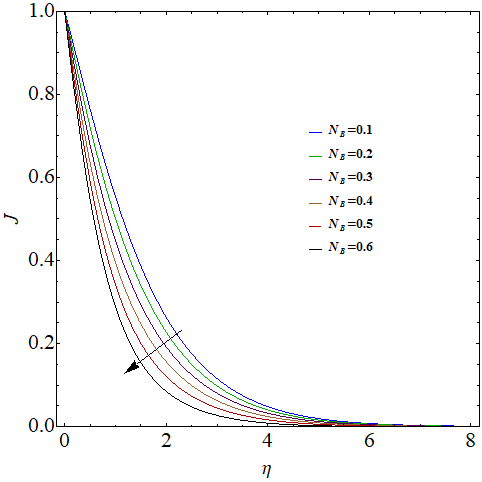
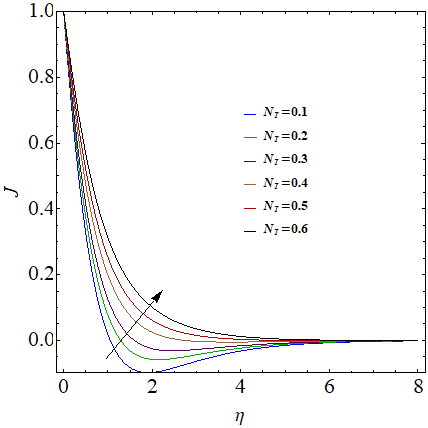
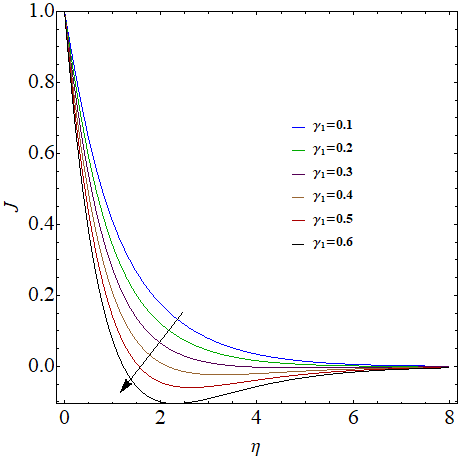
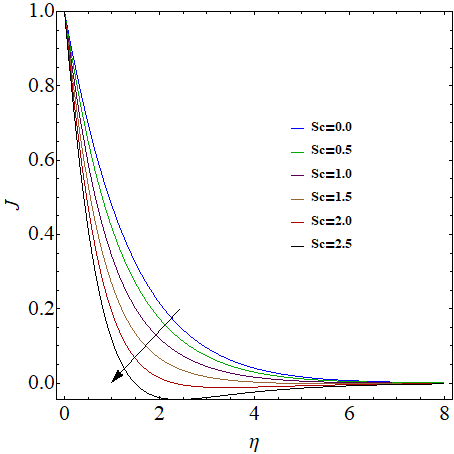
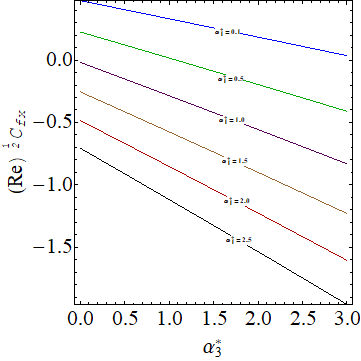
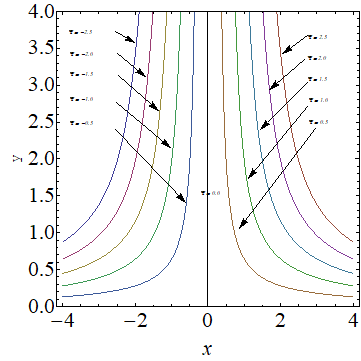
Figure 18 reveals that the concentration decreases with an increase in the Brownian motion parameter . Physically, a higher intensifies molecular collisions within the fluid, leading to heat generation that, in turn, reduces concentration. The influence of the thermophoresis parameter on is examined in Figure 19, showing a notable increase in concentration as rises. Figure 20 illustrates the effect of the mass relaxation parameter , where higher values of reduce mass transfer from the fluid to the surface, resulting in a decline in . Figure 21 indicates that the concentration profile also decreases with increasing Schmidt number , due to reduced mass diffusivity. Figure 22 shows the downward trend in wall shear stress with respect to the material parameters and ; this occurs as their increase leads to greater resistance at the wall, lowering shear stress. Figure 23 presents the streamline structure of the current flow field, providing insight into the flow behavior. Lastly, Table 1 lists the average squared residual errors corresponding to the optimal convergence control factor . The results confirm that residual errors decrease as the order of approximation increases, validating the convergence of the proposed solution.
7. Concluding remarks
In this study, a comprehensive numerical investigation has been carried out to explore the behavior of nonlinear third-grade nanofluids under generalized heat and mass flux conditions in a mixed convective flow regime. The results highlight the significant influence of fluid nonlinearity, nanoparticle concentration, and relaxation parameters on the thermal and concentration boundary layers.
The following are the main results:
Data Availability Statement
Funding
Conflicts of Interest
Ethical Approval and Consent to Participate
References
- Fosdick, R. L., & Rajagopal, K. R. (1980). Thermodynamics and stability of fluids of third grade. Proceedings of the Royal Society of London. A. Mathematical and Physical Sciences, 369(1738), 351-377.
- Adesanya, S. O., & Makinde, O. D. (2015). Thermodynamic analysis for a third grade fluid through a vertical channel with internal heat generation. Journal of Hydrodynamics, 27(2), 264-272.
- Ellahi, R., & Riaz, A. (2010). Analytical solutions for MHD flow in a third-grade fluid with variable viscosity. Mathematical and Computer Modelling, 52(9-10), 1783-1793.
- Hayat, T., Nazar, H., Imtiaz, M., Alsaedi, A., & Ayub, M. (2017). Axisymmetric squeezing flow of third grade fluid in presence of convective conditions. Chinese Journal of Physics, 55(3), 738-754.
- Sajid, M., Mughees, M., Ali, N., & Shahzad, H. (2019). A theoretical analysis of blade coating for third-grade fluid. Journal of Plastic Film & Sheeting, 35(3), 218-238.
- Hayat, T., Naz, R., Asghar, S., & Mesloub, S. (2012). Soret–Dufour effects on three-dimensional flow of third grade fluid. Nuclear engineering and design, 243, 1-14.
- Choi, S. U., & Eastman, J. A. (1995). Enhancing thermal conductivity of fluids with nanoparticles (No. ANL/MSD/CP-84938; CONF-951135-29). Argonne National Lab.(ANL), Argonne, IL (United States).
- Buongiorno, J. (2006). Convective transport in nanofluids.
- Hayat, T., Shah, F., Khan, M. I., Khan, M. I., & Alsaedi, A. (2018). Entropy analysis for comparative study of effective Prandtl number and without effective Prandtl number via $\gamma$Al2O3-H2O and $\gamma$Al2O3-C2H6O2 nanoparticles. Journal of Molecular Liquids, 266, 814-823.
- Ahmad, S., Khan, M. I., Hayat, T., Khan, M. I., & Alsaedi, A. (2018). Entropy generation optimization and unsteady squeezing flow of viscous fluid with five different shapes of nanoparticles. Colloids and Surfaces A: Physicochemical and Engineering Aspects, 554, 197-210.
- Fourier, J. B. J. (1888). Théorie analytique de la chaleur. Gauthier-Villars et fils.
- Cattaneo, C. (1948). Sulla conduzione del calore. Atti Sem. Mat. Fis. Univ. Modena, 3, 83-101.
- Christov, C. I. (2009). On frame indifferent formulation of the Maxwell–Cattaneo model of finite-speed heat conduction. Mechanics research communications, 36(4), 481-486.
- Ciarletta, M., & Straughan, B. (2010). Uniqueness and structural stability for the Cattaneo–Christov equations. Mechanics Research Communications, 37(5), 445-447.
- Haddad, S. A. M. (2014). Thermal instability in Brinkman porous media with Cattaneo–Christov heat flux. International journal of heat and mass transfer, 68, 659-668.
- Yusuf, A., Bhatti, M. M., & Khalique, C. M. (2025). Computational study of the thermophysical properties of graphene oxide/vacuum residue nanofluids for enhanced oil recovery. Journal of Thermal Analysis and Calorimetry, 150(1), 771-783.
- Shah, F., Fall, I., & Zhang, D. (2025). Breakage and coalescence mechanisms in multiphase flow comprehensive PBM-CFD review with turbulence modelling insights for gas-liquid system. International Communications in Heat and Mass Transfer, 165, 109093.
- Shah, F., Zhang, D., & Geng, L. (2025). A computational review of various inter-facial forces in fully developed multiphase fluid under different flow patterns in vertical column. Propulsion and Power Research.
- Ahmad, A., Asghar, S., & Afzal, S. (2016). Flow of nanofluid past a Riga plate. Journal of Magnetism and Magnetic materials, 402, 44-48.
- Liao, S. (2012). Homotopy analysis method in nonlinear differential equations (Vol. 153). Beijing: Higher education press.
- Sheikholeslami, M., Hatami, M., & Ganji, D. D. (2013). Analytical investigation of MHD nanofluid flow in a semi-porous channel. Powder Technology, 246, 327-336.
- Zheng, L., Wang, L., & Zhang, X. (2011). Analytic solutions of unsteady boundary flow and heat transfer on a permeable stretching sheet with non-uniform heat source/sink. Communications in Nonlinear Science and Numerical Simulation, 16(2), 731-740.
- Hayat, T., Shah, F., Hussain, Z., & Alsaedi, A. (2018). Outcomes of double stratification in Darcy–Forchheimer MHD flow of viscoelastic nanofluid. Journal of the Brazilian Society of Mechanical Sciences and Engineering, 40(3), 145.
Cite This Article
Article Metrics
Citations:Article Access Statistics:
Publisher's Note
ICCK stays neutral with regard to jurisdictional claims in published maps and institutional affiliations.
Rights and Permissions

Copyright © 2025 by the Author(s). Published by Institute of Central Computation and Knowledge.
This article is an open access article distributed under the terms and conditions of the Creative Commons Attribution (CC BY) license.