


Numerical Analysis of HBr-Cl2 Capacitive Coupled Plasma Using a Two-Dimensional Fluid Model

Article Information
Abstract
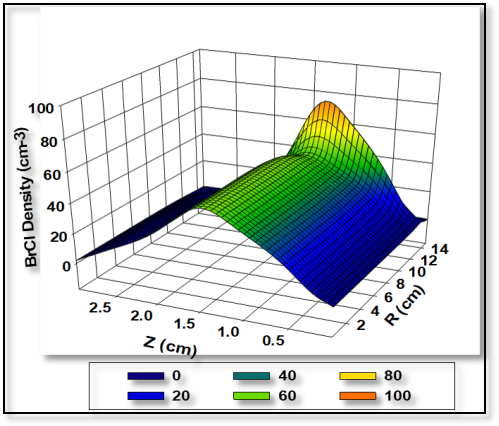
This research focuses on the computational analysis and numerical investigation of BrCl ion density within an HBr-Cl_2 capacitively coupled plasma system. A two-dimensional fluid simulation model was developed to examine the influence of varying the HBr: Cl_2 gas ratio on BrCl ion formation. The simulation framework incorporates fundamental plasma fluid equations, including the continuity equation, momentum conservation equations, and energy conservation equations, along with appropriate boundary conditions. The investigation specifically explored gas composition variations ranging from 10% Cl_2 and 90% HBr to 90% Cl_2 and 10% HBr, incremented in 20% steps. The radio frequency (RF) driving frequency was fixed at 13.56 MHz throughout the simulations. Results revealed a positive correlation between the Cl_2 concentration and the BrCl ion density; higher Cl_2 content led to increased BrCl ion production. Notably, elevated BrCl ion densities were observed near the electrode edges and at the electrode center. The generated two-dimensional and three-dimensional simulation data offer foundational insights for practical industrial applications, particularly in advanced semiconductor etching and deposition technologies.
Graphical Abstract
Keywords
Data Availability Statement
Funding
Conflicts of Interest
Ethical Approval and Consent to Participate
References
- Flamm, D. L. (1990). Mechanisms of silicon etching in fluorine-and chlorine-containing plasmas. Pure and Applied Chemistry, 62(9), 1709-1720.
[CrossRef] [Google Scholar] - Aldao, C. M., & Weaver, J. H. (2001). Halogen etching of Si via atomic-scale processes. Progress in surface science, 68(4-6), 189-230.
[CrossRef] [Google Scholar] - Cunge, G., Kogelschatz, M., & Sadeghi, N. (2004). Influence of reactor walls on plasma chemistry and on silicon etch product densities during silicon etching processes in halogen-based plasmas. Plasma Sources Science and Technology, 13(3), 522.
[CrossRef] [Google Scholar] - Ekinci, H., Kuryatkov, V. V., Mauch, D. L., Dickens, J. C., & Nikishin, S. A. (2014). Effect of BCl3 in chlorine-based plasma on etching 4H-SiC for photoconductive semiconductor switch applications. Journal of Vacuum Science & Technology B, 32(5).
[CrossRef] [Google Scholar] - Li, C., Yang, Y., Qu, R., Cao, X., Liu, G., Jin, X., ... & Liu, Y. (2024). Recent Advances in Plasma Etching for Micro and Nano Fabrications of Silicon-based Materials: A Review. Journal of Materials Chemistry C.
[CrossRef] [Google Scholar] - Donnelly, V. M., & Kornblit, A. (2013). Plasma etching: Yesterday, today, and tomorrow. Journal of Vacuum Science & Technology A, 31(5).
[CrossRef] [Google Scholar] - Kushner, M. J. (2009). Hybrid modelling of low temperature plasmas for fundamental investigations and equipment design. Journal of Physics D: Applied Physics, 42(19), 194013.
[CrossRef] [Google Scholar] - Efremov, A., Kim, Y., Lee, H. W., & Kwon, K. H. (2011). A comparative study of HBr-Ar and HBr-Cl 2 plasma chemistries for dry etch applications. Plasma Chemistry and Plasma Processing, 31, 259-271.
[CrossRef] [Google Scholar] - Bouchoule, S., Vallier, L., Patriarche, G., Chevolleau, T., & Cardinaud, C. (2012). Effect of Cl2-and HBr-based inductively coupled plasma etching on InP surface composition analyzed using in situ x-ray photoelectron spectroscopy. Journal of Vacuum Science & Technology A, 30(3).
[CrossRef] [Google Scholar] - Wagner, M. L., & Nine, R. (2013). The use of HBr in polysilicon etching. Gases & Instrumentation International, 7(4), 1-7. https://www.pall.com/content/dam/pall/microelectronics/literature-library/non-gated/HBr_Polysilicon.pdf
[Google Scholar] - Cunge, G., Inglebert, R. L., Joubert, O., Vallier, L., & Sadeghi, N. (2002). Ion flux composition in HBr/Cl 2/O 2 and HBr/Cl 2/O 2/CF 4 chemistries during silicon etching in industrial high-density plasmas. Journal of Vacuum Science & Technology B: Microelectronics and Nanometer Structures Processing, Measurement, and Phenomena, 20(5), 2137-2148.
[CrossRef] [Google Scholar] - Ono, K., Ohta, H., & Eriguchi, K. (2010). Plasma–surface interactions for advanced plasma etching processes in nanoscale ULSI device fabrication: A numerical and experimental study. Thin Solid Films, 518(13), 3461-3468.
[CrossRef] [Google Scholar] - Majeed, M., Gul, B., & Zia, G. (2020). Numerical investigation of the effect of variation of gas mixture ratio on density distribution of etchant species (Br, Br+, Cl, Cl+, and H) in HBr/Cl 2/Ar plasma discharge. The European Physical Journal D, 74, 1-10.
[CrossRef] [Google Scholar] - Gul, B., Ahmad, I., & Zia, G. (2016). Numerical study of capacitive coupled HBr/Cl2 plasma discharge for dry etch applications. Physics of Plasmas, 23(9).
[CrossRef] [Google Scholar]
Cite This Article
TY  - JOUR
AU  - Shahzadi, Iqra
AU  - Ahmed, Muhammad Waqar
PY  - 2025
DA  - 2025/06/21
TI  - Numerical Analysis of HBr-Cl2 Capacitive Coupled Plasma Using a Two-Dimensional Fluid Model
JO  - ICCK Journal of Applied Mathematics
T2  - ICCK Journal of Applied Mathematics
JF  - ICCK Journal of Applied Mathematics
VL  - 1
IS  - 1
SP  - 15
EP  - 24
DO  - 10.62762/JAM.2025.440251
UR  - https://www.icck.org/article/abs/JAM.2025.440251
KW  - two-dimensional fluid simulation
KW  - BrCl ion density
KW  - numerical analysis
AB  - This research focuses on the computational analysis and numerical investigation of BrCl ion density within an HBr-Cl_2 capacitively coupled plasma system. A two-dimensional fluid simulation model was developed to examine the influence of varying the HBr: Cl_2 gas ratio on BrCl ion formation. The simulation framework incorporates fundamental plasma fluid equations, including the continuity equation, momentum conservation equations, and energy conservation equations, along with appropriate boundary conditions. The investigation specifically explored gas composition variations ranging from 10% Cl_2 and 90% HBr to 90% Cl_2 and 10% HBr, incremented in 20% steps. The radio frequency (RF) driving frequency was fixed at 13.56 MHz throughout the simulations. Results revealed a positive correlation between the Cl_2 concentration and the BrCl ion density; higher Cl_2 content led to increased BrCl ion production. Notably, elevated BrCl ion densities were observed near the electrode edges and at the electrode center. The generated two-dimensional and three-dimensional simulation data offer foundational insights for practical industrial applications, particularly in advanced semiconductor etching and deposition technologies.
SN  - 3068-5656
PB  - Institute of Central Computation and Knowledge
LA  - English
ER  -
@article{Shahzadi2025Numerical,
  author = {Iqra Shahzadi and Muhammad Waqar Ahmed},
  title = {Numerical Analysis of HBr-Cl2 Capacitive Coupled Plasma Using a Two-Dimensional Fluid Model},
  journal = {ICCK Journal of Applied Mathematics},
  year = {2025},
  volume = {1},
  number = {1},
  pages = {15-24},
  doi = {10.62762/JAM.2025.440251},
  url = {https://www.icck.org/article/abs/JAM.2025.440251},
  abstract = {This research focuses on the computational analysis and numerical investigation of BrCl ion density within an HBr-Cl\_2 capacitively coupled plasma system. A two-dimensional fluid simulation model was developed to examine the influence of varying the HBr: Cl\_2 gas ratio on BrCl ion formation. The simulation framework incorporates fundamental plasma fluid equations, including the continuity equation, momentum conservation equations, and energy conservation equations, along with appropriate boundary conditions. The investigation specifically explored gas composition variations ranging from 10\% Cl\_2 and 90\% HBr to 90\% Cl\_2 and 10\% HBr, incremented in 20\% steps. The radio frequency (RF) driving frequency was fixed at 13.56 MHz throughout the simulations. Results revealed a positive correlation between the Cl\_2 concentration and the BrCl ion density; higher Cl\_2 content led to increased BrCl ion production. Notably, elevated BrCl ion densities were observed near the electrode edges and at the electrode center. The generated two-dimensional and three-dimensional simulation data offer foundational insights for practical industrial applications, particularly in advanced semiconductor etching and deposition technologies.},
  keywords = {two-dimensional fluid simulation, BrCl ion density, numerical analysis},
  issn = {3068-5656},
  publisher = {Institute of Central Computation and Knowledge}
}
Article Metrics
Publisher's Note
ICCK stays neutral with regard to jurisdictional claims in published maps and institutional affiliations.
Rights and Permissions
 Copyright © 2025 by the Author(s). Published by Institute of Central Computation and Knowledge. This article is an open access article distributed under the terms and conditions of the Creative Commons Attribution (CC BY) license (https://creativecommons.org/licenses/by/4.0/), which permits use, sharing, adaptation, distribution and reproduction in any medium or format, as long as you give appropriate credit to the original author(s) and the source, provide a link to the Creative Commons licence, and indicate if changes were made.

