


A Modified Third-Order Block Numerical Integration Technique for First Order Stiff and Oscillatory Differential Equations




Article Information
Abstract
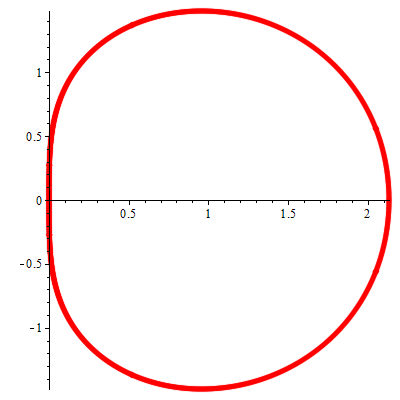
This paper proposes a modified two-point block backward differentiation formula (MBBDF) for the numerical solution of highly stiff and oscillatory ordinary differential equations. The method achieves third-order accuracy with a reduced error constant and computes two solution values simultaneously at each step. For the selected parameter value $\rho=-\dfrac{7}{8}$, stability analysis shows that the resulting scheme is A-stable, making it suitable for the numerical integration of stiff initial value problems. The method is also consistent and zero-stable, and hence convergent. Numerical experiments on benchmark stiff problems show that the relative accuracy of the considered methods depends on the problem and step size. While 2SBBDF generally produces the smallest maximum errors, the proposed MBBDF method maintains competitive accuracy and often requires substantially less computational time than 2SBBDF and 2ISBBDF. The results indicate that MBBDF provides a favorable compromise between numerical accuracy, stability, and computational efficiency for the solution of stiff and oscillatory ordinary differential equations.
Graphical Abstract
Keywords
Data Availability Statement
Funding
Conflicts of Interest
AI Use Statement
Ethical Approval and Consent to Participate
References
- Hairer, E., & Wanner, G. (1996). Solving Ordinary Differential Equations II: Stiff and Differential-Algebraic Problems (Vol. 2). Springer. https://www.researchgate.net/publication/200175469
[Google Scholar] - Lambert, J. D. (1991). Numerical Methods for Ordinary Differential Systems. New York: John Wiley & Sons. https://dl.acm.org/doi/abs/10.5555/129839
[Google Scholar] - Suleiman, M. B., Musa, H., Ismail, F., Senu, N., & Ibrahim, Z. B. (2014). A new superclass of block backward differentiation formula for stiff ordinary differential equations. Asian-european journal of mathematics, 7(01), 1350034.
[CrossRef] [Google Scholar] - Zawawi, I. S. M., Ibrahim, Z. B., Ismail, F., & Majid, Z. A. (2012). Diagonally implicit block backward differentiation formulas for solving ordinary differential equations. International journal of mathematics and mathematical sciences, 2012(1), 767328.
[CrossRef] [Google Scholar] - Gear, C. W. (1971). The automatic integration of ordinary differential equations. Communications of the ACM, 14(3), 176--179.
[CrossRef] [Google Scholar] - Cash, J. R. (1980). On the integration of stiff systems of ODEs using extended backward differentiation formulae. Numerische Mathematik, 34(3), 235-246.
[CrossRef] [Google Scholar] - Mohd Zawawi, I. S., Ibrahim, Z. B., & Othman, K. I. (2015). Derivation of diagonally implicit block backward differentiation formulas for solving stiff initial value problems. Mathematical problems in engineering, 2015(1), 179231.
[CrossRef] [Google Scholar] - Yatim, S. A. M., Ibrahim, Z. B., Othman, K. I., & Suleiman, M. B. (2013). A numerical algorithm for solving stiff ordinary differential equations. Mathematical Problems in Engineering, 2013(1), 989381.
[CrossRef] [Google Scholar] - Ibrahim, Z. B., Othman, K. I., & Suleiman, M. (2007). Implicit r-point block backward differentiation formula for solving first-order stiff ODEs. Applied Mathematics and Computation, 186(1), 558-565.
[CrossRef] [Google Scholar] - Abdulganiy, R. I., Akinfenwa, O. A., & Okunuga, S. A. (2018). Construction of L stable second derivative trigonometrically fitted block backward differentiation formula for the solution of oscillatory initial value problems. African Journal of Science, Technology, Innovation and Development, 10(4), 411-419. https://hdl.handle.net/10520/EJC-fa42b17e4
[Google Scholar] - Ijam, H. M., Ibrahim, Z. B., & Zawawi, I. S. M. (2024). Stiffly stable diagonally implicit block backward differentiation formula with adaptive step size strategy for stiff ordinary differential equations. Matematika, 27-47.
[CrossRef] [Google Scholar] - Nasarudin, A. A., Ibrahim, Z. B., & Rosali, H. (2020). On the integration of stiff ODEs using block backward differentiation formulas of order six. Symmetry, 12(6), 952.
[CrossRef] [Google Scholar] - Mohd Ijam, H., & Ibrahim, Z. B. (2019). Diagonally implicit block backward differentiation formula with optimal stability properties for stiff ordinary differential equations. Symmetry, 11(11), 1342.
[CrossRef] [Google Scholar] - Jana Aksah, S., Ibrahim, Z. B., & Mohd Zawawi, I. S. (2019). Stability analysis of singly diagonally implicit block backward differentiation formulas for stiff ordinary differential equations. Mathematics, 7(2), 211.
[CrossRef] [Google Scholar] - Suleiman, M. B., Musa, H., Ismail, F., & Senu, N. (2013). A new variable step size block backward differentiation formula for solving stiff initial value problems. International Journal of Computer Mathematics, 90(11), 2391-2408.
[CrossRef] [Google Scholar] - Bala, N., Alhassan, B., & Musa, H. (2022). A new 3-point implicit block numerical method for solving first order stiff initial value problems. Timbou-Africa Academic Publications, International Journal of Science Research and Technology, 9(9). ISSN: 2623-7861. https://www.researchgate.net/publication/366720880
[Google Scholar] - Musa, H., Suleiman, M. B., Ismail, F., Senu, N., Majid, Z. A., & Ibrahim, Z. B. (2014). A new fifth order implicit block method for solving first order stiff ordinary differential equations. Malaysian Journal of Mathematical Sciences, 8(S), 45-59. https://www.researchgate.net/publication/316516689
[Google Scholar] - Abdulrahman, A., & Hamisu, M. (2025). An Improved Extended 2-Point Super Class of Block Backward Differentiation Formula for Solving Stiff Initial Value Problems. Journal of Science and Technology, 17(1), 11-22. https://journal.uthm.edu.my/index.php/JST/article/view/20763
[Google Scholar] - Lambert, J. D. (1973). Computational Methods in Ordinary Differential Equations. New York: John Wiley & Sons.
[Google Scholar] - Dahlquist, G. G. (1963). A special stability problem for linear multistep methods. BIT Numerical Mathematics, 3(1), 27-43.
[CrossRef] [Google Scholar]
Cite This Article
TY  - JOUR
AU  - Adamu, Abdulrahman
AU  - Alhassan, Buhari
PY  - 2026
DA  - 2026/09/04
TI  - A Modified Third-Order Block Numerical Integration Technique for First Order Stiff and Oscillatory Differential Equations
JO  - ICCK Journal of Applied Mathematics
T2  - ICCK Journal of Applied Mathematics
JF  - ICCK Journal of Applied Mathematics
VL  - 2
IS  - 3
SP  - 242
EP  - 250
DO  - 10.62762/JAM.2026.326643
UR  - https://www.icck.org/article/abs/JAM.2026.326643
KW  - a-stability
KW  - order
KW  - convergence
KW  - block backward differentiation formula
KW  - stiff
AB  - This paper proposes a modified two-point block backward differentiation formula (MBBDF) for the numerical solution of highly stiff and oscillatory ordinary differential equations. The method achieves third-order accuracy with a reduced error constant and computes two solution values simultaneously at each step. For the selected parameter value $\rho=-\dfrac{7}{8}$, stability analysis shows that the resulting scheme is A-stable, making it suitable for the numerical integration of stiff initial value problems. The method is also consistent and zero-stable, and hence convergent. Numerical experiments on benchmark stiff problems show that the relative accuracy of the considered methods depends on the problem and step size. While 2SBBDF generally produces the smallest maximum errors, the proposed MBBDF method maintains competitive accuracy and often requires substantially less computational time than 2SBBDF and 2ISBBDF. The results indicate that MBBDF provides a favorable compromise between numerical accuracy, stability, and computational efficiency for the solution of stiff and oscillatory ordinary differential equations.
SN  - 3068-5656
PB  - Institute of Central Computation and Knowledge
LA  - English
ER  -
@article{Adamu2026A,
  author = {Abdulrahman Adamu and Buhari Alhassan},
  title = {A Modified Third-Order Block Numerical Integration Technique for First Order Stiff and Oscillatory Differential Equations},
  journal = {ICCK Journal of Applied Mathematics},
  year = {2026},
  volume = {2},
  number = {3},
  pages = {242-250},
  doi = {10.62762/JAM.2026.326643},
  url = {https://www.icck.org/article/abs/JAM.2026.326643},
  abstract = {This paper proposes a modified two-point block backward differentiation formula (MBBDF) for the numerical solution of highly stiff and oscillatory ordinary differential equations. The method achieves third-order accuracy with a reduced error constant and computes two solution values simultaneously at each step. For the selected parameter value \$\rho=-\dfrac{7}{8}\$, stability analysis shows that the resulting scheme is A-stable, making it suitable for the numerical integration of stiff initial value problems. The method is also consistent and zero-stable, and hence convergent. Numerical experiments on benchmark stiff problems show that the relative accuracy of the considered methods depends on the problem and step size. While 2SBBDF generally produces the smallest maximum errors, the proposed MBBDF method maintains competitive accuracy and often requires substantially less computational time than 2SBBDF and 2ISBBDF. The results indicate that MBBDF provides a favorable compromise between numerical accuracy, stability, and computational efficiency for the solution of stiff and oscillatory ordinary differential equations.},
  keywords = {a-stability, order, convergence, block backward differentiation formula, stiff},
  issn = {3068-5656},
  publisher = {Institute of Central Computation and Knowledge}
}
Article Metrics
Publisher's Note
ICCK stays neutral with regard to jurisdictional claims in published maps and institutional affiliations.
Rights and Permissions
 Copyright © 2026 by the Author(s). Published by Institute of Central Computation and Knowledge. This article is an open access article distributed under the terms and conditions of the Creative Commons Attribution (CC BY) license (https://creativecommons.org/licenses/by/4.0/), which permits use, sharing, adaptation, distribution and reproduction in any medium or format, as long as you give appropriate credit to the original author(s) and the source, provide a link to the Creative Commons licence, and indicate if changes were made.

