


Mathematical Modelling of PM2.5 Dynamics in Hyderabad: A First-Order ODE Approach with Wind-Driven Removal


Article Information
Abstract
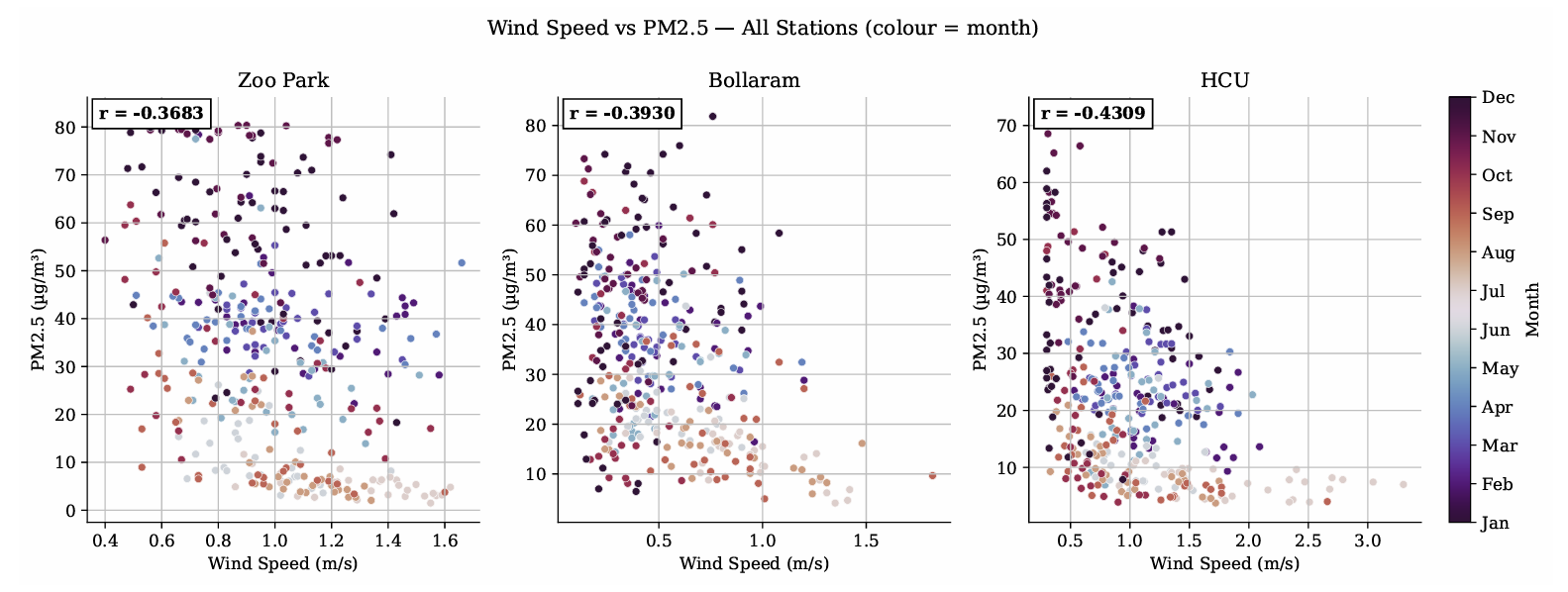
Daily mean PM\(_{2.5}\) concentrations in Hyderabad routinely exceed both the 24-hour (\(60\,\mu\text{g/m}^3\)) and the annual (\(40\,\mu\text{g/m}^3\)) National Ambient Air Quality Standards, motivating the development of transparent and inexpensive descriptive models of their seasonal behaviour. To this end, we develop and calibrate a parsimonious first-order linear ordinary differential equation (ODE) that describes the daily evolution of ambient PM\(_{2.5}\) as the balance between a seasonally varying emission source \(E(t)=E_{0}+A\cos(2\pi(t-\varphi)/365)\) and a wind-driven first-order removal \(\lambda(t)=\alpha v(t)+\lambda_{0}\). The five parameters are estimated by Differential Evolution against a year (2024) of measured daily PM\(_{2.5}\) and wind data from three monitoring stations in Hyderabad---Zoo Park (urban), Bollaram (industrial), and the University of Hyderabad (peri-urban). The model is integrated by the forward Euler and classical fourth-order Runge--Kutta schemes and verified against the analytical integrating-factor solution. The calibrated model successfully reproduces the winter peak and the monsoon minimum, explaining between 63% and 83% of the weekly variability in PM\(_{2.5}\), with weekly root-mean-square errors in the range \(8.7\)--\(15.4\,\mu\text{g/m}^3\). It also yields physically plausible station-dependent removal coefficients (\(\alpha_{\mathrm{HCU}}>\alpha_{\mathrm{ZP}}>\alpha_{\mathrm{B}}\)) consistent with each station's exposure to ventilation, while a cross-year test quantifies the loss of skill under inter-annual variability. Overall, this demonstrates that a minimal five-parameter ODE, coupled with a robust global optimiser and a high-order integrator, serves as an effective descriptive tool for seasonal PM\(_{2.5}\) analysis in data-sparse urban environments and verifies the classical convergence theory of the two numerical schemes on real environmental data.
Graphical Abstract
Keywords
Data Availability Statement
Funding
Conflicts of Interest
AI Use Statement
Ethical Approval and Consent to Participate
References
- Pope III, C. A., & Dockery, D. W. (2006). Health effects of fine particulate air pollution: lines that connect. Journal of the Air & Waste Management Association, 56(6), 709--742.
[CrossRef] [Google Scholar] - Gokhale, S., & Raokhande, N. (2008). Performance evaluation of air quality models for predicting PM10 and PM2.5 concentrations at urban traffic intersection during winter period. Science of the Total Environment, 394(1), 9--24.
[CrossRef] [Google Scholar] - World Health Organization. (2021). WHO global air quality guidelines: Particulate matter (PM2.5 and PM10), ozone, nitrogen dioxide, sulfur dioxide and carbon monoxide. WHO. Retrieved from https://www.who.int/publications/i/item/9789240034228
[Google Scholar] - Cohen, A. J., Brauer, M., Burnett, R., Anderson, H. R., Frostad, J., Estep, K., ... & Forouzanfar, M. H. (2017). Estimates and 25-year trends of the global burden of disease attributable to ambient air pollution: an analysis of data from the Global Burden of Diseases Study 2015. The lancet, 389(10082), 1907-1918.
[CrossRef] [Google Scholar] - Central Pollution Control Board. (2009). National ambient air quality standards (Notification G.S.R. 826(E)). Ministry of Environment, Forest and Climate Change, Government of India. https://cpcb.gov.in/uploads/National_Ambient_Air_Quality_Standards.pdf
[Google Scholar] - Sharma, D., & Mauzerall, D. (2022). Analysis of air pollution data in India between 2015 and 2019. Aerosol and Air Quality Research, 22(2), 210204.
[CrossRef] [Google Scholar] - Stockie, J. M. (2011). The mathematics of atmospheric dispersion modeling. SIAM Review, 53(2), 349--372.
[CrossRef] [Google Scholar] - Zhang, Y., Bocquet, M., Mallet, V., Seigneur, C., & Baklanov, A. (2012). Real-time air quality forecasting, part I: History, techniques, and current status. Atmospheric Environment, 60, 632--655.
[CrossRef] [Google Scholar] - Mirzaei, S., Liao, T. L., & Hsu, C. Y. (2025). Modeling PM\(_{2.5\) urban pollution using hybrid models incorporating decomposition and multiple factors. Urban Climate, 60, 102338.
[CrossRef] [Google Scholar] - Makhdoomi, A., Sarkhosh, M., & Ziaei, S. (2025). PM\(_{2.5\) concentration prediction using machine learning algorithms: An approach to virtual monitoring stations. Scientific Reports, 15(1), 8076.
[CrossRef] [Google Scholar] - Vardoulakis, S., Fisher, B. E., Pericleous, K., & Gonzalez-Flesca, N. (2003). Modelling air quality in street canyons: a review. Atmospheric Environment, 37(2), 155--182.
[CrossRef] [Google Scholar] - Seinfeld, J. H., & Pandis, S. N. (2016). Atmospheric chemistry and physics: From air pollution to climate change (3rd ed.). John Wiley & Sons. https://www.wiley.com/en-us/Atmospheric+Chemistry+and+Physics%3A+From+Air+Pollution+to+Climate+Change%2C+3rd+Edition-p-9781118947401
[Google Scholar] - Storn, R., & Price, K. (1997). Differential evolution-a simple and efficient heuristic for global optimization over continuous spaces. Journal of Global Optimization, 11(4), 341--359.
[CrossRef] [Google Scholar] - Mathew, A., Gokul, P. R., Raja Shekar, P., Arunab, K. S., Ghassan Abdo, H., Almohamad, H., & Abdullah Al Dughairi, A. (2023). Air quality analysis and PM2. 5 modelling using machine learning techniques: A study of Hyderabad city in India. Cogent Engineering, 10(1), 2243743.
[CrossRef] [Google Scholar] - Butcher, J. C. (2003). Numerical methods for ordinary differential equations. John Wiley & Sons.
[CrossRef] [Google Scholar] - LeVeque, R. J. (2007). Finite difference methods for ordinary and partial differential equations. SIAM.
[CrossRef] [Google Scholar] - Rios, L. M., & Sahinidis, N. V. (2013). Derivative-free optimization: a review of algorithms and comparison of software implementations. Journal of Global Optimization, 56(3), 1247--1293.
[CrossRef] [Google Scholar] - Guttikunda, S. K., & Kopakka, R. V. (2014). Source emissions and health impacts of urban air pollution in Hyderabad, India. Air Quality, Atmosphere & Health, 7(2), 195--207.
[CrossRef] [Google Scholar] - Kreyszig, E. (2011). Advanced engineering mathematics (10th ed.). John Wiley & Sons. https://www.wiley.com/en-us/advanced-engineering-mathematics-10th-edition-p-9781119446842
[Google Scholar]
Cite This Article
TY  - JOUR
AU  - Reddy, Cherlacola Srinivas
AU  - Vaishnavi, CH.
AU  - Anuhya, D.
AU  - Kavya, K. N.
AU  - Vaishnavi, N.
AU  - Sindhuja, V.
AU  - Shruthi, P.
PY  - 2026
DA  - 2026/08/13
TI  - Mathematical Modelling of PM2.5 Dynamics in Hyderabad: A First-Order ODE Approach with Wind-Driven Removal
JO  - ICCK Journal of Applied Mathematics
T2  - ICCK Journal of Applied Mathematics
JF  - ICCK Journal of Applied Mathematics
VL  - 2
IS  - 3
SP  - 221
EP  - 232
DO  - 10.62762/JAM.2026.575197
UR  - https://www.icck.org/article/abs/JAM.2026.575197
KW  - air quality modelling
KW  - PM2.5
KW  - Ordinary differential equation
KW  - Differential Evolution
KW  - Runge--Kutta method
KW  - Hyderabad
AB  - Daily mean PM\(_{2.5}\) concentrations in Hyderabad routinely exceed both the 24-hour (\(60\,\mu\text{g/m}^3\)) and the annual (\(40\,\mu\text{g/m}^3\)) National Ambient Air Quality Standards, motivating the development of transparent and inexpensive descriptive models of their seasonal behaviour. To this end, we develop and calibrate a parsimonious first-order linear ordinary differential equation (ODE) that describes the daily evolution of ambient PM\(_{2.5}\) as the balance between a seasonally varying emission source \(E(t)=E_{0}+A\cos(2\pi(t-\varphi)/365)\) and a wind-driven first-order removal \(\lambda(t)=\alpha v(t)+\lambda_{0}\). The five parameters are estimated by Differential Evolution against a year (2024) of measured daily PM\(_{2.5}\) and wind data from three monitoring stations in Hyderabad---Zoo Park (urban), Bollaram (industrial), and the University of Hyderabad (peri-urban). The model is integrated by the forward Euler and classical fourth-order Runge--Kutta schemes and verified against the analytical integrating-factor solution. The calibrated model successfully reproduces the winter peak and the monsoon minimum, explaining between 63% and 83% of the weekly variability in PM\(_{2.5}\), with weekly root-mean-square errors in the range \(8.7\)--\(15.4\,\mu\text{g/m}^3\). It also yields physically plausible station-dependent removal coefficients (\(\alpha_{\mathrm{HCU}}>\alpha_{\mathrm{ZP}}>\alpha_{\mathrm{B}}\)) consistent with each station's exposure to ventilation, while a cross-year test quantifies the loss of skill under inter-annual variability. Overall, this demonstrates that a minimal five-parameter ODE, coupled with a robust global optimiser and a high-order integrator, serves as an effective descriptive tool for seasonal PM\(_{2.5}\) analysis in data-sparse urban environments and verifies the classical convergence theory of the two numerical schemes on real environmental data.
SN  - 3068-5656
PB  - Institute of Central Computation and Knowledge
LA  - English
ER  -
@article{Reddy2026Mathematic,
  author = {Cherlacola Srinivas Reddy and CH. Vaishnavi and D. Anuhya and K. N. Kavya and N. Vaishnavi and V. Sindhuja and P. Shruthi},
  title = {Mathematical Modelling of PM2.5 Dynamics in Hyderabad: A First-Order ODE Approach with Wind-Driven Removal},
  journal = {ICCK Journal of Applied Mathematics},
  year = {2026},
  volume = {2},
  number = {3},
  pages = {221-232},
  doi = {10.62762/JAM.2026.575197},
  url = {https://www.icck.org/article/abs/JAM.2026.575197},
  abstract = {Daily mean PM\(\_{2.5}\) concentrations in Hyderabad routinely exceed both the 24-hour (\(60\,\mu\text{g/m}^3\)) and the annual (\(40\,\mu\text{g/m}^3\)) National Ambient Air Quality Standards, motivating the development of transparent and inexpensive descriptive models of their seasonal behaviour. To this end, we develop and calibrate a parsimonious first-order linear ordinary differential equation (ODE) that describes the daily evolution of ambient PM\(\_{2.5}\) as the balance between a seasonally varying emission source \(E(t)=E\_{0}+A\cos(2\pi(t-\varphi)/365)\) and a wind-driven first-order removal \(\lambda(t)=\alpha v(t)+\lambda\_{0}\). The five parameters are estimated by Differential Evolution against a year (2024) of measured daily PM\(\_{2.5}\) and wind data from three monitoring stations in Hyderabad---Zoo Park (urban), Bollaram (industrial), and the University of Hyderabad (peri-urban). The model is integrated by the forward Euler and classical fourth-order Runge--Kutta schemes and verified against the analytical integrating-factor solution. The calibrated model successfully reproduces the winter peak and the monsoon minimum, explaining between 63\% and 83\% of the weekly variability in PM\(\_{2.5}\), with weekly root-mean-square errors in the range \(8.7\)--\(15.4\,\mu\text{g/m}^3\). It also yields physically plausible station-dependent removal coefficients (\(\alpha\_{\mathrm{HCU}}>\alpha\_{\mathrm{ZP}}>\alpha\_{\mathrm{B}}\)) consistent with each station's exposure to ventilation, while a cross-year test quantifies the loss of skill under inter-annual variability. Overall, this demonstrates that a minimal five-parameter ODE, coupled with a robust global optimiser and a high-order integrator, serves as an effective descriptive tool for seasonal PM\(\_{2.5}\) analysis in data-sparse urban environments and verifies the classical convergence theory of the two numerical schemes on real environmental data.},
  keywords = {air quality modelling, PM2.5, Ordinary differential equation, Differential Evolution, Runge--Kutta method, Hyderabad},
  issn = {3068-5656},
  publisher = {Institute of Central Computation and Knowledge}
}
Article Metrics
Publisher's Note
ICCK stays neutral with regard to jurisdictional claims in published maps and institutional affiliations.
Rights and Permissions
 Copyright © 2026 by the Author(s). Published by Institute of Central Computation and Knowledge. This article is an open access article distributed under the terms and conditions of the Creative Commons Attribution (CC BY) license (https://creativecommons.org/licenses/by/4.0/), which permits use, sharing, adaptation, distribution and reproduction in any medium or format, as long as you give appropriate credit to the original author(s) and the source, provide a link to the Creative Commons licence, and indicate if changes were made.

