

$J2$-Aware Joint Optimization of Fuel Station Placement and Satellite Assignment for SSO Satellite Clusters



Article Information
Abstract
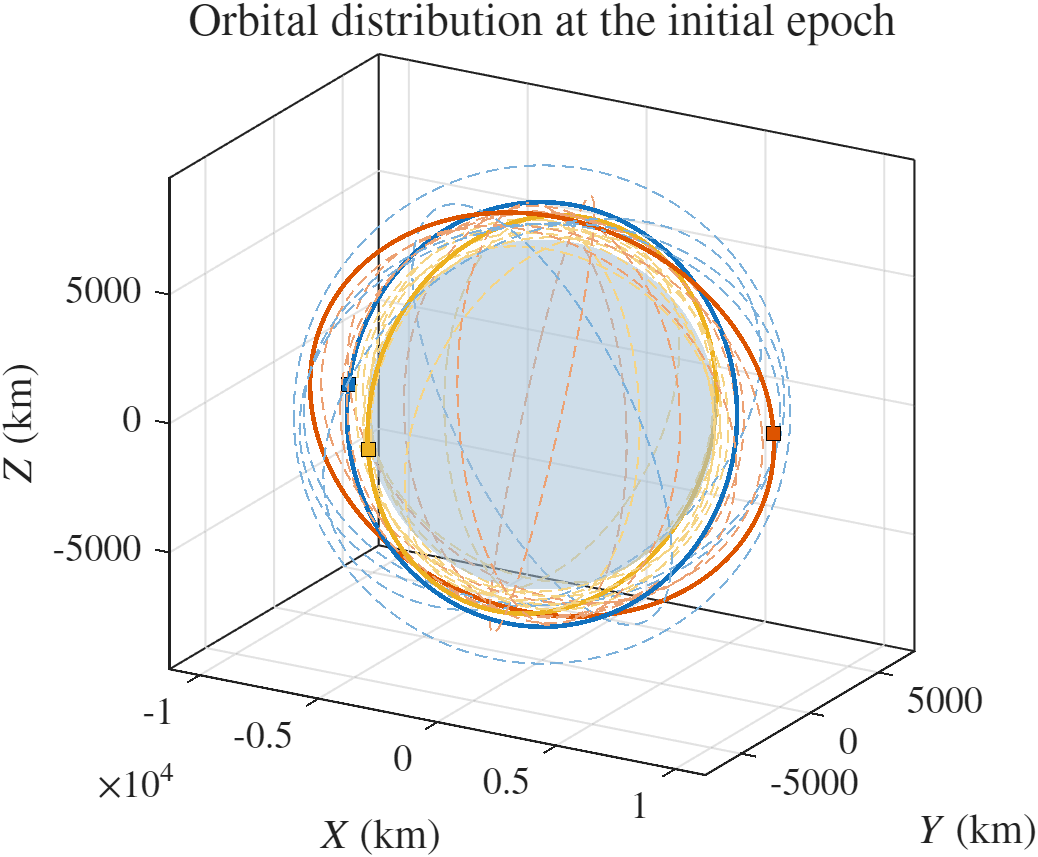
On-orbit refueling of sun-synchronous-orbit (SSO) satellite clusters requires effective deployment of fuel stations (FSs). To this end, this paper investigates the deployment optimization problem of fuel stations for SSO clusters by considering orbital geometry, satellite-to-station assignment, and refueling mission feasibility. A \(J_2\)-aware optimization framework is proposed, in which a particle swarm optimizer searches for optimal fuel-station orbital parameters and satellite assignments. For each candidate deployment, a deterministic mission evaluator is employed to estimate natural alignment opportunities, transfer requirements, and fuel consumption. The proposed approach considers the variation of the relative right ascension of the ascending node (RAAN) between the station and each target during the service interval, and evaluates transfer costs using both departure and terminal orbital geometries. A multi-objective optimization model is formulated to trade off propellant consumption, cluster balance, servicing-spacecraft requirements, and constraint violation penalty. Simulation results for a 20-target SSO cluster show that the optimized three-FS deployment serves all targets with a total refueling-related propellant consumption of 3405.8~kg and a total servicing-spacecraft requirement of four.
Graphical Abstract
Keywords
Data Availability Statement
Funding
Conflicts of Interest
AI Use Statement
Ethical Approval and Consent to Participate
References
- Luu, M. A., & Hastings, D. E. (2022). On-orbit servicing system architectures for proliferated low-Earth-orbit constellations. Journal of Spacecraft and Rockets, 59(6), 1946-1965.
[CrossRef] [Google Scholar] - Selva, D., Golkar, A., Korobova, O., Lluch i Cruz, I., Collopy, P., & de Weck, O. L. (2017). Distributed Earth satellite systems: What is needed to move forward? Journal of Aerospace Information Systems, 14(8), 412-438.
[CrossRef] [Google Scholar] - Xu, C., Wang, J., & Zhang, C. (2026). Boundary-constrained spacecraft swarm maintenance via periodic reconfiguration in $J_2$-perturbed near-circular orbits. Aerospace Science and Technology, 178, 113046.
[CrossRef] [Google Scholar] - Macdonald, M., McKay, R., Vasile, M., & Frescheville, F. B. D. (2010). Extension of the sun-synchronous orbit. Journal of Guidance, Control, and Dynamics, 33(6), 1935-1940.
[CrossRef] [Google Scholar] - Aorpimai, M., & Palmer, P. L. (2007). Repeat-groundtrack orbit acquisition and maintenance for Earth-observation satellites. Journal of guidance, control, and dynamics, 30(3), 654-659.
[CrossRef] [Google Scholar] - Zhao, S., Zhang, J., Xiang, K., & Qi, R. (2017). Target sequence optimization for multiple debris rendezvous using low thrust based on characteristics of SSO. Astrodynamics, 1(1), 85-99.
[CrossRef] [Google Scholar] - Malyh, D., Vaulin, S., Fedorov, V., Peshkov, R., & Shalashov, M. (2022). A brief review on in-orbit refueling projects and critical techniques. Aerospace Systems, 5(2), 185-196.
[CrossRef] [Google Scholar] - Kim, J., Sung, T., Hwang, W., & Ahn, J. (2026). On-Orbit Servicing-Integrated Maintenance Strategy for a Satellite Constellation. Journal of Spacecraft and Rockets, 1-18.
[CrossRef] [Google Scholar] - Du Jonchay, T. S., & Ho, K. (2017). Quantification of the responsiveness of on-orbit servicing infrastructure for modularized earth-orbiting platforms. Acta Astronautica, 132, 192-203.
[CrossRef] [Google Scholar] - Dutta, A., & Tsiotras, P. (2010). Network flow formulation for cooperative peer-to-peer refueling strategies. Journal of Guidance, Control, and Dynamics, 33(5), 1539-1549.
[CrossRef] [Google Scholar] - Meng, B., Huang, J., Li, Z., Huang, L., Pang, Y., Han, X., & Zhang, Z. (2019). The orbit deployment strategy of OOS system for refueling near-earth orbit satellites. Acta Astronautica, 159, 486-498.
[CrossRef] [Google Scholar] - Vallado, D. A. (2013). Fundamentals of Astrodynamics and Applications (4th ed.). Hawthorne, CA: Microcosm Press. ISBN 978-1-881883-18-0. https://books.google.co.in/books?id=PJLlWzMBKjkC
[Google Scholar] - Zuo, X., Li, K., Chen, L., He, X., & Xu, M. (2025). Fixed-period strategy for maintaining the absolute configuration of large-scale LEO constellations. Advances in Space Research, 76(8), 4663-4678.
[CrossRef] [Google Scholar] - Shimane, Y., Gollins, N., & Ho, K. (2024). Orbital facility location problem for satellite constellation servicing depots. Journal of Spacecraft and Rockets, 61(3), 808-825.
[CrossRef] [Google Scholar] - Chen, X., & Yu, J. (2017). Optimal mission planning of GEO on-orbit refueling in mixed strategy. Acta Astronautica, 133, 63-72.
[CrossRef] [Google Scholar] - Li, C., & Xu, B. (2020). Optimal scheduling of multiple Sun-synchronous orbit satellites refueling. Advances in Space Research, 66(2), 345-358.
[CrossRef] [Google Scholar] - Zhang, J., Parks, G. T., Luo, Y., & Tang, G. (2014). Multispacecraft refueling optimization considering the $J_2$ perturbation and window constraints. Journal of Guidance, Control, and Dynamics, 37(1), 111-122.
[CrossRef] [Google Scholar] - Zhao, Z., Zhang, J., Li, H., & Zhou, J. (2017). LEO cooperative multi-spacecraft refueling mission optimization considering $J_2$ perturbation and target's surplus propellant constraint. Advances in Space Research, 59(1), 252-262.
[CrossRef] [Google Scholar] - Zhu, X., Chen, J., Zhang, C., & Qiao, B. (2020). Optimal fuel station arrangement for multiple GEO spacecraft refueling mission. Advances in Space Research, 66(8), 1924-1936.
[CrossRef] [Google Scholar] - Zhu, X., Zhang, C., Sun, R., Chen, J., & Wan, X. (2020). Orbit determination for fuel station in multiple SSO spacecraft refueling considering the $J_2$ perturbation. Aerospace Science and Technology, 105, 105994.
[CrossRef] [Google Scholar] - Han, P., Guo, Y., Wang, P., Li, C., & Pedrycz, W. (2023). Optimal orbit design and mission scheduling for Sun-synchronous orbit on-orbit refueling system. IEEE Transactions on Aerospace and Electronic Systems, 59(5), 4968-4983.
[CrossRef] [Google Scholar] - Kim, J., Shimane, Y., & Ho, K. (2025). Orbital depot location optimization for satellite constellation servicing with low-thrust transfers. Journal of Spacecraft and Rockets.
[CrossRef] [Google Scholar] - Kennedy, J., & Eberhart, R. (1995). Particle swarm optimization. In Proceedings of ICNN'95 - International Conference on Neural Networks (Vol. 4, pp. 1942-1948).
[CrossRef] [Google Scholar] - Shi, Y., & Eberhart, R. (1998, May). A modified particle swarm optimizer. In Evolutionary computation proceedings (Vol. 890, pp. 69-73).
[CrossRef] [Google Scholar] - Zhou, Y., Yan, Y., Huang, X., & Kong, L. (2015). Optimal scheduling of multiple geosynchronous satellites refueling based on a hybrid particle swarm optimizer. Aerospace Science and Technology, 47, 125-134.
[CrossRef] [Google Scholar] - Sorenson, S. E., & Pinkley, S. G. N. (2023). Multi-orbit routing and scheduling of refuellable on-orbit servicing space robots. Computers & Industrial Engineering, 176, 108852.
[CrossRef] [Google Scholar]
Cite This Article
TY  - JOUR
AU  - Yin, Tianle
AU  - Zhu, Jiajing
AU  - Qiao, Zheng
AU  - Xu, Shijie
AU  - Zhao, Lei
PY  - 2026
DA  - 2026/09/24
TI  - $J2$-Aware Joint Optimization of Fuel Station Placement and Satellite Assignment for SSO Satellite Clusters
JO  - Aerospace Engineering Communications
T2  - Aerospace Engineering Communications
JF  - Aerospace Engineering Communications
VL  - 1
IS  - 3
SP  - 119
EP  - 127
DO  - 10.62762/AEC.2026.761344
UR  - https://www.icck.org/article/abs/AEC.2026.761344
KW  - on-orbit refueling
KW  - SSO
KW  - fuel-station placement
KW  - $J_2$ perturbation
AB  - On-orbit refueling of sun-synchronous-orbit (SSO) satellite clusters requires effective deployment of fuel stations (FSs). To this end, this paper investigates the deployment optimization problem of fuel stations for SSO clusters by considering orbital geometry, satellite-to-station assignment, and refueling mission feasibility. A \(J_2\)-aware optimization framework is proposed, in which a particle swarm optimizer searches for optimal fuel-station orbital parameters and satellite assignments. For each candidate deployment, a deterministic mission evaluator is employed to estimate natural alignment opportunities, transfer requirements, and fuel consumption. The proposed approach considers the variation of the relative right ascension of the ascending node (RAAN) between the station and each target during the service interval, and evaluates transfer costs using both departure and terminal orbital geometries. A multi-objective optimization model is formulated to trade off propellant consumption, cluster balance, servicing-spacecraft requirements, and constraint violation penalty. Simulation results for a 20-target SSO cluster show that the optimized three-FS deployment serves all targets with a total refueling-related propellant consumption of 3405.8~kg and a total servicing-spacecraft requirement of four.
SN  - 3071-1967
PB  - Institute of Central Computation and Knowledge
LA  - English
ER  -
@article{Yin2026J2Aware,
  author = {Tianle Yin and Jiajing Zhu and Zheng Qiao and Shijie Xu and Lei Zhao},
  title = {\$J2\$-Aware Joint Optimization of Fuel Station Placement and Satellite Assignment for SSO Satellite Clusters},
  journal = {Aerospace Engineering Communications},
  year = {2026},
  volume = {1},
  number = {3},
  pages = {119-127},
  doi = {10.62762/AEC.2026.761344},
  url = {https://www.icck.org/article/abs/AEC.2026.761344},
  abstract = {On-orbit refueling of sun-synchronous-orbit (SSO) satellite clusters requires effective deployment of fuel stations (FSs). To this end, this paper investigates the deployment optimization problem of fuel stations for SSO clusters by considering orbital geometry, satellite-to-station assignment, and refueling mission feasibility. A \(J\_2\)-aware optimization framework is proposed, in which a particle swarm optimizer searches for optimal fuel-station orbital parameters and satellite assignments. For each candidate deployment, a deterministic mission evaluator is employed to estimate natural alignment opportunities, transfer requirements, and fuel consumption. The proposed approach considers the variation of the relative right ascension of the ascending node (RAAN) between the station and each target during the service interval, and evaluates transfer costs using both departure and terminal orbital geometries. A multi-objective optimization model is formulated to trade off propellant consumption, cluster balance, servicing-spacecraft requirements, and constraint violation penalty. Simulation results for a 20-target SSO cluster show that the optimized three-FS deployment serves all targets with a total refueling-related propellant consumption of 3405.8~kg and a total servicing-spacecraft requirement of four.},
  keywords = {on-orbit refueling, SSO, fuel-station placement, \$J\_2\$ perturbation},
  issn = {3071-1967},
  publisher = {Institute of Central Computation and Knowledge}
}
Article Metrics
Publisher's Note
ICCK stays neutral with regard to jurisdictional claims in published maps and institutional affiliations.
Rights and Permissions
 Copyright © 2026 by the Author(s). Published by Institute of Central Computation and Knowledge. This article is an open access article distributed under the terms and conditions of the Creative Commons Attribution (CC BY) license (https://creativecommons.org/licenses/by/4.0/), which permits use, sharing, adaptation, distribution and reproduction in any medium or format, as long as you give appropriate credit to the original author(s) and the source, provide a link to the Creative Commons licence, and indicate if changes were made.


Portico
