

A Comparative Analysis of the Gene Sequences, Structural Models and Identification of Candidate Epitope of Dengue Envelope Protein Domain III




Article Information
Abstract
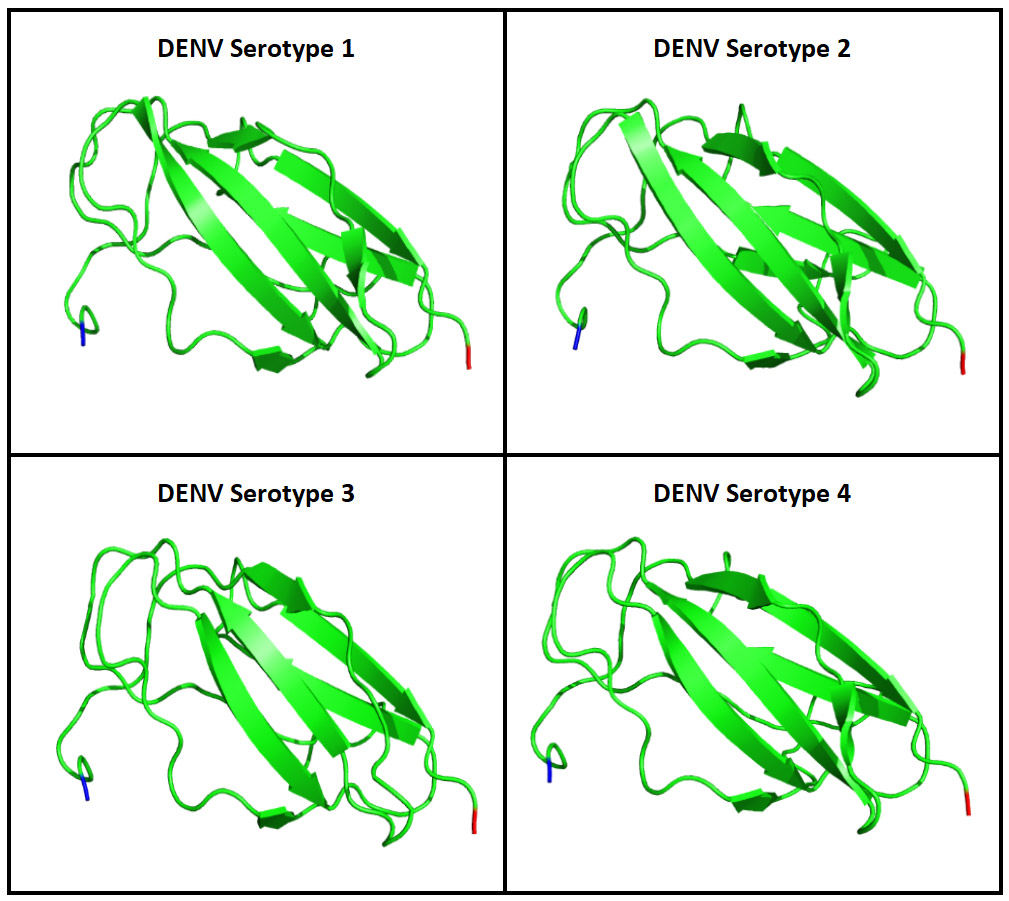
Dengue is a major public health concern in tropical and subtropical regions worldwide. The World Health Organization (WHO) classifies dengue as an endemic disease in more than 125 countries, with approximately 75% of the affected population residing in the Asia-Pacific region, including the Philippines. This study aimed to compare and analyze the four-dengue virus (DENV) serotypes in terms of gene and protein sequence alignment, structural modeling, and identification of candidate epitopes within envelope protein domain III (E-DIII). The DENV E-DIII region plays a critical role in host-cell interaction and is considered a promising immunogenic target for the development of dengue subunit vaccines and diagnostic tools. Bioinformatics tools were employed for gene and protein sequence alignment, protein structure prediction, structural annotation, and peptide analysis. Conserved and variable regions among the four DENV serotypes were identified and analyzed using multiple epitope prediction methods. The study computationally predicted two candidate linear epitope regions: discriminatory residues from K16–T25 and non-discriminatory residues from N72–E81 or N72–D81. These peptide regions were predicted to be non-toxic, non-glycosylated, and exhibited average to high scores across multiple epitope prediction algorithms. The findings provide insights into the structural and sequence characteristics of DENV E-DIII and contribute to the identification of potential peptide targets for future dengue antigen and vaccine development.
Graphical Abstract
Keywords
Data Availability Statement
Funding
Conflicts of Interest
AI Use Statement
Ethical Approval and Consent to Participate
References
- WHO Regional Office for South-East Asia. (2011). Comprehensive Guidelines for Prevention and Control of Dengue and Dengue Haemorrhagic Fever, Revised and Expanded Edition. New Delhi: World Health Organisation Southeast Asia Regional Office. Retrieved from https://iris.who.int/handle/10665/204894
[Google Scholar] - Beatty, M. E., Beutels, P., Meltzer, M. I., Shepard, D. S., Hombach, J., Hutubessy, R., ... & Kuritsky, J. N. (2011). Health economics of dengue: a systematic literature review and expert panel's assessment. The American journal of tropical medicine and hygiene, 84(3), 473.
[CrossRef] [Google Scholar] - Gubler, D. J. (2011). Dengue, urbanization and globalization: the unholy trinity of the 21st century. Tropical medicine and health, 39(4SUPPLEMENT), S3-S11.
[CrossRef] [Google Scholar] - Gubler, D. J. (2012). The economic burden of dengue. The American journal of tropical medicine and hygiene, 86(5), 743.
[CrossRef] [Google Scholar] - Brady, O. J., Gething, P. W., Bhatt, S., Messina, J. P., Brownstein, J. S., Hoen, A. G., ... & Hay, S. I. (2012). Refining the global spatial limits of dengue virus transmission by evidence-based consensus. Plos Neglected Tropical Diseases, 6(8), e1760.
[CrossRef] [Google Scholar] - Lim, L. E., & Stransky, E. (1956, October). On infectious acute thrombocytopenic purpura (hemorrhagic fever) observed in children in the Philippines. In Annales paediatrici. International review of pediatrics (Vol. 187, No. 4, pp. 309-320). https://pubmed.ncbi.nlm.nih.gov/13363112/
[Google Scholar] - Quintos, F., Lim, L., Juliano, L., Reyes, A., & Lacson, P. (1954). Hemorrhagic fever observed among children in the Philippines. Philipp. J. Pediatr., 3, 1–9. https://www.herdin.ph/index.php/component/herdin/?view=research&cid=25171
[Google Scholar] - Save the Children. (2019, August 15). Nearly half of all dengue deaths in the Philippines are children under nine years old. ReliefWeb. Retrieved from https://reliefweb.int/report/philippines/nearly-half-all-dengue-deaths-philippines-are-children-under-nine-years-old
[Google Scholar] - Agrupis, K. A., Ylade, M., Aldaba, J., Lopez, A. L., & Deen, J. (2019). Trends in dengue research in the Philippines: A systematic review. PLoS neglected tropical diseases, 13(4), e0007280.
[CrossRef] [Google Scholar] - Guzman, M. G., Halstead, S. B., Artsob, H., Buchy, P., Farrar, J., Gubler, D. J., ... & Peeling, R. W. (2010). Dengue: a continuing global threat. Nature reviews microbiology, 8(Suppl 12), S7-S16.
[CrossRef] [Google Scholar] - Sangkawibha, N., Rojanasuphot, S., Ahandrik, S., Viriyapongse, S., Jatanasen, S., Salitul, V., ... & Halstead, S. B. (1984). Risk factors in dengue shock syndrome: a prospective epidemiologic study in Rayong, Thailand: I. The 1980 outbreak. American journal of epidemiology, 120(5), 653-669.
[CrossRef] [Google Scholar] - Beatty, M. E., Stone, A., Fitzsimons, D. W., Hanna, J. N., Lam, S. K., Vong, S., ... & Asia-Pacific and Americas Dengue Prevention Boards Surveillance Working Group. (2010). Best practices in dengue surveillance: a report from the Asia-Pacific and Americas Dengue Prevention Boards. PLoS neglected tropical diseases, 4(11), e890.
[CrossRef] [Google Scholar] - Daugelaite, J., O' Driscoll, A., & Sleator, R. D. (2013). An overview of multiple sequence alignments and cloud computing in bioinformatics. International Scholarly Research Notices, 2013(1), 615630.
[CrossRef] [Google Scholar] - Kumar, S., Stecher, G., Li, M., Knyaz, C., & Tamura, K. (2018). MEGA X: molecular evolutionary genetics analysis across computing platforms. Molecular biology and evolution, 35(6), 1547-1549.
[CrossRef] [Google Scholar] - Yang, J., & Zhang, Y. (2015). I-TASSER server: new development for protein structure and function predictions. Nucleic acids research, 43(W1), W174-W181.
[CrossRef] [Google Scholar] - DeLano, W. L. (2009). Introduction to PyMOL. DeLano Scientific LLC. Retrieved from https://sites.pitt.edu/~epolinko/IntroPyMOL.pdf
[Google Scholar] - Gupta, S., Kapoor, P., Chaudhary, K., Gautam, A., Kumar, R., Open Source Drug Discovery Consortium, & Raghava, G. P. (2013). In silico approach for predicting toxicity of peptides and proteins. PloS one, 8(9), e73957.
[CrossRef] [Google Scholar] - Gupta, S., Kapoor, P., Chaudhary, K., Gautam, A., Kumar, R., & Raghava, G. P. (2014). Peptide toxicity prediction. In Computational peptidology (pp. 143-157). New York, NY: Springer New York.
[CrossRef] [Google Scholar] - Jankun-Kelly, T. J., Lindeman, A. D., & Bridges, S. M. (2009). Exploratory visual analysis of conserved domains on multiple sequence alignments. BMC bioinformatics, 10(Suppl 11), S7.
[CrossRef] [Google Scholar] - Sitbon, E., & Pietrokovski, S. (2007). Occurrence of protein structure elements in conserved sequence regions. BMC structural biology, 7(1), 3.
[CrossRef] [Google Scholar] - Nardin, E. H., Calvo-Calle, J. M., Oliveira, G. A., Nussenzweig, R. S., Schneider, M., Tiercy, J. M., ... & Rose, K. (2001). A totally synthetic polyoxime malaria vaccine containing Plasmodium falciparum B cell and universal T cell epitopes elicits immune responses in volunteers of diverse HLA types. The Journal of Immunology, 166(1), 481-489.
[CrossRef] [Google Scholar] - Karplus, P. A., & Schulz, G. E. (1985). Prediction of chain flexibility in proteins: a tool for the selection of peptide antigens. Naturwissenschaften, 72(4), 212-213.
[CrossRef] [Google Scholar] - Kolaskar, A. S., & Tongaonkar, P. C. (1990). A semi-empirical method for prediction of antigenic determinants on protein antigens. FEBS letters, 276(1-2), 172-174.
[CrossRef] [Google Scholar] - Emini, E. A., Hughes, J. V., Perlow, D., & Boger, J. (1985). Induction of hepatitis A virus-neutralizing antibody by a virus-specific synthetic peptide. Journal of virology, 55(3), 836-839.
[CrossRef] [Google Scholar]
Cite This Article
TY  - JOUR
AU  - Santiago, Jhunel V.
AU  - Tan, Cynthia G.
PY  - 2026
DA  - 2026/06/29
TI  - A Comparative Analysis of the Gene Sequences, Structural Models and Identification of Candidate Epitope of Dengue Envelope Protein Domain III
JO  - Biomedical Informatics and Smart Healthcare
T2  - Biomedical Informatics and Smart Healthcare
JF  - Biomedical Informatics and Smart Healthcare
VL  - 2
IS  - 2
SP  - 98
EP  - 107
DO  - 10.62762/BISH.2026.340536
UR  - https://www.icck.org/article/abs/BISH.2026.340536
KW  - dengue virus
KW  - serotypes
KW  - envelope protein domain III
KW  - epitope prediction
KW  - conserved sequences
AB  - Dengue is a major public health concern in tropical and subtropical regions worldwide. The World Health Organization (WHO) classifies dengue as an endemic disease in more than 125 countries, with approximately 75% of the affected population residing in the Asia-Pacific region, including the Philippines. This study aimed to compare and analyze the four-dengue virus (DENV) serotypes in terms of gene and protein sequence alignment, structural modeling, and identification of candidate epitopes within envelope protein domain III (E-DIII). The DENV E-DIII region plays a critical role in host-cell interaction and is considered a promising immunogenic target for the development of dengue subunit vaccines and diagnostic tools. Bioinformatics tools were employed for gene and protein sequence alignment, protein structure prediction, structural annotation, and peptide analysis. Conserved and variable regions among the four DENV serotypes were identified and analyzed using multiple epitope prediction methods. The study computationally predicted two candidate linear epitope regions: discriminatory residues from K16–T25 and non-discriminatory residues from N72–E81 or N72–D81. These peptide regions were predicted to be non-toxic, non-glycosylated, and exhibited average to high scores across multiple epitope prediction algorithms. The findings provide insights into the structural and sequence characteristics of DENV E-DIII and contribute to the identification of potential peptide targets for future dengue antigen and vaccine development.
SN  - 3068-5524
PB  - Institute of Central Computation and Knowledge
LA  - English
ER  -
@article{Santiago2026A,
  author = {Jhunel V. Santiago and Cynthia G. Tan},
  title = {A Comparative Analysis of the Gene Sequences, Structural Models and Identification of Candidate Epitope of Dengue Envelope Protein Domain III},
  journal = {Biomedical Informatics and Smart Healthcare},
  year = {2026},
  volume = {2},
  number = {2},
  pages = {98-107},
  doi = {10.62762/BISH.2026.340536},
  url = {https://www.icck.org/article/abs/BISH.2026.340536},
  abstract = {Dengue is a major public health concern in tropical and subtropical regions worldwide. The World Health Organization (WHO) classifies dengue as an endemic disease in more than 125 countries, with approximately 75\% of the affected population residing in the Asia-Pacific region, including the Philippines. This study aimed to compare and analyze the four-dengue virus (DENV) serotypes in terms of gene and protein sequence alignment, structural modeling, and identification of candidate epitopes within envelope protein domain III (E-DIII). The DENV E-DIII region plays a critical role in host-cell interaction and is considered a promising immunogenic target for the development of dengue subunit vaccines and diagnostic tools. Bioinformatics tools were employed for gene and protein sequence alignment, protein structure prediction, structural annotation, and peptide analysis. Conserved and variable regions among the four DENV serotypes were identified and analyzed using multiple epitope prediction methods. The study computationally predicted two candidate linear epitope regions: discriminatory residues from K16–T25 and non-discriminatory residues from N72–E81 or N72–D81. These peptide regions were predicted to be non-toxic, non-glycosylated, and exhibited average to high scores across multiple epitope prediction algorithms. The findings provide insights into the structural and sequence characteristics of DENV E-DIII and contribute to the identification of potential peptide targets for future dengue antigen and vaccine development.},
  keywords = {dengue virus, serotypes, envelope protein domain III, epitope prediction, conserved sequences},
  issn = {3068-5524},
  publisher = {Institute of Central Computation and Knowledge}
}
Article Metrics
Publisher's Note
ICCK stays neutral with regard to jurisdictional claims in published maps and institutional affiliations.
Rights and Permissions
 Copyright © 2026 by the Author(s). Published by Institute of Central Computation and Knowledge. This article is an open access article distributed under the terms and conditions of the Creative Commons Attribution (CC BY) license (https://creativecommons.org/licenses/by/4.0/), which permits use, sharing, adaptation, distribution and reproduction in any medium or format, as long as you give appropriate credit to the original author(s) and the source, provide a link to the Creative Commons licence, and indicate if changes were made.


Portico
