

ANFIS-PSO: A Particle Swarm Optimized Adaptive Neuro-Fuzzy Inference System for Early Diagnosis and Risk Stratification of Chronic Kidney Disease



Article Information
Abstract
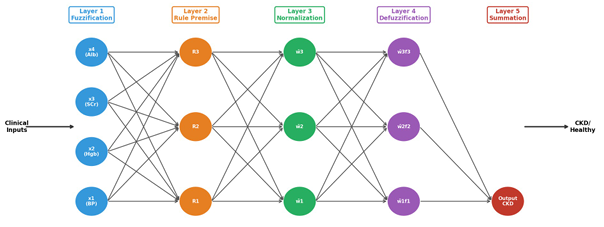
Chronic Kidney Disease (CKD) affects 697.5 million people globally, with \~{}115 million in India. Early detection is clinically challenging as the disease remains asymptomatic through stages 1–3, particularly in resource-limited rural settings like Madhya Pradesh. While high-accuracy black-box models (SVM, Random Forest, DNN) achieve 91.5–98% accuracy on the UCI CKD benchmark, they lack interpretability—creating a Transparency Gap that hinders clinical adoption. This paper proposes ANFIS-PSO, a Particle Swarm Optimization-tuned Adaptive Neuro-Fuzzy Inference System for early CKD diagnosis. A five-stage pipeline incorporating KNN imputation and Min-Max normalization was applied to the 400-record UCI dataset with a 70:30 split. A five-layer ANFIS with Gaussian fuzzification and Takagi-Sugeno defuzzification was constructed, optimizing 125 membership function centers via PSO with validation-based fitness. Evaluation using both single holdout and 5-fold stratified cross-validation yielded 100% test accuracy on the single split (120/120, zero FP/FN, RMSE=0.1440) and mean CV accuracy of 87.00% ± 3.59% (95% CI: [83.85%, 90.15%]), with sensitivity of 91.60% ± 2.33% and specificity of 79.33% ± 9.04%. Five interpretable fuzzy rules were extracted, corresponding to three clinically meaningful CKD patterns. The model is <5KB, runs in microseconds, and requires no GPU or internet—enabling deployment on rural primary health centre hardware. Comparative evaluation shows superiority over SVM (94.3%), KNN (91.5%), Gradient Boosting (96.2%), and prior ANFIS-PSO (99.1%). The ANFIS-PSO system delivers competitive performance with full interpretability and sub-5KB deployability, addressing the Transparency Gap in clinical AI.
Graphical Abstract
Keywords
Data Availability Statement
Funding
Conflicts of Interest
AI Use Statement
Ethical Approval and Consent to Participate
References
- Bikbov, B., Purcell, C. A., Levey, A. S., Smith, M., Abdoli, A., Abebe, M., ... & Owolabi, M. O. (2020). Global, regional, and national burden of chronic kidney disease, 1990–2017: a systematic analysis for the Global Burden of Disease Study 2017. The lancet, 395(10225), 709-733.
[CrossRef] [Google Scholar] - Chittora, P., Chaurasia, S., Chakrabarti, P., Kumawat, G., Chakrabarti, T., Leonowicz, Z., ... & Bolshev, V. (2021). Prediction of chronic kidney disease-a machine learning perspective. IEEE access, 9, 17312-17334.
[CrossRef] [Google Scholar] - Qin, J., Chen, L., Liu, Y., Liu, C., Feng, C., & Chen, B. (2019). A machine learning methodology for diagnosing chronic kidney disease. IEEE Access, 8, 20991-21002.
[CrossRef] [Google Scholar] - Cao, J., Zhou, T., Zhi, S., Lam, S., Ren, G., Zhang, Y., ... & Cai, J. (2024). Fuzzy inference system with interpretable fuzzy rules: Advancing explainable artificial intelligence for disease diagnosis—A comprehensive review. Information sciences, 662, 120212.
[CrossRef] [Google Scholar] - Taylan, O., Alkabaa, A. S., Alqabbaa, H. S., Pamukçu, E., & Leiva, V. (2023). Early prediction in classification of cardiovascular diseases with machine learning, neuro-fuzzy and statistical methods. Biology, 12(1), 117.
[CrossRef] [Google Scholar] - Thamaraimanalan, T., Gopal, D., Vignesh, S., & Kishore Kumar, K. (2025). Exploiting adaptive neuro-fuzzy inference systems for cognitive patterns in multimodal brain signal analysis. Scientific Reports, 15(1), 9029.
[CrossRef] [Google Scholar] - Yadollahpour, A., Nourozi, J., Mirbagheri, S. A., Simancas-Acevedo, E., & Trejo-Macotela, F. R. (2018). Designing and implementing an ANFIS based medical decision support system to predict chronic kidney disease progression. Frontiers in physiology, 9, 1753.
[CrossRef] [Google Scholar] - Dehdar Karsidani, S., Farhadian, M., Mahjub, H., & Mozayanimonfared, A. (2022). Intelligent prediction of major adverse cardiovascular events (MACCE) following percutaneous coronary intervention using ANFIS-PSO model. BMC Cardiovascular Disorders, 22(1), 389.
[CrossRef] [Google Scholar] - Apiecionek, L. (2025). Fuzzy neural networks—A review with case study. Applied Sciences, 15(13), 6980.
[CrossRef] [Google Scholar] - Sobrinho, A., Queiroz, A. C. D. S., Da Silva, L. D., Costa, E. D. B., Pinheiro, M. E., & Perkusich, A. (2020). Computer-aided diagnosis of chronic kidney disease in developing countries: A comparative analysis of machine learning techniques. IEEE Access, 8, 25407-25419.
[CrossRef] [Google Scholar] - Fouad, K. M., Ismail, M. M., Azar, A. T., & Arafa, M. M. (2021). Advanced methods for missing values imputation based on similarity learning. PeerJ Computer Science, 7, e619.
[CrossRef] [Google Scholar] - Talpur, N., Abdulkadir, S. J., Alhussian, H., Hasan, M. H., Aziz, N., & Bamhdi, A. (2022). A comprehensive review of deep neuro-fuzzy system architectures and their optimization methods. Neural Computing and Applications, 34(3), 1837-1875.
[CrossRef] [Google Scholar]
Cite This Article
TY  - JOUR
AU  - Singh, Abhishek
AU  - Hasan, Zohaib
PY  - 2026
DA  - 2026/06/27
TI  - ANFIS-PSO: A Particle Swarm Optimized Adaptive Neuro-Fuzzy Inference System for Early Diagnosis and Risk Stratification of Chronic Kidney Disease
JO  - Biomedical Informatics and Smart Healthcare
T2  - Biomedical Informatics and Smart Healthcare
JF  - Biomedical Informatics and Smart Healthcare
VL  - 2
IS  - 2
SP  - 86
EP  - 97
DO  - 10.62762/BISH.2026.692582
UR  - https://www.icck.org/article/abs/BISH.2026.692582
KW  - chronic kidney disease
KW  - ANFIS
KW  - particle swarm optimization
KW  - fuzzy inference system
KW  - explainable AI
KW  - clinical decision support
KW  - KNN imputation
KW  - rural healthcare
AB  - Chronic Kidney Disease (CKD) affects 697.5 million people globally, with \~{}115 million in India. Early detection is clinically challenging as the disease remains asymptomatic through stages 1–3, particularly in resource-limited rural settings like Madhya Pradesh. While high-accuracy black-box models (SVM, Random Forest, DNN) achieve 91.5–98% accuracy on the UCI CKD benchmark, they lack interpretability—creating a Transparency Gap that hinders clinical adoption. This paper proposes ANFIS-PSO, a Particle Swarm Optimization-tuned Adaptive Neuro-Fuzzy Inference System for early CKD diagnosis. A five-stage pipeline incorporating KNN imputation and Min-Max normalization was applied to the 400-record UCI dataset with a 70:30 split. A five-layer ANFIS with Gaussian fuzzification and Takagi-Sugeno defuzzification was constructed, optimizing 125 membership function centers via PSO with validation-based fitness. Evaluation using both single holdout and 5-fold stratified cross-validation yielded 100% test accuracy on the single split (120/120, zero FP/FN, RMSE=0.1440) and mean CV accuracy of 87.00% ± 3.59% (95% CI: [83.85%, 90.15%]), with sensitivity of 91.60% ± 2.33% and specificity of 79.33% ± 9.04%. Five interpretable fuzzy rules were extracted, corresponding to three clinically meaningful CKD patterns. The model is
SN  - 3068-5524
PB  - Institute of Central Computation and Knowledge
LA  - English
ER  -
@article{Singh2026ANFISPSO,
  author = {Abhishek Singh and Zohaib Hasan},
  title = {ANFIS-PSO: A Particle Swarm Optimized Adaptive Neuro-Fuzzy Inference System for Early Diagnosis and Risk Stratification of Chronic Kidney Disease},
  journal = {Biomedical Informatics and Smart Healthcare},
  year = {2026},
  volume = {2},
  number = {2},
  pages = {86-97},
  doi = {10.62762/BISH.2026.692582},
  url = {https://www.icck.org/article/abs/BISH.2026.692582},
  abstract = {Chronic Kidney Disease (CKD) affects 697.5 million people globally, with \~{}115 million in India. Early detection is clinically challenging as the disease remains asymptomatic through stages 1–3, particularly in resource-limited rural settings like Madhya Pradesh. While high-accuracy black-box models (SVM, Random Forest, DNN) achieve 91.5–98\% accuracy on the UCI CKD benchmark, they lack interpretability—creating a Transparency Gap that hinders clinical adoption. This paper proposes ANFIS-PSO, a Particle Swarm Optimization-tuned Adaptive Neuro-Fuzzy Inference System for early CKD diagnosis. A five-stage pipeline incorporating KNN imputation and Min-Max normalization was applied to the 400-record UCI dataset with a 70:30 split. A five-layer ANFIS with Gaussian fuzzification and Takagi-Sugeno defuzzification was constructed, optimizing 125 membership function centers via PSO with validation-based fitness. Evaluation using both single holdout and 5-fold stratified cross-validation yielded 100\% test accuracy on the single split (120/120, zero FP/FN, RMSE=0.1440) and mean CV accuracy of 87.00\% ± 3.59\% (95\% CI: [83.85\%, 90.15\%]), with sensitivity of 91.60\% ± 2.33\% and specificity of 79.33\% ± 9.04\%. Five interpretable fuzzy rules were extracted, corresponding to three clinically meaningful CKD patterns. The model is},
  keywords = {chronic kidney disease, ANFIS, particle swarm optimization, fuzzy inference system, explainable AI, clinical decision support, KNN imputation, rural healthcare},
  issn = {3068-5524},
  publisher = {Institute of Central Computation and Knowledge}
}
Article Metrics
Publisher's Note
ICCK stays neutral with regard to jurisdictional claims in published maps and institutional affiliations.
Rights and Permissions
 Copyright © 2026 by the Author(s). Published by Institute of Central Computation and Knowledge. This article is an open access article distributed under the terms and conditions of the Creative Commons Attribution (CC BY) license (https://creativecommons.org/licenses/by/4.0/), which permits use, sharing, adaptation, distribution and reproduction in any medium or format, as long as you give appropriate credit to the original author(s) and the source, provide a link to the Creative Commons licence, and indicate if changes were made.


Portico
