

IRENIC: A Prototype and a Review for Developing a Non-invasive Device Revolutionizing the Neuro-diagnostics and Cognitive Therapy



Article Information
Abstract
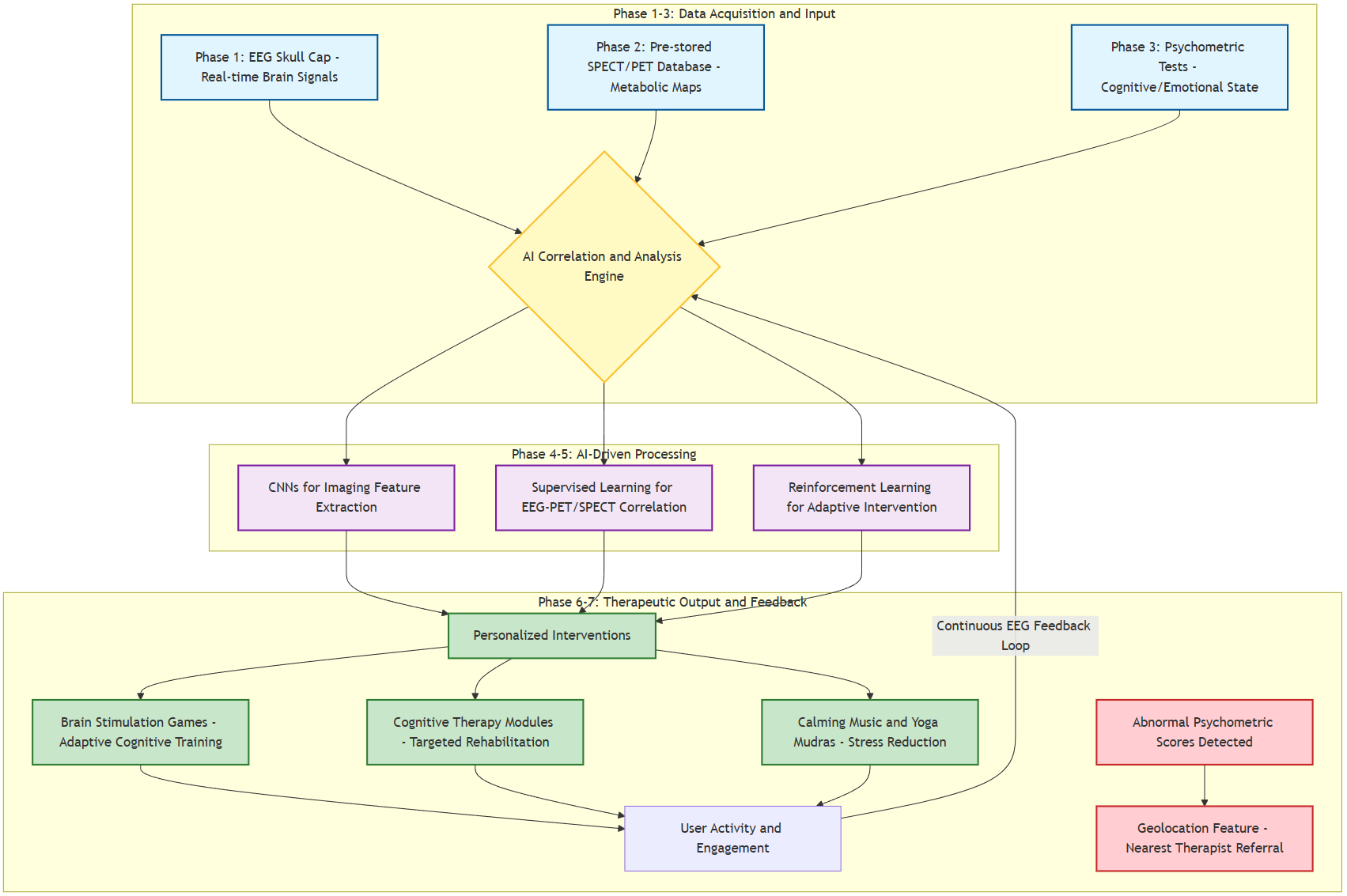
Mental health disorders pose a significant global burden, yet integrated non-invasive tools for simultaneous neurodiagnosis and therapy remain limited. This paper introduces IRENIC, a wearable prototype integrating an EEG skull cap for real-time brain monitoring, pre-stored SPECT/PET databases, AR visualization, psychometric tools, AI algorithms — including CNNs and reinforcement learning — that correlate EEG with neuroimaging data including brain stimulation games, cognitive therapy, calming music, and yoga mudras. The validated conceptual design enables EEG acquisition, AI-powered multi-modal correlation, psychometric evaluation, and closed-loop therapy delivery within a single platform. IRENIC achieves improved completeness over isolated modalities by integrating assessment, visualization, and intervention, with workflow analysis confirming technical viability of real-time data collection, AI-driven interpretation, and personalized feedback in a wearable format. This device offers a scalable paradigm for integrative mental health technology, addressing accessibility and personalization gaps by combining diagnostics and therapy. While focusing on conceptual validation, this work establishes a foundation for future clinical trials, quantitative validation, and AI-enabled neurotherapeutic interventions.
Graphical Abstract
Keywords
Data Availability Statement
Funding
Conflicts of Interest
AI Use Statement
Ethical Approval and Consent to Participate
References
- World Health Organization. (2022). World mental health report: Transforming mental health for all. https://www.who.int/publications/i/item/9789240049338
[Google Scholar] - Michel, C. M., & He, B. (2019). EEG source localization. In Handbook of clinical neurology (Vol. 160, pp. 85-101). Elsevier.
[CrossRef] [Google Scholar] - Ahn, J. W., Ku, Y., & Kim, H. C. (2019). A Novel Wearable EEG and ECG Recording System for Stress Assessment. Sensors, 19(9), 1991.
[CrossRef] [Google Scholar] - Lotte, F., Congedo, M., Lécuyer, A., Lamarche, F., & Arnaldi, B. (2007). A review of classification algorithms for EEG-based brain–computer interfaces. Journal of neural engineering, 4(2), R1-R13.
[CrossRef] [Google Scholar] - Jin, J., Gao, B., Yang, S., Zhao, B., Luo, L., & Woo, W. L. (2020). Attention-block deep learning based features fusion in wearable social sensor for mental wellbeing evaluations. IEEE Access, 8, 89258-89268.
[CrossRef] [Google Scholar] - Sabio, J., Williams, N. S., McArthur, G. M., & Badcock, N. A. (2024). A scoping review on the use of consumer-grade EEG devices for research. Plos one, 19(3), e0291186.
[CrossRef] [Google Scholar] - Minguillon, J., Lopez-Gordo, M. A., & Pelayo, F. (2016). Stress assessment by prefrontal relative gamma. Frontiers in computational neuroscience, 10, 101.
[CrossRef] [Google Scholar] - Torous, J., & Roberts, L. W. (2017). Needed innovation in digital health and smartphone applications for mental health: transparency and trust. JAMA psychiatry, 74(5), 437-438.
[CrossRef] [Google Scholar]
Cite This Article
TY  - JOUR
AU  - Waghray, Nitya
AU  - Waghray, Adarsh
AU  - Mahendra, Rishabh
AU  - Sabat, Kalicharan
AU  - Rajasundaram, Archana
AU  - Johnson, W.M.S.
PY  - 2026
DA  - 2026/05/27
TI  - IRENIC: A Prototype and a Review for Developing a Non-invasive Device Revolutionizing the Neuro-diagnostics and Cognitive Therapy
JO  - Biomedical Informatics and Smart Healthcare
T2  - Biomedical Informatics and Smart Healthcare
JF  - Biomedical Informatics and Smart Healthcare
VL  - 2
IS  - 2
SP  - 79
EP  - 85
DO  - 10.62762/BISH.2026.779754
UR  - https://www.icck.org/article/abs/BISH.2026.779754
KW  - IRENIC
KW  - EEG
KW  - non-invasive brain stimulation
KW  - neurodiagnostics
KW  - cognitive therapy
KW  - augmented reality
KW  - artificial intelligence
KW  - multimodal integration
AB  - Mental health disorders pose a significant global burden, yet integrated non-invasive tools for simultaneous neurodiagnosis and therapy remain limited. This paper introduces IRENIC, a wearable prototype integrating an EEG skull cap for real-time brain monitoring, pre-stored SPECT/PET databases, AR visualization, psychometric tools, AI algorithms — including CNNs and reinforcement learning — that correlate EEG with neuroimaging data including brain stimulation games, cognitive therapy, calming music, and yoga mudras. The validated conceptual design enables EEG acquisition, AI-powered multi-modal correlation, psychometric evaluation, and closed-loop therapy delivery within a single platform. IRENIC achieves improved completeness over isolated modalities by integrating assessment, visualization, and intervention, with workflow analysis confirming technical viability of real-time data collection, AI-driven interpretation, and personalized feedback in a wearable format. This device offers a scalable paradigm for integrative mental health technology, addressing accessibility and personalization gaps by combining diagnostics and therapy. While focusing on conceptual validation, this work establishes a foundation for future clinical trials, quantitative validation, and AI-enabled neurotherapeutic interventions.
SN  - 3068-5524
PB  - Institute of Central Computation and Knowledge
LA  - English
ER  -
@article{Waghray2026IRENIC,
  author = {Nitya Waghray and Adarsh Waghray and Rishabh Mahendra and Kalicharan Sabat and Archana Rajasundaram and W.M.S. Johnson},
  title = {IRENIC: A Prototype and a Review for Developing a Non-invasive Device Revolutionizing the Neuro-diagnostics and Cognitive Therapy},
  journal = {Biomedical Informatics and Smart Healthcare},
  year = {2026},
  volume = {2},
  number = {2},
  pages = {79-85},
  doi = {10.62762/BISH.2026.779754},
  url = {https://www.icck.org/article/abs/BISH.2026.779754},
  abstract = {Mental health disorders pose a significant global burden, yet integrated non-invasive tools for simultaneous neurodiagnosis and therapy remain limited. This paper introduces IRENIC, a wearable prototype integrating an EEG skull cap for real-time brain monitoring, pre-stored SPECT/PET databases, AR visualization, psychometric tools, AI algorithms — including CNNs and reinforcement learning — that correlate EEG with neuroimaging data including brain stimulation games, cognitive therapy, calming music, and yoga mudras. The validated conceptual design enables EEG acquisition, AI-powered multi-modal correlation, psychometric evaluation, and closed-loop therapy delivery within a single platform. IRENIC achieves improved completeness over isolated modalities by integrating assessment, visualization, and intervention, with workflow analysis confirming technical viability of real-time data collection, AI-driven interpretation, and personalized feedback in a wearable format. This device offers a scalable paradigm for integrative mental health technology, addressing accessibility and personalization gaps by combining diagnostics and therapy. While focusing on conceptual validation, this work establishes a foundation for future clinical trials, quantitative validation, and AI-enabled neurotherapeutic interventions.},
  keywords = {IRENIC, EEG, non-invasive brain stimulation, neurodiagnostics, cognitive therapy, augmented reality, artificial intelligence, multimodal integration},
  issn = {3068-5524},
  publisher = {Institute of Central Computation and Knowledge}
}
Article Metrics
Publisher's Note
ICCK stays neutral with regard to jurisdictional claims in published maps and institutional affiliations.
Rights and Permissions
 Copyright © 2026 by the Author(s). Published by Institute of Central Computation and Knowledge. This article is an open access article distributed under the terms and conditions of the Creative Commons Attribution (CC BY) license (https://creativecommons.org/licenses/by/4.0/), which permits use, sharing, adaptation, distribution and reproduction in any medium or format, as long as you give appropriate credit to the original author(s) and the source, provide a link to the Creative Commons licence, and indicate if changes were made.


Portico
