

A Taylor-Series-Based Computational Framework for Simulating Lung Tumor Regression During Radiotherapy: Toward Model-Informed Decision Support in Precision Oncology




Article Information
Abstract
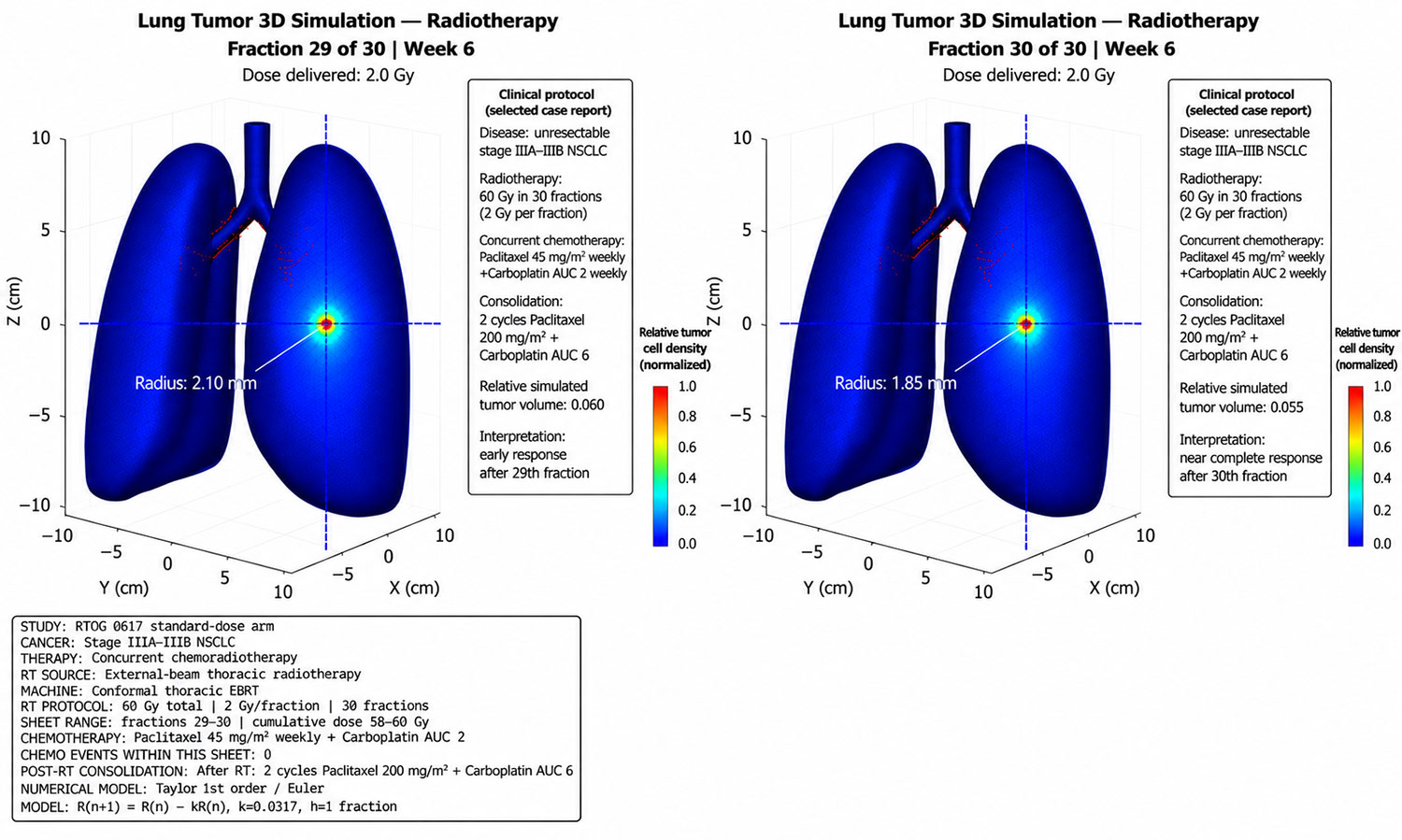
Mechanistic tumor-response models that are transparent and updatable with patient data are important for model-informed precision radiotherapy. This study presents a reproducible computational framework integrating an explicit mathematical derivation, numerical solver, clinical protocol-derived parameters, and three-dimensional visualization to simulate simplified lung tumor regression during radiotherapy for non-small cell lung cancer (NSCLC). A first-order Taylor approximation, equivalent to the forward Euler method, is derived from Taylor's formula with integral remainder, with local truncation error of order $h^2$. The resulting update rule is applied to a first-order regression model with a constant coefficient $k=0.0317$ per fraction. Treatment parameters were extracted from the standard-dose arm of the phase III RTOG 0617 trial (60 Gy in 30 fractions of 2 Gy with concurrent weekly paclitaxel and carboplatin), enabling fraction-by-fraction simulation of the documented treatment schedule. The simulated trajectory drives a three-dimensional tumor representation rendered using Geant4. The relative difference between numerical and exact exponential solutions remained below 1% through fraction 19 and reached 1.53% at fraction 30. These results establish mathematical and computational consistency, rather than clinical validation of response magnitude. The explicit and auditable framework provides a transparent baseline for future patient-specific calibration using longitudinal imaging, adaptive radiotherapy, and digital-twin applications in smart healthcare.
Graphical Abstract
Keywords
Data Availability Statement
Funding
Conflicts of Interest
AI Use Statement
Ethical Approval and Consent to Participate
References
- Bray, F., Laversanne, M., Sung, H., Ferlay, J., Siegel, R. L., Soerjomataram, I., & Jemal, A. (2024). Global cancer statistics 2022: GLOBOCAN estimates of incidence and mortality worldwide for 36 cancers in 185 countries. CA: a cancer journal for clinicians, 74(3), 229-263.
[CrossRef] [Google Scholar] - Zhou, J., Xu, Y., Liu, J., Feng, L., Yu, J., & Chen, D. (2024). Global burden of lung cancer in 2022 and projections to 2050: Incidence and mortality estimates from GLOBOCAN. Cancer Epidemiology, 93, 102693.
[CrossRef] [Google Scholar] - Zhu, Q., Sun, K., Yao, Y., Li, H., Li, X., Chen, R., ... & Zheng, R. (2026). The global landscape of cancer burden attributable to tobacco smoking in 2022: a population-based systematic analysis. EClinicalMedicine, 94.
[CrossRef] [Google Scholar] - Rockne, R. C., Hawkins-Daarud, A., Swanson, K. R., Sluka, J. P., Glazier, J. A., Macklin, P., ... & Scott, J. G. (2019). The 2019 mathematical oncology roadmap. Physical biology, 16(4), 041005.
[CrossRef] [Google Scholar] - Enderling, H., Alfonso, J. C. L., Moros, E., Caudell, J. J., & Harrison, L. B. (2019). Integrating mathematical modeling into the roadmap for personalized adaptive radiation therapy. Trends in Cancer, 5(8), 467-474.
[CrossRef] [Google Scholar] - Prokopiou, S., Moros, E. G., Poleszczuk, J., Caudell, J., Torres-Roca, J. F., Latifi, K., ... & Enderling, H. (2015). A proliferation saturation index to predict radiation response and personalize radiotherapy fractionation. Radiation Oncology, 10(1), 159.
[CrossRef] [Google Scholar] - Jabbour, S. K., Kim, S., Haider, S. A., Xu, X., Wu, A., Surakanti, S., ... & Zou, W. (2015). Reduction in tumor volume by cone beam computed tomography predicts overall survival in non-small cell lung cancer treated with chemoradiation therapy. International Journal of Radiation Oncology* Biology* Physics, 92(3), 627-633.
[CrossRef] [Google Scholar] - Hernandez-Boussard, T., Macklin, P., Greenspan, E. J., Gryshuk, A. L., Stahlberg, E., Syeda-Mahmood, T., & Shmulevich, I. (2021). Digital twins for predictive oncology will be a paradigm shift for precision cancer care. Nature medicine, 27(12), 2065-2066.
[CrossRef] [Google Scholar] - Hairer, E., Wanner, G., & Nørsett, S. P. (1993). Solving ordinary differential equations I: Nonstiff problems. Berlin, Heidelberg: Springer Berlin Heidelberg.
[CrossRef] [Google Scholar] - Barrio, R. (2015). Taylor series methods. In B. Engquist (Ed.), Encyclopedia of Applied and Computational Mathematics. Springer, Berlin, Heidelberg.
[CrossRef] [Google Scholar] - Hsiao, K. Y., Yang, D. H., Chiu, S. W., Pan, L. F., & Pan, L. K. (2020). Refined Taylor series expansion-based prediction of the overall survival for nonsmall cell lung cancer patients of clinical stage IIIA-N2 after various treatments: Taiwan population-based study of 2655 cases from 2010 to 2017. Journal of Mechanics in Medicine and Biology, 20(10), 2040034.
[CrossRef] [Google Scholar] - Fowler, J. F. (2010). 21 years of biologically effective dose. The British journal of radiology, 83(991), 554-568.
[CrossRef] [Google Scholar] - Kyriakou, I., Sakata, D., Tran, H. N., Perrot, Y., Shin, W. G., Lampe, N., ... & Incerti, S. (2021). Review of the Geant4-DNA simulation toolkit for radiobiological applications at the cellular and DNA level. Cancers, 14(1), 35.
[CrossRef] [Google Scholar] - Agostinelli, S., Allison, J., Amako, K. A., Apostolakis, J., Araujo, H., Arce, P., ... & Geant4 Collaboration. (2003). Geant4—a simulation toolkit. Nuclear instruments and methods in physics research section A: Accelerators, Spectrometers, Detectors and Associated Equipment, 506(3), 250-303.
[CrossRef] [Google Scholar] - Allison, J., Amako, K., Apostolakis, J., Arce, P., Asai, M., Aso, T., ... & Yoshida, H. (2016). Recent developments in Geant4. Nuclear instruments and methods in physics research section A: Accelerators, Spectrometers, Detectors and Associated Equipment, 835, 186-225.
[CrossRef] [Google Scholar] - Wolfram Research. Series expansions--Wolfram Language documentation. Retrieved March 28, 2026, from https://reference.wolfram.com/language/guide/SeriesExpansions.html
[Google Scholar] - Bradley, J. D., Paulus, R., Komaki, R., Masters, G., Blumenschein, G., Schild, S., ... & Choy, H. (2015). Standard-dose versus high-dose conformal radiotherapy with concurrent and consolidation carboplatin plus paclitaxel with or without cetuximab for patients with stage IIIA or IIIB non-small-cell lung cancer (RTOG 0617): a randomised, two-by-two factorial phase 3 study. The lancet oncology, 16(2), 187-199.
[CrossRef] [Google Scholar] - Bradley, J. D., Hu, C., Komaki, R. R., Masters, G. A., Blumenschein, G. R., Schild, S. E., ... & Choy, H. (2020). Long-term results of NRG oncology RTOG 0617: standard-versus high-dose chemoradiotherapy with or without cetuximab for unresectable stage III non–small-cell lung cancer. Journal of Clinical Oncology, 38(7), 706-714.
[CrossRef] [Google Scholar] - ClinicalTrials.gov. (n.d.). High-dose or standard-dose radiation therapy and chemotherapy with or without cetuximab in treating patients with newly diagnosed stage III non-small cell lung cancer that cannot be removed by surgery (NCT00533949). U.S. National Library of Medicine. Retrieved March 28, 2026, from https://clinicaltrials.gov/study/NCT00533949
[Google Scholar] - Taylor, B. (1715). Methodus Incrementorum Directa et Inversa. London: William Innys.
[CrossRef] [Google Scholar] - Kudryavtsev, L. D. Taylor formula. Encyclopedia of Mathematics. Retrieved March 28, 2026, from https://encyclopediaofmath.org/index.php?title=Taylor_formula
[Google Scholar] - Butcher, J. C. (2016). Numerical Methods for Ordinary Differential Equations (3rd ed.). John Wiley & Sons, Chichester.
[CrossRef] [Google Scholar] - Hong, W. S., Wang, S. G., & Zhang, G. Q. (2021). Lung cancer radiotherapy: simulation and analysis based on a multicomponent mathematical model. Computational and Mathematical Methods in Medicine, 2021(1), 6640051.
[CrossRef] [Google Scholar] - Wilkinson, M. D., Dumontier, M., Aalbersberg, I. J., Appleton, G., Axton, M., Baak, A., ... & Mons, B. (2016). The FAIR Guiding Principles for scientific data management and stewardship. Scientific data, 3(1), 160018.
[CrossRef] [Google Scholar]
Cite This Article
TY  - JOUR
AU  - Farias, Matheus dos Santos
AU  - Batista, Juciene dos Santos
AU  - Ferreira, Joiciane Sousa de Carvalho
PY  - 2026
DA  - 2026/09/27
TI  - A Taylor-Series-Based Computational Framework for Simulating Lung Tumor Regression During Radiotherapy: Toward Model-Informed Decision Support in Precision Oncology
JO  - Biomedical Informatics and Smart Healthcare
T2  - Biomedical Informatics and Smart Healthcare
JF  - Biomedical Informatics and Smart Healthcare
VL  - 2
IS  - 3
SP  - 152
EP  - 165
DO  - 10.62762/BISH.2026.811248
UR  - https://www.icck.org/article/abs/BISH.2026.811248
KW  - computational oncology
KW  - Taylor series
KW  - forward Euler method
KW  - tumor regression
KW  - radiotherapy
KW  - non-small cell lung cancer
KW  - Geant4
KW  - clinical decision support
AB  - Mechanistic tumor-response models that are transparent and updatable with patient data are important for model-informed precision radiotherapy. This study presents a reproducible computational framework integrating an explicit mathematical derivation, numerical solver, clinical protocol-derived parameters, and three-dimensional visualization to simulate simplified lung tumor regression during radiotherapy for non-small cell lung cancer (NSCLC). A first-order Taylor approximation, equivalent to the forward Euler method, is derived from Taylor's formula with integral remainder, with local truncation error of order $h^2$. The resulting update rule is applied to a first-order regression model with a constant coefficient $k=0.0317$ per fraction. Treatment parameters were extracted from the standard-dose arm of the phase III RTOG 0617 trial (60 Gy in 30 fractions of 2 Gy with concurrent weekly paclitaxel and carboplatin), enabling fraction-by-fraction simulation of the documented treatment schedule. The simulated trajectory drives a three-dimensional tumor representation rendered using Geant4. The relative difference between numerical and exact exponential solutions remained below 1% through fraction 19 and reached 1.53% at fraction 30. These results establish mathematical and computational consistency, rather than clinical validation of response magnitude. The explicit and auditable framework provides a transparent baseline for future patient-specific calibration using longitudinal imaging, adaptive radiotherapy, and digital-twin applications in smart healthcare.
SN  - 3068-5524
PB  - Institute of Central Computation and Knowledge
LA  - English
ER  -
@article{Farias2026A,
  author = {Matheus dos Santos Farias and Juciene dos Santos Batista and Joiciane Sousa de Carvalho Ferreira},
  title = {A Taylor-Series-Based Computational Framework for Simulating Lung Tumor Regression During Radiotherapy: Toward Model-Informed Decision Support in Precision Oncology},
  journal = {Biomedical Informatics and Smart Healthcare},
  year = {2026},
  volume = {2},
  number = {3},
  pages = {152-165},
  doi = {10.62762/BISH.2026.811248},
  url = {https://www.icck.org/article/abs/BISH.2026.811248},
  abstract = {Mechanistic tumor-response models that are transparent and updatable with patient data are important for model-informed precision radiotherapy. This study presents a reproducible computational framework integrating an explicit mathematical derivation, numerical solver, clinical protocol-derived parameters, and three-dimensional visualization to simulate simplified lung tumor regression during radiotherapy for non-small cell lung cancer (NSCLC). A first-order Taylor approximation, equivalent to the forward Euler method, is derived from Taylor's formula with integral remainder, with local truncation error of order \$h^2\$. The resulting update rule is applied to a first-order regression model with a constant coefficient \$k=0.0317\$ per fraction. Treatment parameters were extracted from the standard-dose arm of the phase III RTOG 0617 trial (60 Gy in 30 fractions of 2 Gy with concurrent weekly paclitaxel and carboplatin), enabling fraction-by-fraction simulation of the documented treatment schedule. The simulated trajectory drives a three-dimensional tumor representation rendered using Geant4. The relative difference between numerical and exact exponential solutions remained below 1\% through fraction 19 and reached 1.53\% at fraction 30. These results establish mathematical and computational consistency, rather than clinical validation of response magnitude. The explicit and auditable framework provides a transparent baseline for future patient-specific calibration using longitudinal imaging, adaptive radiotherapy, and digital-twin applications in smart healthcare.},
  keywords = {computational oncology, Taylor series, forward Euler method, tumor regression, radiotherapy, non-small cell lung cancer, Geant4, clinical decision support},
  issn = {3068-5524},
  publisher = {Institute of Central Computation and Knowledge}
}
Article Metrics
Publisher's Note
ICCK stays neutral with regard to jurisdictional claims in published maps and institutional affiliations.
Rights and Permissions
 Copyright © 2026 by the Author(s). Published by Institute of Central Computation and Knowledge. This article is an open access article distributed under the terms and conditions of the Creative Commons Attribution (CC BY) license (https://creativecommons.org/licenses/by/4.0/), which permits use, sharing, adaptation, distribution and reproduction in any medium or format, as long as you give appropriate credit to the original author(s) and the source, provide a link to the Creative Commons licence, and indicate if changes were made.


Portico
