Convolutional Neural Network for Ellipse Extended Target Tracking



Article Information
Abstract
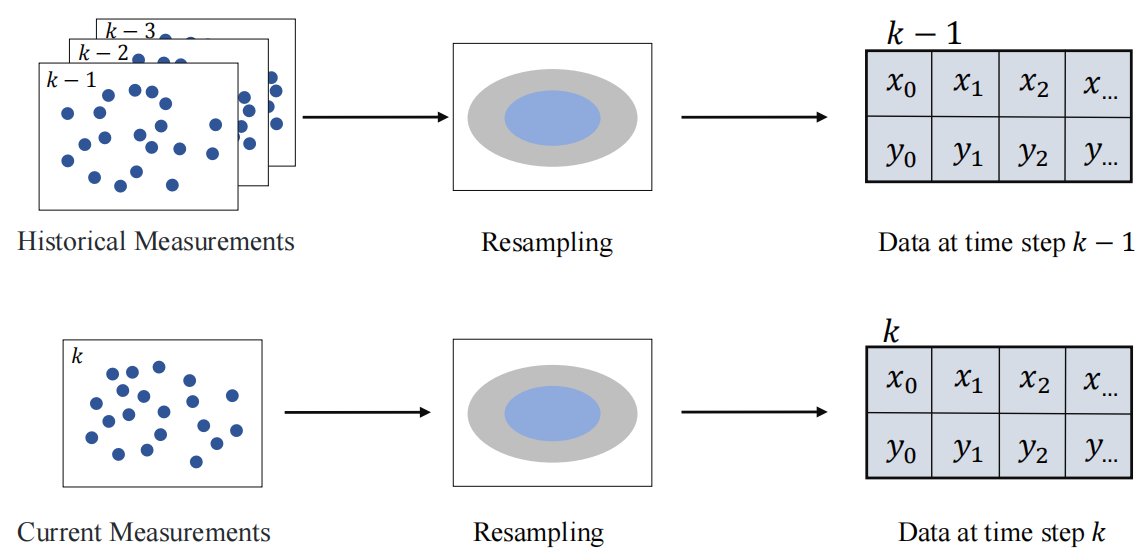
In the field of extended target tracking and information fusion, constrained by the sparse measurement set from radar, the target contour is commonly estimated as an elliptical shape. This paper uses convolutional neural networks to estimate the size and orientation information of extended targets. First, by establishing a systematic model for elliptical extended targets and modeling its measurement information, data normalization, and length equalization operations were conducted to provide reliable measurement data for subsequent neural network processing. Subsequently, through the construction of a convolutional neural network model, accurate estimation of the contour parameters of elliptical extended targets was achieved, and integration with Kalman filtering enabled precise tracking of the target positions. Finally, the effectiveness of the proposed method was verified through the construction of simulation scenarios, and the performance of the method was comprehensively evaluated using the Gaussian Wasserstein distance.
Graphical Abstract
Keywords
Data Availability Statement
Funding
Conflicts of Interest
Ethical Approval and Consent to Participate
References
- Chen, H., Du, J. R., & Han, C. Z. (2018). An adaptive tracking algorithm for irregular shape extended target.
[Google Scholar] - Lan, J. (2023). Extended object tracking using random matrix with extension-dependent measurement numbers. IEEE Transactions on Aerospace and Electronic Systems, 59(4), 4464-4477.
[CrossRef] [Google Scholar] - Baum, M., & Hanebeck, U. D. (2011, July). Shape tracking of extended objects and group targets with star-convex RHMs. In 14th International Conference on Information Fusion (pp. 1-8). IEEE.
[Google Scholar] - Baur, T., Reuter, J., Zea, A., & Hanebeck, U. D. (2022, July). Extent estimation of sailing boats applying elliptic cones to 3D lidar data. In 2022 25th International Conference on Information Fusion (FUSION) (pp. 1-8). IEEE.
[CrossRef] [Google Scholar] - Buhren, M., & Yang, B. (2006, June). Simulation of automotive radar target lists using a novel approach of object representation. In 2006 IEEE Intelligent Vehicles Symposium (pp. 314-319). IEEE.
[CrossRef] [Google Scholar] - Cao, X., Lan, J., & Li, X. R. (2016, July). Extension-deformation approach to extended object tracking. In 2016 19th International Conference on Information Fusion (FUSION) (pp. 1185-1192). IEEE.
[Google Scholar] - CHEN, H., ZENG, W., LIAN, F., & HAN, C. (2023). Non-star-convex extended target tracking algorithm for level-set gaussian process. Journal of Electronics & Information Technology, 45(10), 3786-3795. http://dx.doi.org/10.11999/JEIT220997
[Google Scholar] - Feldmann, M., & Franken, D. (2008, June). Tracking of extended objects and group targets using random matrices—a new approach. In 2008 11th International Conference on Information Fusion (pp. 1-8). IEEE.
[CrossRef] [Google Scholar] - Feldmann, M., Fränken, D., & Koch, W. (2010). Tracking of extended objects and group targets using random matrices. IEEE Transactions on Signal Processing, 59(4), 1409-1420.
[CrossRef] [Google Scholar] - Fowdur, J. S., Baum, M., & Heymann, F. (2021, November). An elliptical principal axes-based model for extended target tracking with marine radar data. In 2021 IEEE 24th International Conference on Information Fusion (FUSION) (pp. 1-8). IEEE.
[CrossRef] [Google Scholar] - Gao, L., Battistelli, G., Chisci, L., & Tesori, M. (2023). Superquadric-based 3D extended object tracking. Authorea Preprints.
[Google Scholar] - Gilholm, K., & Salmond, D. (2005). Spatial distribution model for tracking extended objects. IEE Proceedings-Radar, Sonar and Navigation, 152(5), 364-371.
[CrossRef] [Google Scholar] - Gning, A., Ristic, B., & Mihaylova, L. (2011, July). A box particle filter for stochastic and set-theoretic measurements with association uncertainty. In 14th International Conference on Information Fusion (pp. 1-8). IEEE.
[Google Scholar] - Govaers, F. (2019, October). On independent axes estimation for extended target tracking. In 2019 Sensor Data Fusion: Trends, Solutions, Applications (SDF) (pp. 1-6). IEEE.
[CrossRef] [Google Scholar] - Hammarstrand, L., Svensson, L., Sandblom, F., & Sorstedt, J. (2012). Extended object tracking using a radar resolution model. IEEE Transactions on Aerospace and Electronic Systems, 48(3), 2371-2386.
[CrossRef] [Google Scholar] - Honer, J., & Kaulbersch, H. (2020, September). Bayesian extended target tracking with automotive radar using learned spatial distribution models. In 2020 IEEE International Conference on Multisensor Fusion and Integration for Intelligent Systems (MFI) (pp. 316-322). IEEE.
[CrossRef] [Google Scholar] - Abdallah, F., Gning, A., & Bonnifait, P. (2008). Box particle filtering for nonlinear state estimation using interval analysis. Automatica, 44(3), 807-815.
[CrossRef] [Google Scholar] - Chen, H., Wang, L., & Han, C. Z. (2022). Student’st inverse wishart filter based on random matrix modeling.
[Google Scholar] - Klambauer, G., Unterthiner, T., Mayr, A., & Hochreiter, S. (2017). Self-normalizing neural networks. Advances in neural information processing systems, 30.
[Google Scholar] - Koch, J. W. (2008). Bayesian approach to extended object and cluster tracking using random matrices. IEEE Transactions on Aerospace and Electronic Systems, 44(3), 1042-1059.
[CrossRef] [Google Scholar] - Baum, M., & Hanebeck, U. D. (2009, December). Random hypersurface models for extended object tracking. In 2009 IEEE International Symposium on Signal Processing and Information Technology (ISSPIT) (pp. 178-183). IEEE.
[CrossRef] [Google Scholar] - Lan, J., & Li, X. R. (2012, July). Tracking of extended object or target group using random matrix—Part I: New model and approach. In 2012 15th International Conference on Information Fusion (pp. 2177-2184). IEEE.
[Google Scholar] - Lan, J., & Li, X. R. (2014). Tracking of maneuvering non-ellipsoidal extended object or target group using random matrix. IEEE Transactions on Signal Processing, 62(9), 2450-2463.
[CrossRef] [Google Scholar] - Li, M., Lan, J., & Li, X. R. (2023). Tracking of elliptical object with unknown but fixed lengths of axes. IEEE Transactions on Aerospace and Electronic Systems, 59(5), 6518-6533.
[CrossRef] [Google Scholar] - Li, Z., Wang, H., Yan, S., Zou, H., & Du, M. (2022, September). Distributed extended object tracking filter through embedded ADMM technique. In 2022 IEEE International Conference on Multisensor Fusion and Integration for Intelligent Systems (MFI) (pp. 1-6). IEEE.
[CrossRef] [Google Scholar] - Lu, L., Shin, Y., Su, Y., & Karniadakis, G. E. (2019). Dying relu and initialization: Theory and numerical examples. arXiv preprint arXiv:1903.06733.
[Google Scholar] - Lyu, X., Wu, S., Ca, R., Zheng, X., & Xie, Y. (2023). Spawning extended target tracking based on ggiw-pmb. Computer Systems and Applications, 32(5), 220-226.
[Google Scholar] - Nezhadarya, E., Liu, Y., & Liu, B. (2019, June). BoxNet: A Deep Learning Method for 2D Bounding Box Estimation from Bird's-Eye View Point Cloud. In 2019 IEEE Intelligent Vehicles Symposium (IV) (pp. 1557-1564). IEEE.
[CrossRef] [Google Scholar] - Povey, D., Zhang, X., & Khudanpur, S. (2014). Parallel training of DNNs with natural gradient and parameter averaging. arXiv preprint arXiv:1410.7455.
[Google Scholar] - Steuernagel, S., Thormann, K., & Baum, M. (2022, July). CNN-based shape estimation for extended object tracking using point cloud measurements. In 2022 25th International Conference on Information Fusion (FUSION) (pp. 1-8). IEEE.
[CrossRef] [Google Scholar] - Swain, A., & Clark, D. (2010, July). Extended object filtering using spatial independent cluster processes. In 2010 13th International Conference on Information Fusion (pp. 1-8). IEEE.
[CrossRef] [Google Scholar] - Tan, J. T., Qi, G. Q., Qi, J. J., Yang, Y. J., Li, Y. Y., & Sheng, A. D. (2022, November). Model parameter adaptive approach of extended object tracking using random matrix and identification. In 2022 International Conference on Cyber-Physical Social Intelligence (ICCSI) (pp. 91-97). IEEE.
[CrossRef] [Google Scholar] - Thormann, K., Yang, S., & Baum, M. (2020, July). A comparison of Kalman filter-based approaches for elliptic extended object tracking. In 2020 IEEE 23rd International Conference on Information Fusion (FUSION) (pp. 1-8). IEEE.
[CrossRef] [Google Scholar] - Xia, Y., García-Fernández, Á. F., Meyer, F., Williams, J. L., Granström, K., & Svensson, L. (2023). Trajectory PMB filters for extended object tracking using belief propagation. IEEE Transactions on Aerospace and Electronic Systems, 59(6), 9312-9331.
[CrossRef] [Google Scholar] - Yang, J. L., Li, P., & Ge, H. W. (2014). Extended target shape estimation by fitting B‐spline curve. Journal of Applied Mathematics, 2014(1), 741892.
[CrossRef] [Google Scholar] - Yang, S., & Baum, M. (2019). Tracking the orientation and axes lengths of an elliptical extended object. IEEE Transactions on Signal Processing, 67(18), 4720-4729.
[CrossRef] [Google Scholar] - Yang, S., Baum, M., & Granström, K. (2016, September). Metrics for performance evaluation of elliptic extended object tracking methods. In 2016 IEEE International Conference on Multisensor Fusion and Integration for Intelligent Systems (MFI) (pp. 523-528). IEEE.
[CrossRef] [Google Scholar] - Zhang, Y., Ji, H., & Hu, Q. (2017). A box-particle implementation of standard PHD filter for extended target tracking. Information Fusion, 34, 55-69.
[CrossRef] [Google Scholar]
Cited By (4)
-
Baihui Xiao, Shulan Ruan, Zhi Li, Shaohui Li, Yu Liu, Xiu Li, You He. Improving Radar–Camera Fusion for 3D Object Detection via Eliciting Knowledge From Foundation Model.
IEEE/ASME Transactions on Mechatronics, 2025 , 30 (6).
[CrossRef] -
Mingchao Yan, Yonghua Xiong, Hiroaki Kurokawa, Jinhua She. Multimodal Localization Distillation Method for 3D Single Object Tracking Task in Intelligent Transportation Systems.
IEEE Transactions on Intelligent Transportation Systems, 2025 , 26 (10).
[CrossRef] -
Runhe Gan, Wei Xia. .
2025 Asia Pacific Signal and Information Processing Association Annual Summit and Conference (APSIPA ASC), 2025 .
[CrossRef] -
Xiangfei Zheng, Yujie Zhang, Sunyong Wu, Hongwei Li. Extended Object Tracking With Inaccurate Heavy-Tailed Noises.
IEEE Transactions on Instrumentation and Measurement, 2025 , 74 .
[CrossRef]
Cite This Article
TY  - JOUR
AU  - Bian, Binchao
AU  - Chen, Hui
PY  - 2024
DA  - 2024/09/23
TI  - Convolutional Neural Network for Ellipse Extended Target Tracking
JO  - Chinese Journal of Information Fusion
T2  - Chinese Journal of Information Fusion
JF  - Chinese Journal of Information Fusion
VL  - 1
IS  - 2
SP  - 93
EP  - 108
DO  - 10.62762/CJIF.2024.160538
UR  - https://www.icck.org/article/abs/cjif.2024.160538
KW  - extended target tracking
KW  - information fusion
KW  - elliptical
KW  - convolutional neural network
KW  - gaussian wasserstein distance
AB  - In the field of extended target tracking and information fusion, constrained by the sparse measurement set from radar, the target contour is commonly estimated as an elliptical shape. This paper uses convolutional neural networks to estimate the size and orientation information of extended targets. First, by establishing a systematic model for elliptical extended targets and modeling its measurement information, data normalization, and length equalization operations were conducted to provide reliable measurement data for subsequent neural network processing. Subsequently, through the construction of a convolutional neural network model, accurate estimation of the contour parameters of elliptical extended targets was achieved, and integration with Kalman filtering enabled precise tracking of the target positions. Finally, the effectiveness of the proposed method was verified through the construction of simulation scenarios, and the performance of the method was comprehensively evaluated using the Gaussian Wasserstein distance.
SN  - 2998-3371
PB  - Institute of Central Computation and Knowledge
LA  - English
ER  -
@article{Bian2024Convolutio,
  author = {Binchao Bian and Hui Chen},
  title = {Convolutional Neural Network for Ellipse Extended Target Tracking},
  journal = {Chinese Journal of Information Fusion},
  year = {2024},
  volume = {1},
  number = {2},
  pages = {93-108},
  doi = {10.62762/CJIF.2024.160538},
  url = {https://www.icck.org/article/abs/cjif.2024.160538},
  abstract = {In the field of extended target tracking and information fusion, constrained by the sparse measurement set from radar, the target contour is commonly estimated as an elliptical shape. This paper uses convolutional neural networks to estimate the size and orientation information of extended targets. First, by establishing a systematic model for elliptical extended targets and modeling its measurement information, data normalization, and length equalization operations were conducted to provide reliable measurement data for subsequent neural network processing. Subsequently, through the construction of a convolutional neural network model, accurate estimation of the contour parameters of elliptical extended targets was achieved, and integration with Kalman filtering enabled precise tracking of the target positions. Finally, the effectiveness of the proposed method was verified through the construction of simulation scenarios, and the performance of the method was comprehensively evaluated using the Gaussian Wasserstein distance.},
  keywords = {extended target tracking, information fusion, elliptical, convolutional neural network, gaussian wasserstein distance},
  issn = {2998-3371},
  publisher = {Institute of Central Computation and Knowledge}
}
Publisher's Note
ICCK stays neutral with regard to jurisdictional claims in published maps and institutional affiliations.
Rights and Permissions
 Copyright © 2024 by the Author(s). Published by Institute of Central Computation and Knowledge. This article is an open access article distributed under the terms and conditions of the Creative Commons Attribution (CC BY) license (https://creativecommons.org/licenses/by/4.0/), which permits use, sharing, adaptation, distribution and reproduction in any medium or format, as long as you give appropriate credit to the original author(s) and the source, provide a link to the Creative Commons licence, and indicate if changes were made.


Portico