Using Psycholinguistic Clues to Index Deep Semantic Evidences: Personality Detection in Social Media Texts










Article Information
Abstract
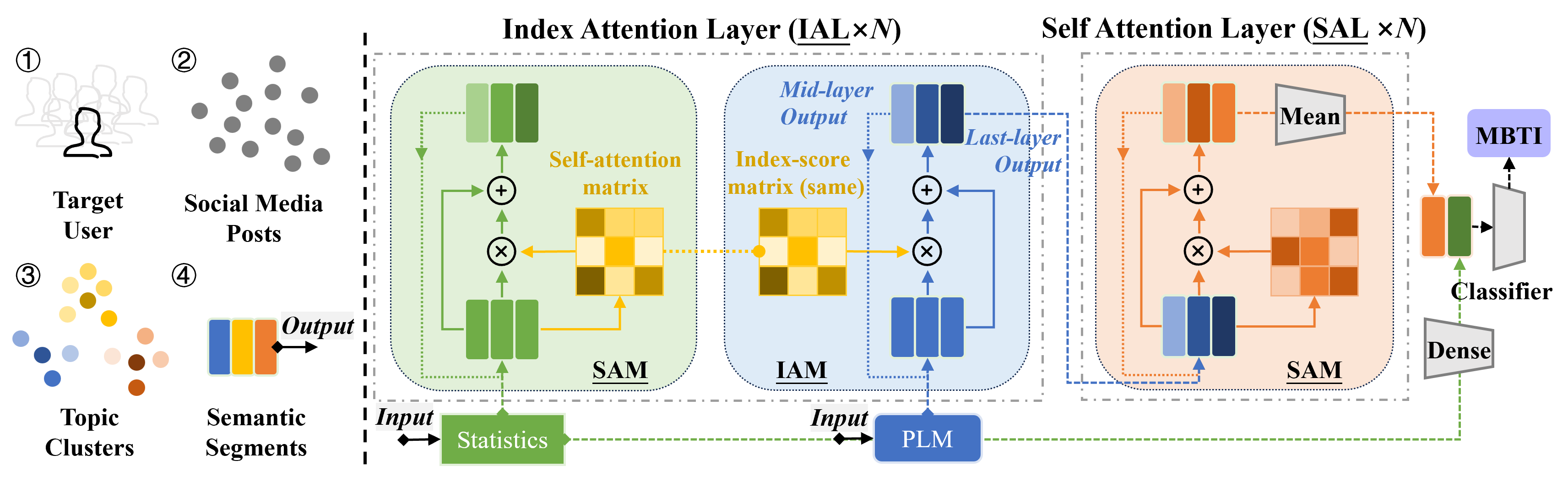
Detecting personalities in social media content is an important application of personality psychology. Most early studies apply a coherent piece of writing to personality detection, but today, the challenge is to identify dominant personality traits from a series of short, noisy social media posts. To this end, recent studies have attempted to individually encode the deep semantics of posts, often using attention-based methods, and then relate them, or directly assemble them into graph structures. However, due to the inherently disjointed and noisy nature of social media content, constructing meaningful connections remains challenging. While such methods rely on well-defined relationships between posts, effectively capturing these connections in fragmented and sparse content is non-trivial, particularly under limited supervision or noisy input. To tackle this, we draw inspiration from the scanning reading technique—commonly recommended for efficiently processing large volumes of information—and propose an index attention mechanism as a solution. This mechanism leverages prior psycholinguistic knowledge as an “index” to guide attention, thereby enabling more effective information fusion across scattered semantic signals. Building on this idea, we introduce the Index Attention Network (IAN)—a novel framework designed to infer personality labels by performing targeted information fusion over deep semantic representations of individual posts. Through a series of experiments, IAN achieved state-of-the-art performance on the Kaggle dataset and performance comparable to graph convolutional networks (GCN) on the Pandora dataset. Notably, IAN delivered an average improvement of 13% in terms of macro-F1 scores with the Kaggle dataset. The code for IAN is available at GitHub: https://github.com/Once2gain/IAN.
Graphical Abstract
Keywords
Data Availability Statement
Funding
Conflicts of Interest
Ethical Approval and Consent to Participate
References
- Mairesse, F., Walker, M. A., Mehl, M. R., & Moore, R. K. (2007). Using linguistic cues for the automatic recognition of personality in conversation and text. Journal of artificial intelligence research, 30, 457-500.
[CrossRef] [Google Scholar] - Holtgraves, T. (2011). Text messaging, personality, and the social context. Journal of research in personality, 45(1), 92-99.
[CrossRef] [Google Scholar] - Lee, C. H., Kim, K., Seo, Y. S., & Chung, C. K. (2007). The relations between personality and language use. The Journal of general psychology, 134(4), 405-413.
[CrossRef] [Google Scholar] - Fast, L. A., & Funder, D. C. (2008). Personality as manifest in word use: Correlations with self-report, acquaintance report, and behavior. Journal of personality and social psychology, 94(2), 334.
[Google Scholar] - Schnurr, P. P., Rosenberg, S. D., Oxman, T. E., & Tucker, G. J. (1986). A methodological note on content analysis: Estimates of reliability. Journal of personality assessment, 50(4), 601-609.
[CrossRef] [Google Scholar] - Pennebaker, J. W., & King, L. A. (1999). Linguistic styles: language use as an individual difference. Journal of personality and social psychology, 77(6), 1296.
[Google Scholar] - Pennebaker, J. W., Mehl, M. R., & Niederhoffer, K. G. (2003). Psychological aspects of natural language use: Our words, our selves. Annual review of psychology, 54(1), 547-577.
[CrossRef] [Google Scholar] - Mehl, M. R., Gosling, S. D., & Pennebaker, J. W. (2006). Personality in its natural habitat: manifestations and implicit folk theories of personality in daily life. Journal of personality and social psychology, 90(5), 862.
[Google Scholar] - Hirsh, J. B., & Peterson, J. B. (2009). Personality and language use in self-narratives. Journal of research in personality, 43(3), 524-527.
[CrossRef] [Google Scholar] - Ireland, M. E., & Pennebaker, J. W. (2010). Language style matching in writing: synchrony in essays, correspondence, and poetry. Journal of personality and social psychology, 99(3), 549.
[Google Scholar] - Nowson, S., & Oberlander, J. (2007, March). Identifying more bloggers: Towards large scale personality classification of personal weblogs. In Proceedings of the international conference on weblogs and social.
[Google Scholar] - Yarkoni, T. (2010). Personality in 100,000 words: A large-scale analysis of personality and word use among bloggers. Journal of research in personality, 44(3), 363-373.
[CrossRef] [Google Scholar] - Golbeck, J., Robles, C., & Turner, K. (2011). Predicting personality with social media. In CHI'11 extended abstracts on human factors in computing systems (pp. 253-262).
[CrossRef] [Google Scholar] - Schwartz, H. A., Eichstaedt, J. C., Kern, M. L., Dziurzynski, L., Ramones, S. M., Agrawal, M., ... & Ungar, L. H. (2013). Personality, gender, and age in the language of social media: The open-vocabulary approach. PloS one, 8(9), e73791.
[CrossRef] [Google Scholar] - Tausczik, Y. R., & Pennebaker, J. W. (2010). The psychological meaning of words: LIWC and computerized text analysis methods. Journal of language and social psychology, 29(1), 24-54.
[CrossRef] [Google Scholar] - Pennebaker, J. W., Francis, M. E., & Booth, R. J. (2001). Linguistic inquiry and word count: LIWC 2001. Mahway: Lawrence Erlbaum Associates, 71(2001), 2001.
[Google Scholar] - Poria, S., Gelbukh, A., Agarwal, B., Cambria, E., & Howard, N. (2013). Common sense knowledge based personality recognition from text. In Advances in Soft Computing and Its Applications: 12th Mexican International Conference on Artificial Intelligence, MICAI 2013, Mexico City, Mexico, November 24-30, 2013, Proceedings, Part II 12 (pp. 484-496). Springer Berlin Heidelberg.
[CrossRef] [Google Scholar] - Majumder, N., Poria, S., Gelbukh, A., & Cambria, E. (2017). Deep learning-based document modeling for personality detection from text. IEEE intelligent systems, 32(2), 74-79.
[CrossRef] [Google Scholar] - Watson, D., & Clark, L. A. (1992). On traits and temperament: General and specific factors of emotional experience and their relation to the five‐factor model. Journal of personality, 60(2), 441-476.
[CrossRef] [Google Scholar] - Park, G., Schwartz, H. A., Eichstaedt, J. C., Kern, M. L., Kosinski, M., Stillwell, D. J., ... & Seligman, M. E. (2015). Automatic personality assessment through social media language. Journal of personality and social psychology, 108(6), 934.
[Google Scholar] - Sun, X., Liu, B., Cao, J., Luo, J., & Shen, X. (2018, May). Who am I? Personality detection based on deep learning for texts. In 2018 IEEE international conference on communications (ICC) (pp. 1-6). IEEE.
[CrossRef] [Google Scholar] - Mehta, Y., Fatehi, S., Kazameini, A., Stachl, C., Cambria, E., & Eetemadi, S. (2020, November). Bottom-up and top-down: Predicting personality with psycholinguistic and language model features. In 2020 IEEE international conference on data mining (ICDM) (pp. 1184-1189). IEEE.
[CrossRef] [Google Scholar] - Celli, F., Pianesi, F., Stillwell, D., & Kosinski, M. (2013). Workshop on computational personality recognition: Shared task. In Proceedings of the International AAAI Conference on Web and Social Media (Vol. 7, No. 2, pp. 2-5).
[CrossRef] [Google Scholar] - Oberlander, J., & Nowson, S. (2006, July). Whose thumb is it anyway? Classifying author personality from weblog text. In Proceedings of the COLING/ACL 2006 main conference poster sessions (pp. 627-634).
[Google Scholar] - Vaswani, A., Shazeer, N., Parmar, N., Uszkoreit, J., Jones, L., Gomez, A. N., ... & Polosukhin, I. (2017). Attention is all you need. Advances in neural information processing systems, 30.
[Google Scholar] - Christian, H., Suhartono, D., Chowanda, A., & Zamli, K. Z. (2021). Text based personality prediction from multiple social media data sources using pre-trained language model and model averaging. Journal of Big Data, 8(1), 68.
[CrossRef] [Google Scholar] - Han, S., Huang, H., & Tang, Y. (2020). Knowledge of words: An interpretable approach for personality recognition from social media. Knowledge-Based Systems, 194, 105550.
[CrossRef] [Google Scholar] - Gjurković, M., & Šnajder, J. (2018, June). Reddit: A gold mine for personality prediction. In Proceedings of the second workshop on computational modeling of people’s opinions, personality, and emotions in social media (pp. 87-97).
[CrossRef] [Google Scholar] - Gjurković, M., Karan, M., Vukojević, I., Bošnjak, M., & Šnajder, J. (2020). PANDORA talks: Personality and demographics on Reddit. arXiv preprint arXiv:2004.04460.
[Google Scholar] - Yang, T., Deng, J., Quan, X., & Wang, Q. (2023, June). Orders are unwanted: dynamic deep graph convolutional network for personality detection. In Proceedings of the AAAI Conference on Artificial Intelligence (Vol. 37, No. 11, pp. 13896-13904).
[CrossRef] [Google Scholar] - Yang, F., Quan, X., Yang, Y., & Yu, J. (2021, May). Multi-document transformer for personality detection. In Proceedings of the AAAI conference on artificial intelligence (Vol. 35, No. 16, pp. 14221-14229).
[CrossRef] [Google Scholar] - Yang, T., Yang, F., Ouyang, H., & Quan, X. (2021). Psycholinguistic tripartite graph network for personality detection. arXiv preprint arXiv:2106.04963.
[Google Scholar] - Zhu, Y., Hu, L., Ge, X., Peng, W., & Wu, B. (2022). Contrastive Graph Transformer Network for Personality Detection. In IJCAI (pp. 4559-4565).
[Google Scholar] - Lynn, V., Balasubramanian, N., & Schwartz, H. A. (2020, July). Hierarchical modeling for user personality prediction: The role of message-level attention. In Proceedings of the 58th annual meeting of the association for computational linguistics (pp. 5306-5316).
[CrossRef] [Google Scholar] - Ren, Z., Shen, Q., Diao, X., & Xu, H. (2021). A sentiment-aware deep learning approach for personality detection from text. Information Processing & Management, 58(3), 102532.
[CrossRef] [Google Scholar] - Štajner, S., & Yenikent, S. (2021, April). Why is MBTI personality detection from texts a difficult task?. In Proceedings of the 16th conference of the European chapter of the association for computational linguistics: main volume (pp. 3580-3589).
[CrossRef] [Google Scholar] - Liu, Y., Wang, J., & Jiang, Y. (2016). PT-LDA: A latent variable model to predict personality traits of social network users. Neurocomputing, 210, 155-163.
[CrossRef] [Google Scholar] - Zhao, J., Zeng, D., Xiao, Y., Che, L., & Wang, M. (2020). User personality prediction based on topic preference and sentiment analysis using LSTM model. Pattern Recognition Letters, 138, 397-402.
[CrossRef] [Google Scholar] - Gill, A., Nowson, S., & Oberlander, J. (2009, March). What are they blogging about? Personality, topic and motivation in blogs. In Proceedings of the International AAAI Conference on Web and Social Media (Vol. 3, No. 1, pp. 18-25).
[CrossRef] [Google Scholar] - Devlin, J., Chang, M. W., Lee, K., & Toutanova, K. (2019, June). Bert: Pre-training of deep bidirectional transformers for language understanding. In Proceedings of the 2019 conference of the North American chapter of the association for computational linguistics: human language technologies, volume 1 (long and short papers) (pp. 4171-4186).
[CrossRef] [Google Scholar] - Campello, R. J., Moulavi, D., & Sander, J. (2013, April). Density-based clustering based on hierarchical density estimates. In Pacific-Asia conference on knowledge discovery and data mining (pp. 160-172). Berlin, Heidelberg: Springer Berlin Heidelberg.
[CrossRef] [Google Scholar] - El-Demerdash, K., El-Khoribi, R. A., Shoman, M. A. I., & Abdou, S. (2022). Deep learning based fusion strategies for personality prediction. Egyptian Informatics Journal, 23(1), 47-53.
[CrossRef] [Google Scholar] - KN, P. K., & Gavrilova, M. L. (2021). Latent personality traits assessment from social network activity using contextual language embedding. IEEE Transactions on Computational Social Systems, 9(2), 638-649.
[CrossRef] [Google Scholar] - Cambria, E., Liu, Q., Decherchi, S., Xing, F., & Kwok, K. (2022). SenticNet 7: A commonsense-based neurosymbolic AI framework for explainable sentiment analysis. In Proceedings of the Thirteenth Language Resources and Evaluation Conference (pp. 3829–3839).
[Google Scholar] - Susanto, Y., Livingstone, A. G., Ng, B. C., & Cambria, E. (2020). The hourglass model revisited. IEEE Intelligent Systems, 35(5), 96-102.
[CrossRef] [Google Scholar] - Mohammad, S. M., & Turney, P. D. (2013). Crowdsourcing a word–emotion association lexicon. Computational intelligence, 29(3), 436-465.
[CrossRef] [Google Scholar] - Coltheart, M. (1981). The MRC psycholinguistic database. The Quarterly Journal of Experimental Psychology Section A, 33(4), 497-505.
[CrossRef] [Google Scholar] - Liu, Y., Ott, M., Goyal, N., Du, J., Joshi, M., Chen, D., ... & Stoyanov, V. (2019). Roberta: A robustly optimized bert pretraining approach. arXiv preprint arXiv:1907.11692.
[Google Scholar] - Ott, M., Edunov, S., Baevski, A., Fan, A., Gross, S., Ng, N., ... & Auli, M. (2019). fairseq: A fast, extensible toolkit for sequence modeling. arXiv preprint arXiv:1904.01038.
[Google Scholar]
Cited By (3)
-
Jizhao Zhu, Quanxin Jin, Xiang Li, Xinlong Pan, Lei Lin. Dr.MEA: Leveraging large language model to enhance multi-modal entity alignment.
Knowledge-Based Systems, 2026 , 348 .
[CrossRef] -
Shangwu Shen, Yue Yuan. Forecasting the development trend of the green finance market based on long short-term memory and transformer models.
Scientific Reports, 2026 , 16 (1).
[CrossRef] -
J. Satya Gnanesh, P. Krishna Surya, A. Manimaran. .
2025 1st International Conference on Data Science and Intelligent Network Computing (ICDSINC), 2025 .
[CrossRef]
Cite This Article
TY  - JOUR
AU  - Tang, Qirui
AU  - Jiang, Wenkang
AU  - Pan, Xinlong
AU  - Lin, Lei
AU  - Zhu, Jizhao
AU  - Du, Yihua
AU  - Sun, Donghong
PY  - 2025
DA  - 2025/04/26
TI  - Using Psycholinguistic Clues to Index Deep Semantic Evidences: Personality Detection in Social Media Texts
JO  - Chinese Journal of Information Fusion
T2  - Chinese Journal of Information Fusion
JF  - Chinese Journal of Information Fusion
VL  - 2
IS  - 2
SP  - 112
EP  - 126
DO  - 10.62762/CJIF.2025.820998
UR  - https://www.icck.org/article/abs/cjif.2025.820998
KW  - personality detection
KW  - attention mechanism
KW  - social media text mining
KW  - information fusion
AB  - Detecting personalities in social media content is an important application of personality psychology. Most early studies apply a coherent piece of writing to personality detection, but today, the challenge is to identify dominant personality traits from a series of short, noisy social media posts. To this end, recent studies have attempted to individually encode the deep semantics of posts, often using attention-based methods, and then relate them, or directly assemble them into graph structures. However, due to the inherently disjointed and noisy nature of social media content, constructing meaningful connections remains challenging. While such methods rely on well-defined relationships between posts, effectively capturing these connections in fragmented and sparse content is non-trivial, particularly under limited supervision or noisy input. To tackle this, we draw inspiration from the scanning reading technique—commonly recommended for efficiently processing large volumes of information—and propose an index attention mechanism as a solution. This mechanism leverages prior psycholinguistic knowledge as an “index” to guide attention, thereby enabling more effective information fusion across scattered semantic signals. Building on this idea, we introduce the Index Attention Network (IAN)—a novel framework designed to infer personality labels by performing targeted information fusion over deep semantic representations of individual posts. Through a series of experiments, IAN achieved state-of-the-art performance on the Kaggle dataset and performance comparable to graph convolutional networks (GCN) on the Pandora dataset. Notably, IAN delivered an average improvement of 13% in terms of macro-F1 scores with the Kaggle dataset. The code for IAN is available at GitHub: https://github.com/Once2gain/IAN.
SN  - 2998-3371
PB  - Institute of Central Computation and Knowledge
LA  - English
ER  -
@article{Tang2025Using,
  author = {Qirui Tang and Wenkang Jiang and Xinlong Pan and Lei Lin and Jizhao Zhu and Yihua Du and Donghong Sun},
  title = {Using Psycholinguistic Clues to Index Deep Semantic Evidences: Personality Detection in Social Media Texts},
  journal = {Chinese Journal of Information Fusion},
  year = {2025},
  volume = {2},
  number = {2},
  pages = {112-126},
  doi = {10.62762/CJIF.2025.820998},
  url = {https://www.icck.org/article/abs/cjif.2025.820998},
  abstract = {Detecting personalities in social media content is an important application of personality psychology. Most early studies apply a coherent piece of writing to personality detection, but today, the challenge is to identify dominant personality traits from a series of short, noisy social media posts. To this end, recent studies have attempted to individually encode the deep semantics of posts, often using attention-based methods, and then relate them, or directly assemble them into graph structures. However, due to the inherently disjointed and noisy nature of social media content, constructing meaningful connections remains challenging. While such methods rely on well-defined relationships between posts, effectively capturing these connections in fragmented and sparse content is non-trivial, particularly under limited supervision or noisy input. To tackle this, we draw inspiration from the scanning reading technique—commonly recommended for efficiently processing large volumes of information—and propose an index attention mechanism as a solution. This mechanism leverages prior psycholinguistic knowledge as an “index” to guide attention, thereby enabling more effective information fusion across scattered semantic signals. Building on this idea, we introduce the Index Attention Network (IAN)—a novel framework designed to infer personality labels by performing targeted information fusion over deep semantic representations of individual posts. Through a series of experiments, IAN achieved state-of-the-art performance on the Kaggle dataset and performance comparable to graph convolutional networks (GCN) on the Pandora dataset. Notably, IAN delivered an average improvement of 13\% in terms of macro-F1 scores with the Kaggle dataset. The code for IAN is available at GitHub: https://github.com/Once2gain/IAN.},
  keywords = {personality detection, attention mechanism, social media text mining, information fusion},
  issn = {2998-3371},
  publisher = {Institute of Central Computation and Knowledge}
}
Publisher's Note
ICCK stays neutral with regard to jurisdictional claims in published maps and institutional affiliations.
Rights and Permissions
 Copyright © 2025 by the Author(s). Published by Institute of Central Computation and Knowledge. This article is an open access article distributed under the terms and conditions of the Creative Commons Attribution (CC BY) license (https://creativecommons.org/licenses/by/4.0/), which permits use, sharing, adaptation, distribution and reproduction in any medium or format, as long as you give appropriate credit to the original author(s) and the source, provide a link to the Creative Commons licence, and indicate if changes were made.


Portico