An Improved Yolov12-Based Object Detection Model For Ship Monitoring in SAR Images



Article Information
Abstract
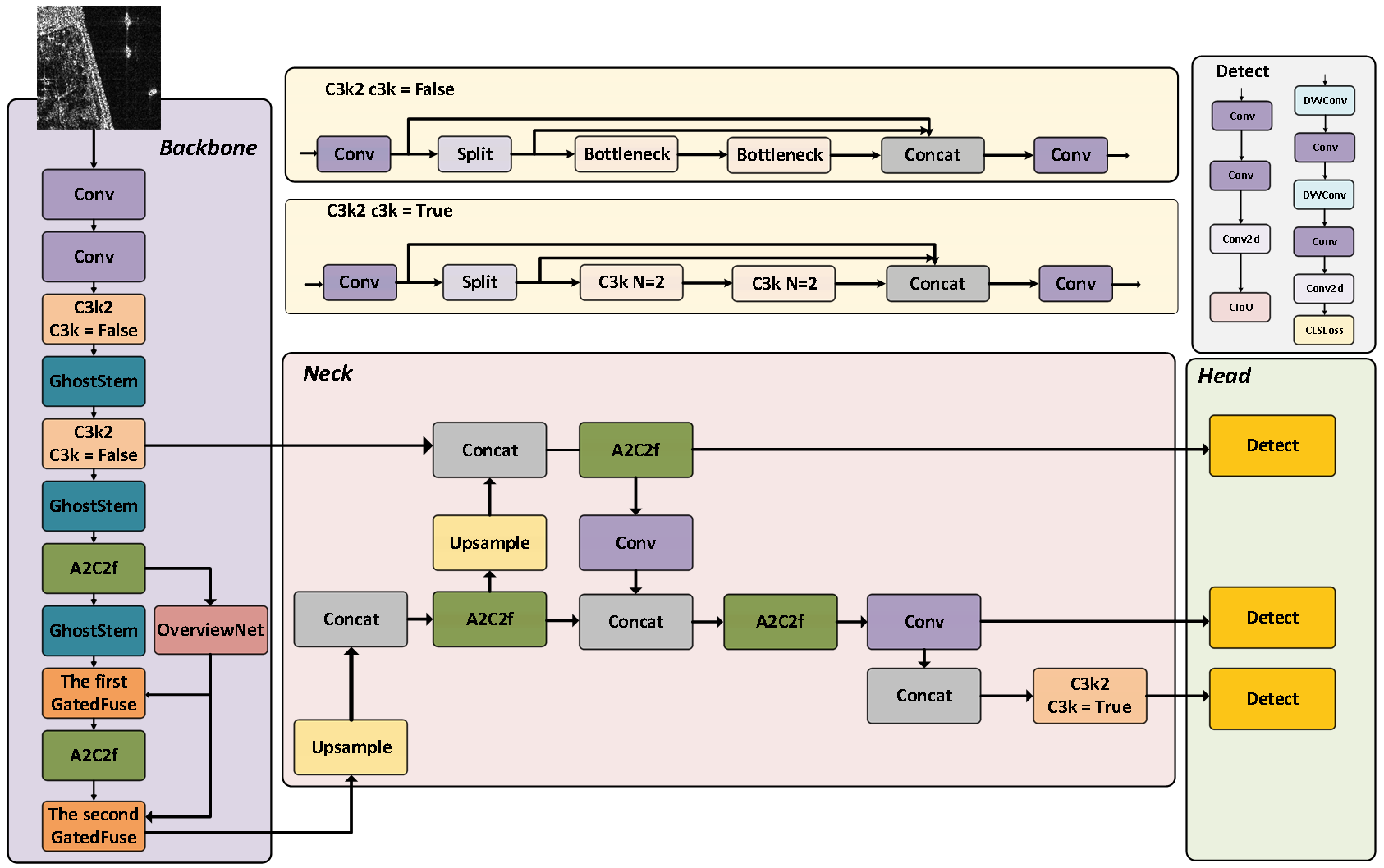
Ship detection in Synthetic Aperture Radar (SAR) imagery is crucial for maritime surveillance. However, it faces significant challenges, including small target sizes, complex sea clutter interference, and stringent requirements for computational efficiency in on-board processing. While detection frameworks like YOLOv12 have achieved a favorable balance between speed and accuracy by integrating attention mechanisms with convolutional neural networks (CNNs), their generic architectures are not optimized for the unique physical characteristics of SAR imagery and the scattering properties of ship targets. To develop a more suitable lightweight and high-precision model for SAR ship detection, this study proposes an improved YOLOv12 framework. Specifically, two modules are adopted: First, the GhostStem module is embedded into the shallow network layers to replace traditional convolutional layers. This lightweight feature extraction module effectively reduces the number of parameters and computational cost in the early stages, establishing an efficient foundation for target detection in SAR images. Second, the OverLookGate (OLGate) module is incorporated. By extracting lightweight global semantic priors and employing a two-level feature gating mechanism, it significantly enhances the model's capability to discriminate and localize features within SAR imagery under complex backgrounds (e.g., coastlines and island interference) and among distributed small-scale ship targets. Experiments on publicly available SAR ship detection datasets show that, compared with the original YOLOv12 and other mainstream detectors, the proposed improved model maintains high accuracy while demonstrating competitive performance, particularly achieving significant improvements in Recall and [email protected], especially in achieving higher recall and overall accuracy for small targets in complex scenarios.
Graphical Abstract
Keywords
Data Availability Statement
Funding
Conflicts of Interest
AI Use Statement
Ethical Approval and Consent to Participate
References
- Maître, H. (Ed.). (2013). Processing of synthetic aperture radar (SAR) images. John Wiley & Sons.
[Google Scholar] - Chan, Y. K., & Koo, V. (2008). An introduction to synthetic aperture radar (SAR). Progress In Electromagnetics Research B, 2, 27-60. http://dx.doi.org/10.2528/PIERB07110101
[Google Scholar] - Carpenter, A. (2015). European maritime safety agency CleanSeaNet activities in the North Sea. In Oil Pollution in the North Sea (pp. 33-47). Cham: Springer International Publishing.
[CrossRef] [Google Scholar] - Svanberg, M., Santén, V., Hörteborn, A., Holm, H., & Finnsgård, C. (2019). AIS in maritime research. Marine Policy, 106, 103520.
[CrossRef] [Google Scholar] - Kanjir, U., Greidanus, H., & Oštir, K. (2018). Vessel detection and classification from spaceborne optical images: A literature survey. Remote sensing of environment, 207, 1-26.
[CrossRef] [Google Scholar] - Sun, Z., Dai, M., Leng, X., Lei, Y., Xiong, B., Ji, K., & Kuang, G. (2021). An anchor-free detection method for ship targets in high-resolution SAR images. IEEE Journal of Selected Topics in Applied Earth Observations and Remote Sensing, 14, 7799-7816.
[CrossRef] [Google Scholar] - Li, T., Liu, Z., Xie, R., & Ran, L. (2017). An improved superpixel-level CFAR detection method for ship targets in high-resolution SAR images. IEEE Journal of Selected Topics in Applied Earth Observations and Remote Sensing, 11(1), 184-194.
[CrossRef] [Google Scholar] - Wei, G., Qingwen, Q., Lili, J., & Ping, Z. (2008, July). A new method of SAR image target recognition based on AdaBoost algorithm. In IGARSS 2008-2008 IEEE International Geoscience and Remote Sensing Symposium (Vol. 3, pp. III-1194). IEEE.
[CrossRef] [Google Scholar] - Anagnostopoulos, G. C. (2009). SVM-based target recognition from synthetic aperture radar images using target region outline descriptors. Nonlinear Analysis: Theory, Methods & Applications, 71(12), e2934-e2939.
[CrossRef] [Google Scholar] - Yue, T., Zhang, Y., Liu, P., Xu, Y., & Yu, C. (2022). A generating-anchor network for small ship detection in SAR images. IEEE Journal of Selected Topics in Applied Earth Observations and Remote Sensing, 15, 7665-7676.
[CrossRef] [Google Scholar] - Ren, Z., Hou, B., Wen, Z., & Jiao, L. (2018). Patch-sorted deep feature learning for high resolution SAR image classification. IEEE Journal of Selected Topics in Applied Earth Observations and Remote Sensing, 11(9), 3113-3126.
[CrossRef] [Google Scholar] - Gao, Y., Wu, Z., Ren, M., & Wu, C. (2022). Improved YOLOv4 based on attention mechanism for ship detection in SAR images. IEEE Access, 10, 23785-23797.
[CrossRef] [Google Scholar] - Yasir, M., Liu, S., Pirasteh, S., Xu, M., Sheng, H., Wan, J., ... & Li, J. (2024). YOLOShipTracker: Tracking ships in SAR images using lightweight YOLOv8. International Journal of Applied Earth Observation and Geoinformation, 134, 104137.
[CrossRef] [Google Scholar] - Tian, Y., Ye, Q., & Doermann, D. (2026). Yolov12: Attention-centric real-time object detectors. Advances in neural information processing systems, 38, 78433-78457.
[Google Scholar] - Ren, S., He, K., Girshick, R., & Sun, J. (2015). Faster r-cnn: Towards real-time object detection with region proposal networks. Advances in neural information processing systems, 28.
[Google Scholar] - Duan, K., Bai, S., Xie, L., Qi, H., Huang, Q., & Tian, Q. (2019, October). CenterNet: Keypoint Triplets for Object Detection. In 2019 IEEE/CVF International Conference on Computer Vision (ICCV) (pp. 6568-6577). IEEE.
[CrossRef] [Google Scholar] - Tan, M., Pang, R., & Le, Q. V. (2020, June). EfficientDet: Scalable and Efficient Object Detection. In 2020 IEEE/CVF Conference on Computer Vision and Pattern Recognition (CVPR) (pp. 10778-10787). IEEE.
[CrossRef] [Google Scholar] - Liu, S., Huang, D., & Wang, Y. (2019). Learning spatial fusion for single-shot object detection. arXiv preprint arXiv:1911.09516.
[CrossRef] [Google Scholar] - Zhang, X., Zhou, X., Lin, M., & Sun, J. (2018, June). ShuffleNet: An Extremely Efficient Convolutional Neural Network for Mobile Devices. In 2018 IEEE/CVF Conference on Computer Vision and Pattern Recognition (pp. 6848-6856). IEEE.
[CrossRef] [Google Scholar] - Hu, J., Shen, L., Albanie, S., Sun, G., & Wu, E. (2019). Squeeze-and-Excitation Networks. IEEE Transactions on Pattern Analysis and Machine Intelligence, 42(8), 2011-2023.
[CrossRef] [Google Scholar] - Zhang, Y., Hao, L. Y., & Li, Y. (2024, December). SD-YOLO: An attention mechanism guided YOLO network for ship detection. In 2024 14th International Conference on Information Science and Technology (ICIST) (pp. 769-776). IEEE.
[CrossRef] [Google Scholar] - Han, K., Wang, Y., Tian, Q., Guo, J., Xu, C., & Xu, C. (2020, June). GhostNet: More Features From Cheap Operations. In 2020 IEEE/CVF Conference on Computer Vision and Pattern Recognition (CVPR) (pp. 1577-1586). IEEE.
[CrossRef] [Google Scholar] - Lou, M., & Yu, Y. (2025, June). OverLoCK: An Overview-first-Look-Closely-next ConvNet with Context-Mixing Dynamic Kernels. In 2025 IEEE/CVF Conference on Computer Vision and Pattern Recognition (CVPR) (pp. 128-138). IEEE.
[CrossRef] [Google Scholar] - Jocher, G., Stoken, A., Borovec, J., NanoCode012, ChristopherSTAN, Liu, C., Laughing, Hogan, A., lorenzomammana, tkianai, yxNONG, AlexWang1900, Diaconu, L., Marc, wanghaoyang0106, ml5ah, Doug, Hatovix, Poznanski, J., Yu, L., changyu98, Rai, P., Ferriday, R., Sullivan, T., Wang, X., YuriRibeiro, Claramunt, E. R., hopesala, dave, p., & yzchen. (2020). ultralytics/yolov5: v3.0 (v3.0) [Computer software]. Zenodo.
[CrossRef] [Google Scholar] - Li, C., Li, L., Jiang, H., Weng, K., Geng, Y., Li, L., ... & Wei, X. (2022). YOLOv6: A single-stage object detection framework for industrial applications. arXiv preprint arXiv:2209.02976.
[CrossRef] [Google Scholar] - Mo, H., Wu, J., Xia, H., Yu, X., & Zhao, A. E. (2025). A lightweight, efficient, adaptive design of YOLOv5 for enhanced SAR ship detection. Remote Sensing Letters, 16(5), 549-559.
[CrossRef] [Google Scholar]
Cite This Article
TY  - JOUR
AU  - Wang, Wenqi
AU  - Zhang, Xu
AU  - Ma, Jun
AU  - Ren, Xunhuan
AU  - Tsviatkou, Viktar Yurevich
PY  - 2026
DA  - 2026/06/11
TI  - An Improved Yolov12-Based Object Detection Model For Ship Monitoring in SAR Images
JO  - Chinese Journal of Information Fusion
T2  - Chinese Journal of Information Fusion
JF  - Chinese Journal of Information Fusion
VL  - 3
IS  - 2
SP  - 125
EP  - 137
DO  - 10.62762/CJIF.2025.869982
UR  - https://www.icck.org/article/abs/CJIF.2025.869982
KW  - YOLOv12
KW  - ship detection
KW  - small-scale target
KW  - synthetic aperture radar (SAR)
AB  - Ship detection in Synthetic Aperture Radar (SAR) imagery is crucial for maritime surveillance. However, it faces significant challenges, including small target sizes, complex sea clutter interference, and stringent requirements for computational efficiency in on-board processing. While detection frameworks like YOLOv12 have achieved a favorable balance between speed and accuracy by integrating attention mechanisms with convolutional neural networks (CNNs), their generic architectures are not optimized for the unique physical characteristics of SAR imagery and the scattering properties of ship targets. To develop a more suitable lightweight and high-precision model for SAR ship detection, this study proposes an improved YOLOv12 framework. Specifically, two modules are adopted: First, the GhostStem module is embedded into the shallow network layers to replace traditional convolutional layers. This lightweight feature extraction module effectively reduces the number of parameters and computational cost in the early stages, establishing an efficient foundation for target detection in SAR images. Second, the OverLookGate (OLGate) module is incorporated. By extracting lightweight global semantic priors and employing a two-level feature gating mechanism, it significantly enhances the model's capability to discriminate and localize features within SAR imagery under complex backgrounds (e.g., coastlines and island interference) and among distributed small-scale ship targets. Experiments on publicly available SAR ship detection datasets show that, compared with the original YOLOv12 and other mainstream detectors, the proposed improved model maintains high accuracy while demonstrating competitive performance, particularly achieving significant improvements in Recall and [email protected], especially in achieving higher recall and overall accuracy for small targets in complex scenarios.
SN  - 2998-3371
PB  - Institute of Central Computation and Knowledge
LA  - English
ER  -
@article{Wang2026An,
  author = {Wenqi Wang and Xu Zhang and Jun Ma and Xunhuan Ren and Viktar Yurevich Tsviatkou},
  title = {An Improved Yolov12-Based Object Detection Model For Ship Monitoring in SAR Images},
  journal = {Chinese Journal of Information Fusion},
  year = {2026},
  volume = {3},
  number = {2},
  pages = {125-137},
  doi = {10.62762/CJIF.2025.869982},
  url = {https://www.icck.org/article/abs/CJIF.2025.869982},
  abstract = {Ship detection in Synthetic Aperture Radar (SAR) imagery is crucial for maritime surveillance. However, it faces significant challenges, including small target sizes, complex sea clutter interference, and stringent requirements for computational efficiency in on-board processing. While detection frameworks like YOLOv12 have achieved a favorable balance between speed and accuracy by integrating attention mechanisms with convolutional neural networks (CNNs), their generic architectures are not optimized for the unique physical characteristics of SAR imagery and the scattering properties of ship targets. To develop a more suitable lightweight and high-precision model for SAR ship detection, this study proposes an improved YOLOv12 framework. Specifically, two modules are adopted: First, the GhostStem module is embedded into the shallow network layers to replace traditional convolutional layers. This lightweight feature extraction module effectively reduces the number of parameters and computational cost in the early stages, establishing an efficient foundation for target detection in SAR images. Second, the OverLookGate (OLGate) module is incorporated. By extracting lightweight global semantic priors and employing a two-level feature gating mechanism, it significantly enhances the model's capability to discriminate and localize features within SAR imagery under complex backgrounds (e.g., coastlines and island interference) and among distributed small-scale ship targets. Experiments on publicly available SAR ship detection datasets show that, compared with the original YOLOv12 and other mainstream detectors, the proposed improved model maintains high accuracy while demonstrating competitive performance, particularly achieving significant improvements in Recall and [email protected], especially in achieving higher recall and overall accuracy for small targets in complex scenarios.},
  keywords = {YOLOv12, ship detection, small-scale target, synthetic aperture radar (SAR)},
  issn = {2998-3371},
  publisher = {Institute of Central Computation and Knowledge}
}
Article Metrics
Publisher's Note
ICCK stays neutral with regard to jurisdictional claims in published maps and institutional affiliations.
Rights and Permissions
 Copyright © 2026 by the Author(s). Published by Institute of Central Computation and Knowledge. This article is an open access article distributed under the terms and conditions of the Creative Commons Attribution (CC BY) license (https://creativecommons.org/licenses/by/4.0/), which permits use, sharing, adaptation, distribution and reproduction in any medium or format, as long as you give appropriate credit to the original author(s) and the source, provide a link to the Creative Commons licence, and indicate if changes were made.


Portico