Dynamic Target Association Algorithm for Unknown Models and Strong Interference



Article Information
Abstract
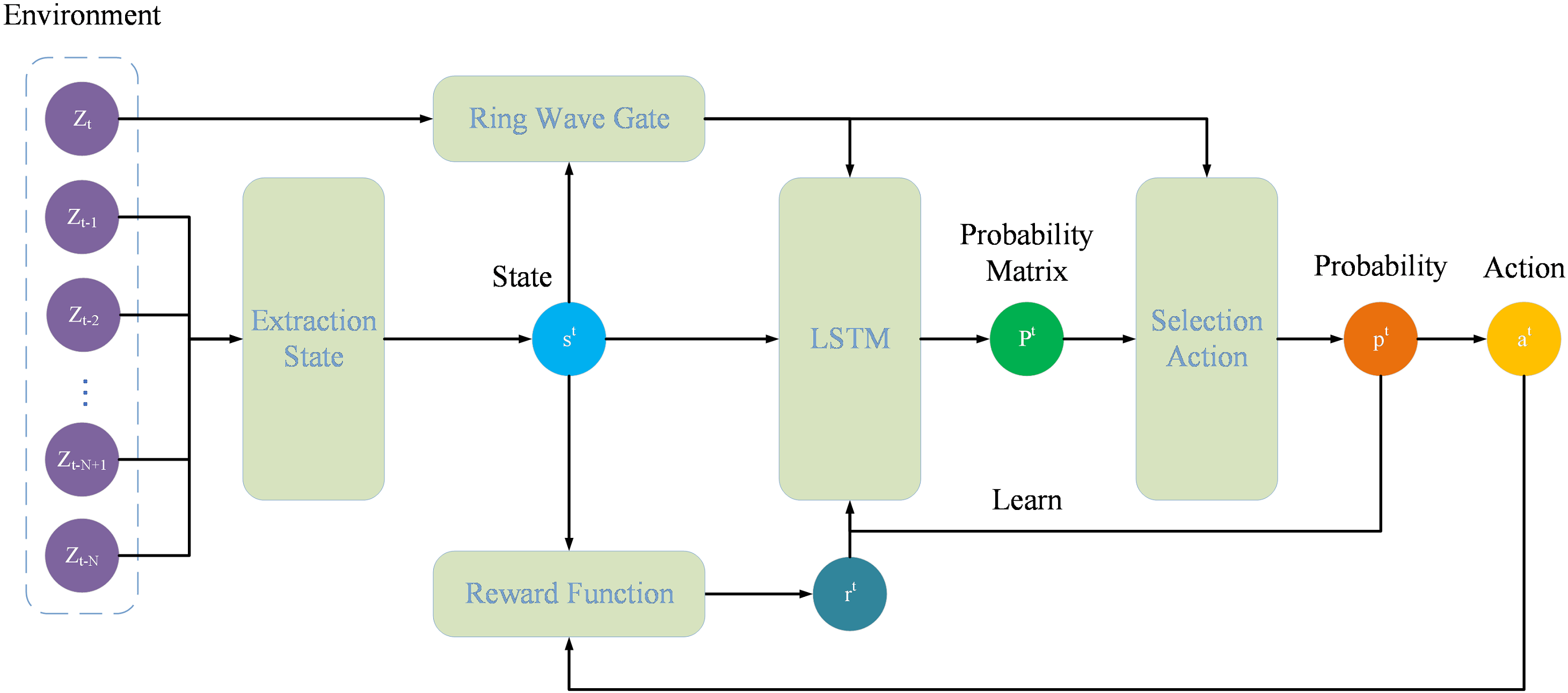
To address the performance degradation of traditional data association algorithms caused by unknown target motion models, environmental interference, and strong maneuvering behaviors in complex dynamic scenarios, this paper proposes an innovative fusion algorithm that integrates reinforcement learning and deep learning. By constructing a policy network that combines Long Short-Term Memory (LSTM) memory units and reinforcement learning dynamic decision-making, a dynamic prediction model for "measurement-target" association probability is established. Additionally, a hybrid predictor incorporating Bayesian networks and multi-order curve fitting is designed to formulate the reward function. To tackle practical interference, a dynamic ring gate screening mechanism and a trajectory consistency-based error correction module are developed, effectively suppressing clutter interference and enabling autonomous correction of association errors. Experimental results demonstrate that the proposed method significantly improves association accuracy in high-noise environments compared to traditional algorithms, enhancing robustness in complex unknown scenarios.
Graphical Abstract
Keywords
Data Availability Statement
Funding
Conflicts of Interest
Ethical Approval and Consent to Participate
References
- Huang, X. P., & Wang, Y. (2015). Kalman filter principle and application.Publishing House of Electronics Industry: Beijing, China.
[Google Scholar] - Lexa, M., Coraluppi, S., Carthel, C., & Willett, P. (2020, March). Distributed MHT and ML-PMHT approaches to multi-sensor passive sonar tracking. In 2020 IEEE Aerospace Conference (pp. 1-12). IEEE.
[CrossRef] [Google Scholar] - Li, Q., Song, L., & Zhang, Y. (2021). Multiple extended target tracking by truncated JPDA in a clutter environment. IET Signal Processing, 15(3), 207-219.
[CrossRef] [Google Scholar] - Fan, E., Xie, W., Pei, J., Hu, K., Li, X., & Podpečan, V. (2018). Improved joint probabilistic data association (JPDA) filter using motion feature for multiple maneuvering targets in uncertain tracking situations. Information, 9(12), 322.
[CrossRef] [Google Scholar] - He, S., Shin, H. S., & Tsourdos, A. (2020). Distributed multiple model joint probabilistic data association with Gibbs sampling-aided implementation. Information Fusion, 64, 20-31.
[CrossRef] [Google Scholar] - Ma, M., Wang, D., Sun, H., & Zhang, T. (2021). Radiation intensity Gaussian mixture PHD filter for close target tracking. Signal Processing, 188, 108196.
[CrossRef] [Google Scholar] - Qin, Z., Liang, Y., Li, K., & Zhou, J. (2021). Measurement-driven sequential random sample consensus GM-PHD filter for ballistic target tracking. Mechanical Systems and Signal Processing, 155, 107407.
[CrossRef] [Google Scholar] - Li, T., Prieto, J., Fan, H., & Corchado, J. M. (2018). A robust multi-sensor PHD filter based on multi-sensor measurement clustering. IEEE Communications Letters, 22(10), 2064-2067.
[CrossRef] [Google Scholar] - Streit, R., Angle, R. B., Efe, M., Streit, R., Angle, R. B., & Efe, M. (2021). Multi-Bernoulli Mixture and Multiple Hypothesis Tracking Filters. Analytic Combinatorics for Multiple Object Tracking, 113-143.
[CrossRef] [Google Scholar] - Leung, H. (1996). Neural network data association with application to multiple-target tracking. Optical Engineering, 35(3), 693-700. Journal of Intelligent Systems, 31(1), 1-14.
[CrossRef] [Google Scholar] - Tian, Y., Dehghan, A., & Shah, M. (2018). On detection, data association and segmentation for multi-target tracking. IEEE transactions on pattern analysis and machine intelligence, 41(9), 2146-2160.
[CrossRef] [Google Scholar] - Wadley, J. E., & Engebretson, K. R. (2022). Applying Artificial Intelligence to the Data Association Problem. In AIAA SCITECH 2022 Forum (p. 0248).
[CrossRef] [Google Scholar] - Zhang, X., Li, P., Zhu, Y., Li, C., Yao, C., Wang, L., ... & Li, S. (2021). Coherent beam combination based on Q-learning algorithm. Optics Communications, 490, 126930.
[CrossRef] [Google Scholar] - Li, H., Zhang, X., Bai, J., & Sun, H. (2021, April). Quadric Lyapunov Algorithm for Stochastic Networks Optimization with Q-learning Perspective. In Journal of Physics: Conference Series (Vol. 1885, No. 4, p. 042070). IOP Publishing.
[CrossRef] [Google Scholar] - Zhang, Y., Ma, R., Zhao, D., Huangfu, Y., & Liu, W. (2021). A novel energy management strategy based on dual reward function Q-learning for fuel cell hybrid electric vehicle. IEEE Transactions on Industrial Electronics, 69(2), 1537-1547.
[CrossRef] [Google Scholar] - Li, M., Wang, Z., Li, K., Liao, X., Hone, K., & Liu, X. (2021). Task allocation on layered multiagent systems: When evolutionary many-objective optimization meets deep Q-learning. IEEE Transactions on Evolutionary Computation, 25(5), 842-855.
[CrossRef] [Google Scholar] - Zhao, B., Ren, G., Dong, X., & Zhang, H. (2021). Distributed Q-learning based joint relay selection and access control scheme for IoT-oriented satellite terrestrial relay networks. IEEE Communications Letters, 25(6), 1901-1905.
[CrossRef] [Google Scholar] - Zhang, Q., Lin, M., Yang, L. T., Chen, Z., & Li, P. (2017). Energy-efficient scheduling for real-time systems based on deep Q-learning model. IEEE transactions on sustainable computing, 4(1), 132-141.
[CrossRef] [Google Scholar] - Huang, R., Yu, T., Ding, Z., & Zhang, S. (2020). Policy gradient. Deep Reinforcement Learning: Fundamentals, Research and Applications, 161-212.
[CrossRef] [Google Scholar] - Mnih, V., Kavukcuoglu, K., Silver, D., Rusu, A. A., Veness, J., Bellemare, M. G., ... & Hassabis, D. (2015). Human-level control through deep reinforcement learning. nature, 518(7540), 529-533.
[CrossRef] [Google Scholar] - Liu, Y., Hu, Y., Gao, Y., Chen, Y., & Fan, C. (2019, August). Value Function Transfer for Deep Multi-Agent Reinforcement Learning Based on N-Step Returns. In IJCAI (pp. 457-463).
[Google Scholar] - Tirinzoni, A., Sessa, A., Pirotta, M., & Restelli, M. (2018, July). Importance weighted transfer of samples in reinforcement learning. In International Conference on Machine Learning (pp. 4936-4945). PMLR.
[Google Scholar] - Gamrian, S., & Goldberg, Y. (2019, May). Transfer learning for related reinforcement learning tasks via image-to-image translation. In International conference on machine learning (pp. 2063-2072). PMLR.
[Google Scholar] - Khan, A., Jiang, F., Liu, S., & Omara, I. (2019). Playing a FPS doom video game with deep visual reinforcement learning. Automatic Control and Computer Sciences, 53(3), 214-222.
[CrossRef] [Google Scholar] - Jithesh, V., Sagayaraj, M. J., & Srinivasa, K. G. (2017, February). LSTM recurrent neural networks for high resolution range profile based radar target classification. In 2017 3rd International conference on computational intelligence & communication technology (CICT) (pp. 1-6). IEEE.
[CrossRef] [Google Scholar] - Li, B., & Yang, Y. (2018). Complexity of concept classes induced by discrete Markov networks and Bayesian networks. Pattern Recognition, 82, 31-37.
[CrossRef] [Google Scholar] - Wang, C., Wang, H. P., Xiong, W., & He, Y. (2016). Data association algorithm based on least square fitting. Acta Aeronautica et Astronautica Sinica, 37(5), 1603-1613.
[Google Scholar] - Faisal, S., & Tutz, G. (2021). Multiple imputation using nearest neighbor methods. Information Sciences, 570, 500-516.
[CrossRef] [Google Scholar] - Wei, X., Gu, X., & Yaqi, C. (2022). Point‐track association method with unknown system model. IET Radar, Sonar & Navigation, 16(11), 1779-1795.
[CrossRef] [Google Scholar]
Cited By (1)
-
Mengke Li, Yangzi Zhang, Xinyu Sun, Weiyi Chen. STG-DB net for athlete pose estimation and pose rational optimization in complex sports scenes.
Scientific Reports, 2026 , 16 (1).
[CrossRef]
Cite This Article
TY  - JOUR
AU  - Gu, Xiangqi
AU  - Ding, Ziran
AU  - Xia, Shutao
AU  - Xiong, Wei
PY  - 2025
DA  - 2025/04/12
TI  - Dynamic Target Association Algorithm for Unknown Models and Strong Interference
JO  - Chinese Journal of Information Fusion
T2  - Chinese Journal of Information Fusion
JF  - Chinese Journal of Information Fusion
VL  - 2
IS  - 2
SP  - 100
EP  - 111
DO  - 10.62762/CJIF.2025.986522
UR  - https://www.icck.org/article/abs/cjif.2025.986522
KW  - data association
KW  - motion model
KW  - LSTM
KW  - Bayesian networks
AB  - To address the performance degradation of traditional data association algorithms caused by unknown target motion models, environmental interference, and strong maneuvering behaviors in complex dynamic scenarios, this paper proposes an innovative fusion algorithm that integrates reinforcement learning and deep learning. By constructing a policy network that combines Long Short-Term Memory (LSTM) memory units and reinforcement learning dynamic decision-making, a dynamic prediction model for "measurement-target" association probability is established. Additionally, a hybrid predictor incorporating Bayesian networks and multi-order curve fitting is designed to formulate the reward function. To tackle practical interference, a dynamic ring gate screening mechanism and a trajectory consistency-based error correction module are developed, effectively suppressing clutter interference and enabling autonomous correction of association errors. Experimental results demonstrate that the proposed method significantly improves association accuracy in high-noise environments compared to traditional algorithms, enhancing robustness in complex unknown scenarios.
SN  - 2998-3371
PB  - Institute of Central Computation and Knowledge
LA  - English
ER  -
@article{Gu2025Dynamic,
  author = {Xiangqi Gu and Ziran Ding and Shutao Xia and Wei Xiong},
  title = {Dynamic Target Association Algorithm for Unknown Models and Strong Interference},
  journal = {Chinese Journal of Information Fusion},
  year = {2025},
  volume = {2},
  number = {2},
  pages = {100-111},
  doi = {10.62762/CJIF.2025.986522},
  url = {https://www.icck.org/article/abs/cjif.2025.986522},
  abstract = {To address the performance degradation of traditional data association algorithms caused by unknown target motion models, environmental interference, and strong maneuvering behaviors in complex dynamic scenarios, this paper proposes an innovative fusion algorithm that integrates reinforcement learning and deep learning. By constructing a policy network that combines Long Short-Term Memory (LSTM) memory units and reinforcement learning dynamic decision-making, a dynamic prediction model for "measurement-target" association probability is established. Additionally, a hybrid predictor incorporating Bayesian networks and multi-order curve fitting is designed to formulate the reward function. To tackle practical interference, a dynamic ring gate screening mechanism and a trajectory consistency-based error correction module are developed, effectively suppressing clutter interference and enabling autonomous correction of association errors. Experimental results demonstrate that the proposed method significantly improves association accuracy in high-noise environments compared to traditional algorithms, enhancing robustness in complex unknown scenarios.},
  keywords = {data association, motion model, LSTM, Bayesian networks},
  issn = {2998-3371},
  publisher = {Institute of Central Computation and Knowledge}
}
Publisher's Note
ICCK stays neutral with regard to jurisdictional claims in published maps and institutional affiliations.
Rights and Permissions
 Copyright © 2025 by the Author(s). Published by Institute of Central Computation and Knowledge. This article is an open access article distributed under the terms and conditions of the Creative Commons Attribution (CC BY) license (https://creativecommons.org/licenses/by/4.0/), which permits use, sharing, adaptation, distribution and reproduction in any medium or format, as long as you give appropriate credit to the original author(s) and the source, provide a link to the Creative Commons licence, and indicate if changes were made.


Portico