


Machine Learning and Deep Learning in Agriculture: A PRISMA Systematic Review of Architectures, Applications, and Open Science Practices (2019–2026)



Article Information
Abstract
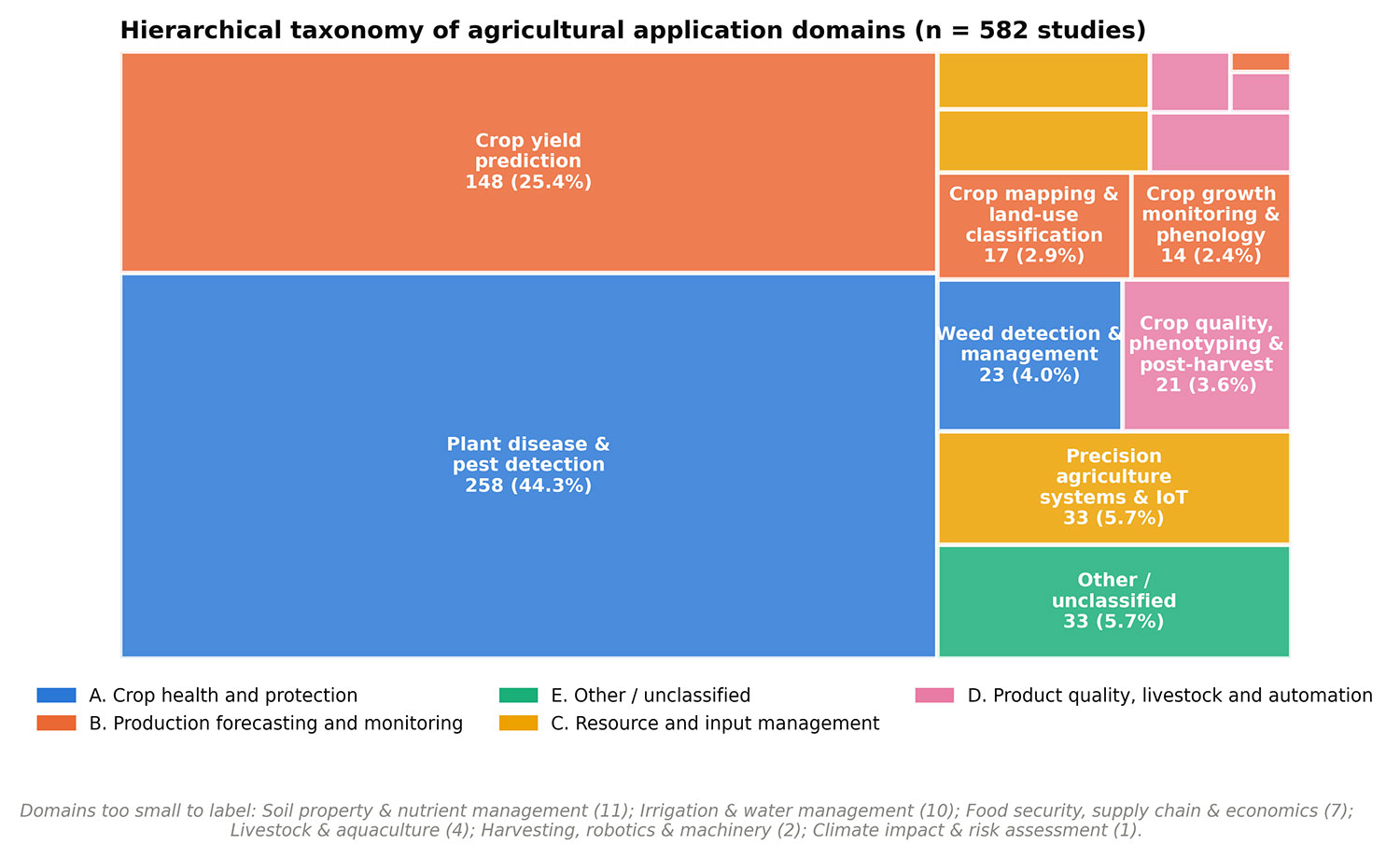
Agriculture faces growing pressures from food insecurity, climate change, and resource scarcity, increasing demand for scalable analytical tools. This PRISMA 2020-compliant systematic review synthesised 582 peer-reviewed studies on machine learning (ML) and deep learning (DL) in agriculture published between January 2019 and March 2026, with 430 retrieved full texts forming the analytic subsample. Publication volume increased from 6 papers in 2019 to 251 in 2025, corresponding to a compound annual growth of approximately 86%. Convolutional backbones remained dominant (57.2%), while Transformer-based models increased from 14.3% in 2022 to 41.2% in 2025. South and East Asia contributed 59.3% of publications, whereas Sub-Saharan Africa and Latin America and the Caribbean accounted for only 1.5% and 1.4%, respectively. Evidence-maturity analysis showed that 33.0% of studies remained confined to curated data, 36.5% reached field validation, and 30.5% reached operational prototypes. Median reported accuracy declined from 99.0% for public-benchmark-only studies to 95.0% for studies using their own field data ($p<0.001$). Reproducibility was also limited: the median index was 3/10, with code openly available in 7.2% of studies, data in 24.7%, and both in 4.9%. Although open-data disclosure increased significantly over time, code sharing did not. These findings highlight persistent gaps between benchmark performance and field deployment, underscoring the need for field-realistic validation, reproducibility, smallholder-relevant design, and greater geographic equity.
Graphical Abstract
Keywords
Data Availability Statement
Funding
Conflicts of Interest
AI Use Statement
Ethical Approval and Consent to Participate
References
- FAO, IFAD, UNICEF, WFP, & WHO. (2023). The state of food security and nutrition in the world 2023. FAO.
[CrossRef] [Google Scholar] - LeCun, Y., Bengio, Y., & Hinton, G. (2015). Deep learning. Nature, 521(7553), 436-444.
[CrossRef] [Google Scholar] - Kamilaris, A., & Prenafeta-Boldú, F. X. (2018). Deep learning in agriculture: A survey. Computers and electronics in agriculture, 147, 70-90.
[CrossRef] [Google Scholar] - Vaswani, A., Shazeer, N., Parmar, N., Uszkoreit, J., Jones, L., Gomez, A. N., ... & Polosukhin, I. (2017). Attention is all you need. Advances in neural information processing systems, 30.
[Google Scholar] - Ronneberger, O., Fischer, P., & Brox, T. (2015, October). U-net: Convolutional networks for biomedical image segmentation. In International Conference on Medical image computing and computer-assisted intervention (pp. 234-241). Cham: Springer international publishing.
[CrossRef] [Google Scholar] - Hochreiter, S., & Schmidhuber, J. (1997). Long short-term memory. Neural Computation, 9(8), 1735-1780.
[CrossRef] [Google Scholar] - Breiman, L. (2001). Random forests. Machine Learning, 45(1), 5-32.
[CrossRef] [Google Scholar] - Page, M. J., McKenzie, J. E., Bossuyt, P. M., Boutron, I., Hoffmann, T. C., Mulrow, C. D., ... & Moher, D. (2021). The PRISMA 2020 statement: an updated guideline for reporting systematic reviews. bmj, 372.
[CrossRef] [Google Scholar] - Hughes, D. P., & Salath\'e, M. (2015). An open access repository of images on plant health to enable the development of mobile disease diagnostics. arXiv preprint arXiv:1511.08060.
[CrossRef] [Google Scholar] - Cao, J., Zhang, Z., Tao, F., Zhang, L., Luo, Y., Zhang, J., ... & Xie, J. (2021). Integrating multi-source data for rice yield prediction across China using machine learning and deep learning approaches. Agricultural and forest meteorology, 297, 108275.
[CrossRef] [Google Scholar] - Sun, J., Lai, Z., Di, L., Sun, Z., Tao, J., & Shen, Y. (2020). Multilevel deep learning network for county-level corn yield estimation in the US Corn Belt. IEEE Journal of Selected Topics in Applied Earth Observations and Remote Sensing, 13, 5048-5060.
[CrossRef] [Google Scholar] - Nejad, S. M. M., Abbasi-Moghadam, D., Sharifi, A., Farmonov, N., Amankulova, K., & Lászlź, M. (2022). Multispectral crop yield prediction using 3D-convolutional neural networks and attention convolutional LSTM approaches. IEEE Journal of Selected Topics in Applied Earth Observations and Remote Sensing, 16, 254-266.
[CrossRef] [Google Scholar] - Wang, Y., Wang, P., Tansey, K., Liu, J., Delaney, B., & Quan, W. (2025). An interpretable approach combining Shapley additive explanations and LightGBM based on data augmentation for improving wheat yield estimates. Computers and Electronics in Agriculture, 229, 109758.
[CrossRef] [Google Scholar] - Liakos, K. G., Busato, P., Moshou, D., Pearson, S., & Bochtis, D. (2018). Machine learning in agriculture: A review. Sensors, 18(8), 2674.
[CrossRef] [Google Scholar] - Weiss, M., Jacob, F., & Duveiller, G. (2020). Remote sensing for agricultural applications: A meta-review. Remote sensing of environment, 236, 111402.
[CrossRef] [Google Scholar] - Mohanty, S. P., Hughes, D. P., & Salathè, M. (2016). Using deep learning for image-based plant disease detection. Frontiers in plant science, 7, 215232.
[CrossRef] [Google Scholar] - Yu, S., Xie, L., & Dai, L. (2025). ST-CFI: Swin Transformer with convolutional feature interactions for identifying plant diseases. Scientific Reports, 15(1), 25000.
[CrossRef] [Google Scholar] - Shafik, W., Tufail, A., Liyanage De Silva, C., & Awg Haji Mohd Apong, R. A. (2025). A novel hybrid inception-xception convolutional neural network for efficient plant disease classification and detection. Scientific Reports, 15(1), 3936.
[CrossRef] [Google Scholar] - Ngugi, H. N., Ezugwu, A. E., Akinyelu, A. A., & Abualigah, L. (2024). Revolutionizing crop disease detection with computational deep learning: a comprehensive review. Environmental monitoring and assessment, 196(3), 302.
[CrossRef] [Google Scholar] - Erike, A., Ikerionwu, C., Azubogu, A., & Obodoagwu, V. (2025). Is AI for illiterate farmers? A systematic literature review of AI and machine learning applications and challenges for precision agriculture. Discover Artificial Intelligence, 5(1), 204.
[CrossRef] [Google Scholar] - Shams, M. Y., Gamel, S. A., & Talaat, F. M. (2024). Enhancing crop recommendation systems with explainable artificial intelligence: a study on agricultural decision-making. Neural Computing and Applications, 36(11), 5695-5714.
[CrossRef] [Google Scholar] - Akkem, Y., Biswas, S. K., & Varanasi, A. (2025). Role of explainable AI in crop recommendation technique of smart farming. International Journal of Intelligent Systems and Applications, 17(1), 31-52.
[CrossRef] [Google Scholar] - Wang, X., He, Y., Chen, H., Luo, S., Jiao, Y., Ning, J., ... & Yin, J. (2026). From data to decisions: the use of explainable AI to forecast soybean yield in major producing countries. Scientific Reports, 16(1), 5103.
[CrossRef] [Google Scholar] - Mamba Kabala, D., Hafiane, A., Bobelin, L., & Canals, R. (2023). Image-based crop disease detection with federated learning. Scientific Reports, 13(1), 19220.
[CrossRef] [Google Scholar] - Aggarwal, M., Khullar, V., Goyal, N., Alammari, A., Albahar, M. A., & Singh, A. (2023). Lightweight federated learning for rice leaf disease classification using non independent and identically distributed images. Sustainability, 15(16), 12149.
[CrossRef] [Google Scholar] - Sun, G., Zhang, W., Lou, Y., Liao, T., Chen, C., Ren, L., ... & Ma, Y. (2026). Soil knowledge-guided multi-task transformer model for predicting soil properties and crop traits with early warning alerts. Artificial Intelligence in Agriculture, 16(2), 1197-1211.
[CrossRef] [Google Scholar] - Kouame, A. K., Heuvelink, G. B., & Bindraban, P. S. (2026). Modeling and explaining fertilizer effect heterogeneity on maize yield in Ghana using causal and predictive machine learning. Field Crops Research, 337, 110287.
[CrossRef] [Google Scholar] - Singh, R., De, M., Banerjee, R., Nayak, A., Dasgupta, S., Das, A., ... & Chakraborty, S. (2025). Enhancing soil organic carbon estimation with generative AI and Nix color sensor. Scientific Reports, 15(1), 40628.
[CrossRef] [Google Scholar] - Abate, J., Aman, A., & Adem, D. (2025). Integration of satellite data for predicting crop yields in Eastern Ethiopia using machine learning. Scientific Reports, 15(1), 33809.
[CrossRef] [Google Scholar] - Hussein, E. E., Zerouali, B., Bailek, N., Derdour, A., Ghoneim, S. S., Santos, C. A. G., & Hashim, M. A. (2024). Harnessing explainable AI for sustainable agriculture: SHAP-based feature selection in multi-model evaluation of irrigation water quality indices. Water, 17(1), 59.
[CrossRef] [Google Scholar] - Arumuga Arun, R., Umamaheswari, S., Mohamed Meerasha, I., & Mohankumar, B. (2025). Enhancing the weed segmentation in diverse crop fields using computationally effective concatenated attention U-Net with convolutional block attention module. Scientific Reports, 16(1), 1774.
[CrossRef] [Google Scholar] - Bahaa, M., Hesham, A., Ashraf, F., & Abdel-Hamid, L. (2026). A smart AIoT-based mobile application for plant disease detection and environment management in small-scale farms using MobileViT. AgriEngineering, 8(1), 11.
[CrossRef] [Google Scholar] - Zhu, B., Lv, Q., Liu, Y., Cao, H., & Tan, Z. (2026). ADC-YOLO: Adaptive Perceptual Dynamic Convolution-Based Accurate Detection of Rice in UAV Images. Remote Sensing, 18(3), 446.
[CrossRef] [Google Scholar] - Li, X., Li, Y., Yan, B., Gao, Y., Su, S., Zhou, H., ... & Li, Y. (2026). Oilseed Flax Yield Prediction in Arid Gansu, China Using a CNN–Informer Model and Multi-Source Spatio-Temporal Data. Remote Sensing, 18(1), 181.
[CrossRef] [Google Scholar]
Cite This Article
TY  - JOUR
AU  - Rasul, Azad
PY  - 2026
DA  - 2026/09/20
TI  - Machine Learning and Deep Learning in Agriculture: A PRISMA Systematic Review of Architectures, Applications, and Open Science Practices (2019–2026)
JO  - Digital Intelligence in Agriculture
T2  - Digital Intelligence in Agriculture
JF  - Digital Intelligence in Agriculture
VL  - 2
IS  - 3
SP  - 126
EP  - 157
DO  - 10.62762/DIA.2026.703096
UR  - https://www.icck.org/article/abs/DIA.2026.703096
KW  - systematic review
KW  - precision agriculture
KW  - convolutional neural network
KW  - vision transformer
KW  - crop yield prediction
KW  - evidence maturity
KW  - open science
KW  - reproducibility
AB  - Agriculture faces growing pressures from food insecurity, climate change, and resource scarcity, increasing demand for scalable analytical tools. This PRISMA 2020-compliant systematic review synthesised 582 peer-reviewed studies on machine learning (ML) and deep learning (DL) in agriculture published between January 2019 and March 2026, with 430 retrieved full texts forming the analytic subsample. Publication volume increased from 6 papers in 2019 to 251 in 2025, corresponding to a compound annual growth of approximately 86%. Convolutional backbones remained dominant (57.2%), while Transformer-based models increased from 14.3% in 2022 to 41.2% in 2025. South and East Asia contributed 59.3% of publications, whereas Sub-Saharan Africa and Latin America and the Caribbean accounted for only 1.5% and 1.4%, respectively. Evidence-maturity analysis showed that 33.0% of studies remained confined to curated data, 36.5% reached field validation, and 30.5% reached operational prototypes. Median reported accuracy declined from 99.0% for public-benchmark-only studies to 95.0% for studies using their own field data ($p
SN  - 3069-3187
PB  - Institute of Central Computation and Knowledge
LA  - English
ER  -
@article{Rasul2026Machine,
  author = {Azad Rasul},
  title = {Machine Learning and Deep Learning in Agriculture: A PRISMA Systematic Review of Architectures, Applications, and Open Science Practices (2019–2026)},
  journal = {Digital Intelligence in Agriculture},
  year = {2026},
  volume = {2},
  number = {3},
  pages = {126-157},
  doi = {10.62762/DIA.2026.703096},
  url = {https://www.icck.org/article/abs/DIA.2026.703096},
  abstract = {Agriculture faces growing pressures from food insecurity, climate change, and resource scarcity, increasing demand for scalable analytical tools. This PRISMA 2020-compliant systematic review synthesised 582 peer-reviewed studies on machine learning (ML) and deep learning (DL) in agriculture published between January 2019 and March 2026, with 430 retrieved full texts forming the analytic subsample. Publication volume increased from 6 papers in 2019 to 251 in 2025, corresponding to a compound annual growth of approximately 86\%. Convolutional backbones remained dominant (57.2\%), while Transformer-based models increased from 14.3\% in 2022 to 41.2\% in 2025. South and East Asia contributed 59.3\% of publications, whereas Sub-Saharan Africa and Latin America and the Caribbean accounted for only 1.5\% and 1.4\%, respectively. Evidence-maturity analysis showed that 33.0\% of studies remained confined to curated data, 36.5\% reached field validation, and 30.5\% reached operational prototypes. Median reported accuracy declined from 99.0\% for public-benchmark-only studies to 95.0\% for studies using their own field data (\$p},
  keywords = {systematic review, precision agriculture, convolutional neural network, vision transformer, crop yield prediction, evidence maturity, open science, reproducibility},
  issn = {3069-3187},
  publisher = {Institute of Central Computation and Knowledge}
}
Article Metrics
Publisher's Note
ICCK stays neutral with regard to jurisdictional claims in published maps and institutional affiliations.
Rights and Permissions
 Copyright © 2026 by the Author(s). Published by Institute of Central Computation and Knowledge. This article is an open access article distributed under the terms and conditions of the Creative Commons Attribution (CC BY) license (https://creativecommons.org/licenses/by/4.0/), which permits use, sharing, adaptation, distribution and reproduction in any medium or format, as long as you give appropriate credit to the original author(s) and the source, provide a link to the Creative Commons licence, and indicate if changes were made.

