

Soret Influence in the Presence of Thermal Radiation, Heat Generation, and Chemical Reaction on Unsteady Magnetohydrodynamic Mixed Convective Oscillatory Flow through a Two-Phase Horizontal Channel

Article Information
Abstract
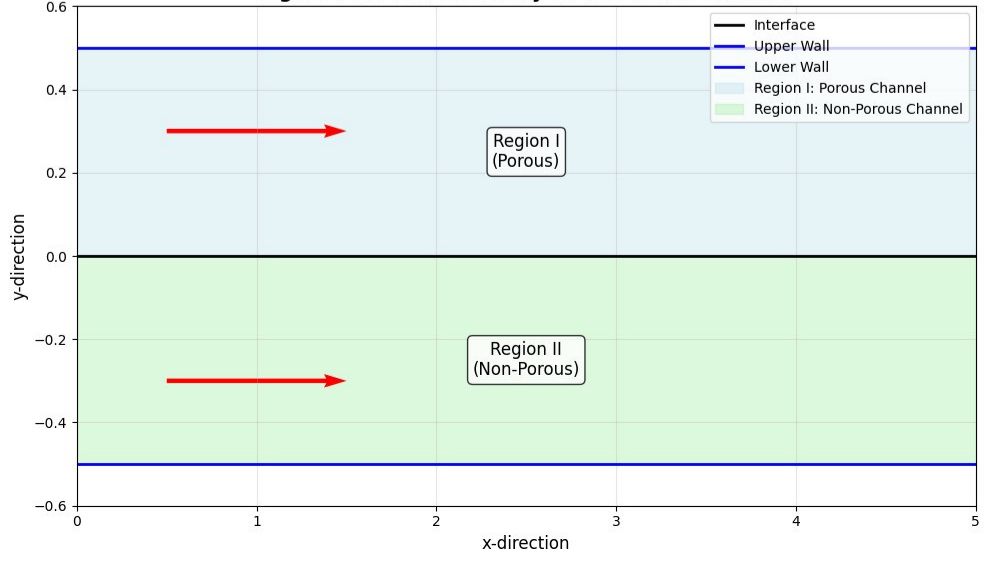
This paper analytically investigates unsteady, laminar, magnetohydrodynamic (MHD) mixed convective oscillatory flow of two immiscible viscous fluids through a horizontal two-phase channel. The channel consists of a porous upper region (Region~I, $0 \le y \le h$) and a non-porous lower region (Region~II, $-h \le y \le 0$), separated by a permeable interface, with a uniform transverse magnetic field $B_0$ applied normal to the flow. The governing equations incorporate thermal buoyancy ($Gr$), concentration buoyancy ($Gc$), Darcy porous resistance, thermal radiation (Rosseland approximation), volumetric heat generation/absorption, first-order destructive chemical reaction, and the Soret effect in both regions. An oscillatory suction/injection velocity is assumed at the walls, and a perturbation expansion in the small parameter $\varepsilon \ll 1$ decouples the system into zeroth-order (steady) and first-order (oscillatory) ODEs, solved analytically. Six interface conditions enforce continuity of velocity, shear stress, temperature, heat flux, concentration, and mass flux. Closed-form expressions are derived for velocity, temperature, and concentration profiles, as well as skin friction $\tau$, Nusselt number $Nu$, and Sherwood number $Sh$. Parametric studies show that increasing the Soret number $Sr$ enhances velocity by 15-20% in the porous region, while increasing the Hartmann number $M$ retards flow by up to 40% via the Lorentz force. Thermal radiation augments both $Nu$ and the thermal field, and destructive chemical reaction increases $Sh$ by 25-30%. Results are validated against limiting cases including hydrodynamic flow ($M=0$), no Soret effect ($Sr=0$), and the single-phase limit.
Graphical Abstract
Keywords
Data Availability Statement
Funding
Conflicts of Interest
AI Use Statement
Ethical Approval and Consent to Participate
References
- Zigta, B. (2018). Effect of thermal radiation, chemical reaction and viscous dissipation on MHD flow. International Journal of Applied Mechanics and Engineering, 23(3), 787-801.
[CrossRef] [Google Scholar] - Bhutto, A. A., Ahmed, I., Rajput, S. A., & Shah, S. A. R. (2023). The effect of oscillating streams on heat transfer in viscous magnetohydrodynamic MHD fluid flow. VFAST Transactions on Mathematics, 11(1), 1-16.
[CrossRef] [Google Scholar] - Iqbal, J., & Abbasi, F. M. (2025). Advanced cooling and solar aircraft applications using MHD Carreau trihybrid nanofluid with solar radiation. International Journal of Modern Physics B, 39(23), 2550210.
[CrossRef] [Google Scholar] - Sarma, S., & Ahmed, N. (2022). Dufour effect on unsteady MHD flow past a vertical plate embedded in porous medium with ramped temperature. Scientific Reports, 12(1), 13343.
[CrossRef] [Google Scholar] - Soundalgekar, V. M. (1975). Free Convection Effects on the Oscillatory Flow of an incompressible, Electriccally Conducting, Viscous Fluid past an Infinite, Vertical Porous Plate with Constant Suction and the Transverse Magnetic Field. ZAMM‐Journal of Applied Mathematics and Mechanics/Zeitschrift für Angewandte Mathematik und Mechanik, 55(5), 257-267.
[CrossRef] [Google Scholar] - Mahanthesh, B., Gireesha, B. J., Gorla, R. S., & Makinde, O. D. (2018). Magnetohydrodynamic three-dimensional flow of nanofluids with slip and thermal radiation over a nonlinear stretching sheet: a numerical study. Neural Computing and Applications, 30(5), 1557-1567.
[CrossRef] [Google Scholar] - Shaban, R. A., Abdullah, E. Y., & Albukhuttar, A. N. (2022). Study unsteady flow of synovial fluid in the elastic porosity of layers using double ZZ transformation. Journal of Interdisciplinary Mathematics, 25(6), 1933-1950.
[CrossRef] [Google Scholar] - Dey, D., Makinde, O. D., & Borah, R. (2022). Analysis of dual solutions in MHD fluid flow with heat and mass transfer past an exponentially shrinking/stretching surface in a porous medium. International Journal of Applied and Computational Mathematics, 8(2), 66.
[CrossRef] [Google Scholar] - Ojjela, O., & Naresh Kumar, N. (2014). Unsteady heat and mass transfer of chemically reacting micropolar fluid in a porous channel with hall and ion slip currents. International Scholarly Research Notices, 2014(1), 646957.
[CrossRef] [Google Scholar] - Patil, A. B., Humane, P. P., Patil, V. S., & Rajput, G. R. (2022). MHD Prandtl nanofluid flow due to convectively heated stretching sheet below the control of chemical reaction with thermal radiation. International Journal of Ambient Energy, 43(1), 4310-4322.
[CrossRef] [Google Scholar] - Yadav, S., Kumar, M., & Kumar, V. (2022). Analysis of Resonant Curve and Phase Portrait Due to Earth’s Equatorial Ellipticity In the Earth-Moon System Using Perturbation Technique. Journal of Dynamical Systems and Geometric Theories, 20(2), 275-298.
[CrossRef] [Google Scholar] - Zeng, W., & Wang, Q. (2024). A locally divergence-free oscillation-eliminating discontinuous Galerkin method for ideal magnetohydrodynamic equations. arXiv preprint arXiv:2404.14274.
[CrossRef] [Google Scholar] - Li, C., & Zeng, F. (2015). Numerical methods for fractional calculus. CRC Press.
[Google Scholar] - Sreenadh, S., Govardhan, P., & Kumar, Y. R. (2014). Effects of slip and heat transfer on the peristaltic pumping of a Williamson fluid in an inclined channel. Int. J. Appl. Sci. Eng, 12(2), 143-155. https://gigvvy.com/journals/ijase/articles/ijase-201406-12-2-143.pdf
[Google Scholar] - Krishna, M. V., Jyothi, K., & Chamkha, A. J. (2018). Heat and mass transfer on unsteady, magnetohydrodynamic, oscillatory flow of second-grade fluid through a porous medium between two vertical plates, under the influence of fluctuating heat source/sink, and chemical reaction. International Journal of Fluid Mechanics Research, 45(5).
[CrossRef] [Google Scholar] - Sasikumar, J., & Govindarajan, A. (2015). Free convective MHD oscillatory flow past parallel plates in a porous medium with heat source and chemical reaction. International Journal of Scientific & Engineering Research, 6, 266-270. https://www.researchgate.net/publication/341387428
[Google Scholar] - Chauhan, D. S., & Rastogi, P. (2009). Hall current and heat transfer effects on MHD flow in a channel partially filled with a porous medium in a rotating system. Turkish Journal of Engineering & Environmental Sciences, 33(3), 167-184.
[CrossRef] [Google Scholar] - Dwivedi, K., Khare, R. K., & Paul, A. (2018). MHD Flow through a horizontal channel containing porous medium placed under an inclined magnetic field. Journal of computer and mathematical Sciences, 9(8), 1057-1062. https://www.researchgate.net/publication/327391194
[Google Scholar] - Shateyi, S., Mabood, F., & Lorenzini, G. (2017). Casson fluid flow: Free convective heat and mass transfer over an unsteady permeable stretching surface considering viscous dissipation. Journal of Engineering Thermophysics, 26(1), 39-52.
[CrossRef] [Google Scholar] - Seth, G. S., Hussain, S. M., & Sarkar, S. (2015). Hydromagnetic natural convection flow with heat and mass transfer of a chemically reacting and heat absorbing fluid past an accelerated moving vertical plate with ramped temperature and ramped surface concentration through a porous medium. Journal of the Egyptian Mathematical Society, 23(1), 197-207. http://dx.doi.org/10.1016/j.joems.2014.03.006
[Google Scholar] - Seth, G. S., Sarkar, S., Hussain, S. M., & Mahato, G. K. (2014). Effects of hall current and rotation on hydromagnetic natural convection flow with heat and mass transfer of a heat absorbing fluid past an impulsively moving vertical plate with ramped temperature. Journal of Applied Fluid Mechanics, 8(1), 159-171.
[CrossRef] [Google Scholar] - Abdullah, M. R. (2018). Transient Free Convection MHD Flow Past an Accelerated Vertical Plate with Periodic Temperature. Chemical Engineering Transactions, 66, 331-336.
[CrossRef] [Google Scholar] - Anyanwu, E. O., Olayiwola, R. O., Shehu, M. D., & Lawal, A. (2020). Radiative effects on unsteady MHD Couette flow through a parallel plate with constant pressure gradient. Asian Research Journal of Mathematics, 16(9), 1-19.
[CrossRef] [Google Scholar] - Asghar, S., & Ahmad, A. (2012). Unsteady Couette flow of viscous fluid under a non-uniform magnetic field. Applied Mathematics Letters, 25(11), 1953-1958.
[CrossRef] [Google Scholar] - Yanaoka, H. (2025). Energy-conserving finite difference scheme based on velocity interpolation applicable to unsteady flows using collocated grids. Numerical Heat Transfer, Part B: Fundamentals, 86(10), 3312-3341.
[CrossRef] [Google Scholar] - Yanaoka, H., & Inafune, R. (2023). Frequency response of three-dimensional natural convection of nanofluids under microgravity environments with gravity modulation. Numerical Heat Transfer, Part A: Applications, 83(7), 745-769.
[CrossRef] [Google Scholar]
Cite This Article
TY  - JOUR
AU  - Avinash, N.
AU  - Govindan, Vediyappan
PY  - 2026
DA  - 2026/06/05
TI  - Soret Influence in the Presence of Thermal Radiation, Heat Generation, and Chemical Reaction on Unsteady Magnetohydrodynamic Mixed Convective Oscillatory Flow through a Two-Phase Horizontal Channel
JO  - International Journal of Thermo-Fluid Systems and Sustainable Energy
T2  - International Journal of Thermo-Fluid Systems and Sustainable Energy
JF  - International Journal of Thermo-Fluid Systems and Sustainable Energy
VL  - 2
IS  - 2
SP  - 63
EP  - 80
DO  - 10.62762/IJTSSE.2026.295982
UR  - https://www.icck.org/article/abs/IJTSSE.2026.295982
KW  - MHD oscillatory flow
KW  - two-phase channel
KW  - Soret effect
KW  - thermal radiation
KW  - chemical reaction
KW  - mixed convection
KW  - porous medium
KW  - perturbation method
KW  - heat generation
KW  - skin friction
AB  - This paper analytically investigates unsteady, laminar, magnetohydrodynamic (MHD) mixed convective oscillatory flow of two immiscible viscous fluids through a horizontal two-phase channel. The channel consists of a porous upper region (Region~I, $0 \le y \le h$) and a non-porous lower region (Region~II, $-h \le y \le 0$), separated by a permeable interface, with a uniform transverse magnetic field $B_0$ applied normal to the flow. The governing equations incorporate thermal buoyancy ($Gr$), concentration buoyancy ($Gc$), Darcy porous resistance, thermal radiation (Rosseland approximation), volumetric heat generation/absorption, first-order destructive chemical reaction, and the Soret effect in both regions. An oscillatory suction/injection velocity is assumed at the walls, and a perturbation expansion in the small parameter $\varepsilon \ll 1$ decouples the system into zeroth-order (steady) and first-order (oscillatory) ODEs, solved analytically. Six interface conditions enforce continuity of velocity, shear stress, temperature, heat flux, concentration, and mass flux. Closed-form expressions are derived for velocity, temperature, and concentration profiles, as well as skin friction $\tau$, Nusselt number $Nu$, and Sherwood number $Sh$. Parametric studies show that increasing the Soret number $Sr$ enhances velocity by 15-20% in the porous region, while increasing the Hartmann number $M$ retards flow by up to 40% via the Lorentz force. Thermal radiation augments both $Nu$ and the thermal field, and destructive chemical reaction increases $Sh$ by 25-30%. Results are validated against limiting cases including hydrodynamic flow ($M=0$), no Soret effect ($Sr=0$), and the single-phase limit.
SN  - 3069-1877
PB  - Institute of Central Computation and Knowledge
LA  - English
ER  -
@article{Avinash2026Soret,
  author = {N. Avinash and Vediyappan Govindan},
  title = {Soret Influence in the Presence of Thermal Radiation, Heat Generation, and Chemical Reaction on Unsteady Magnetohydrodynamic Mixed Convective Oscillatory Flow through a Two-Phase Horizontal Channel},
  journal = {International Journal of Thermo-Fluid Systems and Sustainable Energy},
  year = {2026},
  volume = {2},
  number = {2},
  pages = {63-80},
  doi = {10.62762/IJTSSE.2026.295982},
  url = {https://www.icck.org/article/abs/IJTSSE.2026.295982},
  abstract = {This paper analytically investigates unsteady, laminar, magnetohydrodynamic (MHD) mixed convective oscillatory flow of two immiscible viscous fluids through a horizontal two-phase channel. The channel consists of a porous upper region (Region~I, \$0 \le y \le h\$) and a non-porous lower region (Region~II, \$-h \le y \le 0\$), separated by a permeable interface, with a uniform transverse magnetic field \$B\_0\$ applied normal to the flow. The governing equations incorporate thermal buoyancy (\$Gr\$), concentration buoyancy (\$Gc\$), Darcy porous resistance, thermal radiation (Rosseland approximation), volumetric heat generation/absorption, first-order destructive chemical reaction, and the Soret effect in both regions. An oscillatory suction/injection velocity is assumed at the walls, and a perturbation expansion in the small parameter \$\varepsilon \ll 1\$ decouples the system into zeroth-order (steady) and first-order (oscillatory) ODEs, solved analytically. Six interface conditions enforce continuity of velocity, shear stress, temperature, heat flux, concentration, and mass flux. Closed-form expressions are derived for velocity, temperature, and concentration profiles, as well as skin friction \$\tau\$, Nusselt number \$Nu\$, and Sherwood number \$Sh\$. Parametric studies show that increasing the Soret number \$Sr\$ enhances velocity by 15-20\% in the porous region, while increasing the Hartmann number \$M\$ retards flow by up to 40\% via the Lorentz force. Thermal radiation augments both \$Nu\$ and the thermal field, and destructive chemical reaction increases \$Sh\$ by 25-30\%. Results are validated against limiting cases including hydrodynamic flow (\$M=0\$), no Soret effect (\$Sr=0\$), and the single-phase limit.},
  keywords = {MHD oscillatory flow, two-phase channel, Soret effect, thermal radiation, chemical reaction, mixed convection, porous medium, perturbation method, heat generation, skin friction},
  issn = {3069-1877},
  publisher = {Institute of Central Computation and Knowledge}
}
Article Metrics
Publisher's Note
ICCK stays neutral with regard to jurisdictional claims in published maps and institutional affiliations.
Rights and Permissions
 Copyright © 2026 by the Author(s). Published by Institute of Central Computation and Knowledge. This article is an open access article distributed under the terms and conditions of the Creative Commons Attribution (CC BY) license (https://creativecommons.org/licenses/by/4.0/), which permits use, sharing, adaptation, distribution and reproduction in any medium or format, as long as you give appropriate credit to the original author(s) and the source, provide a link to the Creative Commons licence, and indicate if changes were made.


Portico
