

Magnetohydrodynamic and Thermal Behaviour of Maxwell Fluids over Cylindrical Surfaces in Porous Media with Joule Heating Effects



Article Information
Abstract
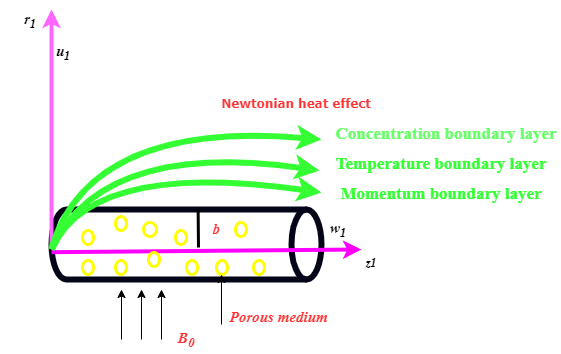
This work examines steady, laminar, axisymmetric flow of an electrically conducting upper-convected Maxwell fluid over a stretching cylinder embedded in a Darcy porous medium, with Joule heating, viscous dissipation and Newtonian (conjugate) wall heating acting together. Similarity transformations reduce the momentum, energy and species equations to coupled nonlinear ordinary differential equations, which are solved with a fourth-order collocation method with residual control (bvp4c). In the limiting case of a flat sheet, the computed skin-friction coefficients agree with five published benchmark solutions to within 0.032%, and tolerance, mesh and domain-length tests confirm convergence. Raising the magnetic parameter from 0.5 to 1.0 increases the skin-friction coefficient by 13.37% and the Nusselt number by 10.61%, but lowers the Sherwood number by 6.73%. Raising the porous-medium parameter $Po$ from 0.3 to 0.5 increases the skin friction by 6.10% and the Nusselt number by 2.41%, and a larger Maxwell (relaxation-time) parameter, from 0.1 to 0.3, gives 3.77% more skin friction and a 2.04% higher Nusselt number; both reduce the Sherwood number. Heat transfer is most sensitive to the wall-heating parameters: the Nusselt number rises by 16.86% when $Ec$ increases from 0.3 to 0.5 and by a factor of about 5.3 when the Newtonian heating parameter increases from 0.1 to 0.3, whereas it varies non-monotonically with $Pr$. Increasing the Schmidt number from 2 to 4 raises the Sherwood number by 52.79%. The magnetic, porous and viscoelastic parameters thicken the thermal and concentration boundary layers, while a larger curvature parameter lowers the wall temperature but thickens the outer part of both layers. The results are relevant to polymer extrusion, wire and fibre coating, heat exchangers, chemical reactors and thermal management of electronic devices.
Graphical Abstract
Keywords
Data Availability Statement
Funding
Conflicts of Interest
AI Use Statement
Ethical Approval and Consent to Participate
References
- Khan, S. A., Khan, M. I., Alsallami, S. A., Alhazmi, S. E., Alharbi, F. M., & El-Zahar, E. R. (2022). Irreversibility analysis in hydromagnetic flow of Newtonian fluid with Joule heating: Darcy-Forchheimer model. Journal of Petroleum Science and Engineering, 212, 110206.
[CrossRef] [Google Scholar] - Sudarmozhi, K., Iranian, D., Khan, I., Ashmaig, M. A. M., & Omer, A. S. (2023). Thermofluid of Maxwellian type past a porous stretching cylinder with heat generation and chemical reaction. International Journal of Thermofluids, 20, 100444.
[CrossRef] [Google Scholar] - Mahanthesh, B., Al‐Kouz, W., Swain, K., & Rout, P. K. (2021). Computational modeling of heat transfer in magneto‐non‐Newtonian material in a circular tube with viscous and Joule heating. Heat Transfer, 50(7), 6703-6718.
[CrossRef] [Google Scholar] - Khedher, N. B., Ullah, Z., Alturki, M., Mirza, C. R., & Eldin, S. M. (2024). Effect of Joule heating and MHD on periodical analysis of current density and amplitude of heat transfer of electrically conducting fluid along thermally magnetized cylinder. Ain Shams Engineering Journal, 15(2), 102374.
[CrossRef] [Google Scholar] - Ahmed, J., Khan, M., & Ahmad, L. (2019). Joule heating effects in thermally radiative swirling flow of Maxwell fluid over a porous rotating disk. International Journal of Thermophysics, 40(12), 106.
[CrossRef] [Google Scholar] - Gangadhar, K., Edukondala Nayak, R., Vinodh Kumar, P., & Chamkha, A. J. (2026). Von Kármán viscous pump of rotating disk in a magnetized Maxwell fluid with Joule heating. Waves in Random and Complex Media, 36(4), 6386-6405.
[CrossRef] [Google Scholar] - Suraiah Palaiah, S., Basha, H., Reddy, G. J., & Sheremet, M. A. (2021). Magnetized dissipative Soret effect on chemically reactive Maxwell fluid over a stretching sheet with Joule heating. Coatings, 11(5), 528.
[CrossRef] [Google Scholar] - Zaidi, Z. A., & Mohyud-Din, S. T. (2017). Effect of joule heating and MHD in the presence of convective boundary condition for upper convected Maxwell fluid through wall jet. Journal of Molecular Liquids, 230, 230-234.
[CrossRef] [Google Scholar] - Ullah, Z., Aldhabani, M. S., & Qaiser, M. A. (2023). Oscillatory and periodical behavior of heat transfer and magnetic flux along magnetic-driven cylinder with viscous dissipation and Joule heating effects. Mathematics, 11(18), 3917.
[CrossRef] [Google Scholar] - Althobaiti, N. (2024). Importance of activation energy on magnetized dissipative Casson-Maxwell fluid through porous medium incorporating chemical reaction, Joule heating, and Soret effects: Numerical study. Journal of Applied Mathematics, 2024(1), 5730530.
[CrossRef] [Google Scholar] - Islam, S., Dawar, A., Shah, Z., & Tariq, A. (2021). Cattaneo–Christov theory for a time-dependent magnetohydrodynamic Maxwell fluid flow through a stretching cylinder. Advances in Mechanical Engineering, 13(7), 16878140211030152.
[CrossRef] [Google Scholar] - Naqvi, S. M. R. S., Muhammad, T., & Asma, M. (2020). Hydromagnetic flow of Casson nanofluid over a porous stretching cylinder with Newtonian heat and mass conditions. Physica A: Statistical Mechanics and its Applications, 550, 123988.
[CrossRef] [Google Scholar] - Murthy, D. V., Babu, P. S., & Srinivasulu, C. (2023). Cattaneo-Christov model for mixed convective radiative flow of Casson fluid with Joule heating in the presence of chemical reaction over a stretching cylinder. JP Journal of Heat and Mass Transfer, 34, 153-181.
[CrossRef] [Google Scholar] - Kada, B., Bilal, S., Pasha, A. A., Waqas, M., Zamri, N., & Formanova, S. B. (2024). Analytical assessment based on radiative-magnetized nanomaterial viscoplastic flow configured by cylindrical regime with Darcy–Forchheimer porosity, Joule heating and chemical reaction. Case Studies in Thermal Engineering, 61, 104960.
[CrossRef] [Google Scholar] - Hayat, T., Rashid, M., Alsaedi, A., & Asghar, S. (2019). Nonlinear convective flow of Maxwell nanofluid past a stretching cylinder with thermal radiation and chemical reaction. Journal of the Brazilian Society of Mechanical Sciences and Engineering, 41(2), 86.
[CrossRef] [Google Scholar] - Megahed, A. M. (2021). Improvement of heat transfer mechanism through a Maxwell fluid flow over a stretching sheet embedded in a porous medium and convectively heated. Mathematics and Computers in Simulation, 187, 97-109.
[CrossRef] [Google Scholar] - Hayat, T., & Qasim, M. (2010). Influence of thermal radiation and Joule heating on MHD flow of a Maxwell fluid in the presence of thermophoresis. International Journal of Heat and Mass Transfer, 53(21-22), 4780-4788.
[CrossRef] [Google Scholar] - Islam, S., Khan, A., Kumam, P., Alrabaiah, H., Shah, Z., Khan, W., ... & Jawad, M. (2020). Radiative mixed convection flow of Maxwell nanofluid over a stretching cylinder with Joule heating and heat source/sink effects. Scientific Reports, 10, 17823.
[CrossRef] [Google Scholar] - Mukhopadhyay, S. (2013). MHD boundary layer slip flow along a stretching cylinder. Ain Shams Engineering Journal, 4(2), 317-324.
[CrossRef] [Google Scholar] - Mishra, A., & Kumar, M. (2020). Velocity and thermal slip effects on MHD nanofluid flow past a stretching cylinder with viscous dissipation and Joule heating. SN Applied Sciences, 2(8), 1350.
[CrossRef] [Google Scholar] - Ramzan, M., Shaheen, N., Chung, J. D., Kadry, S., Chu, Y. M., & Howari, F. (2021). Impact of Newtonian heating and Fourier and Fick’s laws on a magnetohydrodynamic dusty Casson nanofluid flow with variable heat source/sink over a stretching cylinder. Scientific Reports, 11(1), 2357.
[CrossRef] [Google Scholar] - Raj, U., Sagadevan, P., & Alessa, N. (2024). Effect of heat generation on MHD Maxwell fluid flow on a stretching cylinder embedded in a porous medium along with impact of radiation. Journal of King Saud University - Science, 36, 103530.
[CrossRef] [Google Scholar] - Vajravelu, K., Prasad, K. V., & Santhi, S. R. (2012). Axisymmetric magneto-hydrodynamic (MHD) flow and heat transfer at a non-isothermal stretching cylinder. Applied Mathematics and computation, 219(8), 3993-4005.
[CrossRef] [Google Scholar] - Loganathan, K., Alessa, N., Namgyel, N., & Karthik, T. S. (2021). MHD flow of thermally radiative Maxwell fluid past a heated stretching sheet with Cattaneo–Christov dual diffusion. Journal of Mathematics, 2021(1), 5562667.
[CrossRef] [Google Scholar] - Salleh, M. Z., Nazar, R., & Pop, I. (2010). Boundary layer flow and heat transfer over a stretching sheet with Newtonian heating. Journal of the Taiwan Institute of Chemical Engineers, 41(6), 651-655.
[CrossRef] [Google Scholar] - Sadeghy, K., Najafi, A. H., & Saffaripour, M. (2005). Sakiadis flow of an upper-convected Maxwell fluid. International Journal of Non-Linear Mechanics, 40(9), 1220-1228.
[CrossRef] [Google Scholar] - Abbas, A., Jeelani, M. B., & Alharthi, N. H. (2022). Darcy–Forchheimer relation influence on MHD dissipative third-grade fluid flow and heat transfer in porous medium with joule heating effects: A numerical approach. Processes, 10(5), 906.
[CrossRef] [Google Scholar] - Shehzad, S. A., Alsaedi, A., & Hayat, T. (2013). Hydromagnetic steady flow of Maxwell fluid over a bidirectional stretching surface with prescribed surface temperature and prescribed surface heat flux. Plos One, 8(7), e68139.
[CrossRef] [Google Scholar] - Merkin, J. H. (1994). Natural-convection boundary-layer flow on a vertical surface with Newtonian heating. International Journal of Heat and Fluid Flow, 15(5), 392-398.
[CrossRef] [Google Scholar] - Wang, C. Y. (1988). Fluid flow due to a stretching cylinder. The Physics of Fluids, 31(3), 466-468.
[CrossRef] [Google Scholar] - Kierzenka, J., & Shampine, L. F. (2001). A BVP solver based on residual control and the Maltab PSE. ACM Transactions on Mathematical Software (TOMS), 27(3), 299-316.
[CrossRef] [Google Scholar] - Subhas Abel, M., Tawade, J. V., & Nandeppanavar, M. M. (2012). MHD flow and heat transfer for the upper-convected Maxwell fluid over a stretching sheet. Meccanica, 47(2), 385-393.
[CrossRef] [Google Scholar] - Megahed, A. M. (2013). Variable fluid properties and variable heat flux effects on the flow and heat transfer in a non-Newtonian Maxwell fluid over an unsteady stretching sheet with slip velocity. Chinese Physics B, 22(9), 094701.
[CrossRef] [Google Scholar] - Waqas, M., Khan, M. I., Hayat, T., & Alsaedi, A. (2017). Stratified flow of an Oldroyd-B nanoliquid with heat generation. Results in Physics, 7, 2489-2496.
[CrossRef] [Google Scholar] - Irfan, M., Khan, M., & Khan, W. A. (2019). Impact of homogeneous–heterogeneous reactions and non-Fourier heat flux theory in Oldroyd-B fluid with variable conductivity. Journal of the Brazilian Society of Mechanical Sciences and Engineering, 41(3), 135.
[CrossRef] [Google Scholar] - Ahmed, A., Alhowaity, S., Ghoneim, M. E., Gamaoun, F., Tag-eldin, E., Yassen, M. F., & Sarfraz, M. (2022). Material and wave relaxation phenomena effects on the rheology of Maxwell nanofluids. Frontiers in Physics, 10, 1005056.
[CrossRef] [Google Scholar]
Cite This Article
TY  - JOUR
AU  - Sudarmozhi, K.
PY  - 2026
DA  - 2026/10/20
TI  - Magnetohydrodynamic and Thermal Behaviour of Maxwell Fluids over Cylindrical Surfaces in Porous Media with Joule Heating Effects
JO  - International Journal of Thermo-Fluid Systems and Sustainable Energy
T2  - International Journal of Thermo-Fluid Systems and Sustainable Energy
JF  - International Journal of Thermo-Fluid Systems and Sustainable Energy
VL  - 2
IS  - 2
SP  - 117
EP  - 129
DO  - 10.62762/IJTSSE.2026.517065
UR  - https://www.icck.org/article/abs/IJTSSE.2026.517065
KW  - joule heating
KW  - Maxwell fluid
KW  - Newtonian heating
KW  - stretching cylinder
KW  - porous medium
KW  - bvp4c
AB  - This work examines steady, laminar, axisymmetric flow of an electrically conducting upper-convected Maxwell fluid over a stretching cylinder embedded in a Darcy porous medium, with Joule heating, viscous dissipation and Newtonian (conjugate) wall heating acting together. Similarity transformations reduce the momentum, energy and species equations to coupled nonlinear ordinary differential equations, which are solved with a fourth-order collocation method with residual control (bvp4c). In the limiting case of a flat sheet, the computed skin-friction coefficients agree with five published benchmark solutions to within 0.032%, and tolerance, mesh and domain-length tests confirm convergence. Raising the magnetic parameter from 0.5 to 1.0 increases the skin-friction coefficient by 13.37% and the Nusselt number by 10.61%, but lowers the Sherwood number by 6.73%. Raising the porous-medium parameter $Po$ from 0.3 to 0.5 increases the skin friction by 6.10% and the Nusselt number by 2.41%, and a larger Maxwell (relaxation-time) parameter, from 0.1 to 0.3, gives 3.77% more skin friction and a 2.04% higher Nusselt number; both reduce the Sherwood number. Heat transfer is most sensitive to the wall-heating parameters: the Nusselt number rises by 16.86% when $Ec$ increases from 0.3 to 0.5 and by a factor of about 5.3 when the Newtonian heating parameter increases from 0.1 to 0.3, whereas it varies non-monotonically with $Pr$. Increasing the Schmidt number from 2 to 4 raises the Sherwood number by 52.79%. The magnetic, porous and viscoelastic parameters thicken the thermal and concentration boundary layers, while a larger curvature parameter lowers the wall temperature but thickens the outer part of both layers. The results are relevant to polymer extrusion, wire and fibre coating, heat exchangers, chemical reactors and thermal management of electronic devices.
SN  - 3069-1877
PB  - Institute of Central Computation and Knowledge
LA  - English
ER  -
@article{Sudarmozhi2026Magnetohyd,
  author = {K. Sudarmozhi},
  title = {Magnetohydrodynamic and Thermal Behaviour of Maxwell Fluids over Cylindrical Surfaces in Porous Media with Joule Heating Effects},
  journal = {International Journal of Thermo-Fluid Systems and Sustainable Energy},
  year = {2026},
  volume = {2},
  number = {2},
  pages = {117-129},
  doi = {10.62762/IJTSSE.2026.517065},
  url = {https://www.icck.org/article/abs/IJTSSE.2026.517065},
  abstract = {This work examines steady, laminar, axisymmetric flow of an electrically conducting upper-convected Maxwell fluid over a stretching cylinder embedded in a Darcy porous medium, with Joule heating, viscous dissipation and Newtonian (conjugate) wall heating acting together. Similarity transformations reduce the momentum, energy and species equations to coupled nonlinear ordinary differential equations, which are solved with a fourth-order collocation method with residual control (bvp4c). In the limiting case of a flat sheet, the computed skin-friction coefficients agree with five published benchmark solutions to within 0.032\%, and tolerance, mesh and domain-length tests confirm convergence. Raising the magnetic parameter from 0.5 to 1.0 increases the skin-friction coefficient by 13.37\% and the Nusselt number by 10.61\%, but lowers the Sherwood number by 6.73\%. Raising the porous-medium parameter \$Po\$ from 0.3 to 0.5 increases the skin friction by 6.10\% and the Nusselt number by 2.41\%, and a larger Maxwell (relaxation-time) parameter, from 0.1 to 0.3, gives 3.77\% more skin friction and a 2.04\% higher Nusselt number; both reduce the Sherwood number. Heat transfer is most sensitive to the wall-heating parameters: the Nusselt number rises by 16.86\% when \$Ec\$ increases from 0.3 to 0.5 and by a factor of about 5.3 when the Newtonian heating parameter increases from 0.1 to 0.3, whereas it varies non-monotonically with \$Pr\$. Increasing the Schmidt number from 2 to 4 raises the Sherwood number by 52.79\%. The magnetic, porous and viscoelastic parameters thicken the thermal and concentration boundary layers, while a larger curvature parameter lowers the wall temperature but thickens the outer part of both layers. The results are relevant to polymer extrusion, wire and fibre coating, heat exchangers, chemical reactors and thermal management of electronic devices.},
  keywords = {joule heating, Maxwell fluid, Newtonian heating, stretching cylinder, porous medium, bvp4c},
  issn = {3069-1877},
  publisher = {Institute of Central Computation and Knowledge}
}
Article Metrics
Publisher's Note
ICCK stays neutral with regard to jurisdictional claims in published maps and institutional affiliations.
Rights and Permissions
 Copyright © 2026 by the Author(s). Published by Institute of Central Computation and Knowledge. This article is an open access article distributed under the terms and conditions of the Creative Commons Attribution (CC BY) license (https://creativecommons.org/licenses/by/4.0/), which permits use, sharing, adaptation, distribution and reproduction in any medium or format, as long as you give appropriate credit to the original author(s) and the source, provide a link to the Creative Commons licence, and indicate if changes were made.


Portico
