

Effect of Assisted Sintering Temperature on the Structural, Dielectric, and Magnetic Properties of BaK$_{1-x}$Na$_x$Gd$_3$Fe$_5$O$_{15}$ Tetragonal Tungsten Bronze Ceramics




Article Information
Abstract
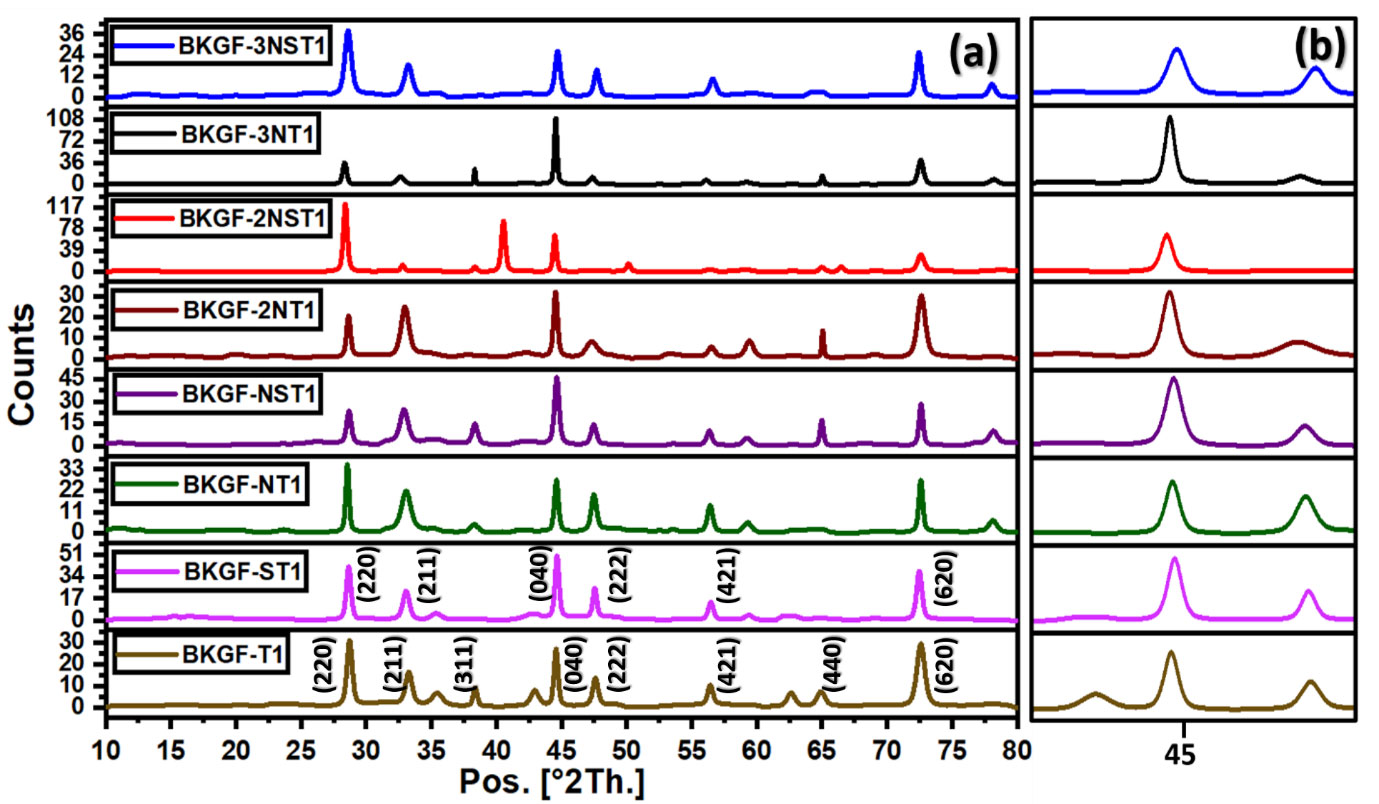
A series of non-stoichiometric BaK$_{1-x}$Na$_x$Gd$_3$Fe$_5$O$_{15}$ ($x = 0.00$, 0.10, 0.20, 0.30) tetragonal tungsten bronze (TTB) ceramics were synthesized via solid-state reaction, cold sintering at 150$^\circ$C, and assisted sintering at 400$^\circ$C and 500$^\circ$C. XRD confirmed single-phase TTB formation. Enhanced crystallinity and sharper diffraction peaks with increasing assisted sintering temperature indicated improved grain growth and ordering. Density measurements revealed Na$^+$ substitution combined with salt-assisted processing significantly influenced densification, with BKGF-1NST$_2$ achieving the highest bulk density of 4.32g/cm$^3$. Dielectric characterization showed frequency-dependent behavior with decreasing loss at higher frequencies, while selected compositions exhibited stable dielectric response after 500$^\circ$C assisted sintering. Magnetic measurements confirmed ferrimagnetic behavior via Fe$^{3+}$-mediated interactions. BKGF-2NT$_2$ ($x = 0.20$, assisted sintered at 500$^\circ$C) delivered optimal magnetic performance: $M_s = 4.97$emug$^{-1}$, $M_r = 1.59$emug$^{-1}$, $H_c = 1435.84$Oe, attributed to optimized exchange interactions, improved crystallinity, and enhanced grain connectivity. Co-doping with cold-assisted sintering governs the structural, dielectric, and magnetic properties of TTB ceramics.
Graphical Abstract
Keywords
Data Availability Statement
Funding
Conflicts of Interest
AI Use Statement
Ethical Approval and Consent to Participate
References
- Khomskii, D. I. (2006). Multiferroics: Different ways to combine magnetism and ferroelectricity. Journal of Magnetism and Magnetic Materials, 306 (1), 1–8.
[CrossRef] [Google Scholar] - Roulland, F., Josse, M., Castel, E., & Maglione, M. (2009). Influence of ceramic process and Eu content on the composite multiferroic properties of the Ba6-2xLn2xFe1+ xNb9-xO30 TTB system. Solid state sciences, 11 (9), 1709-1716.
[CrossRef] [Google Scholar] - Spaldin, N. A., & Fiebig, M. (2005). The renaissance of magnetoelectric multiferroics. Science, 309 (5733), 391-392.
[CrossRef] [Google Scholar] - Fiebig, M. (2005). Revival of the magnetoelectric effect. Journal of physics D: applied physics, 38 (8), R123-R152.
[CrossRef] [Google Scholar] - Josse, M., Bidault, O., Roulland, F., Castel, E., Simon, A., Michau, D., ... & Maglione, M. (2009). The Ba2LnFeNb4O15 "tetragonal tungsten bronze": Towards RT composite multiferroics. Solid state sciences, 11 (6), 1118-1123.
[CrossRef] [Google Scholar] - Schmid, H. (1994). Multi-ferroic magnetoelectrics. Ferroelectrics, 162 (1), 317-338.
[CrossRef] [Google Scholar] - Wang, D. H., Goh, W. C., Ning, M., & Ong, C. K. (2006). Effect of Ba doping on magnetic, ferroelectric, and magnetoelectric properties in mutiferroic BiFeO3 at room temperature. Applied physics letters, 88 (21).
[CrossRef] [Google Scholar] - Aamlid, S. S., Selbach, S. M., & Grande, T. (2019). The effect of cation disorder on ferroelectric properties of SrxBa1-xNb2O6 tungsten bronzes. Materials, 12 (7), 1156.
[CrossRef] [Google Scholar] - Schneck, J., Toledano, J. C., Joffrin, C., Aubree, J., Joukoff, B., & Gabelotaud, A. (1982). Neutron scattering study of the tetragonal-to-incommensurate ferroelastic transition in barium sodium niobate. Physical Review B, 25 (3), 1766.
[CrossRef] [Google Scholar] - Fang, P. H., & Roth, R. S. (1960). Ferroelectric and ferrimagnetic properties of (Ba6- 2xR2x)(Nb9-xFe1+x) O30. Journal of Applied Physics, 31 (5), S278-S278.
[CrossRef] [Google Scholar] - Wang, D., Hussain, F., Khesro, A., Feteira, A., Tian, Y., Zhao, Q., & Reaney, I. M. (2017). Composition and temperature dependence of structure and piezoelectricity in (1-x)(K1-yNay) NbO3‐x (Bi1/2Na1/2) ZrO3 lead‐free ceramics. Journal of the American Ceramic Society, 100 (2), 627-637.
[CrossRef] [Google Scholar] - Han, M., Wang, Y., Tong, Y., Feng, Z., Chao, X., Yang, Z., ... & Wei, L. (2025). Remarkable energy storage performances in tungsten bronze Sr2Ag0. 2Na0. 8Nb5O15-based ceramics through relaxor tuning. Chemical Engineering Journal, 513 , 162844.
[CrossRef] [Google Scholar] - Fan, J., Yang, B., Wei, L., & Wang, Z. (2016). B-cation effect on relaxor behavior and electric properties in Sr2NaNb5-xSbxO15 tungsten bronze ceramics. Ceramics International, 42 (3), 4054-4062.
[CrossRef] [Google Scholar] - Fatima, S. M., Hussain, F., Tabak, Y., Riaz, M. F., Yıldız, İ., Evcin, A., ... & Almuhawish, N. F. (2026). Cold-Sintered K 3 Bi 3-x Na x Mg 2 Fe 5-x Nb x O 15 Tetragonal Tungsten Bronze Ceramics: Structure, Dielectric, and Magnetic Properties. Journal of Alloys and Compounds , 187476.
[CrossRef] [Google Scholar] - Jindal, S., Vasishth, A., Devi, S., Aggarwal, N., & Kushwah, K. K. (2020). Investigation of structural, ferroelectric and magnetic properties of iron doped tungsten bronze multiferroic ceramics. Physica B: Condensed Matter, 595 , 412341.
[CrossRef] [Google Scholar] - Grasso, S., Biesuz, M., Zoli, L., Taveri, G., Duff, A. I., Ke, D., ... & Reece, M. J. (2020). A review of cold sintering processes. Advances in Applied Ceramics, 119 (3), 115-143.
[CrossRef] [Google Scholar] - Ibn-Mohammed, T., Randall, C. A., Mustapha, K. B., Guo, J., Walker, J., Berbano, S., ... & Reaney, I. M. (2019). Decarbonising ceramic manufacturing: A techno-economic analysis of energy efficient sintering technologies in the functional materials sector. Journal of the European ceramic society, 39 (16), 5213-5235.
[CrossRef] [Google Scholar] - Faouri, S. S., Mostaed, A., Dean, J. S., Wang, D., Sinclair, D. C., Zhang, S., ... & Reaney, I. M. (2019). High quality factor cold sintered Li2MoO4BaFe12O19 composites for microwave applications. Acta Materialia, 166 , 202-207.
[CrossRef] [Google Scholar] - Guo, J., Floyd, R., Lowum, S., Maria, J. P., Herisson de Beauvoir, T., Seo, J. H., & Randall, C. A. (2019). Cold sintering: progress, challenges, and future opportunities. Annual Review of Materials Research, 49 (1), 275-295.
[CrossRef] [Google Scholar] - Heidary, D. S. B., Lanagan, M., & Randall, C. A. (2018). Contrasting energy efficiency in various ceramic sintering processes. Journal of the European Ceramic Society, 38 (4), 1018-1029.
[CrossRef] [Google Scholar] - Lan, J. J., Chen, X. M., Liu, L. N., Lian, H. L., He, Y. R., Song, Y. C., ... & Liu, P. (2023). Low-temperature synthesis of K0. 5Na0. 5NbO3 ceramics in a wide temperature window via cold-sintering assisted sintering method and enhanced electrical properties. Journal of the European Ceramic Society, 43 (1), 73-81.
[CrossRef] [Google Scholar] - Zubairi, H., Hussain, F., Sheikh, S., Shaikh, A. A., Wang, D., & Reaney, I. M. (2023). Comparative study of cold assisted and conventional sintering of (1-2x) K0. 5Na0. 5NbO3-xBaTiO3-xBiFeO3 multiferroic ceramics. Materials Science and Engineering: B, 296 , 116632.
[CrossRef] [Google Scholar] - Cong, L., Huajing, W., Jianzhang, M., Baoyu, D., Xiao, W., Tengfei, L., ... & Xing, Y. (2020). Effect of dwell time on cold sintering assisted sintering based highly transparent 0.9 K0. 5Na0. 5NbO3-0.1 LiBiO3 ceramics. Journal of Alloys and Compounds, 826 , 154249.
[CrossRef] [Google Scholar] - Ma, J., Li, H., Wang, H., Lin, C., Wu, X., Lin, T., ... & Yu, X. (2019). Composition, microstructure and electrical properties of K0. 5Na0. 5NbO3 ceramics fabricated by cold sintering assisted sintering. Journal of the European Ceramic Society, 39 (4), 986-993.
[CrossRef] [Google Scholar] - Bartoletti, A., Mercadelli, E., Gondolini, A., & Sanson, A. (2024). Exploring the potential of cold sintering for proton-conducting ceramics: A review. Materials, 17 (20), 5116.
[CrossRef] [Google Scholar] - Jamieson, P. B., Abrahams, S. C., & Bernstein, J. L. (1969). Ferroelectric tungsten bronze‐type crystal structures. II. Barium sodium niobate Ba (4+x) Na (2-2x) Nb10O30. The Journal of Chemical Physics, 50 (10), 4352-4363.
[CrossRef] [Google Scholar] - Grendal, O. G., Evans, D. M., & Aamlid, S. S. (2023). Revisiting the structures and phase transitions of Ba2NaNb5O15. Applied Crystallography, 56 (5), 1456-1465.
[CrossRef] [Google Scholar] - Peirson, H., Pan, J., Li, Y., Hall, D. A., Brown, A. P., Drummond-Brydson, R. M., & Milne, S. J. (2023). Structure and dielectric properties of yttrium-doped Ca0. 28Ba0. 72Nb2O6 ceramics. Journal of Alloys and Compounds, 950 , 169891.
[CrossRef] [Google Scholar] - Gardner, J., & Morrison, F. D. (2014). A-site size effect in a family of unfilled ferroelectric tetragonal tungsten bronzes: Ba4R0. 67Nb10O30 (R= La, Nd, Sm, Gd, Dy and Y). Dalton transactions, 43 (30), 11687-11695.
[CrossRef] [Google Scholar] - Rahaman, M. N. (2017). Ceramic processing and sintering . CRC press.
[CrossRef] [Google Scholar] - Bendahhou, A., Jalafi, I., Chaou, F., Barkany, S. E., Bahari, Z., & Abou-Salama, M. (2023). Effect of sodium substitution by yttrium on the structural, dielectric and electrical properties of Ba2Na (1-3x) YxNb5O15 ceramics. Heliyon, 9 (11).
[CrossRef] [Google Scholar] - Li, R., Pu, Y., Zhang, Q., Wang, W., Li, J., Du, X., ... & Sun, Z. (2020). The relationship between enhanced dielectric property and structural distortion in Ca doped Ba2NaNb5O15 tungsten bronze ceramics. Journal of the European Ceramic Society, 40 (13), 4509-4516.
[CrossRef] [Google Scholar] - Miller, A. J., Rotaru, A., Arnold, D. C., & Morrison, F. D. (2015). Effect of local A-site strain on dipole stability in A6GaNb9O30 (A= Ba, Sr, Ca) tetragonal tungsten bronze relaxor dielectrics. Dalton Transactions, 44 (23), 10738-10745.
[CrossRef] [Google Scholar] - Zhang, X., Yan, H., & Reece, M. J. (2008). Effect of A site substitution on the properties of CaBi2Nb2O9 ferroelectric ceramics. Journal of the American Ceramic Society, 91 (9), 2928-2932.
[CrossRef] [Google Scholar] - Rahaman, M. N. (2017). Ceramic Processing . CRC Press.
[CrossRef] [Google Scholar] - Koops, C. G. (1951). On the Dispersion of Resistivity and Dielectric Constant of Some Semiconductors at Audiofrequencies. Physical Review, 83 (1), 121–124.
[CrossRef] [Google Scholar] - Mandve, D. N., & Waghule, N. N. (2026). Structural, Dielectric, Magnetic, and Magnetoelectric Properties of Lead-Free BCZT–CZFO Composite Ceramics. Journal of Superconductivity and Novel Magnetism, 39 (4), 117.
[CrossRef] [Google Scholar] - Ali, A., Safeen, K., Alrefaee, S. H., Alhodaib, A., Safeen, A., Saydaxmetova, S., ... & Zaman, A. (2025). Studies of structural, optical, magnetic and dielectric properties of Sr0. 7Bi0. 2 (Ti1-xZrx) O3 0.0$\leq$ x $\leq$ 0.6 ceramics for wireless application. Electrochemistry Communications, 176 , 107962.
[CrossRef] [Google Scholar] - Givord, D. (2001). Introduction to Magnetism and Magnetic Materials. In Magnetism and Synchrotron Radiation (pp. 3–23). Springer.
[CrossRef] [Google Scholar] - El-Hilo, M., Pfeiffer, H., O'grady, K., Schüppel, W., Sinn, E., Görnert, P., ... & Chantrell, R. W. (1994). Magnetic properties of barium hexaferrite powders. Journal of magnetism and magnetic materials, 129 (2-3), 339-347.
[CrossRef] [Google Scholar] - FRS, E. C. S. (1947). Ferromagnetism. Reports on Progress in Physics, 11 (1), 43-112.
[CrossRef] [Google Scholar] - Shah, W. H., Safeen, K., & Rehman, G. (2012). Effects of divalent alkaline earth ions on the magnetic and transport features of La0. 65A0. 35Mn0. 95Fe0. 05O3 (A= Ca, Sr, Pb, Ba) compounds. Current Applied Physics, 12 (3), 742-747.
[CrossRef] [Google Scholar]
Cite This Article
TY  - JOUR
AU  - Fatima, Syeda Mahnoor
AU  - Hussain, Fayaz
AU  - Nadeem, Shehreen
AU  - Riaz, Muhammad Fahad
AU  - Sheikh, Sajida
AU  - Tabak, Yasemin
AU  - Evcin, Atilla
PY  - 2026
DA  - 2026/08/19
TI  - Effect of Assisted Sintering Temperature on the Structural, Dielectric, and Magnetic Properties of BaK$_{1-x}$Na$_x$Gd$_3$Fe$_5$O$_{15}$ Tetragonal Tungsten Bronze Ceramics
JO  - Journal of Advanced Electronic Materials
T2  - Journal of Advanced Electronic Materials
JF  - Journal of Advanced Electronic Materials
VL  - 2
IS  - 3
SP  - 101
EP  - 112
DO  - 10.62762/JAEM.2026.128242
UR  - https://www.icck.org/article/abs/JAEM.2026.128242
KW  - tetragonal tungsten bronze
KW  - cold-assisted sintering
KW  - magnetic property
KW  - dielectric
KW  - particle size
AB  - A series of non-stoichiometric BaK$_{1-x}$Na$_x$Gd$_3$Fe$_5$O$_{15}$ ($x = 0.00$, 0.10, 0.20, 0.30) tetragonal tungsten bronze (TTB) ceramics were synthesized via solid-state reaction, cold sintering at 150$^\circ$C, and assisted sintering at 400$^\circ$C and 500$^\circ$C. XRD confirmed single-phase TTB formation. Enhanced crystallinity and sharper diffraction peaks with increasing assisted sintering temperature indicated improved grain growth and ordering. Density measurements revealed Na$^+$ substitution combined with salt-assisted processing significantly influenced densification, with BKGF-1NST$_2$ achieving the highest bulk density of 4.32g/cm$^3$. Dielectric characterization showed frequency-dependent behavior with decreasing loss at higher frequencies, while selected compositions exhibited stable dielectric response after 500$^\circ$C assisted sintering. Magnetic measurements confirmed ferrimagnetic behavior via Fe$^{3+}$-mediated interactions. BKGF-2NT$_2$ ($x = 0.20$, assisted sintered at 500$^\circ$C) delivered optimal magnetic performance: $M_s = 4.97$emug$^{-1}$, $M_r = 1.59$emug$^{-1}$, $H_c = 1435.84$Oe, attributed to optimized exchange interactions, improved crystallinity, and enhanced grain connectivity. Co-doping with cold-assisted sintering governs the structural, dielectric, and magnetic properties of TTB ceramics.
SN  - 3070-5649
PB  - Institute of Central Computation and Knowledge
LA  - English
ER  -
@article{Fatima2026Effect,
  author = {Syeda Mahnoor Fatima and Fayaz Hussain and Shehreen Nadeem and Muhammad Fahad Riaz and Sajida Sheikh and Yasemin Tabak and Atilla Evcin},
  title = {Effect of Assisted Sintering Temperature on the Structural, Dielectric, and Magnetic Properties of BaK\$\_{1-x}\$Na\$\_x\$Gd\$\_3\$Fe\$\_5\$O\$\_{15}\$ Tetragonal Tungsten Bronze Ceramics},
  journal = {Journal of Advanced Electronic Materials},
  year = {2026},
  volume = {2},
  number = {3},
  pages = {101-112},
  doi = {10.62762/JAEM.2026.128242},
  url = {https://www.icck.org/article/abs/JAEM.2026.128242},
  abstract = {A series of non-stoichiometric BaK\$\_{1-x}\$Na\$\_x\$Gd\$\_3\$Fe\$\_5\$O\$\_{15}\$ (\$x = 0.00\$, 0.10, 0.20, 0.30) tetragonal tungsten bronze (TTB) ceramics were synthesized via solid-state reaction, cold sintering at 150\$^\circ\$C, and assisted sintering at 400\$^\circ\$C and 500\$^\circ\$C. XRD confirmed single-phase TTB formation. Enhanced crystallinity and sharper diffraction peaks with increasing assisted sintering temperature indicated improved grain growth and ordering. Density measurements revealed Na\$^+\$ substitution combined with salt-assisted processing significantly influenced densification, with BKGF-1NST\$\_2\$ achieving the highest bulk density of 4.32g/cm\$^3\$. Dielectric characterization showed frequency-dependent behavior with decreasing loss at higher frequencies, while selected compositions exhibited stable dielectric response after 500\$^\circ\$C assisted sintering. Magnetic measurements confirmed ferrimagnetic behavior via Fe\$^{3+}\$-mediated interactions. BKGF-2NT\$\_2\$ (\$x = 0.20\$, assisted sintered at 500\$^\circ\$C) delivered optimal magnetic performance: \$M\_s = 4.97\$emug\$^{-1}\$, \$M\_r = 1.59\$emug\$^{-1}\$, \$H\_c = 1435.84\$Oe, attributed to optimized exchange interactions, improved crystallinity, and enhanced grain connectivity. Co-doping with cold-assisted sintering governs the structural, dielectric, and magnetic properties of TTB ceramics.},
  keywords = {tetragonal tungsten bronze, cold-assisted sintering, magnetic property, dielectric, particle size},
  issn = {3070-5649},
  publisher = {Institute of Central Computation and Knowledge}
}
Article Metrics
Publisher's Note
ICCK stays neutral with regard to jurisdictional claims in published maps and institutional affiliations.
Rights and Permissions
 Copyright © 2026 by the Author(s). Published by Institute of Central Computation and Knowledge. This article is an open access article distributed under the terms and conditions of the Creative Commons Attribution (CC BY) license (https://creativecommons.org/licenses/by/4.0/), which permits use, sharing, adaptation, distribution and reproduction in any medium or format, as long as you give appropriate credit to the original author(s) and the source, provide a link to the Creative Commons licence, and indicate if changes were made.


Portico
