

Deep Learning-Based Segmentation, Action, and Phase Recognition in Laparoscopic Cholecystectomy: A Review



Article Information
Abstract
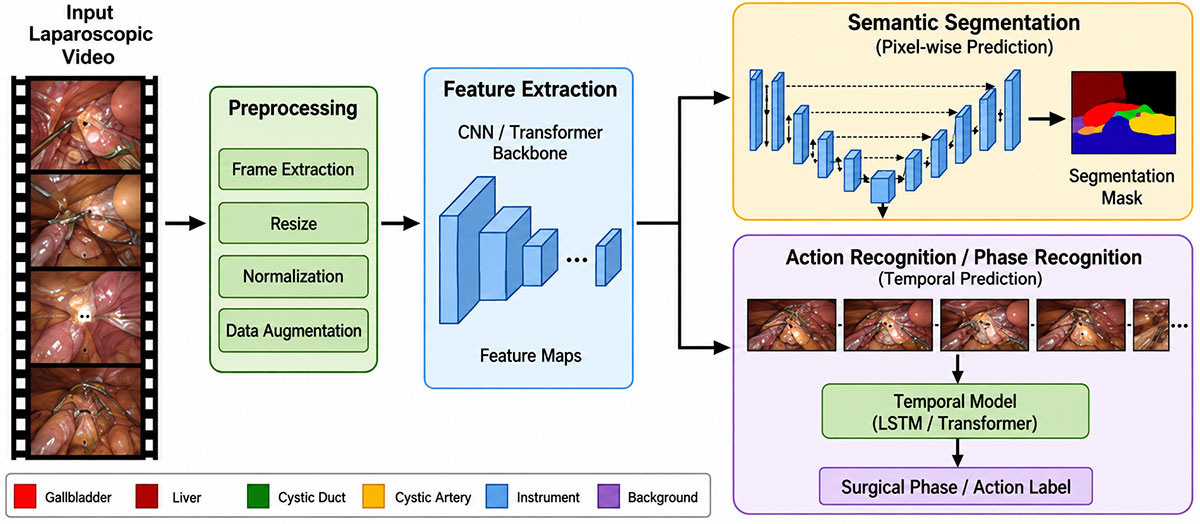
The integration of artificial intelligence into biomedical image analysis represents a paradigm shift in clinical decision support and surgical informatics. Laparoscopic cholecystectomy (LC) is a widely performed minimally invasive procedure but remains technically challenging due to limited visibility, anatomical variations, and the risk of complications such as bile duct injury. Artificial intelligence (AI), particularly deep learning (DL), has shown great potential for improving intraoperative understanding through automated surgical video analysis. This review summarizes recent advances in DL-based LC video analysis, focusing on semantic segmentation and surgical action or phase recognition. Existing approaches are categorized into convolutional neural networks (CNNs), transformer-based architectures, and hybrid spatio-temporal models. For segmentation, U-Net variants, DeepLab architectures, and vision transformers are reviewed for identifying anatomical structures and surgical instruments. For action and phase recognition, CNN-LSTM frameworks, 3D CNNs, and video transformers are discussed for modeling surgical workflows and temporal dependencies. We also summarize commonly used datasets, including Cholec80 and CholecSeg8k, and evaluation metrics such as Dice score, IoU, accuracy, and F1-score. Major challenges include data scarcity, inter-surgeon variability, domain shift, and real-time computational constraints. Future research should emphasize self-supervised learning, multi-modal fusion, and clinically explainable AI to improve robustness, generalizability, and real-world surgical deployment.
Graphical Abstract
Keywords
Data Availability Statement
Funding
Conflicts of Interest
AI Use Statement
Ethical Approval and Consent to Participate
References
- Fernicola, A., Palomba, G., Capuano, M., De Palma, G. D., & Aprea, G. (2024). Artificial intelligence applied to laparoscopic cholecystectomy: what is the next step? A narrative review. Updates in Surgery, 76(5), 1655-1667.
[CrossRef] [Google Scholar] - Liao, W., Zhu, Y., Zhang, H., Wang, D., Zhang, L., Chen, T., ... & Ye, Z. (2025). Artificial intelligence-assisted phase recognition and skill assessment in laparoscopic surgery: a systematic review. Frontiers in Surgery, 12, 1551838.
[CrossRef] [Google Scholar] - Zhou, R., Wang, D., Zhang, H., Zhu, Y., Zhang, L., Chen, T., ... & Ye, Z. (2025). Vision techniques for anatomical structures in laparoscopic surgery: a comprehensive review. Frontiers in Surgery, 12, 1557153.
[CrossRef] [Google Scholar] - Corallino, D., Balla, A., Coletta, D., Pacella, D., Podda, M., Pronio, A., ... & Aldrighetti, L. (2025). Systematic review on the use of artificial intelligence to identify anatomical structures during laparoscopic cholecystectomy: a tool towards the future. Langenbeck's archives of surgery, 410(1), 101.
[CrossRef] [Google Scholar] - Gammulle, H., Chen, Y., Sridharan, S., Klein, T., & Fookes, C. (2023). Learning through guidance: knowledge distillation for endoscopic image classification. arXiv preprint arXiv:2308.08731.
[CrossRef] [Google Scholar] - Anteby, R., Horesh, N., Soffer, S., Zager, Y., Barash, Y., Amiel, I., ... & Klang, E. (2021). Deep learning visual analysis in laparoscopic surgery: a systematic review and diagnostic test accuracy meta-analysis. Surgical endoscopy, 35(4), 1521-1533.
[CrossRef] [Google Scholar] - Yousef, M., Aly, K. E., Ahmed, M., Ahmed, F. A., Al Jalham, K., & Balakrishnan, S. (2026). Bibliometric analysis of deep learning for surgical instrument segmentation, detection and tracking in minimally invasive surgery. Frontiers in Digital Health, 8, 1633888.
[CrossRef] [Google Scholar] - Maier-Hein, L., Vedula, S. S., Speidel, S., Navab, N., Kikinis, R., Park, A., ... & Jannin, P. (2017). Surgical data science for next-generation interventions. Nature Biomedical Engineering, 1(9), 691-696.
[CrossRef] [Google Scholar] - Levendovics, R., Levendovics, T., Kronreif, G., & Haidegger, T. (2024). Surgical data science: Emerging trends and future pathways. Recent Advances in Intelligent Engineering: Volume Dedicated to Imre J. Rudas’ Seventy-Fifth Birthday, 65-84.
[CrossRef] [Google Scholar] - Twinanda, A. P., Shehata, S., Mutter, D., Marescaux, J., De Mathelin, M., & Padoy, N. (2016). Endonet: a deep architecture for recognition tasks on laparoscopic videos. IEEE transactions on medical imaging, 36(1), 86-97.
[CrossRef] [Google Scholar] - Mascagni, P., Alapatt, D., Sestini, L., Altieri, M. S., Madani, A., Watanabe, Y., ... & Hashimoto, D. A. (2022). Computer vision in surgery: from potential to clinical value. npj Digital Medicine, 5(1), 163.
[CrossRef] [Google Scholar] - Pescio, M., Marzola, F., Distefano, G., Leoncini, P., Ammirati, C. A., Barontini, F., ... & Arezzo, A. (2026). Artificial intelligence in minimally invasive and robotic gastrointestinal surgery: Major applications and recent advances. Journal of Personalized Medicine, 16(2), 71.
[CrossRef] [Google Scholar] - Kitaguchi, D., Takeshita, N., Hasegawa, H., & Ito, M. (2022). Artificial intelligence‐based computer vision in surgery: Recent advances and future perspectives. Annals of gastroenterological surgery, 6(1), 29-36.
[CrossRef] [Google Scholar] - Wagner, M., Müller-Stich, B. P., Kisilenko, A., Tran, D., Heger, P., Mündermann, L., ... & Bodenstedt, S. (2023). Comparative validation of machine learning algorithms for surgical workflow and skill analysis with the HeiChole benchmark. Medical image analysis, 86, 102770.
[CrossRef] [Google Scholar] - Jin, Y., Li, H., Dou, Q., Chen, H., Qin, J., Fu, C. W., & Heng, P. A. (2020). Multi-task recurrent convolutional network with correlation loss for surgical video analysis. Medical image analysis, 59, 101572.
[CrossRef] [Google Scholar] - Demir, K. C., Schieber, H., Weise, T., Roth, D., May, M., Maier, A., & Yang, S. H. (2023). Deep learning in surgical workflow analysis: a review of phase and step recognition. IEEE Journal of Biomedical and Health Informatics, 27(11), 5405-5417.
[CrossRef] [Google Scholar] - Ali, S. (2022). Where do we stand in AI for endoscopic image analysis? Deciphering gaps and future directions. npj Digital Medicine, 5(1), 184.
[CrossRef] [Google Scholar] - Garrow, C. R., Kowalewski, K. F., Li, L., Wagner, M., Schmidt, M. W., Engelhardt, S., ... & Nickel, F. (2021). Machine learning for surgical phase recognition: a systematic review. Annals of surgery, 273(4), 684-693.
[CrossRef] [Google Scholar] - Hegde, S. R., Namazi, B., Iyengar, N., Cao, S., Desir, A., Marques, C., ... & Sankaranarayanan, G. (2024). Automated segmentation of phases, steps, and tasks in laparoscopic cholecystectomy using deep learning. Surgical endoscopy, 38(1), 158-170.
[CrossRef] [Google Scholar] - Siddique, N., Paheding, S., Elkin, C. P., & Devabhaktuni, V. (2021). U-net and its variants for medical image segmentation: A review of theory and applications. IEEE access, 9, 82031-82057.
[CrossRef] [Google Scholar] - Limon, D., Satish, V., Raghavan, N., Nguyen, P., & Rajesh, A. (2026). Artificial intelligence in surgery revisited: a 2025 guide to understanding and applying AI models in clinical practice. The American Surgeon™, 92(3), 687-697.
[CrossRef] [Google Scholar] - Hussain, S. M., Brunetti, A., Lucarelli, G., Memeo, R., Bevilacqua, V., & Buongiorno, D. (2022). Deep learning based image processing for robot assisted surgery: a systematic literature survey. IEEE Access, 10, 122627-122657.
[CrossRef] [Google Scholar] - Dick, L., Boyle, C. P., Skipworth, R. J., Smink, D. S., Tallentire, V. R., & Yule, S. (2024). Automated analysis of operative video in surgical training: scoping review. BJS open, 8(5), zrae124.
[CrossRef] [Google Scholar] - Li, Y., Zhao, Z., Li, R., & Li, F. (2024). Deep learning for surgical workflow analysis: a survey of progresses, limitations, and trends. Artificial Intelligence Review, 57(11), 291.
[CrossRef] [Google Scholar] - Tokuyasu, T., Iwashita, Y., Matsunobu, Y., Kamiyama, T., Ishikake, M., Sakaguchi, S., ... & Inomata, M. (2021). Development of an artificial intelligence system using deep learning to indicate anatomical landmarks during laparoscopic cholecystectomy. Surgical endoscopy, 35(4), 1651-1658.
[CrossRef] [Google Scholar] - King, A., Fowler, G. E., Macefield, R. C., Walker, H., Thomas, C., Markar, S., ... & Blencowe, N. S. (2025). Use of artificial intelligence in the analysis of digital videos of invasive surgical procedures: scoping review. BJS open, 9(4), zraf073.
[CrossRef] [Google Scholar] - Oktay, O., Schlemper, J., Folgoc, L. L., Lee, M., Heinrich, M., Misawa, K., ... & Rueckert, D. (2018). Attention u-net: Learning where to look for the pancreas. arXiv preprint arXiv:1804.03999.
[CrossRef] [Google Scholar] - Zhou, Z., Siddiquee, M. M. R., Tajbakhsh, N., & Liang, J. (2018). UNet++: A nested U-Net architecture for medical image segmentation. In Deep Learning in Medical Image Analysis and Multimodal Learning for Clinical Decision Support (pp. 3–11). Springer, Cham.
[CrossRef] [Google Scholar] - Grammatikopoulou, M., Sanchez-Matilla, R., Bragman, F., Owen, D., Culshaw, L., Kerr, K., Stoyanov, D., & Luengo, I. (2024). A spatio-temporal network for video semantic segmentation in surgical videos. International Journal of Computer Assisted Radiology and Surgery, 19(2), 375–382.
[CrossRef] [Google Scholar] - Bravo, A., Razzaq, S., Murari, M., Ahuja, A., Birchett, D., & Schumacher, L. (2026). Transformers in surgical artificial intelligence: A domain-stratified, study-level narrative review. JTCVS open, 101597.
[CrossRef] [Google Scholar] - Kolbinger, F. R., Rinner, F. M., Jenke, A. C., Carstens, M., Krell, S., Leger, S., Distler, M., Weitz, J., Speidel, S., & Bodenstedt, S. (2023). Anatomy segmentation in laparoscopic surgery: comparison of machine learning and human expertise – an experimental study. International Journal of Surgery, 109(10), 2962–2974.
[CrossRef] [Google Scholar] - El Boghdady, M., Temori, S., Khaireldin, D., Ewalds-Kvist, B., Ghazanfar, M. A., & Aroori, S. (2025). The role of artificial intelligence in enhancing safety assessment of laparoscopic cholecystectomy: a systematic review. HPB.
[CrossRef] [Google Scholar] - Czempiel, T., Paschali, M., Ostler, D., Kim, S. T., Busam, B., & Navab, N. (2021, September). Opera: Attention-regularized transformers for surgical phase recognition. In International conference on medical image computing and computer-assisted intervention (pp. 604-614). Cham: Springer International Publishing.
[CrossRef] [Google Scholar] - Eppler, M. B., Sayegh, A. S., Maas, M., Venkat, A., Hemal, S., Desai, M. M., ... & Goldenberg, M. G. (2023). Automated capture of intraoperative adverse events using artificial intelligence: a systematic review and meta-analysis. Journal of Clinical Medicine, 12(4), 1687.
[CrossRef] [Google Scholar] - Gao, X., Jin, Y., Long, Y., Dou, Q., & Heng, P. A. (2021, September). Trans-svnet: Accurate phase recognition from surgical videos via hybrid embedding aggregation transformer. In International conference on medical image computing and computer-assisted intervention (pp. 593-603). Cham: Springer International Publishing.
[CrossRef] [Google Scholar] - Ronneberger, O., Fischer, P., & Brox, T. (2015, October). U-net: Convolutional networks for biomedical image segmentation. In International Conference on Medical image computing and computer-assisted intervention (pp. 234-241). Cham: Springer international publishing.
[CrossRef] [Google Scholar] - Alom, M. Z., Yakopcic, C., Hasan, M., Taha, T. M., & Asari, V. K. (2019). Recurrent residual U-Net for medical image segmentation. Journal of medical imaging, 6(1), 014006-014006.
[CrossRef] [Google Scholar] - Chen, L. C., Zhu, Y., Papandreou, G., Schroff, F., & Adam, H. (2018, September). Encoder-decoder with atrous separable convolution for semantic image segmentation. In European conference on computer vision (pp. 833-851). Cham: Springer International Publishing.
[CrossRef] [Google Scholar] - Liu, Z., Lin, Y., Cao, Y., Hu, H., Wei, Y., Zhang, Z., ... & Guo, B. (2021, October). Swin transformer: Hierarchical vision transformer using shifted windows. In 2021 IEEE/CVF international conference on computer vision (ICCV) (pp. 9992-10002). IEEE.
[CrossRef] [Google Scholar] - Madani, A., Namazi, B., Altieri, M. S., Hashimoto, D. A., Rivera, A. M., Pucher, P. H., ... & Alseidi, A. (2020). Artificial intelligence for intraoperative guidance: using semantic segmentation to identify surgical anatomy during laparoscopic cholecystectomy. Annals of surgery, 276(2), 363.
[CrossRef] [Google Scholar] - Silva, B., Oliveira, B., Morais, P., Buschle, L. R., Correia-Pinto, J., Lima, E., & Vilaca, J. L. (2022). Analysis of current deep learning networks for semantic segmentation of anatomical structures in laparoscopic surgery. In 2022 44th Annual International Conference of the IEEE Engineering in Medicine & Biology Society (EMBC) (pp. 3502-3505). IEEE.
[CrossRef] [Google Scholar] - Khan, U., Nawaz, U., Qayyum, A., Baig, I., Alam, M., Ashraf, S., ... & Qadir, J. (2026). Surgical scene understanding in the era of foundation AI models: A comprehensive review. IEEE Access, 14, 137034-137089.
[CrossRef] [Google Scholar] - Bian, G. B., Peng, Y., Zhang, L., Li, J., & Li, Z. (2024, June). Algorithms in surgical action recognition: A survey. In 2024 IEEE International Conference on Real-time Computing and Robotics (RCAR) (pp. 366-371). IEEE.
[CrossRef] [Google Scholar] - Padoy, N. (2019). Machine and deep learning for workflow recognition during surgery. Minimally Invasive Therapy & Allied Technologies, 28(2), 82-90.
[CrossRef] [Google Scholar] - Guo, K., Tao, H., Zhu, Y., Li, B., Fang, C., Qian, Y., & Yang, J. (2023). Current applications of artificial intelligence-based computer vision in laparoscopic surgery. Laparoscopic, Endoscopic and Robotic Surgery, 6(3), 91-96.
[CrossRef] [Google Scholar] - Nwoye, C. I., Yu, T., Gonzalez, C., Seeliger, B., Mascagni, P., Mutter, D., ... & Padoy, N. (2022). Rendezvous: Attention mechanisms for the recognition of surgical action triplets in endoscopic videos. Medical Image Analysis, 78, 102433.
[CrossRef] [Google Scholar] - Batić, D., Holm, F., Özsoy, E., Czempiel, T., & Navab, N. (2024). EndoViT: pretraining vision transformers on a large collection of endoscopic images. International Journal of Computer Assisted Radiology and Surgery, 19(6), 1085-1091.
[CrossRef] [Google Scholar] - Liu, Y., Boels, M., Garcia-Peraza-Herrera, L. C., Vercauteren, T., Dasgupta, P., Granados, A., & Ourselin, S. (2025). LoViT: Long video transformer for surgical phase recognition. Medical Image Analysis, 99, 103366.
[CrossRef] [Google Scholar] - Chadebecq, F., Lovat, L. B., & Stoyanov, D. (2023). Artificial intelligence and automation in endoscopy and surgery. Nature Reviews Gastroenterology & Hepatology, 20(3), 171-182.
[CrossRef] [Google Scholar] - Rivas-Blanco, I., Perez-Del-Pulgar, C. J., Garcia-Morales, I., & Munoz, V. F. (2021). A review on deep learning in minimally invasive surgery. IEEE Access, 9, 48658-48678.
[CrossRef] [Google Scholar] - Jin, Y., Long, Y., Chen, C., Zhao, Z., Dou, Q., & Heng, P. A. (2021). Temporal memory relation network for workflow recognition from surgical video. IEEE Transactions on Medical Imaging, 40(7), 1911-1923.
[CrossRef] [Google Scholar] - Kadkhodamohammadi, A., Luengo, I., & Stoyanov, D. (2022). PATG: position-aware temporal graph networks for surgical phase recognition on laparoscopic videos. International Journal of Computer Assisted Radiology and Surgery, 17(5), 849-856.
[CrossRef] [Google Scholar] - Funke, I., Bodenstedt, S., Oehme, F., von Bechtolsheim, F., Weitz, J., & Speidel, S. (2019, October). Using 3D convolutional neural networks to learn spatiotemporal features for automatic surgical gesture recognition in video. In International conference on medical image computing and computer-assisted intervention (pp. 467-475). Cham: Springer International Publishing.
[CrossRef] [Google Scholar] - Seenivasan, L., Mitheran, S., Islam, M., & Ren, H. (2022). Global-reasoned multi-task learning model for surgical scene understanding. IEEE Robotics and Automation Letters, 7(2), 3858-3865.
[CrossRef] [Google Scholar] - Jin, Y., Dou, Q., Chen, H., Yu, L., Qin, J., Fu, C. W., & Heng, P. A. (2017). SV-RCNet: workflow recognition from surgical videos using recurrent convolutional network. IEEE transactions on medical imaging, 37(5), 1114-1126.
[CrossRef] [Google Scholar] - Yang, Z., Wen, J., Huang, D., Yang, A., Zhang, R., Ren, B., ... & Qin, N. (2025). Efficient segmentation of intraoperative anatomical landmarks in laparoscopic cholecystectomy based on deep learning. Computer Methods and Programs in Biomedicine, 109012.
[CrossRef] [Google Scholar] - Leifman, G., Golany, T., Rivlin, E., Khoury, W., Assalia, A., & Reissman, P. (2024). Real-time artificial intelligence validation of critical view of safety in laparoscopic cholecystectomy. Intelligence-Based Medicine, 10, 100153.
[CrossRef] [Google Scholar] - Murali, A., Alapatt, D., Mascagni, P., Vardazaryan, A., Garcia, A., Okamoto, N., ... & Padoy, N. (2023). The endoscapes dataset for surgical scene segmentation, object detection, and critical view of safety assessment: Official splits and benchmark. Scientific Data, 12.
[CrossRef] [Google Scholar] - Hong, W. Y., Kao, C. L., Kuo, Y. H., Wang, J. R., Chang, W. L., & Shih, C. S. (2020). Cholecseg8k: a semantic segmentation dataset for laparoscopic cholecystectomy based on cholec80. arXiv preprint arXiv:2012.12453.
[CrossRef] [Google Scholar] - Alabi, O., Toe, K. K. Z., Zhou, Z., Budd, C., Raison, N., Shi, M., & Vercauteren, T. (2025). Cholecinstanceseg: A tool instance segmentation dataset for laparoscopic surgery. Scientific Data, 12(1), 825.
[CrossRef] [Google Scholar] - Allan, M., Kondo, S., Bodenstedt, S., Leger, S., Kadkhodamohammadi, R., Luengo, I., ... & Speidel, S. (2020). 2018 robotic scene segmentation challenge. arXiv preprint arXiv:2001.11190.
[CrossRef] [Google Scholar] - Taha, A. A., & Hanbury, A. (2015). Metrics for evaluating 3D medical image segmentation: analysis, selection, and tool. BMC medical imaging, 15(1), 29.
[CrossRef] [Google Scholar] - Czempiel, T., Paschali, M., Keicher, M., Simson, W., Feussner, H., Kim, S. T., & Navab, N. (2020, September). Tecno: Surgical phase recognition with multi-stage temporal convolutional networks. In International conference on medical image computing and computer-assisted intervention (pp. 343-352). Cham: Springer International Publishing.
[CrossRef] [Google Scholar] - Ramesh, S., Srivastav, V., Alapatt, D., Yu, T., Murali, A., Sestini, L., ... & Padoy, N. (2023). Dissecting self-supervised learning methods for surgical computer vision. Medical Image Analysis, 88, 102844.
[CrossRef] [Google Scholar] - Özsoy, E., Örnek, E. P., Eck, U., Czempiel, T., Tombari, F., & Navab, N. (2022, September). 4d-or: Semantic scene graphs for or domain modeling. In International conference on medical image computing and computer-assisted intervention (pp. 475-485). Cham: Springer Nature Switzerland.
[CrossRef] [Google Scholar] - Mascagni, P., Vardazaryan, A., Alapatt, D., Urade, T., Emre, T., Fiorillo, C., ... & Padoy, N. (2022). Artificial intelligence for surgical safety: automatic assessment of the critical view of safety in laparoscopic cholecystectomy using deep learning. Annals of surgery, 275(5), 955-961.
[CrossRef] [Google Scholar] - Van der Velden, B. H., Kuijf, H. J., Gilhuijs, K. G., & Viergever, M. A. (2022). Explainable artificial intelligence (XAI) in deep learning-based medical image analysis. Medical image analysis, 79, 102470.
[CrossRef] [Google Scholar] - Özsoy, E., Pellegrini, C., Bani-Harouni, D., Yuan, K., Keicher, M., & Navab, N. (2026). Specialized foundation models for intelligent operating rooms. NPJ Digital Medicine.
[CrossRef] [Google Scholar]
Cite This Article
TY  - JOUR
AU  - Gulzar, Hafsa
AU  - Bilal, Muhammad
AU  - Nawaz, Muhammad Zubair
AU  - Yaqub, Muhammad
AU  - Bunterngchite, Chayut
PY  - 2026
DA  - 2026/09/22
TI  - Deep Learning-Based Segmentation, Action, and Phase Recognition in Laparoscopic Cholecystectomy: A Review
JO  - Journal of Artificial Intelligence in Bioinformatics
T2  - Journal of Artificial Intelligence in Bioinformatics
JF  - Journal of Artificial Intelligence in Bioinformatics
VL  - 2
IS  - 2
SP  - 55
EP  - 67
DO  - 10.62762/JAIB.2026.698089
UR  - https://www.icck.org/article/abs/JAIB.2026.698089
KW  - laparoscopic cholecystectomy
KW  - deep learning
KW  - semantic segmentation
KW  - surgical phase recognition
KW  - surgical action recognition
AB  - The integration of artificial intelligence into biomedical image analysis represents a paradigm shift in clinical decision support and surgical informatics. Laparoscopic cholecystectomy (LC) is a widely performed minimally invasive procedure but remains technically challenging due to limited visibility, anatomical variations, and the risk of complications such as bile duct injury. Artificial intelligence (AI), particularly deep learning (DL), has shown great potential for improving intraoperative understanding through automated surgical video analysis. This review summarizes recent advances in DL-based LC video analysis, focusing on semantic segmentation and surgical action or phase recognition. Existing approaches are categorized into convolutional neural networks (CNNs), transformer-based architectures, and hybrid spatio-temporal models. For segmentation, U-Net variants, DeepLab architectures, and vision transformers are reviewed for identifying anatomical structures and surgical instruments. For action and phase recognition, CNN-LSTM frameworks, 3D CNNs, and video transformers are discussed for modeling surgical workflows and temporal dependencies. We also summarize commonly used datasets, including Cholec80 and CholecSeg8k, and evaluation metrics such as Dice score, IoU, accuracy, and F1-score. Major challenges include data scarcity, inter-surgeon variability, domain shift, and real-time computational constraints. Future research should emphasize self-supervised learning, multi-modal fusion, and clinically explainable AI to improve robustness, generalizability, and real-world surgical deployment.
SN  - 3068-7535
PB  - Institute of Central Computation and Knowledge
LA  - English
ER  -
@article{Gulzar2026Deep,
  author = {Hafsa Gulzar and Muhammad Bilal and Muhammad Zubair Nawaz and Muhammad Yaqub and Chayut Bunterngchite},
  title = {Deep Learning-Based Segmentation, Action, and Phase Recognition in Laparoscopic Cholecystectomy: A Review},
  journal = {Journal of Artificial Intelligence in Bioinformatics},
  year = {2026},
  volume = {2},
  number = {2},
  pages = {55-67},
  doi = {10.62762/JAIB.2026.698089},
  url = {https://www.icck.org/article/abs/JAIB.2026.698089},
  abstract = {The integration of artificial intelligence into biomedical image analysis represents a paradigm shift in clinical decision support and surgical informatics. Laparoscopic cholecystectomy (LC) is a widely performed minimally invasive procedure but remains technically challenging due to limited visibility, anatomical variations, and the risk of complications such as bile duct injury. Artificial intelligence (AI), particularly deep learning (DL), has shown great potential for improving intraoperative understanding through automated surgical video analysis. This review summarizes recent advances in DL-based LC video analysis, focusing on semantic segmentation and surgical action or phase recognition. Existing approaches are categorized into convolutional neural networks (CNNs), transformer-based architectures, and hybrid spatio-temporal models. For segmentation, U-Net variants, DeepLab architectures, and vision transformers are reviewed for identifying anatomical structures and surgical instruments. For action and phase recognition, CNN-LSTM frameworks, 3D CNNs, and video transformers are discussed for modeling surgical workflows and temporal dependencies. We also summarize commonly used datasets, including Cholec80 and CholecSeg8k, and evaluation metrics such as Dice score, IoU, accuracy, and F1-score. Major challenges include data scarcity, inter-surgeon variability, domain shift, and real-time computational constraints. Future research should emphasize self-supervised learning, multi-modal fusion, and clinically explainable AI to improve robustness, generalizability, and real-world surgical deployment.},
  keywords = {laparoscopic cholecystectomy, deep learning, semantic segmentation, surgical phase recognition, surgical action recognition},
  issn = {3068-7535},
  publisher = {Institute of Central Computation and Knowledge}
}
Article Metrics
Publisher's Note
ICCK stays neutral with regard to jurisdictional claims in published maps and institutional affiliations.
Rights and Permissions
 Copyright © 2026 by the Author(s). Published by Institute of Central Computation and Knowledge. This article is an open access article distributed under the terms and conditions of the Creative Commons Attribution (CC BY) license (https://creativecommons.org/licenses/by/4.0/), which permits use, sharing, adaptation, distribution and reproduction in any medium or format, as long as you give appropriate credit to the original author(s) and the source, provide a link to the Creative Commons licence, and indicate if changes were made.


Portico
