


Artificial Neural Network-Based Modeling of Transient Bio-Convective Williamson Tri-Hybrid Nanofluid Flow with Gyrotactic Microorganisms over a Stretching Sheet



Article Information
Abstract
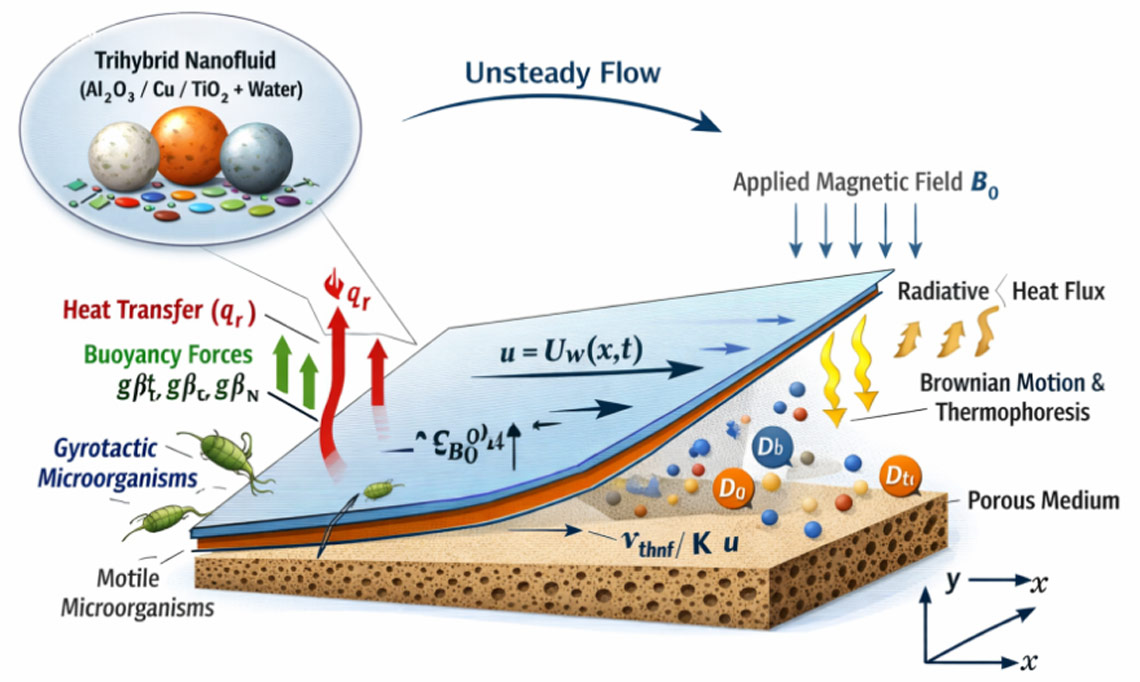
In this paper, we study the unsteady magnetohydrodynamic (MHD) flow and the heat and mass transfer of a Williamson tri-hybrid nanofluid (THNF) composed of water and Al$_2$O$_3$, TiO$_2$ and Cu nanoparticles over a stretching sheet. The model incorporates thermal radiation, activation energy, chemical reaction, a heat source and the bioconvection of motile gyrotactic microorganisms. An artificial neural network (ANN) is employed for the predictive modeling of such THNF flows under these combined effects. Similarity transformations reduce the governing nonlinear partial differential equations (PDEs) to coupled ordinary differential equations (ODEs), which are solved numerically with a boundary-value-problem solver (SciPy solve_bvp). A feed-forward ANN is trained on the numerical dataset and validated through regression analysis, training convergence, comparison of numerical and predicted data, and error analysis, which results in an ANN with excellent predictive accuracy. The results show that the magnetic field, thermal radiation, Eckert number and heat source increase the temperature field, whereas the Williamson and unsteadiness parameters decrease the velocity profile. The concentration increases with the activation energy, whereas a stronger chemical reaction and a larger Schmidt number lower the concentration profile. Furthermore, the skin-friction coefficient, Nusselt number, Sherwood number and motile-microorganism density number are evaluated over a range of physical parameters. The proposed ANN-assisted framework is an efficient and reliable tool for analyzing and optimizing advanced THNF-based thermal systems.
Graphical Abstract
Keywords
Data Availability Statement
Funding
Conflicts of Interest
AI Use Statement
Ethical Approval and Consent to Participate
References
- Xuan, Z., Zhai, Y., Ma, M., Li, Y., & Wang, H. (2021). Thermo-economic performance and sensitivity analysis of ternary hybrid nanofluids. Journal of Molecular Liquids, 323, 114889.
[CrossRef] [Google Scholar] - Imran, M., Hussain, M., Jia, W., Shah, N. A., & Ali, B. (2025). Machine learning-based Bayesian regularization algorithm for thermal analysis of tri-hybrid nanofluid flow over a stretched sheet. International Communications in Heat and Mass Transfer, 169, 109761.
[CrossRef] [Google Scholar] - Hussain, M., Lin, D., Waqas, H., Jiang, F., & Muhammad, T. (2025). Advanced thermal performance of blood-integrated tri-hybrid nanofluid: an artificial neural network-based modeling and simulation. Mechanics of Time-Dependent Materials, 29(1), 16.
[CrossRef] [Google Scholar] - Keerthiga, M., & Reddy, P. B. A. (2025). Unsteady MHD Casson trihybrid nanofluid flow over a rotating sphere via various neural networks. International Journal of Ambient Energy, 46(1), 2487043.
[CrossRef] [Google Scholar] - Faisal, Rauf, A., Ahmad, F., & Ali Shah, N. (2025). Exploring the influence of nanolayer morphology on magnetized tri-hybrid nanofluid flow using artificial neural networks and Levenberg–Marquardt optimization. Numerical Heat Transfer, Part B: Fundamentals, 86(8), 2617-2639.
[CrossRef] [Google Scholar] - Jalili, M., Ehsani, H., Ganji, A. M., Shateri, A., Mahboobtosi, M., Wu, Y., Jalili, P., Jalili, B., & Ganji, D. D. (2025). Data-driven prediction of thermal and flow fields in magnetized Boger-micropolar tri-hybrid nanofluids via deep artificial neural networks. Engineering Applications of Artificial Intelligence, 161, 112232.
[CrossRef] [Google Scholar] - Butt, Z. I., Raja, M. A. Z., Ahmad, I., Hussain, S. I., Shoaib, M., & Ilyas, H. (2024). Radial basis kernel harmony in neural networks for the analysis of MHD Williamson nanofluid flow with thermal radiation and chemical reaction: An evolutionary approach. Alexandria Engineering Journal, 103, 98-120.
[CrossRef] [Google Scholar] - Sankari, M. S., Rao, M. E., Shams, Z. E., Algarni, S., Sharif, M. N., Alqahtani, T., ... & Irshad, K. (2024). Williamson MHD nanofluid flow via a porous exponentially stretching sheet with bioconvective fluxes. Case Studies in Thermal Engineering, 59, 104453.
[CrossRef] [Google Scholar] - Sankari, S., Rao, M. E., Elsiddieg, A. M., Khan, W., Makinde, O. D., Saidani, T., ... & Garalleh, H. A. (2025). Analytical solution of MHD bioconvection Williamson nanofluid flow over an exponentially stretching sheet with the impact of viscous dissipation and gyrotactic microorganism. PloS one, 20(3), e0306358.
[CrossRef] [Google Scholar] - Chakradhar, K., Nandagopal, K., Prashanthi, V., Parandhama, A., Somaiah, T., Thrinath, B. S., ... & Abduvalieva, D. (2025). MHD effect on peristaltic motion of Williamson fluid via porous channel with suction and injection. Partial Differential Equations in Applied Mathematics, 13, 101103.
[CrossRef] [Google Scholar] - Divya, A., Alasiri, A., Jawad, M., & Al Garalleh, H. (2025). Mixed convection and heat transfer in Williamson fluid bounded by nonlinear curved surface with heat sink/source. Case Studies in Thermal Engineering, 73, 106673.
[CrossRef] [Google Scholar] - Kumar, P., Guruprasad, M. N., Almeida, F., & Muhammad, T. (2025). Optimising the thermal characteristics of Williamson fluid flow through a microchannel influenced by the Hall effect using response surface methodology. Case Studies in Thermal Engineering, 70, 106139.
[CrossRef] [Google Scholar] - Waqas, H., Farooq, U., Muhammad, T., Hussain, S., & Khan, I. (2021). Thermal effect on bioconvection flow of Sutterby nanofluid between two rotating disks with motile microorganisms. Case Studies in Thermal Engineering, 26, 101136.
[CrossRef] [Google Scholar] - Ahmad, F., Gul, T., Khan, I., Saeed, A., Selim, M. M., Kumam, P., & Ali, I. (2021). MHD thin film flow of the Oldroyd-B fluid together with bioconvection and activation energy. Case Studies in Thermal Engineering, 27, 101218.
[CrossRef] [Google Scholar] - Ben Hamida, M. B., Irfan, M., Puthalath, A. K., & Anwar, M. S. (2025). Bioconvection behavior in radiative MHD maxwell nanofluids with gyrotactic motile microorganisms: toward enhanced solar thermal energy performance. Journal of Thermal Analysis and Calorimetry, 150(20), 15969-15983.
[CrossRef] [Google Scholar] - Madkhali, H. A., Salmi, A., Alharbi, S. O., & Alqahtani, A. S. (2026). Impact of hybrid nanoparticles on heat and mass transfer in the presence of movement of motile gyrotactic microorganisms. Waves in Random and Complex Media, 35(7), 13262-13280.
[CrossRef] [Google Scholar] - Arif, U., & Nawaz, M. (2025). Numerical study of motile gyrotactic micro-organisms in hybrid nano-Maxwell fluid with mass and heat transfer. Waves in Random and Complex Media, 35(7), 13501-13517.
[CrossRef] [Google Scholar] - Sarma, A. K., & Sarma, D. (2026). Unsteady magnetohydrodynamic bioconvection Casson fluid flow in presence of gyrotactic microorganisms over a vertically stretched sheet. Numerical Heat Transfer, Part A: Applications, 87(1), 2389338.
[CrossRef] [Google Scholar] - Hussain, M., Shahid, S., Akbar, N. S., & Alaoui, M. K. (2025). Unsteady flow and heat transfer optimization of viscous fluid with bioconvection over a rotating stretchable disk and gyrotactic motile microorganisms. Case Studies in Thermal Engineering, 66, 105796.
[CrossRef] [Google Scholar] - Panda, S., Ontela, S., Mishra, S. R., & Thumma, T. (2024). Effect of Arrhenius activation energy on two-phase nanofluid flow and heat transport inside a circular segment with convective boundary conditions: Optimization and sensitivity analysis. International Journal of Modern Physics B, 38(25), 2450342.
[CrossRef] [Google Scholar] - Raju, U., Rangabashyam, S., Alhazmi, H., & Khan, I. (2024). Irreversible and reversible chemical reaction impacts on convective Maxwell fluid flow over a porous media with activation energy. Case Studies in Thermal Engineering, 61, 104821.
[CrossRef] [Google Scholar] - Varatharaj, K., Tamizharasi, R., & Vajravelu, K. (2024). Carreau nanofluid dynamics with activation energy gyrotactic microorganisms in a porous medium: Application to solar energy. International Journal of Thermofluids, 24, 100823.
[CrossRef] [Google Scholar] - Ullah, H., Abas, S. A., Fiza, M., Jan, A. U., Akgul, A., Abd El-Rahman, M., & Al-Mekhlafi, S. M. (2025). Thermal radiation effects of ternary hybrid nanofluid flow in the activation energy: Numerical computational approach. Results in Engineering, 25, 104062.
[CrossRef] [Google Scholar] - Anwar, T., Ullah, K., Fiza, M., Ullah, H., Mahariq, I., & Al Mekhlafi, S. M. (2025). Recurrent neural network approach to thermal radiation in hybrid nanofluids with activation energy between two rotating disks. Results in Physics, 77, 108451.
[CrossRef] [Google Scholar] - Ayman-Mursaleen, M., Saeed, S. T., Almohammadi, S. M., Arif, K., & Imran, M. (2026). A deep neural network model for heat transfer in Darcy--Forchheimer hybrid nanofluid flow with activation energy. Scientific Reports, 16(1), 8339.
[CrossRef] [Google Scholar] - Rehman, A., Inc, M., Saad, A. A., Abas, S. S., Sudarmozhi, K., & Khashi'ie, N. S. (2026). Thermal radiation and viscous dissipation impact on 2D MHD Williamson ternary hybrid nanofluid flow over a stretching surface. Discover Nano, 21(1), 211.
[CrossRef] [Google Scholar] - Raptis, A. (1998). Radiation and free convection flow through a porous medium. International Communications in Heat and Mass Transfer, 25(2), 289-295.
[CrossRef] [Google Scholar] - Ouyang, Y., Md Basir, M. F., Naganthran, K., & Pop, I. (2024). Triple solutions for unsteady stagnation flow of tri-hybrid nanofluid with heat generation/absorption in a porous medium. Case Studies in Thermal Engineering, 61, 105027.
[CrossRef] [Google Scholar] - Guedri, K., Khan, A., Sene, N., Raizah, Z., Saeed, A., & Galal, A. M. (2022). Thermal flow for radiative ternary hybrid nanofluid over nonlinear stretching sheet subject to Darcy–Forchheimer phenomenon. Mathematical Problems in Engineering, 2022(1), 3429439.
[CrossRef] [Google Scholar]
Cite This Article
TY  - JOUR
AU  - Hafeez, Abdul
AU  - Khan, Javed
AU  - Ying, Xiao
PY  - 2026
DA  - 2026/10/06
TI  - Artificial Neural Network-Based Modeling of Transient Bio-Convective Williamson Tri-Hybrid Nanofluid Flow with Gyrotactic Microorganisms over a Stretching Sheet
JO  - ICCK Journal of Applied Mathematics
T2  - ICCK Journal of Applied Mathematics
JF  - ICCK Journal of Applied Mathematics
VL  - 2
IS  - 4
SP  - 266
EP  - 282
DO  - 10.62762/JAM.2026.618998
UR  - https://www.icck.org/article/abs/JAM.2026.618998
KW  - tri-hybrid nanofluid
KW  - williamson fluid
KW  - neural network prediction
KW  - stretching sheet
KW  - gyrotactic microorganisms
KW  - activation energy
KW  - transient flow
AB  - In this paper, we study the unsteady magnetohydrodynamic (MHD) flow and the heat and mass transfer of a Williamson tri-hybrid nanofluid (THNF) composed of water and Al$_2$O$_3$, TiO$_2$ and Cu nanoparticles over a stretching sheet. The model incorporates thermal radiation, activation energy, chemical reaction, a heat source and the bioconvection of motile gyrotactic microorganisms. An artificial neural network (ANN) is employed for the predictive modeling of such THNF flows under these combined effects. Similarity transformations reduce the governing nonlinear partial differential equations (PDEs) to coupled ordinary differential equations (ODEs), which are solved numerically with a boundary-value-problem solver (SciPy solve_bvp). A feed-forward ANN is trained on the numerical dataset and validated through regression analysis, training convergence, comparison of numerical and predicted data, and error analysis, which results in an ANN with excellent predictive accuracy. The results show that the magnetic field, thermal radiation, Eckert number and heat source increase the temperature field, whereas the Williamson and unsteadiness parameters decrease the velocity profile. The concentration increases with the activation energy, whereas a stronger chemical reaction and a larger Schmidt number lower the concentration profile. Furthermore, the skin-friction coefficient, Nusselt number, Sherwood number and motile-microorganism density number are evaluated over a range of physical parameters. The proposed ANN-assisted framework is an efficient and reliable tool for analyzing and optimizing advanced THNF-based thermal systems.
SN  - 3068-5656
PB  - Institute of Central Computation and Knowledge
LA  - English
ER  -
@article{Hafeez2026Artificial,
  author = {Abdul Hafeez and Javed Khan and Xiao Ying},
  title = {Artificial Neural Network-Based Modeling of Transient Bio-Convective Williamson Tri-Hybrid Nanofluid Flow with Gyrotactic Microorganisms over a Stretching Sheet},
  journal = {ICCK Journal of Applied Mathematics},
  year = {2026},
  volume = {2},
  number = {4},
  pages = {266-282},
  doi = {10.62762/JAM.2026.618998},
  url = {https://www.icck.org/article/abs/JAM.2026.618998},
  abstract = {In this paper, we study the unsteady magnetohydrodynamic (MHD) flow and the heat and mass transfer of a Williamson tri-hybrid nanofluid (THNF) composed of water and Al\$\_2\$O\$\_3\$, TiO\$\_2\$ and Cu nanoparticles over a stretching sheet. The model incorporates thermal radiation, activation energy, chemical reaction, a heat source and the bioconvection of motile gyrotactic microorganisms. An artificial neural network (ANN) is employed for the predictive modeling of such THNF flows under these combined effects. Similarity transformations reduce the governing nonlinear partial differential equations (PDEs) to coupled ordinary differential equations (ODEs), which are solved numerically with a boundary-value-problem solver (SciPy solve\_bvp). A feed-forward ANN is trained on the numerical dataset and validated through regression analysis, training convergence, comparison of numerical and predicted data, and error analysis, which results in an ANN with excellent predictive accuracy. The results show that the magnetic field, thermal radiation, Eckert number and heat source increase the temperature field, whereas the Williamson and unsteadiness parameters decrease the velocity profile. The concentration increases with the activation energy, whereas a stronger chemical reaction and a larger Schmidt number lower the concentration profile. Furthermore, the skin-friction coefficient, Nusselt number, Sherwood number and motile-microorganism density number are evaluated over a range of physical parameters. The proposed ANN-assisted framework is an efficient and reliable tool for analyzing and optimizing advanced THNF-based thermal systems.},
  keywords = {tri-hybrid nanofluid, williamson fluid, neural network prediction, stretching sheet, gyrotactic microorganisms, activation energy, transient flow},
  issn = {3068-5656},
  publisher = {Institute of Central Computation and Knowledge}
}
Article Metrics
Publisher's Note
ICCK stays neutral with regard to jurisdictional claims in published maps and institutional affiliations.
Rights and Permissions
 Copyright © 2026 by the Author(s). Published by Institute of Central Computation and Knowledge. This article is an open access article distributed under the terms and conditions of the Creative Commons Attribution (CC BY) license (https://creativecommons.org/licenses/by/4.0/), which permits use, sharing, adaptation, distribution and reproduction in any medium or format, as long as you give appropriate credit to the original author(s) and the source, provide a link to the Creative Commons licence, and indicate if changes were made.

