


Reynolds-Number-Dependent Energy Harvesting by Freely Rotating Variable-angle Rhombic and Variable-side-length Parallelogram Cylinders



Article Information
Abstract
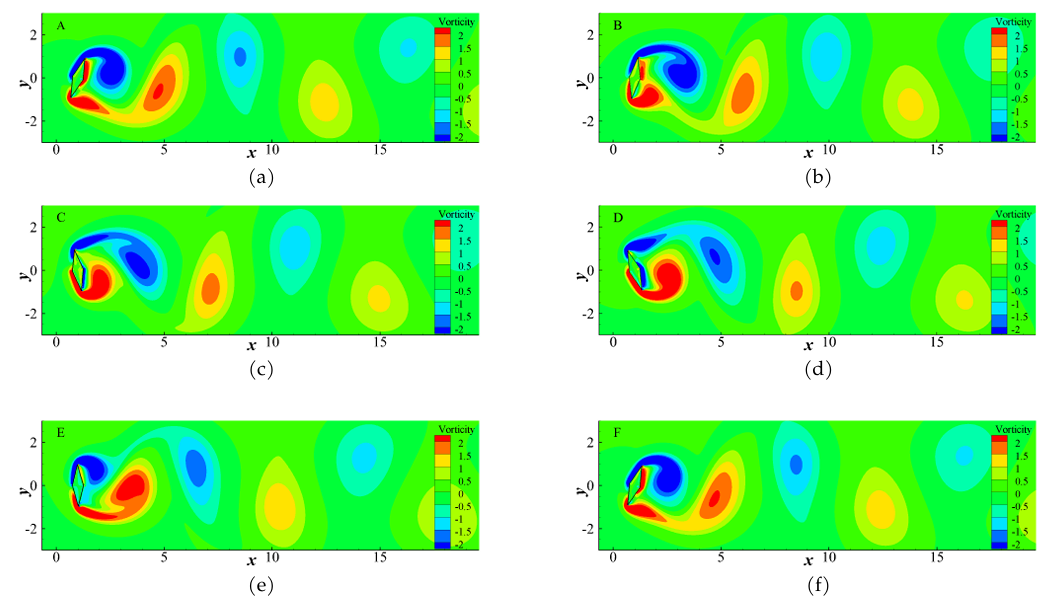
Bluff-body flow-energy harvesters are commonly designed around translational vibration, whereas freely rotating polygonal sections provide an alternative route that harnesses rotational oscillations. In this study, Reynolds-number-dependent energy-harvesting responses of two reconfigurable sections, a variable-angle rhombic cylinder and a variable-side-length parallelogram cylinder, are investigated using an immersed boundary method. The body rotates freely about its centroid without a linear spring or external damping. Results show that at $Re=40$, decreasing the rhombus angle improves start-up and increases the bounded-oscillation amplitude, favoring oscillation-based harvesting, while the parallelogram oscillation amplitude varies non-monotonically with side-length ratio, with $\lambda=1.1$ yielding the largest bounded-oscillation amplitude. At $Re=150$, acute rhombi sustain the largest bounded oscillations, whereas the square cylinder develops autorotation and favors rotary harvesting; the parallelogram family remains on bounded oscillatory branches, with $\lambda=1.5$ producing the largest response envelope. Phase-resolved analyses reveal that periodic near-wake reorganization maintains the oscillation of acute rhombi through favorable alignment between the hydrodynamic moment and the angular velocity. These findings provide geometry-selection guidelines for oscillatory and rotary flow-energy harvesters.
Graphical Abstract
Keywords
Data Availability Statement
Funding
Conflicts of Interest
AI Use Statement
Ethical Approval and Consent to Participate
References
- Rostami, A. B., & Armandei, M. (2017). Renewable energy harvesting by vortex-induced motions: Review and benchmarking of technologies. Renewable and Sustainable Energy Reviews, 70, 193-214.
[CrossRef] [Google Scholar] - Wang, J., Geng, L., Ding, L., Zhu, H., & Yurchenko, D. (2020). The state-of-the-art review on energy harvesting from flow-induced vibrations. Applied Energy, 267, 114902.
[CrossRef] [Google Scholar] - Barrero-Gil, A., Alonso, G., & Sanz-Andres, A. (2010). Energy harvesting from transverse galloping. Journal of Sound and Vibration, 329(14), 2873-2883.
[CrossRef] [Google Scholar] - Ibarra, D., Sorribes, F., Alonso, G., & Meseguer, J. (2014). Transverse galloping of two-dimensional bodies having a rhombic cross-section. Journal of Sound and Vibration, 333(13), 2855-2865.
[CrossRef] [Google Scholar] - Alonso, G., Meseguer, J., & Pérez-Grande, I. (2007). Galloping stability of triangular cross-sectional bodies: a systematic approach. Journal of Wind Engineering and Industrial Aerodynamics, 95(9-11), 928-940.
[CrossRef] [Google Scholar] - Abdelkefi, A., Hajj, M. R., & Nayfeh, A. H. (2012). Power harvesting from transverse galloping of square cylinder. Nonlinear Dynamics, 70(2), 1355-1363.
[CrossRef] [Google Scholar] - Abdelkefi, A., Yan, Z., & Hajj, M. R. (2014). Performance analysis of galloping-based piezoaeroelastic energy harvesters with different cross-section geometries. Journal of Intelligent Material Systems and Structures, 25(2), 246-256.
[CrossRef] [Google Scholar] - Ding, L., Zhang, L., Wu, C., Mao, X., & Jiang, D. (2015). Flow induced motion and energy harvesting of bluff bodies with different cross sections. Energy Conversion and Management, 91, 416-426.
[CrossRef] [Google Scholar] - Zhao, J., Leontini, J. S., Jacono, D. L., & Sheridan, J. (2014). Fluid–structure interaction of a square cylinder at different angles of attack. Journal of Fluid Mechanics, 747, 688-721.
[CrossRef] [Google Scholar] - Barrero-Gil, A., Serruys, S., & Velazquez, A. (2022). Influence of cross-section shape on energy harvesting from transverse flow-induced vibrations of bluff bodies. Journal of Fluid Mechanics, 950, A25.
[CrossRef] [Google Scholar] - Zhang, B., Mao, Z., Song, B., Ding, W., & Tian, W. (2018). Numerical investigation on effect of damping-ratio and mass-ratio on energy harnessing of a square cylinder in FIM. Energy, 144, 218-231.
[CrossRef] [Google Scholar] - Lugt, H. J. (1980). Autorotation of an elliptic cylinder about an axis perpendicular to the flow. Journal of Fluid Mechanics, 99(4), 817-840.
[CrossRef] [Google Scholar] - Zaki, T. G., & Gad-El-Hak, M. (1994). Numerical and experimental investigation of flow past a freely rotatable square cylinder. Journal of Fluids and structures, 8(7), 555-582.
[CrossRef] [Google Scholar] - Robertson, I., Li, L., Sherwin, S. J., & Bearman, P. W. (2003). A numerical study of rotational and transverse galloping rectangular bodies. Journal of fluids and structures, 17(5), 681-699.
[CrossRef] [Google Scholar] - Ryu, S., & Iaccarino, G. (2017). Vortex-induced rotations of a rigid square cylinder at low Reynolds numbers. Journal of Fluid Mechanics, 813, 482-507.
[CrossRef] [Google Scholar] - Ryu, S. (2018). Quadrant analysis on vortex-induced autorotation of a rigid square cylinder. Journal of Mechanical Science and Technology, 32(6), 2629-2635.
[CrossRef] [Google Scholar] - Luo, C., Mou, R., Huang, X., Huang, W. X., & Fang, L. (2023). A free-streamline boundary-layer model for small-amplitude oscillation regime of square cylinder under vortex-induced rotation. Physics of Fluids, 35(9).
[CrossRef] [Google Scholar] - Wang, H. K., Yan, Y. H., Chen, C. M., Ji, C. N., & Zhai, Q. (2019). Numerical investigation on vortex-induced rotations of a triangular cylinder using an immersed boundary method. China Ocean Engineering, 33(6), 723-733.
[CrossRef] [Google Scholar] - Zhu, H., Zhao, Y., & Zhou, T. (2018). Numerical investigation of the vortex-induced vibration of an elliptic cylinder free-to-rotate about its center. Journal of Fluids and Structures, 83, 133-155.
[CrossRef] [Google Scholar] - Mou, R. Y., Huang, W. X., Huang, X. R., & Fang, L. (2024). Vortex-induced rotation of a square cylinder under the influence of Reynolds number and density ratio. Journal of Fluid Mechanics, 986, A15.
[CrossRef] [Google Scholar] - Fernandes, A. C., & Armandei, M. (2014). Low-head hydropower extraction based on torsional galloping. Renewable energy, 69, 447-452.
[CrossRef] [Google Scholar] - Zhang, J., Fang, Z., Shu, C., Zhang, J., Zhang, Q., & Li, C. (2017). A rotational piezoelectric energy harvester for efficient wind energy harvesting. Sensors and Actuators A: Physical, 262, 123-129.
[CrossRef] [Google Scholar] - Zhu, H., Chen, Q., Alam, M. M., Tang, T., Zhong, J., & Zhou, T. (2023). Flow-induced rotation and wake characteristics of polygonal prisms subjected to laminar flow. Physics of Fluids, 35(5).
[CrossRef] [Google Scholar] - Zhao, M., Zhang, Q., & Liu, Y. (2025). Flow-induced vibration and energy harvesting of an elastically mounted circular cylinder with mechanically coupled rotation. Journal of Fluid Mechanics, 1021, A26.
[CrossRef] [Google Scholar] - Huang, W. X., Shin, S. J., & Sung, H. J. (2007). Simulation of flexible filaments in a uniform flow by the immersed boundary method. Journal of computational physics, 226(2), 2206-2228.
[CrossRef] [Google Scholar] - Yoon, D. H., Yang, K. S., & Choi, C. B. (2010). Flow past a square cylinder with an angle of incidence. Physics of fluids, 22(4).
[CrossRef] [Google Scholar] - Sen, S., Mittal, S., & Biswas, G. (2011). Flow past a square cylinder at low Reynolds numbers. International Journal for Numerical Methods in Fluids, 67(9), 1160-1174.
[CrossRef] [Google Scholar] - Park, Y. G., Min, G., Ha, M. Y., & Yoon, H. S. (2015). Response characteristics of vortex around the fixed and freely rotating rectangular cylinder with different width to height ratios. Progress in Computational Fluid Dynamics, an International Journal, 15(1), 1-9.
[CrossRef] [Google Scholar]
Cite This Article
TY  - JOUR
AU  - Mou, Ruiyong
AU  - Huang, Xingrong
AU  - Liu, Feng
PY  - 2026
DA  - 2026/09/29
TI  - Reynolds-Number-Dependent Energy Harvesting by Freely Rotating Variable-angle Rhombic and Variable-side-length Parallelogram Cylinders
JO  - Journal of Carbon Neutrality
T2  - Journal of Carbon Neutrality
JF  - Journal of Carbon Neutrality
VL  - 1
IS  - 2
SP  - 155
EP  - 166
DO  - 10.62762/JCN.2026.692457
UR  - https://www.icck.org/article/abs/JCN.2026.692457
KW  - energy harvesting
KW  - vortex-induced rotation
KW  - immersed boundary method
KW  - variable-angle rhombic cylinder
KW  - variable-side-length parallelogram cylinder
AB  - Bluff-body flow-energy harvesters are commonly designed around translational vibration, whereas freely rotating polygonal sections provide an alternative route that harnesses rotational oscillations. In this study, Reynolds-number-dependent energy-harvesting responses of two reconfigurable sections, a variable-angle rhombic cylinder and a variable-side-length parallelogram cylinder, are investigated using an immersed boundary method. The body rotates freely about its centroid without a linear spring or external damping. Results show that at $Re=40$, decreasing the rhombus angle improves start-up and increases the bounded-oscillation amplitude, favoring oscillation-based harvesting, while the parallelogram oscillation amplitude varies non-monotonically with side-length ratio, with $\lambda=1.1$ yielding the largest bounded-oscillation amplitude. At $Re=150$, acute rhombi sustain the largest bounded oscillations, whereas the square cylinder develops autorotation and favors rotary harvesting; the parallelogram family remains on bounded oscillatory branches, with $\lambda=1.5$ producing the largest response envelope. Phase-resolved analyses reveal that periodic near-wake reorganization maintains the oscillation of acute rhombi through favorable alignment between the hydrodynamic moment and the angular velocity. These findings provide geometry-selection guidelines for oscillatory and rotary flow-energy harvesters.
SN  - 3144-2668
PB  - Institute of Central Computation and Knowledge
LA  - English
ER  -
@article{Mou2026ReynoldsNu,
  author = {Ruiyong Mou and Xingrong Huang and Feng Liu},
  title = {Reynolds-Number-Dependent Energy Harvesting by Freely Rotating Variable-angle Rhombic and Variable-side-length Parallelogram Cylinders},
  journal = {Journal of Carbon Neutrality},
  year = {2026},
  volume = {1},
  number = {2},
  pages = {155-166},
  doi = {10.62762/JCN.2026.692457},
  url = {https://www.icck.org/article/abs/JCN.2026.692457},
  abstract = {Bluff-body flow-energy harvesters are commonly designed around translational vibration, whereas freely rotating polygonal sections provide an alternative route that harnesses rotational oscillations. In this study, Reynolds-number-dependent energy-harvesting responses of two reconfigurable sections, a variable-angle rhombic cylinder and a variable-side-length parallelogram cylinder, are investigated using an immersed boundary method. The body rotates freely about its centroid without a linear spring or external damping. Results show that at \$Re=40\$, decreasing the rhombus angle improves start-up and increases the bounded-oscillation amplitude, favoring oscillation-based harvesting, while the parallelogram oscillation amplitude varies non-monotonically with side-length ratio, with \$\lambda=1.1\$ yielding the largest bounded-oscillation amplitude. At \$Re=150\$, acute rhombi sustain the largest bounded oscillations, whereas the square cylinder develops autorotation and favors rotary harvesting; the parallelogram family remains on bounded oscillatory branches, with \$\lambda=1.5\$ producing the largest response envelope. Phase-resolved analyses reveal that periodic near-wake reorganization maintains the oscillation of acute rhombi through favorable alignment between the hydrodynamic moment and the angular velocity. These findings provide geometry-selection guidelines for oscillatory and rotary flow-energy harvesters.},
  keywords = {energy harvesting, vortex-induced rotation, immersed boundary method, variable-angle rhombic cylinder, variable-side-length parallelogram cylinder},
  issn = {3144-2668},
  publisher = {Institute of Central Computation and Knowledge}
}
Article Metrics
Publisher's Note
ICCK stays neutral with regard to jurisdictional claims in published maps and institutional affiliations.
Rights and Permissions
 Copyright © 2026 by the Author(s). Published by Institute of Central Computation and Knowledge. This article is an open access article distributed under the terms and conditions of the Creative Commons Attribution (CC BY) license (https://creativecommons.org/licenses/by/4.0/), which permits use, sharing, adaptation, distribution and reproduction in any medium or format, as long as you give appropriate credit to the original author(s) and the source, provide a link to the Creative Commons licence, and indicate if changes were made.

