

Saline Lacustrine Dolomitization and Reservoir Significance of the Tengger Formation in the Baiyinchagan Sag



Article Information
Abstract
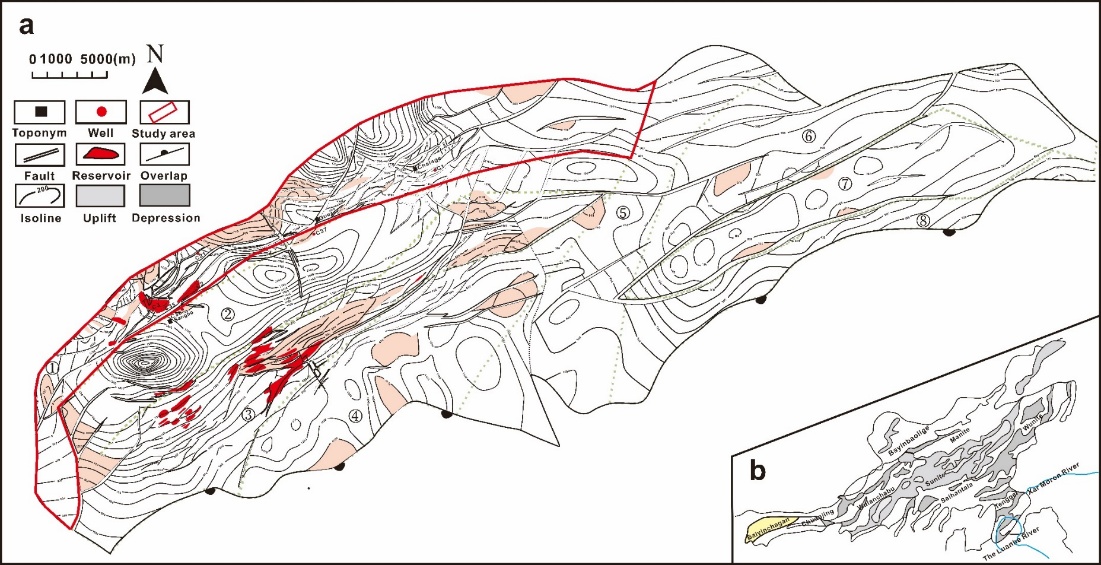
Continental saline lacustrine dolomite reservoirs remain less understood than their marine analogs. This study investigates the lower Cretaceous Tengger Formation in the western Baiyinchagan Sag, Erlian Basin, using core, thin section, SEM, XRD, isotope and petrophysical analyses. The dark muddy dolomitic rocks are composed mainly of ankerite, albite and natrolite with low clay content, indicating a mixed origin of saline lake evaporation and deep-sourced fluids. Two dolomitization types control reservoir quality: penecontemporaneous dolomitization creates intercrystalline pores, whereas burial dolomitization forms cements that block pores. Dissolution pores and high-angle fractures constitute the main storage space and permeability pathways. Laminated microcrystalline to finely crystalline dolomite exhibits the best properties, with average porosity of \(13.8%\) and permeability of \(1.56 \times 10^{-3} \, \mu\text{m}^2\). The semi-deep to deep lacustrine facies near syn-depositional faults are primary exploration targets. These findings provide a genetic model for saline lacustrine dolomite reservoirs and practical guidance for exploration in analogous basins.
Graphical Abstract
Keywords
Data Availability Statement
Funding
Conflicts of Interest
AI Use Statement
Ethical Approval and Consent to Participate
References
- Zhong, D. K., Yang, Z., Sun, H. T., & Zhang, S. (2018). Petrological characteristics of hydrothermal-sedimentary rocks: a case study of the Lower Cretaceous Tengger Formation in the Baiyinchagan sag of Erlian Basin, Inner Mongolia. Journal of Paleogeography, 20(1), 20-32. http://www.gdlxb.cn/CN/10.7605/gdlxb.2018.01.002
[Google Scholar] - Zhenmeng, S., Zheng, Q. I. A. N., & Xiancai, L. (2017). Reservoir property of the special lithologic section in the Lower Tengger Formation of A’nan Depression, Erlian Basin. Geological Bulletin of China, 36(4), 644-653.
[CrossRef] [Google Scholar] - FU, X., ZHANG, T., WU, J., WANG, X., ZHOU, J., JIANG, T., ... & LI, C. (2021). Characteristics and main controlling factors of tight oil reservoirs in Cretaceous Tengger Formation, A'nan Sag, Erlian Basin. Experimental Petroleum Geology, 43(1), 64-76.
[CrossRef] [Google Scholar] - Ma, B., Cao, Y., & Eriksson, K. A. (2020). Microbially induced dolomite precipitates in Eocene lacustrine siliciclastic sequences in the Dongying depression, Bohai Bay Basin, China: Evidence from petrology, geochemistry, and numerical modeling. AAPG Bulletin, 104(10), 2051-2075.
[CrossRef] [Google Scholar] - Wu, A., Cao, J., Zhang, J., Wu, T., & Wang, Y. (2022). Origin of microbial–hydrothermal bedded dolomites in the Permian Lucaogou Formation lacustrine shales, Junggar Basin, NW China. Sedimentary Geology, 440, 106260.
[CrossRef] [Google Scholar] - Su, C., Zhong, D., Ma, Y., Huang, S., Qin, P., & Ren, X. (2022). Genesis of Lower Cretaceous lacustrine pistomesite in Baiyinchagan Sag, Erlian Basin, China: evidence from mineralogy and geochemical characteristics. Arabian Journal of Geosciences, 15(23), 1711.
[CrossRef] [Google Scholar] - Tao, M. E. N. G., Peng, L. I. U., Longwei, Q. I. U., Yongshi, W. A. N. G., Yali, L. I. U., Hongmei, L. I. N., & Changsheng, Q. U. (2017). Formation and distribution of the high quality reservoirs in a deep saline lacustrine basin: A case study from the upper part of the 4th member of Paleogene Shahejie Formation in Bonan sag, Jiyang depression, Bohai Bay Basin, East China. Petroleum Exploration and Development, 44(6), 948-959.
[CrossRef] [Google Scholar] - Zhang, K., Liu, Z., Xu, Z., Chang, Q., Fathy, D., Liu, R., & Bai, E. (2024). Microbial and hydrothermal dolomite formation in Early Cretaceous lacustrine sediments in Yin'e Basin: Insights from petrology and geochemistry. Sedimentary Geology, 471, 106739.
[CrossRef] [Google Scholar] - Wu, P., Dujie, H., Cao, L., Zheng, R., Wei, X., Ma, X., ... & Chen, J. (2023). Paleoenvironment and organic characterization of the lower Cretaceous lacustrine source rocks in the Erlian Basin: The influence of hydrothermal and volcanic activity on the source rock quality. ACS omega, 8(2), 1885-1911.
[CrossRef] [Google Scholar] - Guo, P., Wen, H., Li, C., He, H., & Sánchez-Román, M. (2023). Lacustrine dolomite in deep time: What really matters in early dolomite formation and accumulation?. Earth-Science Reviews, 246, 104575.
[CrossRef] [Google Scholar] - Sorokin, D. Y., Kuenen, J. G., & Muyzer, G. (2011). The microbial sulfur cycle at extremely haloalkaline conditions of soda lakes. Frontiers in microbiology, 2, 44.
[CrossRef] [Google Scholar] - Wanas, H. A., & Sallam, E. (2016). Abiotically-formed, primary dolomite in the mid-Eocene lacustrine succession at Gebel El-Goza El-Hamra, NE Egypt: An approach to the role of smectitic clays. Sedimentary Geology, 343, 132-140.
[CrossRef] [Google Scholar] - Guo, R., Zhang, S., Bai, X., Wang, K., Sun, X., & Liu, X. (2020). Hydrothermal dolomite reservoirs in a fault system and the factors controlling reservoir formation-A case study of Lower Paleozoic carbonate reservoirs in the Gucheng area, Tarim Basin. Marine and Petroleum Geology, 120, 104506.
[CrossRef] [Google Scholar] - Meng, H., Lv, Z., Shen, Z., & Xiong, C. (2018). Carbon and oxygen isotopic composition of saline lacustrine dolomite cements and its palaeoenvironmental significance: A case study of Paleogene Shahejie Formation, Bohai Sea. Minerals, 9(1), 13.
[CrossRef] [Google Scholar] - Davies, G. R. (1979). Dolomite reservoir rocks: Processes, controls, porosity development. In Geology of Carbonate Porosity, Continuing Education Course Note Series 11 (pp. C1-C17).
[CrossRef] [Google Scholar] - Gawthorpe, R. L. (1987). Burial dolomitization and porosity development in a mixed carbonate‐clastic sequence: an example from the Bowland Basin, northern England. Sedimentology, 34(4), 533-558.
[CrossRef] [Google Scholar] - Lei, Z., Hu, W., Xu, H., Xu, B., Cao, C., Cheng, C., & Zhu, Q. (2018). Characteristics of hydrothermal-structure-controlled fracture–vug dolomite reservoir and its influence on oil–water distribution: Lower Cretaceous, Baiyinchagan sag, Erlian Basin, North China. Russian Geology and Geophysics, 59(4), 405-418.
[CrossRef] [Google Scholar] - Gu, Y., Zhou, L., Jiang, Y., Jiang, C., Luo, M., & Zhu, X. (2019). A model of hydrothermal dolomite reservoir facies in Precambrian dolomite, Central Sichuan Basin, SW China and its geochemical characteristics. Acta Geologica Sinica‐English Edition, 93(1), 130-145.
[CrossRef] [Google Scholar] - Yang, Z., Zhong, D., Whitaker, F., Lu, Z., Zhang, S., Tang, Z., ... & Li, Z. (2020). Syn‐sedimentary hydrothermal dolomites in a lacustrine rift basin: Petrographic and geochemical evidence from the lower Cretaceous Erlian Basin, Northern China. Sedimentology, 67(1), 305-329.
[CrossRef] [Google Scholar] - Omidpour, A., Mahboubi, A., Moussavi-Harami, R., & Rahimpour-Bonab, H. (2022). Effects of dolomitization on porosity–Permeability distribution in depositional sequences and its effects on reservoir quality, a case from Asmari Formation, SW Iran. Journal of Petroleum Science and Engineering, 208, 109348.
[CrossRef] [Google Scholar] - El-Yamani, M. S., Al-Ramadan, K., & Cantrell, D. (2022). Diagenetic controls on porosity evolution and reservoir quality of an outcrop analogue of the Jurassic carbonate reservoirs in the Arabian Plate: An example from the Middle Jurassic Tuwaiq Mountain Formation, Central Saudi Arabia. Journal of Petroleum Science and Engineering, 208, 109669.
[CrossRef] [Google Scholar] - Yang, Z., Whitaker, F. F., Liu, R., Phillips, J. C., & Zhong, D. (2021). A new model for formation of lacustrine primary dolomite by subaqueous hydrothermal venting. Geophysical Research Letters, 48(6), e2020GL091335.
[CrossRef] [Google Scholar] - Wei, W., Azmy, K., & Zhu, X. (2022). Impact of diagenesis on reservoir quality of the lacustrine mixed carbonate-siliciclastic-volcaniclastic rocks in China. Journal of Asian Earth Sciences, 233, 105265.
[CrossRef] [Google Scholar] - Deng, Y. X., Ji, Y. L., Xu, S. M., Huang, P., & Guo, X. (2013). Characteristics and main controlling factors of Tenggeer Formation reservoir in Sanghe area, Baiyinchagan sag. Acta Sedimentologica Sinica, 31(2), 350-357. http://www.cjxb.ac.cn/article/id/933
[Google Scholar] - Li, S., Tian, J., Lin, X., Yin, N., Luo, C., & Yang, D. (2022). Reconstruction of the Diagenetic Environments of Tight Sandstone Reservoirs: A Case Study from the Tengger Formation in the Baiyinchagan Sag, Erlian Basin, Northern China. Lithosphere, 2022(Special 9), 9220510.
[CrossRef] [Google Scholar] - Li, S., Tian, J., Lin, X., Zuo, Y., Kang, H., & Yang, D. (2020). Effect of alkaline diagenesis on sandstone reservoir quality: Insights from the Lower Cretaceous Erlian Basin, China. Energy Exploration & Exploitation, 38(2), 434-453.
[CrossRef] [Google Scholar] - Yang, Z., Zhong, D., Whitaker, F., Sun, H., Su, C., & Cao, X. (2021). Reservoir quality of tight oil plays in lacustrine rift basins: Insights from early Cretaceous fine-grained hydrothermal dolomites of the Erlian Basin, NE China. Marine and Petroleum Geology, 124, 104827.
[CrossRef] [Google Scholar] - Guo, P., Wen, H., & Sánchez‐Román, M. (2023). Constraints on dolomite formation in a Late Palaeozoic saline alkaline lake deposit, Junggar Basin, north‐west China. Sedimentology, 70(7), 2302-2330.
[CrossRef] [Google Scholar] - Zhang, S., Liu, Y. Q., Li, H., Jiao, X., & Zhou, D. W. (2020). Hydrothermal-sedimentary dolomite—a case from the Middle Permian in eastern Junggar Basin, China. Journal of Palaeogeography, 9(1), 24.
[CrossRef] [Google Scholar] - Tian, H., Ren, Z., Qi, K., Liu, J., Guo, S., Han, Z., ... & Zhu, L. (2025). Reservoir characteristics and diagenetic evolution of lower cretaceous in Baibei Sag, Erlian Basin, Northern China. Processes, 13(5), 1391.
[CrossRef] [Google Scholar]
Cite This Article
TY  - JOUR
AU  - Li, Shengyu
PY  - 2026
DA  - 2026/06/25
TI  - Saline Lacustrine Dolomitization and Reservoir Significance of the Tengger Formation in the Baiyinchagan Sag
JO  - Journal of Geo-Energy and Environment
T2  - Journal of Geo-Energy and Environment
JF  - Journal of Geo-Energy and Environment
VL  - 2
IS  - 3
SP  - 219
EP  - 229
DO  - 10.62762/JGEE.2026.787396
UR  - https://www.icck.org/article/abs/JGEE.2026.787396
KW  - Baiyinchagan Sag
KW  - tengger formation
KW  - saline lacustrine basin
KW  - dolomite reservoir
AB  - Continental saline lacustrine dolomite reservoirs remain less understood than their marine analogs. This study investigates the lower Cretaceous Tengger Formation in the western Baiyinchagan Sag, Erlian Basin, using core, thin section, SEM, XRD, isotope and petrophysical analyses. The dark muddy dolomitic rocks are composed mainly of ankerite, albite and natrolite with low clay content, indicating a mixed origin of saline lake evaporation and deep-sourced fluids. Two dolomitization types control reservoir quality: penecontemporaneous dolomitization creates intercrystalline pores, whereas burial dolomitization forms cements that block pores. Dissolution pores and high-angle fractures constitute the main storage space and permeability pathways. Laminated microcrystalline to finely crystalline dolomite exhibits the best properties, with average porosity of \(13.8%\) and permeability of \(1.56 \times 10^{-3} \, \mu\text{m}^2\). The semi-deep to deep lacustrine facies near syn-depositional faults are primary exploration targets. These findings provide a genetic model for saline lacustrine dolomite reservoirs and practical guidance for exploration in analogous basins.
SN  - 3069-3268
PB  - Institute of Central Computation and Knowledge
LA  - English
ER  -
@article{Li2026Saline,
  author = {Shengyu Li},
  title = {Saline Lacustrine Dolomitization and Reservoir Significance of the Tengger Formation in the Baiyinchagan Sag},
  journal = {Journal of Geo-Energy and Environment},
  year = {2026},
  volume = {2},
  number = {3},
  pages = {219-229},
  doi = {10.62762/JGEE.2026.787396},
  url = {https://www.icck.org/article/abs/JGEE.2026.787396},
  abstract = {Continental saline lacustrine dolomite reservoirs remain less understood than their marine analogs. This study investigates the lower Cretaceous Tengger Formation in the western Baiyinchagan Sag, Erlian Basin, using core, thin section, SEM, XRD, isotope and petrophysical analyses. The dark muddy dolomitic rocks are composed mainly of ankerite, albite and natrolite with low clay content, indicating a mixed origin of saline lake evaporation and deep-sourced fluids. Two dolomitization types control reservoir quality: penecontemporaneous dolomitization creates intercrystalline pores, whereas burial dolomitization forms cements that block pores. Dissolution pores and high-angle fractures constitute the main storage space and permeability pathways. Laminated microcrystalline to finely crystalline dolomite exhibits the best properties, with average porosity of \(13.8\%\) and permeability of \(1.56 \times 10^{-3} \, \mu\text{m}^2\). The semi-deep to deep lacustrine facies near syn-depositional faults are primary exploration targets. These findings provide a genetic model for saline lacustrine dolomite reservoirs and practical guidance for exploration in analogous basins.},
  keywords = {Baiyinchagan Sag, tengger formation, saline lacustrine basin, dolomite reservoir},
  issn = {3069-3268},
  publisher = {Institute of Central Computation and Knowledge}
}
Article Metrics
Publisher's Note
ICCK stays neutral with regard to jurisdictional claims in published maps and institutional affiliations.
Rights and Permissions
 Copyright © 2026 by the Author(s). Published by Institute of Central Computation and Knowledge. This article is an open access article distributed under the terms and conditions of the Creative Commons Attribution (CC BY) license (https://creativecommons.org/licenses/by/4.0/), which permits use, sharing, adaptation, distribution and reproduction in any medium or format, as long as you give appropriate credit to the original author(s) and the source, provide a link to the Creative Commons licence, and indicate if changes were made.


Portico
