

Sedimentary Evolution and Controlling Mechanisms of Fluvial–lacustrine Systems in the Triassic Halahatang Formation, Tahe Oilfield, Tarim Basin, China


Article Information
Abstract
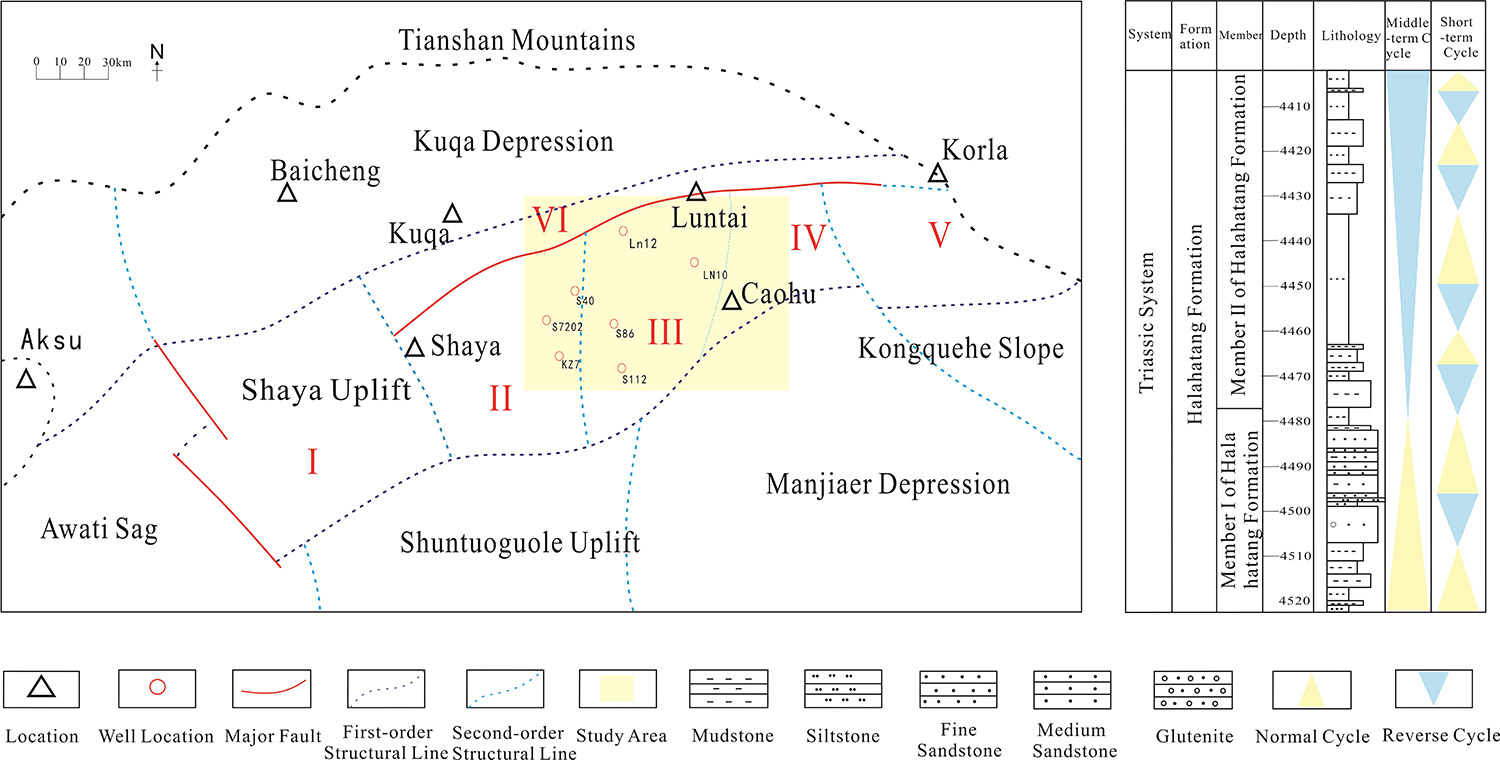
The Triassic Halahatang Formation in the Tahe Oilfield, Tarim Basin, records a complex transition from fluvial to lacustrine depositional systems, yet its depositional architecture, evolutionary process, and controlling mechanisms remain insufficiently constrained. In this study, core observations, thin-section analysis, well-log interpretation, seismic attributes, heavy-mineral assemblages, palynological data, paleotopographic restoration, and sequence stratigraphic analysis were integrated to clarify sedimentary facies types, provenance directions, sandbody stacking patterns, and depositional evolution. The study area developed braided river, meandering river, and shore–shallow lacustrine systems. During deposition of the lower First Member, abundant sediment supply from the north, steep paleoslope, low base level, and strong hydrodynamic conditions promoted thick, vertically stacked braided-channel sandbodies. In the upper First Member, rising base level, reduced sediment supply, decreased paleoslope gradient, and climatic fluctuation drove a progressive transition to meandering rivers, forming thinner channel sandbodies with improved lateral continuity. During Second Member deposition, continued base-level rise and weakened fluvial energy resulted in widespread shore–shallow lacustrine deposits dominated by mud-rich sediments with locally developed sand bars and flats. The braided-to-meandering transition reflects tectonic–climatic coupling, controlled primarily by base-level rise, sediment-supply reduction, paleoslope decrease, and paleoclimate change. The proposed depositional evolution model provides an improved framework for predicting sandbody distribution and guiding hydrocarbon exploration in the Triassic clastic succession of the Tahe Oilfield.
Graphical Abstract
Keywords
Data Availability Statement
Funding
Conflicts of Interest
AI Use Statement
Ethical Approval and Consent to Participate
References
- Xu, H., Guo, X., Cao, Z., Alves, T. M., Tao, Z., Wang, B., ... & Luo, T. (2025). Petroleum-charge history of Paleozoic carbonates in the Tahe oil field, Tarim Basin, northwestern China: Insights from oil geochemistry, fluid inclusion, and U-Pb dating. AAPG Bulletin, 109(1), 57-84.
[CrossRef] [Google Scholar] - Miall, A. D. (2013). The geology of fluvial deposits: sedimentary facies, basin analysis, and petroleum geology. Springer.
[CrossRef] [Google Scholar] - Liu, Z., Yu, Y., Wang, L., Wu, H., & Lin, Q. (2025). Sedimentary characteristics of the sandstone intervals in the fourth member of Triassic akekule formation, Tarim basin: Implications for petroleum exploration. Applied Sciences, 15(6), 3297.
[CrossRef] [Google Scholar] - Wu, H., Cheng, X., Chen, H., Chen, C., Dilek, Y., Shi, J., ... & Zhang, F. (2021). Tectonic switch from Triassic contraction to Jurassic-Cretaceous extension in the western Tarim Basin, Northwest China: New insights into the evolution of the Paleo-Tethyan orogenic belt. Frontiers in Earth Science, 9, 636383.
[CrossRef] [Google Scholar] - Jolivet, M., Dominguez, S., Charreau, J., Chen, Y., Li, Y., & Wang, Q. (2010). Mesozoic and Cenozoic tectonic history of the central Chinese Tian Shan: Reactivated tectonic structures and active deformation. Tectonics, 29(6).
[CrossRef] [Google Scholar] - Metcalfe, I. (2013). Gondwana dispersion and Asian accretion: Tectonic and palaeogeographic evolution of eastern Tethys. Journal of Asian Earth Sciences, 66, 1-33.
[CrossRef] [Google Scholar] - Olsen, H. (1988). The architecture of a sandy braided-meandering river system: an example from the lower triassic Soiling Formation (M. Buntsandstein) in W-Germany. Geologische Rundschau, 77(3), 797-814.
[CrossRef] [Google Scholar] - Kasse, C., Van Balen, R. T., Bohncke, S. J. P., Wallinga, J., & Vreugdenhil, M. (2017). Climate and base-level controlled fluvial system change and incision during the last glacial–interglacial transition, Roer river, the Netherlands–western Germany. Netherlands Journal of Geosciences, 96(2), 71-92.
[CrossRef] [Google Scholar] - Sharma, N., Whittaker, A. C., Watkins, S. E., Valero, L., Vérité, J., Puigdefabregas, C., ... & Castelltort, S. (2023). Water discharge variations control fluvial stratigraphic architecture in the Middle Eocene Escanilla formation, Spain. Scientific Reports, 13(1), 6834.
[CrossRef] [Google Scholar] - Allen, J. P., Fielding, C. R., Gibling, M. R., & Rygel, M. C. (2014). Recognizing products of palaeoclimate fluctuation in the fluvial stratigraphic record: an example from the Pennsylvanian to Lower Permian of Cape Breton Island, Nova Scotia. Sedimentology, 61(5), 1332-1381.
[CrossRef] [Google Scholar] - Colombera, L., & Mountney, N. P. (2019). The lithofacies organization of fluvial channel deposits: A meta-analysis of modern rivers. Sedimentary Geology, 383, 16-40.
[CrossRef] [Google Scholar] - Makaske, B. (2001). Anastomosing rivers: a review of their classification, origin and sedimentary products. Earth-Science Reviews, 53(3-4), 149-196.
[CrossRef] [Google Scholar] - Słowik, M., Dezső, J., Kovács, J., Gałka, M., & Sipos, G. (2022). Conditions to preserve the sedimentary record of channel planforms in temperate rivers of the Northern Hemisphere. Journal of Geophysical Research: Earth Surface, 127(3), e2021JF006188.
[CrossRef] [Google Scholar] - Kędzior, A., Widera, M., & Zieliński, T. (2021). Ancient and modern anastomosing rivers: insights from sedimentological and geomorphological case studies of the Triassic, Neogene and Holocene of Poland. Geological Quarterly, 65(4), 111-138. https://bibliotekanauki.pl/articles/2058684.pdf
[Google Scholar] - Min, Y. A. N. G., Jinhua, L. I. U., Wei, X. I. A. N., Rui, G. U. O., & Buyu, X. I. A. (2019). Description of the Boundary of Banded Sand Body in the Fourth Member of Akekule Formation in Eastern Tahe Oilfield, Tarim Basin. Xinjiang Petroleum Geology, 40(4), 1. http://dianda.cqvip.com/Qikan/Article/Detail?id=7002535190
[Google Scholar] - Laborde, A., Barrier, L., Simoes, M., Li, H., Coudroy, T., van Der Woerd, J., & Tapponnier, P. (2019). Cenozoic deformation of the Tarim Basin and surrounding ranges (Xinjiang, China): A regional overview. Earth-Science Reviews, 197, 102891.
[CrossRef] [Google Scholar] - Kaya, M. Y., Dupont-Nivet, G., Proust, J. N., Roperch, P., & Bougeois, L. (2019). Paleogene evolution and demise of the proto‐Paratethys Sea in Central Asia (Tarim and Tajik basins): role of intensified tectonic activity at ca. 41 Ma. Basin Research, 31(3), 461-486.
[CrossRef] [Google Scholar] - Lin, C., Li, H., & Liu, J. (2012). Major unconformities, tectonostratigraphic frameword, and evolution of the superimposed Tarim basin, Northwest China. Journal of Earth Science, 23(4), 395-407.
[CrossRef] [Google Scholar] - He, B., Jiao, C., Xu, Z., Cai, Z., Zhang, J., Liu, S., ... & Yu, Z. (2016). The paleotectonic and paleogeography reconstructions of the Tarim Basin and its adjacent areas (NW China) during the late Early and Middle Paleozoic. Gondwana Research, 30, 191-206.
[CrossRef] [Google Scholar] - Jiang, Z., Jiang, S., Lan, X., Wang, B., Huang, S., & Zhang, H. (2018). Neotectonic evolution of the Tarim Basin Craton from Neogene to quaternary. International Geology Review, 60(10), 1213-1230.
[CrossRef] [Google Scholar] - Lin, C., Yang, H., Liu, J., Rui, Z., Cai, Z., & Zhu, Y. (2012). Distribution and erosion of the Paleozoic tectonic unconformities in the Tarim Basin, Northwest China: Significance for the evolution of paleo-uplifts and tectonic geography during deformation. Journal of Asian Earth Sciences, 46, 1-19.
[CrossRef] [Google Scholar] - Wang, C., Wu, H., Dilek, Y., Zhang, F., Chen, H., Li, F., ... & Cheng, X. (2025). Multiple episodes of late Neoproterozoic rifting in the Tarim Craton during its separation from the supercontinent Rodinia. Journal of the Geological Society, 182(2), jgs2024-076.
[CrossRef] [Google Scholar] - Shuping, C., Yi, W., & Zhijun, J. (2007). Controls of tectonics on both sedimentary sequences and petroleum systems in Tarim Basin, northwest China. Petroleum Science, 4(2), 1-9.
[CrossRef] [Google Scholar] - Feng, L., Lu, Y. C., Wellner, J. S., Liu, J. S., Liu, X. F., Li, X. Q., & Zhang, J. Y. (2020). Fluvial morphology and reservoir sand-body architecture in lacustrine rift basins with axial and lateral sediment supplies: Oligocene fluvial–lacustrine succession in the Xihu sag, East China Sea Shelf Basin. Australian Journal of Earth Sciences, 67(2), 279-304.
[CrossRef] [Google Scholar] - Wang, J. K., Xia, S. Q., Fan, Q. Q., & Liu, X. L. (2025). The establishment of high-resolution sequence stratigraphy linked to INPEFA analysis in third member of Yanchang Formation, central Ordos Basin. Applied Geophysics, 1-13.
[CrossRef] [Google Scholar] - Wu, H., Ji, Y., Wu, C., Duclaux, G., Wu, H., Gao, C., ... & Chang, L. (2019). Stratigraphic response to spatiotemporally varying tectonic forcing in rifted continental basin: Insight from a coupled tectonic‐stratigraphic numerical model. Basin Research, 31(2), 311-336.
[CrossRef] [Google Scholar] - Ridente, D. (2016). Releasing the sequence stratigraphy paradigm. Overview and perspectives. Journal of the Geological Society, 173(5), 845-853.
[CrossRef] [Google Scholar] - Gibling, M. R. (2006). Width and thickness of fluvial channel bodies and valley fills in the geological record: a literature compilation and classification. Journal of sedimentary Research, 76(5), 731-770.
[CrossRef] [Google Scholar] - Schumm, S. A. (1985). Patterns of alluvial rivers. Annual Review of Earth and Planetary Sciences, 13(1), 5-27.
[CrossRef] [Google Scholar] - Vandenberghe, J. (2001). A typology of Pleistocene cold-based rivers. Quaternary International, 79(1), 111-121.
[CrossRef] [Google Scholar] - Li, W. A. N., Xiao-Wei, J. I. A. N. G., & Xu-Sheng, W. A. N. G. (2010). A common regularity of aquifers: The decay in hydraulic conductivity with depth. Geological Journal of China Universities, 16(1), 7. https://geology.nju.edu.cn/EN/Y2010/V16/I1/7
[Google Scholar] - Mou, Z. H. (1993). A new method to calculate the ancient thickness of sedimentary sequences. Experiment Petroleum Geology, 15(4), 414-422.
[CrossRef] [Google Scholar] - Nichols, G. (2009). Sedimentology and stratigraphy. John Wiley & Sons.
[Google Scholar] - Catuneanu, O. (2020). Sequence stratigraphy in the context of the ‘modeling revolution’. Marine and Petroleum Geology, 116, 104309.
[CrossRef] [Google Scholar] - Peng, J., Li, J., Li, W., Slater, S. M., Zhu, H., & Vajda, V. (2018). The triassic to early jurassic palynological record of the Tarim basin, China. Palaeobiodiversity and Palaeoenvironments, 98(1), 7-28.
[CrossRef] [Google Scholar] - Jiang, D. X., Wang, Y. D., Robbins, E. I., Wei, J., & Tian, N. (2008). Mesozoic non-marine petroleum source rocks determined by palynomorphs in the Tarim Basin, Xinjiang, northwestern China. Geological Magazine, 145(6), 868-885.
[CrossRef] [Google Scholar] - Bing, H. (1994). Study on triassic fin delta sedimention and reservoir in Lunnan Area Tarim basin. Acta Sedimentologica Sinica, 12(2), 54-62. http://www.cjxb.ac.cn/en/article/id/2104
[Google Scholar] - Clift, P. D., Olson, E. D., Lechnowskyj, A., Moran, M. G., Barbato, A., & Lorenzo, J. M. (2019). Grain‐size variability within a mega‐scale point‐bar system, False River, Louisiana. Sedimentology, 66(2), 408-434.
[CrossRef] [Google Scholar] - Rachelly, C., Friedl, F., Boes, R. M., & Weitbrecht, V. (2021). Morphological response of channelized, sinuous gravel‐bed rivers to sediment replenishment. Water Resources Research, 57(6), e2020WR029178.
[CrossRef] [Google Scholar]
Cite This Article
TY  - JOUR
AU  - Ren, Qihang
AU  - Liu, Jinhua
AU  - Ma, Hongtao
AU  - Li, Wenpin
AU  - Diao, Xindong
AU  - Gu, Weili
PY  - 2026
DA  - 2026/06/15
TI  - Sedimentary Evolution and Controlling Mechanisms of Fluvial–lacustrine Systems in the Triassic Halahatang Formation, Tahe Oilfield, Tarim Basin, China
JO  - Journal of Geo-Energy and Environment
T2  - Journal of Geo-Energy and Environment
JF  - Journal of Geo-Energy and Environment
VL  - 2
IS  - 3
SP  - 203
EP  - 218
DO  - 10.62762/JGEE.2026.916754
UR  - https://www.icck.org/article/abs/JGEE.2026.916754
KW  - halahatang formation
KW  - tahe oilfield
KW  - sedimentary evolution
KW  - braided river
KW  - meandering river
KW  - shore–shallow lacustrine deposits
KW  - controlling factors
AB  - The Triassic Halahatang Formation in the Tahe Oilfield, Tarim Basin, records a complex transition from fluvial to lacustrine depositional systems, yet its depositional architecture, evolutionary process, and controlling mechanisms remain insufficiently constrained. In this study, core observations, thin-section analysis, well-log interpretation, seismic attributes, heavy-mineral assemblages, palynological data, paleotopographic restoration, and sequence stratigraphic analysis were integrated to clarify sedimentary facies types, provenance directions, sandbody stacking patterns, and depositional evolution. The study area developed braided river, meandering river, and shore–shallow lacustrine systems. During deposition of the lower First Member, abundant sediment supply from the north, steep paleoslope, low base level, and strong hydrodynamic conditions promoted thick, vertically stacked braided-channel sandbodies. In the upper First Member, rising base level, reduced sediment supply, decreased paleoslope gradient, and climatic fluctuation drove a progressive transition to meandering rivers, forming thinner channel sandbodies with improved lateral continuity. During Second Member deposition, continued base-level rise and weakened fluvial energy resulted in widespread shore–shallow lacustrine deposits dominated by mud-rich sediments with locally developed sand bars and flats. The braided-to-meandering transition reflects tectonic–climatic coupling, controlled primarily by base-level rise, sediment-supply reduction, paleoslope decrease, and paleoclimate change. The proposed depositional evolution model provides an improved framework for predicting sandbody distribution and guiding hydrocarbon exploration in the Triassic clastic succession of the Tahe Oilfield.
SN  - 3069-3268
PB  - Institute of Central Computation and Knowledge
LA  - English
ER  -
@article{Ren2026Sedimentar,
  author = {Qihang Ren and Jinhua Liu and Hongtao Ma and Wenpin Li and Xindong Diao and Weili Gu},
  title = {Sedimentary Evolution and Controlling Mechanisms of Fluvial–lacustrine Systems in the Triassic Halahatang Formation, Tahe Oilfield, Tarim Basin, China},
  journal = {Journal of Geo-Energy and Environment},
  year = {2026},
  volume = {2},
  number = {3},
  pages = {203-218},
  doi = {10.62762/JGEE.2026.916754},
  url = {https://www.icck.org/article/abs/JGEE.2026.916754},
  abstract = {The Triassic Halahatang Formation in the Tahe Oilfield, Tarim Basin, records a complex transition from fluvial to lacustrine depositional systems, yet its depositional architecture, evolutionary process, and controlling mechanisms remain insufficiently constrained. In this study, core observations, thin-section analysis, well-log interpretation, seismic attributes, heavy-mineral assemblages, palynological data, paleotopographic restoration, and sequence stratigraphic analysis were integrated to clarify sedimentary facies types, provenance directions, sandbody stacking patterns, and depositional evolution. The study area developed braided river, meandering river, and shore–shallow lacustrine systems. During deposition of the lower First Member, abundant sediment supply from the north, steep paleoslope, low base level, and strong hydrodynamic conditions promoted thick, vertically stacked braided-channel sandbodies. In the upper First Member, rising base level, reduced sediment supply, decreased paleoslope gradient, and climatic fluctuation drove a progressive transition to meandering rivers, forming thinner channel sandbodies with improved lateral continuity. During Second Member deposition, continued base-level rise and weakened fluvial energy resulted in widespread shore–shallow lacustrine deposits dominated by mud-rich sediments with locally developed sand bars and flats. The braided-to-meandering transition reflects tectonic–climatic coupling, controlled primarily by base-level rise, sediment-supply reduction, paleoslope decrease, and paleoclimate change. The proposed depositional evolution model provides an improved framework for predicting sandbody distribution and guiding hydrocarbon exploration in the Triassic clastic succession of the Tahe Oilfield.},
  keywords = {halahatang formation, tahe oilfield, sedimentary evolution, braided river, meandering river, shore–shallow lacustrine deposits, controlling factors},
  issn = {3069-3268},
  publisher = {Institute of Central Computation and Knowledge}
}
Article Metrics
Publisher's Note
ICCK stays neutral with regard to jurisdictional claims in published maps and institutional affiliations.
Rights and Permissions
 Copyright © 2026 by the Author(s). Published by Institute of Central Computation and Knowledge. This article is an open access article distributed under the terms and conditions of the Creative Commons Attribution (CC BY) license (https://creativecommons.org/licenses/by/4.0/), which permits use, sharing, adaptation, distribution and reproduction in any medium or format, as long as you give appropriate credit to the original author(s) and the source, provide a link to the Creative Commons licence, and indicate if changes were made.


Portico
