

The Economic Singularity: Dimensional Reduction, Invariants, and Stability Analysis of the Financialization Threshold


Article Information
Abstract
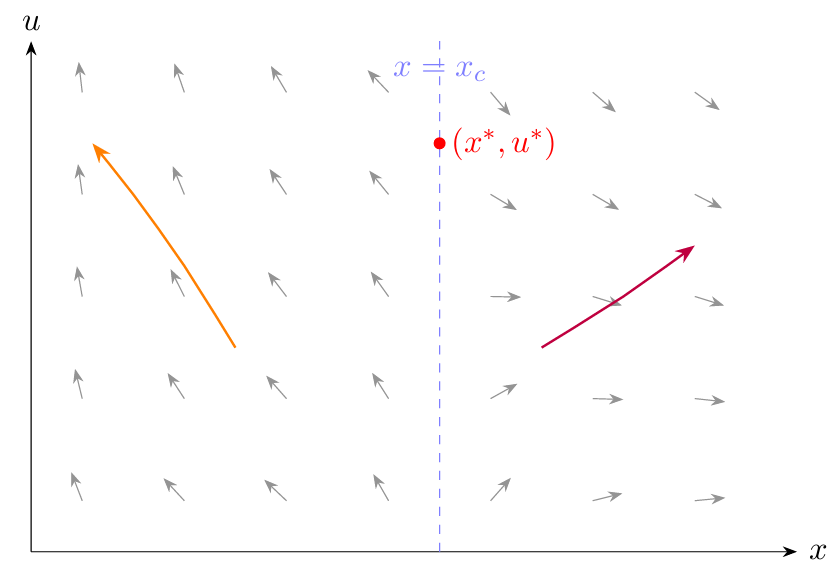
Background: The possibility of an economic singularity---a finite‑time explosion of AI capability, financial capital, and inequality---has been discussed in futurist and economic literature, but endogenous feedback loops between AI, finance, and labour markets remain underexplored. Methods: This paper presents a dimensional reduction of a dynamical systems model of an economy with recursively self‑improving artificial intelligence and financial autocatalysis. By transforming to three economically meaningful ratios---financial depth per AI capability ($x = K_f/A$), AI capital per financial capital ($u = K_{ai}/K_f$), and employment odds ($z = L_p/(1-L_p)$)---the original four‑variable explosive system reduces to a bounded, analytically tractable three‑dimensional system. Results: The reduced model possesses a saddle‑type equilibrium that separates two asymptotic regimes: one in which AI dominates ($x\to0$) and one in which finance explodes ($x\to\infty$, Neofeudalism). The critical financial depth is $x_c = (\lambda+\beta)/\gamma_F$, so that the economy tips into Neofeudalism whenever the initial $x_0 > x_c$. Numerical simulations confirm the saddle structure and the threshold behaviour. Conclusions: The analysis yields sharp policy recommendations: regulate financial autocatalysis to raise the safety threshold, and intervene early to keep the financial‑to‑AI ratio below the critical value. Redistribution alone cannot substitute for structural regulation.
Graphical Abstract
Keywords
Data Availability Statement
Funding
Conflicts of Interest
AI Use Statement
Ethical Approval and Consent to Participate
References
- Good, I. J. (1966). Speculations concerning the first ultraintelligent machine. In Advances in computers (Vol. 6, pp. 31-88). Elsevier.
[CrossRef] [Google Scholar] - Vinge, V. (1993). The coming technological singularity: How to survive in the post-human era. NASA. Lewis Research Center, Vision 21: Interdisciplinary Science and Engineering in the Era of Cyberspace. https://ntrs.nasa.gov/api/citations/19940022856/downloads/19940022856.pdf
[Google Scholar] - Nordhaus, W. D. (2021). Are we approaching an economic singularity? information technology and the future of economic growth. American Economic Journal: Macroeconomics, 13(1), 299-332.
[CrossRef] [Google Scholar] - Aghion, P., Jones, B. F., & Jones, C. I. (2019). Artificial intelligence and economic growth. In A. Agrawal, J. Gans, & A. Goldfarb (Eds.), The economics of artificial intelligence: An agenda (pp. 237–282). University of Chicago Press.
[CrossRef] [Google Scholar] - Brynjolfsson, E., & McAfee, A. (2014). The second machine age: Work progress and prosperity in a time of brilliant technologies. WW Norton & company.
[Google Scholar] - Philippon, T. (2015). Has the US finance industry become less efficient? On the theory and measurement of financial intermediation. American Economic Review, 105(4), 1408-1438.
[CrossRef] [Google Scholar] - Piketty, T. (2014). Capital in the twenty-first century. Harvard University Press.
[CrossRef] [Google Scholar] - Acemoglu, D., & Restrepo, P. (2018). Artificial intelligence, automation, and work. In The economics of artificial intelligence: An agenda (pp. 197-236). University of Chicago Press.
[CrossRef] [Google Scholar] - Brynjolfsson, E., Korinek, A., & Agrawal, A. K. (2025). A research agenda for the economics of transformative AI. NBER Working Paper No.~34256.
[CrossRef] [Google Scholar] - Farmer, J. D., & Foley, D. (2009). The economy needs agent-based modelling. Nature, 460(7256), 685-686.
[CrossRef] [Google Scholar] - Arthur, W. B. (2014). Complexity and the economy. Oxford University Press.
[CrossRef] [Google Scholar] - Beinhocker, E. D. (2006). The origin of wealth: Evolution, complexity, and the radical remaking of economics. Harvard Business Review Press.
[Google Scholar] - Brock, W. A., & Hommes, C. H. (1998). Heterogeneous beliefs and routes to chaos in a simple asset pricing model. Journal of Economic dynamics and Control, 22(8-9), 1235-1274.
[CrossRef] [Google Scholar] - Lux, T. (2011). Stochastic behavioral asset-pricing models and the stylized facts. In Handbook of financial markets: Dynamics and evolution (pp. 161–215).
[CrossRef] [Google Scholar] - Sornette, D. (2017). Why stock markets crash: Critical events in complex financial systems. Princeton University Press.
[CrossRef] [Google Scholar] - Keen, S. (2013). A monetary Minsky model of the Great Moderation and the Great Recession. Journal of Economic Behavior & Organization, 86, 221-235.
[CrossRef] [Google Scholar] - Minsky, H. P. (1986). Stabilizing an unstable economy. Yale University Press.
[Google Scholar] - Gabaix, X. (2016). Power laws in economics: An introduction. Journal of Economic Perspectives, 30(1), 185–206.
[CrossRef] [Google Scholar] - Eggertsson, G. B., Robbins, J. A., & Wold, E. G. (2021). Kaldor and Piketty’s facts: The rise of monopoly power in the United States. Journal of Monetary Economics, 124, S19-S38.
[CrossRef] [Google Scholar] - Strogatz, S. H. (2024). Nonlinear dynamics and chaos: with applications to physics, biology, chemistry, and engineering. Chapman and Hall/CRC.
[CrossRef] [Google Scholar] - Kuznetsov, Y. A. (2004). Elements of applied bifurcation theory (3rd ed.). Springer.
[CrossRef] [Google Scholar] - Perko, L. (2013). Differential equations and dynamical systems (3rd ed.). Springer.
[Google Scholar] - Bender, C. M., & Orszag, S. A. (1999). Advanced mathematical methods for scientists and engineers: Asymptotic methods and perturbation theory (Vol. 1). New York: Springer.
[CrossRef] [Google Scholar] - Gallegati, M., Keen, S., Lux, T., & Ormerod, P. (2006). Worrying trends in econophysics. Physica A: Statistical Mechanics and its Applications, 370(1), 1-6.
[CrossRef] [Google Scholar] - Kaplan, J., McCandlish, S., Henighan, T., Brown, T. B., Chess, B., Child, R., ... & Amodei, D. (2020). Scaling laws for neural language models. arXiv preprint arXiv:2001.08361.
[CrossRef] [Google Scholar] - Krippner, G. R. (2005). The financialization of the American economy. Socio-Economic Review, 3(2), 173--208.
[CrossRef] [Google Scholar] - Sachs, J. D., & Kotlikoff, L. J. (2012). Smart machines and long-term misery. NBER Working Paper No. 18629.
[CrossRef] [Google Scholar] - Trammell, P., & Korinek, A. (2023). Economic growth under transformative AI. Annual Review of Economics, 18.
[CrossRef] [Google Scholar] - Korinek, A., & Stiglitz, J. (2017). Artificial Intelligence and Its Implications for Income Distribution and Unemployment (No. 24174). National Bureau of Economic Research, Inc. https://econpapers.repec.org/paper/nbrnberwo/24174.htm
[Google Scholar]
Cite This Article
TY  - JOUR
AU  - Yaremenko, Mykola
PY  - 2026
DA  - 2026/06/10
TI  - The Economic Singularity: Dimensional Reduction, Invariants, and Stability Analysis of the Financialization Threshold
JO  - Journal of Nonlinear Dynamics and Applications
T2  - Journal of Nonlinear Dynamics and Applications
JF  - Journal of Nonlinear Dynamics and Applications
VL  - 2
IS  - 2
SP  - 119
EP  - 126
DO  - 10.62762/JNDA.2026.489975
UR  - https://www.icck.org/article/abs/JNDA.2026.489975
KW  - economic singularity
KW  - artificial intelligence
KW  - financialization
KW  - stability analysis
KW  - saddle point
KW  - dimensional reduction
KW  - wealth inequality
KW  - Neofeudalism
KW  - dynamical systems
AB  - Background: The possibility of an economic singularity---a finite‑time explosion of AI capability, financial capital, and inequality---has been discussed in futurist and economic literature, but endogenous feedback loops between AI, finance, and labour markets remain underexplored. Methods: This paper presents a dimensional reduction of a dynamical systems model of an economy with recursively self‑improving artificial intelligence and financial autocatalysis. By transforming to three economically meaningful ratios---financial depth per AI capability ($x = K_f/A$), AI capital per financial capital ($u = K_{ai}/K_f$), and employment odds ($z = L_p/(1-L_p)$)---the original four‑variable explosive system reduces to a bounded, analytically tractable three‑dimensional system. Results: The reduced model possesses a saddle‑type equilibrium that separates two asymptotic regimes: one in which AI dominates ($x\to0$) and one in which finance explodes ($x\to\infty$, Neofeudalism). The critical financial depth is $x_c = (\lambda+\beta)/\gamma_F$, so that the economy tips into Neofeudalism whenever the initial $x_0 > x_c$. Numerical simulations confirm the saddle structure and the threshold behaviour. Conclusions: The analysis yields sharp policy recommendations: regulate financial autocatalysis to raise the safety threshold, and intervene early to keep the financial‑to‑AI ratio below the critical value. Redistribution alone cannot substitute for structural regulation.
SN  - 3069-6313
PB  - Institute of Central Computation and Knowledge
LA  - English
ER  -
@article{Yaremenko2026The,
  author = {Mykola Yaremenko},
  title = {The Economic Singularity: Dimensional Reduction, Invariants, and Stability Analysis of the Financialization Threshold},
  journal = {Journal of Nonlinear Dynamics and Applications},
  year = {2026},
  volume = {2},
  number = {2},
  pages = {119-126},
  doi = {10.62762/JNDA.2026.489975},
  url = {https://www.icck.org/article/abs/JNDA.2026.489975},
  abstract = {Background: The possibility of an economic singularity---a finite‑time explosion of AI capability, financial capital, and inequality---has been discussed in futurist and economic literature, but endogenous feedback loops between AI, finance, and labour markets remain underexplored. Methods: This paper presents a dimensional reduction of a dynamical systems model of an economy with recursively self‑improving artificial intelligence and financial autocatalysis. By transforming to three economically meaningful ratios---financial depth per AI capability (\$x = K\_f/A\$), AI capital per financial capital (\$u = K\_{ai}/K\_f\$), and employment odds (\$z = L\_p/(1-L\_p)\$)---the original four‑variable explosive system reduces to a bounded, analytically tractable three‑dimensional system. Results: The reduced model possesses a saddle‑type equilibrium that separates two asymptotic regimes: one in which AI dominates (\$x\to0\$) and one in which finance explodes (\$x\to\infty\$, Neofeudalism). The critical financial depth is \$x\_c = (\lambda+\beta)/\gamma\_F\$, so that the economy tips into Neofeudalism whenever the initial \$x\_0 > x\_c\$. Numerical simulations confirm the saddle structure and the threshold behaviour. Conclusions: The analysis yields sharp policy recommendations: regulate financial autocatalysis to raise the safety threshold, and intervene early to keep the financial‑to‑AI ratio below the critical value. Redistribution alone cannot substitute for structural regulation.},
  keywords = {economic singularity, artificial intelligence, financialization, stability analysis, saddle point, dimensional reduction, wealth inequality, Neofeudalism, dynamical systems},
  issn = {3069-6313},
  publisher = {Institute of Central Computation and Knowledge}
}
Article Metrics
Publisher's Note
ICCK stays neutral with regard to jurisdictional claims in published maps and institutional affiliations.
Rights and Permissions


Portico
