
On the Mathematical Formalism of the Third-Order Runge-Kutta Method and Its Application to Leukemia Dynamics




Article Information
Abstract
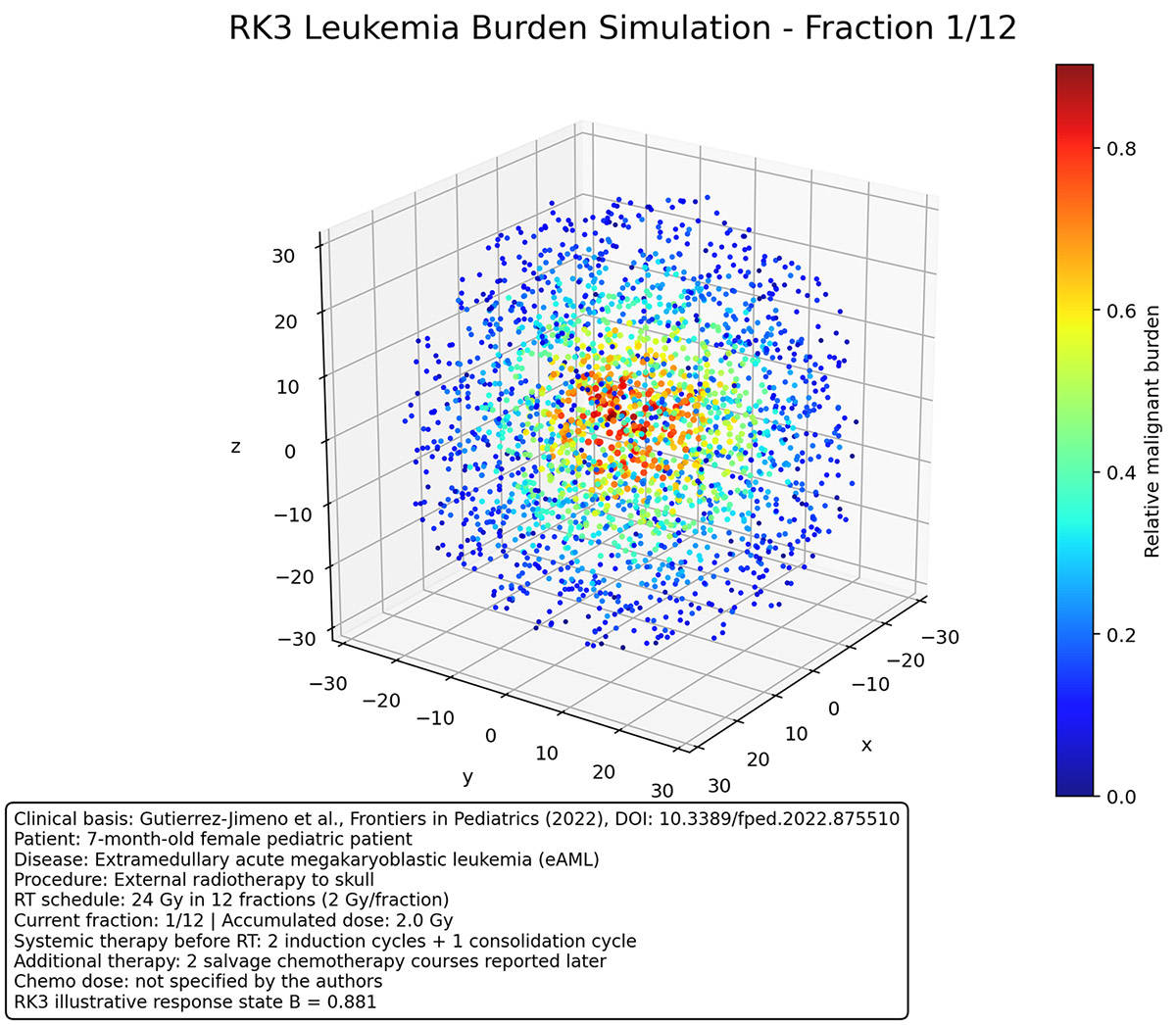
This paper gives a step-by-step derivation of the classical third-order Runge-Kutta (RK3) method and applies it to a reduced model of leukemia burden under fractionated radiotherapy. Starting from the initial-value problem, the RK3 coefficients are obtained from a third-order Taylor expansion and the resulting order conditions, and the absolute-stability interval of the method on the negative real axis is computed. The biomedical example uses a normalized, subtype-independent burden variable that obeys first-order decay. The treatment schedule (24~Gy in 12 fractions of 2~Gy) is taken from a published case of pediatric extramedullary acute megakaryoblastic leukemia; no patient-specific biological parameters are estimated. The decay rate is prescribed so that one fraction reduces the burden to 0.881 of its initial value, and a normalized three-dimensional Gaussian field is used only for visualization. RK3 and the explicit Euler method are compared with the exact solution of the reduced equation. The observed convergence orders approach 3 for RK3 and 1 for Euler, and the one-fraction step lies well inside the RK3 stability interval. The modeled burden decreases from 0.881 after the first fraction to 0.219 after the twelfth. The application is intended as a methodological illustration, not as a patient-specific prediction.
Graphical Abstract
Keywords
Data Availability Statement
Funding
Conflicts of Interest
AI Use Statement
Ethical Approval and Consent to Participate
References
- Daltveit, D. S., Morgan, E., Colombet, M., Steliarova-Foucher, E., Bendahhou, K., Marcos-Gragera, R., ... & Soerjomataram, I. (2025). Global patterns of leukemia by subtype, age, and sex in 185 countries in 2022. Leukemia, 39(2), 412-419.
[CrossRef] [Google Scholar] - Clapp, G., & Levy, D. (2015). A review of mathematical models for leukemia and lymphoma. Drug Discovery Today: Disease Models, 16, 1-6.
[CrossRef] [Google Scholar] - Chulián, S., Martínez-Rubio, Á., Rosa, M., & Pérez-García, V. M. (2022). Mathematical models of leukaemia and its treatment: a review. SeMA Journal, 79(3), 441-486.
[CrossRef] [Google Scholar] - Hassan, I. U., Javeed, S., Khan, M. S., Baleanu, D., & Bayram, M. (2026). Modeling, analysis and numerical simulation of chronic myeloid leukemia. Theory in Biosciences, 145(1), 7.
[CrossRef] [Google Scholar] - Parajdi, L. G., Bai, X., Kegyes, D., & Tomuleasa, C. (2025). A mathematical model of clonal hematopoiesis explaining phase transitions in chronic myeloid leukemia. Mathematical Medicine and Biology: A Journal of the IMA, 42(3), 253-288.
[CrossRef] [Google Scholar] - Bray, F., Laversanne, M., Sung, H., Ferlay, J., Siegel, R. L., Soerjomataram, I., & Jemal, A. (2024). Global cancer statistics 2022: GLOBOCAN estimates of incidence and mortality worldwide for 36 cancers in 185 countries. CA: A Cancer Journal for Clinicians, 74(3), 229-263.
[CrossRef] [Google Scholar] - Kiwumulo, H. F., Muwonge, H., Ibingira, C., Kirabira, J. B., & Ssekitoleko, R. T. (2021). A systematic review of modeling and simulation approaches in designing targeted treatment technologies for leukemia cancer in low and middle income countries. Mathematical Biosciences and Engineering, 18(6), 8149-8173.
[CrossRef] [Google Scholar] - Gutiérrez-Jimeno, M., Panizo-Morgado, E., Calvo-Imirizaldu, M., Galán-Gómez, V., Escudero-López, A., & Patiño-García, A. (2022). Case report: the value of genomic analysis in a case of megakaryoblastic leukemia with atypical initial manifestation. Frontiers in Pediatrics, 10, 875510.
[CrossRef] [Google Scholar] - Hairer, E., Nørsett, S. P., & Wanner, G. (1993). Solving Ordinary Differential Equations I: Nonstiff Problems (2nd rev. ed., Springer Series in Computational Mathematics, Vol. 8). Berlin: Springer.
[CrossRef] [Google Scholar] - Roache, P. J. (2002). Code verification by the method of manufactured solutions. Journal of Fluids Engineering, 124(1), 4-10.
[CrossRef] [Google Scholar] - Runge, C. (1895). Über die numerische Auflösung von Differentialgleichungen. Mathematische Annalen, 46(2), 167-178.
[CrossRef] [Google Scholar] - Kutta, W. (1901). Beitrag zur näherungsweisen Integration totaler Differentialgleichungen. Teubner.
[Google Scholar] - Butcher, J. C. (1996). A history of Runge-Kutta methods. Applied Numerical Mathematics, 20(3), 247-260.
[CrossRef] [Google Scholar]
Cite This Article
TY  - JOUR
AU  - Farias, Matheus dos Santos
PY  - 2026
DA  - 2026/11/22
TI  - On the Mathematical Formalism of the Third-Order Runge-Kutta Method and Its Application to Leukemia Dynamics
JO  - Journal of Numerical Simulations in Physics and Mathematics
T2  - Journal of Numerical Simulations in Physics and Mathematics
JF  - Journal of Numerical Simulations in Physics and Mathematics
VL  - 3
IS  - 1
SP  - 73
EP  - 83
DO  - 10.62762/JNSPM.2026.906286
UR  - https://www.icck.org/article/abs/jnspm.2026.906286
KW  - Runge-Kutta method
KW  - leukemia dynamics
KW  - mathematical modeling
KW  - radiotherapy simulation
KW  - numerical analysis
AB  - This paper gives a step-by-step derivation of the classical third-order Runge-Kutta (RK3) method and applies it to a reduced model of leukemia burden under fractionated radiotherapy. Starting from the initial-value problem, the RK3 coefficients are obtained from a third-order Taylor expansion and the resulting order conditions, and the absolute-stability interval of the method on the negative real axis is computed. The biomedical example uses a normalized, subtype-independent burden variable that obeys first-order decay. The treatment schedule (24~Gy in 12 fractions of 2~Gy) is taken from a published case of pediatric extramedullary acute megakaryoblastic leukemia; no patient-specific biological parameters are estimated. The decay rate is prescribed so that one fraction reduces the burden to 0.881 of its initial value, and a normalized three-dimensional Gaussian field is used only for visualization. RK3 and the explicit Euler method are compared with the exact solution of the reduced equation. The observed convergence orders approach 3 for RK3 and 1 for Euler, and the one-fraction step lies well inside the RK3 stability interval. The modeled burden decreases from 0.881 after the first fraction to 0.219 after the twelfth. The application is intended as a methodological illustration, not as a patient-specific prediction.
SN  - 3068-9082
PB  - Institute of Central Computation and Knowledge
LA  - English
ER  -
@article{Farias2026On,
  author = {Matheus dos Santos Farias},
  title = {On the Mathematical Formalism of the Third-Order Runge-Kutta Method and Its Application to Leukemia Dynamics},
  journal = {Journal of Numerical Simulations in Physics and Mathematics},
  year = {2026},
  volume = {3},
  number = {1},
  pages = {73-83},
  doi = {10.62762/JNSPM.2026.906286},
  url = {https://www.icck.org/article/abs/jnspm.2026.906286},
  abstract = {This paper gives a step-by-step derivation of the classical third-order Runge-Kutta (RK3) method and applies it to a reduced model of leukemia burden under fractionated radiotherapy. Starting from the initial-value problem, the RK3 coefficients are obtained from a third-order Taylor expansion and the resulting order conditions, and the absolute-stability interval of the method on the negative real axis is computed. The biomedical example uses a normalized, subtype-independent burden variable that obeys first-order decay. The treatment schedule (24~Gy in 12 fractions of 2~Gy) is taken from a published case of pediatric extramedullary acute megakaryoblastic leukemia; no patient-specific biological parameters are estimated. The decay rate is prescribed so that one fraction reduces the burden to 0.881 of its initial value, and a normalized three-dimensional Gaussian field is used only for visualization. RK3 and the explicit Euler method are compared with the exact solution of the reduced equation. The observed convergence orders approach 3 for RK3 and 1 for Euler, and the one-fraction step lies well inside the RK3 stability interval. The modeled burden decreases from 0.881 after the first fraction to 0.219 after the twelfth. The application is intended as a methodological illustration, not as a patient-specific prediction.},
  keywords = {Runge-Kutta method, leukemia dynamics, mathematical modeling, radiotherapy simulation, numerical analysis},
  issn = {3068-9082},
  publisher = {Institute of Central Computation and Knowledge}
}
Article Metrics
Publisher's Note
ICCK stays neutral with regard to jurisdictional claims in published maps and institutional affiliations.
Rights and Permissions
 Copyright © 2026 by the Author(s). Published by Institute of Central Computation and Knowledge. This article is an open access article distributed under the terms and conditions of the Creative Commons Attribution (CC BY) license (https://creativecommons.org/licenses/by/4.0/), which permits use, sharing, adaptation, distribution and reproduction in any medium or format, as long as you give appropriate credit to the original author(s) and the source, provide a link to the Creative Commons licence, and indicate if changes were made.


Portico
