


Dual-Layer Adaptation Mechanisms of the Karst Obligate-CAM Epiphytic Dendrobium Loddigesii

Article Information
Abstract
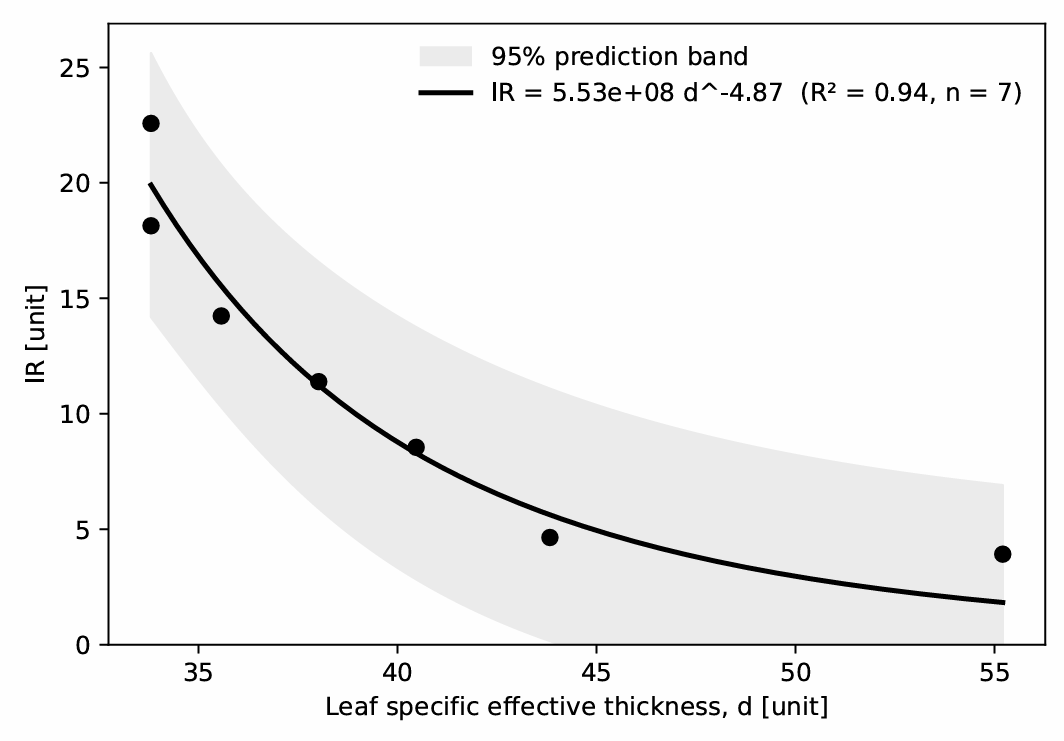
Obligate crassulacean acid metabolism (CAM) plants survive karst drought through daytime stomatal closure, which limits water loss but suspends gas exchange, raising the question of how intracellular metabolism continues under closed stomata. Using a reintroduced population of the orchid \textit{Dendrobium loddigesii} shaped by 15 years of natural selection, we combined a two-season (January and April) between-population comparison with concurrent within-plant comparisons of different-aged leaves, and quantified leaf electrophysiology using an extended Hodgkin-Huxley model. Intracellular water transport rate (WTR) was highly conserved across seasons and leaf ages (overall mean \WTRall, within-group CV $\le$ \WTRcvMax%), suggesting an evolutionarily conserved ``metabolic chassis trait'' that may safeguard basal metabolism. In spring, the effective thickness of overwintered leaves decreased by \dDrop% (Welch's $t$-test, $p\dWelchPeq$), whereas intrinsic physiological resistance (IR) declined non-significantly (\IRDrop%; $p\IRWelchPeq$). Measured IR was \PLratio% of the value extrapolated from a winter power-law thickness-IR model and lay \PLposition{} its 95% prediction interval, a tentative indication of structure-function decoupling. Young leaves varied among individuals in IR (CV \IRcvSY%), some adopting a ``low-resistance, high-flux'' strategy, consistent with risk-spreading across heterogeneous microhabitats. We propose a two-tier adaptation model of ``conserved chassis homeostasis + plastic functional regulation'' for epiphytic CAM plants, extending the static structure-function view of the plant economics spectrum, and introduce an individual-level storage-water exchange coordination index (SWCI) and a group-level source-sink transition response index (SSTRI) as descriptive tools for orchid conservation and karst restoration.
Graphical Abstract
Keywords
Data Availability Statement
Funding
Conflicts of Interest
AI Use Statement
Ethical Approval and Consent to Participate
References
- Jiang, Z., Lian, Y., & Qin, X. (2014). Rocky desertification in Southwest China: Impacts, causes, and restoration. Earth-Science Reviews, 132, 1-12.
[CrossRef] [Google Scholar] - Yang, M., Sun, D., Wang, X., Zhu, S., & Goodale, U. M. (2025). Different leaf strategies between lithophytic and terrestrial orchids in a subtropical karst forest. Plants, 14(8), 1161.
[CrossRef] [Google Scholar] - Zhang, L., Chen, F., Zhang, G. Q., Zhang, Y. Q., Niu, S., Xiong, J. S., Lin, Z., Cheng, Z. M., & Liu, Z. J. (2016). Origin and mechanism of crassulacean acid metabolism in orchids as implied by comparative transcriptomics and genomics of the carbon fixation pathway. The Plant Journal, 86(2), 175-185.
[CrossRef] [Google Scholar] - Yang, S. J., Sun, M., Yang, Q. Y., Ma, R. Y., Zhang, J. L., & Zhang, S. B. (2016). Two strategies by epiphytic orchids for maintaining water balance: thick cuticles in leaves and water storage in pseudobulbs. Aob plants, 8, plw046.
[CrossRef] [Google Scholar] - Zou, L. H., Wan, X., Deng, H., Zheng, B. Q., Li, B. J., & Wang, Y. (2018). RNA-seq transcriptomic profiling of crassulacean acid metabolism pathway in Dendrobium catenatum. Scientific Data, 5(1), 180252.
[CrossRef] [Google Scholar] - Zhang, C., Wu, Y., Su, Y., Xing, D., Dai, Y., Wu, Y., & Fang, L. (2020). A plant's electrical parameters indicate its physiological state: A study of intracellular water metabolism. Plants, 9(10), 1256.
[CrossRef] [Google Scholar] - Jócsák, I., Végvári, G., & Vozáry, E. (2019). Electrical impedance measurement on plants: a review with some insights to other fields. Theoretical and Experimental Plant Physiology, 31(3), 359-375.
[CrossRef] [Google Scholar] - Kozlova, E., Yudina, L., Sukhova, E., & Sukhov, V. (2025). Analysis of electrome as a tool for plant monitoring: progress and perspectives. Plants, 14(10), 1500.
[CrossRef] [Google Scholar] - Qiu, S., Sultana, S., Liu, Z. D., Yin, L. Y., & Wang, C. Y. (2015). Identification of obligate C$_3$ photosynthesis in Dendrobium. Photosynthetica, 53(2), 168-176.
[CrossRef] [Google Scholar] - Nicotra, A. B., Atkin, O. K., Bonser, S. P., Davidson, A. M., Finnegan, E. J., Mathesius, U., ... & van Kleunen, M. (2010). Plant phenotypic plasticity in a changing climate. Trends in plant science, 15(12), 684-692.
[CrossRef] [Google Scholar] - Guo, Y., Ren, G., Zhang, K., Li, Z., Miao, Y., & Guo, H. (2021). Leaf senescence: progression, regulation, and application. Molecular horticulture, 1(1), 5.
[CrossRef] [Google Scholar] - Clément, G., Moison, M., Soulay, F., Reisdorf-Cren, M., & Masclaux-Daubresse, C. (2018). Metabolomics of laminae and midvein during leaf senescence and source-sink metabolite management in Brassica napus L. leaves. Journal of Experimental Botany, 69(4), 891-903.
[CrossRef] [Google Scholar] - Xing, D., Mao, R., Li, Z., Wu, Y., Qin, X., & Fu, W. (2022). Leaf intracellular water transport rate based on physiological impedance: A possible role of leaf internal retained water in photosynthesis and growth of tomatoes. Frontiers in Plant Science, 13, 845628.
[CrossRef] [Google Scholar] - Qin, X. J., Xing, D. K., Wu, Y. Y., Wang, W. X., Li, M. Q., & Solangi, K. A. (2022). Diurnal variation in transport and use of intracellular leaf water and related photosynthesis in three karst plants. Agronomy, 12(11), 2758.
[CrossRef] [Google Scholar] - Schulte, P. J., & Nobel, P. S. (1989). Responses of a CAM plant to drought and rainfall: capacitance and osmotic pressure influences on water movement. Journal of Experimental Botany, 61-70.
[CrossRef] [Google Scholar] - Zotz, G., Andrade, J. L., & Einzmann, H. J. R. (2023). CAM plants: Their importance in epiphyte communities and prospects with global change. Annals of Botany, 132(4), 685-698.
[CrossRef] [Google Scholar] - Luo, Y., Ho, C. L., Helliker, B. R., & Katifori, E. (2021). Leaf water storage and robustness to intermittent drought: A spatially explicit capacitive model for leaf hydraulics. Frontiers in Plant Science, 12, 725995.
[CrossRef] [Google Scholar] - Zhang, C., Su, Y., Wu, Y., Li, H., Zhou, Y., & Xing, D. (2021). Comparison on the nutrient plunder capacity of Orychophragmus violaceus and Brassica napus L. based on electrophysiological information. Horticulturae, 7(8), 206.
[CrossRef] [Google Scholar] - Gianella, M., Bradford, K. J., & Guzzon, F. (2021). Ecological, (epi)genetic and physiological aspects of bet-hedging in angiosperms. Plant Reproduction, 34(1), 21-36.
[CrossRef] [Google Scholar] - Cortijo, S., Aydin, Z., Ahnert, S., & Locke, J. C. (2019). Widespread inter‐individual gene expression variability in Arabidopsis thaliana. Molecular systems biology, 15(1), MSB188591.
[CrossRef] [Google Scholar] - Bolnick, D. I., Amarasekare, P., Araújo, M. S., Bürger, R., Levine, J. M., Novak, M., ... & Vasseur, D. A. (2011). Why intraspecific trait variation matters in community ecology. Trends in ecology & evolution, 26(4), 183-192.
[CrossRef] [Google Scholar] - Westerband, A. C., Funk, J. L., & Barton, K. E. (2021). Intraspecific trait variation in plants: a renewed focus on its role in ecological processes. Annals of botany, 127(4), 397-410.
[CrossRef] [Google Scholar] - Reich, P. B. (2014). The world‐wide 'fast–slow'plant economics spectrum: a traits manifesto. Journal of ecology, 102(2), 275-301.
[CrossRef] [Google Scholar] - Díaz, S., Kattge, J., Cornelissen, J. H., Wright, I. J., Lavorel, S., Dray, S., ... & Gorné, L. D. (2016). The global spectrum of plant form and function. Nature, 529(7585), 167-171.
[CrossRef] [Google Scholar] - Yang, B., Tan, Z., Yan, J., Zhang, K., Ouyang, Z., Fan, R., ... & Guo, L. (2024). Phospholipase-mediated phosphate recycling during plant leaf senescence. Genome Biology, 25(1), 199.
[CrossRef] [Google Scholar] - Verdoucq, L., Rodrigues, O., Martinière, A., Luu, D. T., & Maurel, C. (2014). Plant aquaporins on the move: reversible phosphorylation, lateral motion and cycling. Current Opinion in Plant Biology, 22, 101-107.
[CrossRef] [Google Scholar] - Shivaraj, S. M., Sharma, Y., Chaudhary, J., Rajora, N., Sharma, S., Thakral, V., ... & Deshmukh, R. (2021). Dynamic role of aquaporin transport system under drought stress in plants. Environmental and Experimental Botany, 184, 104367.
[CrossRef] [Google Scholar] - Wu, S. W., Kumar, R., Iswanto, A. B. B., & Kim, J. Y. (2018). Callose balancing at plasmodesmata. Journal of experimental botany, 69(22), 5325-5339.
[CrossRef] [Google Scholar] - Luo, M., Liu, X., Wu, R. J., Yang, P. F., Yang, L., Zhou, M., & Wu, M. K. (2024). Screening of new Dendrobium officinale strains adapted to karst forest environmental stress based on electrophysiological detection method. Agronomy, 14(7), 1530.
[CrossRef] [Google Scholar] - Tran, D., Dutoit, F., Najdenovska, E., Wallbridge, N., Plummer, C., Mazza, M., ... & Camps, C. (2019). Electrophysiological assessment of plant status outside a Faraday cage using supervised machine learning. Scientific reports, 9(1), 17073.
[CrossRef] [Google Scholar]
Cite This Article
TY  - JOUR
AU  - Yang, Pingfei
AU  - Zheng, Zhihong
AU  - Zou, Chen
AU  - Peng, Zhujing
AU  - Wu, Mingkai
PY  - 2026
DA  - 2026/10/01
TI  - Dual-Layer Adaptation Mechanisms of the Karst Obligate-CAM Epiphytic Dendrobium Loddigesii
JO  - Journal of Plant Electrobiology
T2  - Journal of Plant Electrobiology
JF  - Journal of Plant Electrobiology
VL  - 1
IS  - 2
SP  - 153
EP  - 164
DO  - 10.62762/JPE.2026.265468
UR  - https://www.icck.org/article/abs/JPE.2026.265468
KW  - Dendrobium loddigesii
KW  - electrophysiological dynamics
KW  - dual-layer adaptation model
KW  - structure-function decoupling
KW  - metabolic chassis
KW  - source-sink relationship
AB  - Obligate crassulacean acid metabolism (CAM) plants survive karst drought through daytime stomatal closure, which limits water loss but suspends gas exchange, raising the question of how intracellular metabolism continues under closed stomata. Using a reintroduced population of the orchid \textit{Dendrobium loddigesii} shaped by 15 years of natural selection, we combined a two-season (January and April) between-population comparison with concurrent within-plant comparisons of different-aged leaves, and quantified leaf electrophysiology using an extended Hodgkin-Huxley model. Intracellular water transport rate (WTR) was highly conserved across seasons and leaf ages (overall mean \WTRall, within-group CV $\le$ \WTRcvMax%), suggesting an evolutionarily conserved ``metabolic chassis trait'' that may safeguard basal metabolism. In spring, the effective thickness of overwintered leaves decreased by \dDrop% (Welch's $t$-test, $p\dWelchPeq$), whereas intrinsic physiological resistance (IR) declined non-significantly (\IRDrop%; $p\IRWelchPeq$). Measured IR was \PLratio% of the value extrapolated from a winter power-law thickness-IR model and lay \PLposition{} its 95% prediction interval, a tentative indication of structure-function decoupling. Young leaves varied among individuals in IR (CV \IRcvSY%), some adopting a ``low-resistance, high-flux'' strategy, consistent with risk-spreading across heterogeneous microhabitats. We propose a two-tier adaptation model of ``conserved chassis homeostasis + plastic functional regulation'' for epiphytic CAM plants, extending the static structure-function view of the plant economics spectrum, and introduce an individual-level storage-water exchange coordination index (SWCI) and a group-level source-sink transition response index (SSTRI) as descriptive tools for orchid conservation and karst restoration.
SN  - 3071-6268
PB  - Institute of Central Computation and Knowledge
LA  - English
ER  -
@article{Yang2026DualLayer,
  author = {Pingfei Yang and Zhihong Zheng and Chen Zou and Zhujing Peng and Mingkai Wu},
  title = {Dual-Layer Adaptation Mechanisms of the Karst Obligate-CAM Epiphytic Dendrobium Loddigesii},
  journal = {Journal of Plant Electrobiology},
  year = {2026},
  volume = {1},
  number = {2},
  pages = {153-164},
  doi = {10.62762/JPE.2026.265468},
  url = {https://www.icck.org/article/abs/JPE.2026.265468},
  abstract = {Obligate crassulacean acid metabolism (CAM) plants survive karst drought through daytime stomatal closure, which limits water loss but suspends gas exchange, raising the question of how intracellular metabolism continues under closed stomata. Using a reintroduced population of the orchid \textit{Dendrobium loddigesii} shaped by 15 years of natural selection, we combined a two-season (January and April) between-population comparison with concurrent within-plant comparisons of different-aged leaves, and quantified leaf electrophysiology using an extended Hodgkin-Huxley model. Intracellular water transport rate (WTR) was highly conserved across seasons and leaf ages (overall mean \WTRall, within-group CV \$\le\$ \WTRcvMax\%), suggesting an evolutionarily conserved ``metabolic chassis trait'' that may safeguard basal metabolism. In spring, the effective thickness of overwintered leaves decreased by \dDrop\% (Welch's \$t\$-test, \$p\dWelchPeq\$), whereas intrinsic physiological resistance (IR) declined non-significantly (\IRDrop\%; \$p\IRWelchPeq\$). Measured IR was \PLratio\% of the value extrapolated from a winter power-law thickness-IR model and lay \PLposition{} its 95\% prediction interval, a tentative indication of structure-function decoupling. Young leaves varied among individuals in IR (CV \IRcvSY\%), some adopting a ``low-resistance, high-flux'' strategy, consistent with risk-spreading across heterogeneous microhabitats. We propose a two-tier adaptation model of ``conserved chassis homeostasis + plastic functional regulation'' for epiphytic CAM plants, extending the static structure-function view of the plant economics spectrum, and introduce an individual-level storage-water exchange coordination index (SWCI) and a group-level source-sink transition response index (SSTRI) as descriptive tools for orchid conservation and karst restoration.},
  keywords = {Dendrobium loddigesii, electrophysiological dynamics, dual-layer adaptation model, structure-function decoupling, metabolic chassis, source-sink relationship},
  issn = {3071-6268},
  publisher = {Institute of Central Computation and Knowledge}
}
Article Metrics
Publisher's Note
ICCK stays neutral with regard to jurisdictional claims in published maps and institutional affiliations.
Rights and Permissions

